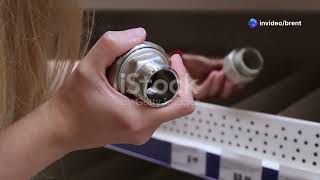

Fix a Leaky Faucet in 10 Steps
45sQuick, actionable DIY fix appeals to homeowners seeking cost-saving solutions.
▶ Play Clip"The title perfectly matches the content—the video delivers exactly what it promises: a step-by-step DIY faucet repair guide."
This video provides a clear, step-by-step guide to repairing a leaky faucet, covering tool preparation through final testing.
Repairing a leaky faucet is often straightforward; a step-by-step guide follows.
Tools needed: adjustable wrench, flathead/Phillips screwdrivers, replacement parts (washers, o-rings, cartridges), plumber's tape (optional), cloth/towel.
Locate shut-off valves under sink, turn clockwise to shut off. If none, shut off main supply. Run faucet briefly to release residual water.
Use cloth or sink plug to block drain, preventing small part loss.
Common types: compression (two handles, washer), ball (single handle, ball bearing), cartridge (single/dual handle, cartridge), ceramic disc (modern, ceramic discs).
Remove handle (screw or set screw), decorative covers, then valve stem/cartridge using adjustable wrench. Note installation orientation.
Check washers/O-rings for cracks, wear; inspect valve stem/cartridge. Clean debris.
Replace with same type and size parts; apply plumber's tape to threaded connections if needed.
Reverse disassembly: reinstall valve stem/cartridge, handle, covers. Ensure all tight.
Slowly open valves, check for leaks; operate handle to test smoothness.
If still leaks, disassemble and verify part installation; consider plumber if issues persist.
Remove tools, rags; if faucet works, job is done.
Following these steps can fix most leaky faucets; if problems continue, consult a plumber.
What are the four common types of faucets?
Compression, ball, cartridge, and ceramic disc.
01:24
What is the first step before disassembling a faucet?
Turn off the water supply (shut-off valves under sink or main supply).
00:42
Why should you plug the drain before repair?
To prevent small parts from falling into the drain.
01:07
What are the most common parts that cause leaks?
Washers and O-rings.
02:47
What type of faucet uses a single handle and ball bearing mechanism?
Ball faucet.
01:24
What tool is recommended to remove the valve stem or cartridge?
An adjustable wrench.
02:19
What should you do if you are unsure about replacement part size?
Take the old parts with you to the hardware store for comparison.
03:31
How do you turn off the shut-off valves?
Turn them clockwise.
00:42
When should you apply plumber's tape?
To threaded connections to ensure a good seal.
03:31
What is the final step if the faucet still leaks after reassembly?
Consult a plumber for further diagnosis.
04:58
Faucet Types Classification
Understanding the four common faucet types (compression, ball, cartridge, ceramic disc) is foundational for selecting correct repair parts.
01:24Common Culprits: Washers and O-rings
Identifying washers and O-rings as the most frequent leak sources directs the repairer's inspection effort efficiently.
02:47Replace with Same Type and Size
The instruction to replace parts with identical components ensures compatibility and prevents future leaks.
03:16When to Call a Plumber
Knowing when to escalate to a professional avoids wasted effort and potential damage from misdiagnosis.
04:58[00:00] Repairing a leaky faucet can often be a straightforward task. Here's a step-by-step guide to fix it.
[00:13] Tools, you'll need adjustable wrench, flathead, and Phillips screwdrivers, replacement parts such as washers, o-rings, or cartridges, depending on the faucet type, plumbers tape,
[00:29] optional, and a cloth or towel to protect surfaces. Step 1. Turn off the water supply.
[00:42] Locate the shut-off valves, typically under the sink. Turn the valves clockwise to shut off the water. If you can't find them, you may need to turn off the main water supply to the house, turn
[00:55] on the faucet, and let it run for a few seconds to release any water still in the pipes. Step 2.
[01:07] Plug the drain. Use a cloth or a sink plug to block the drain. This will prevent any small parts from falling into the drain during the repair.
[01:24] Step 3. Identify the type of faucet. The most common types are compression faucets with two handles, hot and cold, typically with a washer to stop the leak. Ball faucets with a single handle and a ball bearing mechanism, cartridge faucets with
[01:44] single or dual handles, using a cartridge instead of a ball or compression valve, and ceramic disc faucets, which are modern faucets with a smooth flat handle and ceramic discs.
[02:04] Step 4. Disassemble the faucet. Remove the handle, typically by unscrewing it, which may be held by a set screw. Use a screwdriver or Allen wrench, depending on the type of screw.
[02:19] Remove any decorative covers or knobs to expose the internal components. Then take off the valve stem or cartridge, which may require using an adjustable wrench.
[02:35] Carefully remove the component. Noting the way it's installed as you'll need to replace it with a matching part.
[02:47] Step 5. Inspect the parts. Check the washers or O-rings as these are the most common culprits for leaks. Look for signs of wear or damage, such as cracks, riddle-ness, or missing pieces.
[03:03] Inspect the valve stem or cartridge, and if it's worn or damaged it should be replaced. Clean any debris with a cloth.
[03:16] Step 6. Replace damage parts. If you've found any damaged parts, replace them with new ones of the same type in size. You can usually purchase replacement parts at a hardware store.
[03:31] If you're unsure, take the old parts with you for comparison. Apply plumber's tape to any threaded connections if necessary, ensuring a good seal.
[03:44] Step 7. Disassemble the faucet, reverse the disassembly steps, reinstall the valve stem or cartridge, then the handle, and any decorative covers.
[03:59] Ensure all parts are tightly secured. Step 8. Turn the water supply back on, slowly open the shut off valves and check for any leaks.
[04:15] Then the faucet handle on and off to ensure it operates smoothly. Step 9.
[04:27] Test for leaks. If the faucet still leaks, you may need to disassemble and check if all the parts were installed correctly or if something else needs replacing.
[04:43] Step 10. Clean up, remove any tools, rags, or parts from the area. If the faucet is working properly, you're done.
[04:58] If you're still having trouble after these steps, it might be worth consulting a plumber for a more detailed diagnosis as the problem could be more complex.
[05:12] Please remember to like and subscribe and feel free to leave any content suggestions in the comments section.
⚡ Saved you 0h 05m reading this? Transcribe any YouTube video for free — no signup needed.