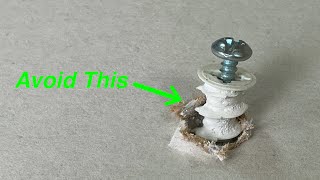

The #1 Mistake That Ruins Drywall Anchors
46sReveals a common DIY mistake (over-tightening) with a high-stakes warning, tapping into viewers' fear of damaging their walls.
▶ Play Clip"The title promises a guide to drywall anchors and delivers exactly that — no fluff, just practical advice."
This video provides a practical guide to installing drywall anchors correctly, addressing common mistakes like over-tightening and using the wrong screws. It also covers how to fix a stripped hole with a toggle bolt and how to choose the strongest type of anchor.
A drywall anchor fails every 15 seconds, with 90% of failures due to incorrect installation.
Over-tightening, even by a quarter or half turn, can crush the drywall and reduce holding power by half or worse.
Use a hand screwdriver instead of a drill or impact driver to prevent over-tightening.
Using a different screw with coarse threads can cause the anchor to twist and lose holding power.
For a stripped hole, use a flip-out toggle bolt; listen for the toggles to flip out before tightening.
Choose anchors that split apart and flare out to the sides for twice the holding power.
What is the most common mistake when installing drywall anchors?
Over-tightening the anchor, even by a quarter or half turn.
00:28
What tool should you use to avoid over-tightening a drywall anchor?
Use a hand screwdriver, not a drill or impact driver.
00:54
Why should you avoid using a different screw than the one that comes with the anchor?
The threads may be too coarse and wide, causing the anchor to twist and lose holding power.
01:08
What is the easiest way to fix a hole where a drywall anchor has pulled out?
A flip-out toggle bolt.
01:39
What type of drywall anchor is twice as strong?
Anchors that split apart and flare out to the sides when the screw is inserted.
02:18
Drywall anchor failure rate
Provides a striking statistic that underscores the importance of proper installation.
Avoid over-tightening
Identifies the most common mistake and offers a simple rule to prevent it.
00:28Use a hand screwdriver
Gives a clear, actionable tool recommendation to avoid damaging the anchor.
00:54Match screw threads to anchor
Explains a subtle but critical compatibility issue that many overlook.
01:08Fix with toggle bolts
Offers a practical solution for repairing a stripped hole, a common DIY problem.
01:39Choose split anchors for strength
Highlights a design feature that significantly increases holding power.
02:18[00:00] It's been said that every 15 seconds one of these little screw-in drywall anchors is failing somewhere in the world. 90% of the time it is due to people not putting them in correctly. So I'm going to show you how to put them in the right way. If you have one that's already pulled
[00:15] out of the wall I'll show you how to fix that quickly. Most importantly if you're looking for one of these anchors even though they all look alike there is a certain type that is actually twice as strong. And when you're installing these anchors and where people go wrong is
[00:28] Under no circumstances can you over tighten them. Even a quarter turn, half turn, that's going to be enough to crush and strip out all that nice drywall that was holding the anchor in place. You're going to cut down the holding power by half or worse. So when you install them, use a hand screwdriver. An impact driver or a drill is going to be a surefire way to over tighten them. Unless you are an absolute power tool guru, even then you're playing with fire.
[00:54] Use a hand screwdriver and snug it up just till it's snug and no further. But where most people get tripped up, including myself, is using the wrong type of screw for these anchors. If you can, use the ones that come in the package.
[01:08] Those are going to fit perfectly. If you end up using a different screw, be very careful that the threads on there are not too coarse and wide for the anchor. even if you have a number eight anchor and you get a number eight wood screw a lot of times
[01:23] those the threads on the wood screw are going to be too big as you putting the screw in you going to notice that the anchor is going to twist just that quarter half turn and completely compromise the holding power of that anchor. But if you do end up with one of these holes where
[01:39] you've compromised it, it's wrecked, something's pulled off of the wall, the easiest way to fix that is with one of these flip out toggle bolts. The flip out toggle bolt is going to fit right in
[01:51] this existing gaping hole shove it in there listen for the little sound for the little toggles to flip out if you don't hear that flip out sound try and try again if you go and tighten this without
[02:03] them flipping out it's just going to pull out it's very frustrating hear the sound tighten up the bolt the flip out toggle bolt is going to be a lot stronger than any of the screw and anchors they're a bit more difficult to use so if you can use the screw and anchor properly that's going to be the
[02:18] easiest way to go. And then finally if you need to get some drywall anchors make sure you look for the ones that split apart and caulk over to the side when you insert the screw. If you can't find them out in the wild I will put links in the description you can get them off Amazon. What
[02:33] ends up happening with that there that extra little bit of resistance on the back of the drywall is going to offer a lot more holding power than just the regular ones where the screw just kind of pokes straight out the bottom. And hey, if you've ever struggled with any caulking around the house,
[02:49] go ahead and check out this video right over here. It's pretty good. I made it. It's... A lot of people will watch that one.
⚡ Saved you 0h 02m reading this? Transcribe any YouTube video for free — no signup needed.