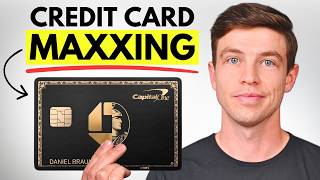

The Obsession with Credit Card Maximizing
45sTaps into the trending 'maxing' culture, making viewers curious about extreme credit card strategies.
▶ Play Clip"Delivers solid, actionable advice, but the '99%' claim is hyperbolic marketing fluff."
This video offers a strategy for maximizing credit card rewards through five key principles: paying off balances in full, prioritizing sign-up bonuses, building an optimized core card setup, never being loyal to a single card, and learning to redeem points for maximum value. The host shares personal experience and concrete examples to help viewers earn thousands in travel rewards with minimal effort.
Always pay your statement balance in full and on time to avoid interest charges. Earning rewards is pointless if you're paying 25% interest on balances.
Sign-up bonuses offer the highest return on spend (20-40%), far exceeding the 1-5% from everyday spending categories. Example: $5,000 spend yields $1,000 bonus = 20% return.
Flexible points (Chase Ultimate Rewards, Amex Membership Rewards) allow transfers to airline/hotel partners, often yielding >2 cents per point vs 1 cent for cash back.
Use multiple cards to maximize category bonuses (e.g., 4x on groceries, dining, travel) and a catch-all card for uncategorized spend. Organization is key.
Credit cards change terms frequently. Always evaluate each card's short-term value and be ready to cancel, downgrade, or switch to another card if it no longer suits your needs.
Maximize value by transferring points to travel partners or booking through travel portals. Redeeming for cash back at 1 cent per point leaves significant value on the table.
Mastering credit card rewards requires a strategic approach: avoid debt, chase sign-up bonuses, maintain a flexible card setup, and always seek the highest redemption value. The host claims these steps can put you ahead of 99% of users, but the advice is solid nonetheless.
What is the 'golden rule' of credit card usage according to the video?
Always pay your statement balance in full and on time every month.
01:19
What is 'return on spend' in the context of credit cards?
The percentage of rewards earned relative to the amount spent on a card.
03:17
Why are sign-up bonuses more valuable than category rewards?
Sign-up bonuses typically offer 20-40% return on spend, while category bonuses only offer 3-5%.
04:10
What is a flexible points currency?
Points from issuers like Chase, Amex, and Capital One that can be transferred to multiple airline/hotel partners.
04:52
What is the recommended composition of a core credit card setup?
Cards earning 3-5x on key categories (dining, groceries, gas) plus a catch-all card earning at least 2x.
06:12
What does 'never marry, always date' mean for credit cards?
Don't stay loyal to a card — regularly reassess and change cards when terms or your spending patterns shift.
09:12
What percentage of credit card users did not redeem any rewards in a recent year?
Nearly one in four people (25%) did not redeem any rewards.
11:50
How can you achieve more than 1 cent per point in redemption?
By transferring points to airline or hotel partners for premium travel bookings.
12:16
What is the approximate return on spend for a $5,000 spend earning a 100,000-point bonus redeemed at 2 cents per point?
40% ($2,000 value on $5,000 spend).
12:16
Avoid Interest at All Costs
Establishes the non-negotiable foundation for profitable card use: never carry a balance.
01:19Sign-Up Bonuses Yield 20-40% Return
Quantifies the massive advantage of chasing bonuses over category spending, a key insight for optimizing rewards.
03:17Cards Are Tools, Not Partners
Encourages a pragmatic, unemotional approach to card selection and retention, which is critical in a changing landscape.
09:12Redemption Strategy Doubles Value
Highlights the often-overlooked step of maximizing point value via transfers, which can double the effective return.
11:38[00:01] the internet's been taken over by people trying to maximize pretty much anything talking about trends like looks maxing, gym maxing, sleep maxing, and all these people want to do to the fullest. Now, there's a fine line between these
[00:14] extreme and actually useful, which kind of gets blurred sometimes. And this comes to maximizing my favorite topic to talk about here on this channel, which been doing what I would call credit card
[00:26] opening 30 plus cards during that time, earning millions of points, and then thousands of dollars in free travel. And a lot of you who watch my channel have you may know, the world of credit cards can become highly addicting with the way
[00:39] basically gamified the stuff. And some people definitely take things way too week to it and becoming consumed with achieving these so-called perfect credit premium cards these days becoming almost like small metal coupon books with the
[00:54] packed into them. So, sometimes keeping track of all that can feel like you're in an episode of extreme couponing, be exhausting. So, in this video, I want to the right way, and to me that means using credit cards to get the most
[01:06] rewards back from every dollar you spend, turning those rewards into free those two things with minimal time and minimal effort in a way that also boosts interest all at once. Now, I've got five keys here that'll help you start to
[01:19] just like that, as well as a few bonus tips throughout this video that have card game on easy mode over the past decade. So, the first key I want to basically the foundation that everything else is built on, and that is that you
[01:32] time and in full. Now, I'm not going to spend too much time here on this because channel that are dedicated to walking you through how your credit card bill about how important it is to avoid carrying a balance and paying interest
[01:45] just does not work if you're earning maybe 5% back on something, but then you're paying 25% in interest. That's like Venmoing your friend 25 bucks for because you like the way it feels when someone gives you what you perceive as
[01:59] paying those insanely high interest rates is to follow what I call the rule is to always pay off what's known as your statement balance, which can be you want to be paying that off on time and in full every single month before
[02:12] found in your statement. The way I look at things is that all I want to do with a credit card is basically just use it as a substitute payment method for debit card or cash to pay for anyway, and I never use a credit card to buy
[02:24] money set aside for that purchase in my bank account. The day you start looking the day you lose the credit card game. So, I like to recommend having at least 1 month's worth of expenses inside your checking account, and then another 3 to
[02:37] savings account at all times. That way you've always got a solid safety net of cash to fall back on to avoid the trap of getting into credit card debt. Now, foundational golden rule of credit cards, the next thing they typically end
[02:49] rewards that credit cards offer is they go out there and they get something like they stay at Marriotts or they fly United a lot. Or maybe they get a card multiplier, and then a card that's good for earning points on gas, and then one
[03:03] tell you that is not the right way or the best way to go about credit card next key here is that you want to prioritize taking advantage of sign up bonuses are actually what's going to allow you to earn the most rewards in
[03:17] least amount of spending possible. So, to me, the name of the game with credit called return on spend. Return on spend is basically just how you can look at getting back for each dollar that leaves your wallet. So, let's say there's a
[03:31] you can earn 100,000 points after spending maybe $5,000 in the first 3 are some easy numbers to work with. If those 100,000 points could be redeemed even just for cash back at a value of at least 1 cent per point, then the minimum
[03:45] value of that sign up bonus would be at least $1,000. Now, since it took you $5,000 of spending to obtain that 100k bonus that's worth a thousand bucks, we can divide 1,000 by the $5,000 minimum spend requirement and that's going to
[03:57] this example. That's not even factoring in that you're probably going to earn well as you're working towards that minimum spend. A 20% return is great 20 cents back for every dollar of normal everyday spending you're doing while
[04:10] card to earn that big bonus. But now let's say that instead of prioritizing a you just focused on using your existing credit card setup that you've built out you've got one card that earns 3% on groceries, one that earns 3% on gas, and
[04:25] then another that earns 3% on dining. So if you spent the same $5,000 on all course of the same three months, you would earn $150 of cash back, which is fine. But that's obviously only a 3% return on spend compared to the 20% that
[04:38] spend towards a good sign-up bonus. Now the cool thing is there's not just a few this, but there's literally dozens of great offers out there at all times. And maxing even further, then another tip that I'd recommend is checking out
[04:52] whenever you find them. On top of that, I'd also recommend focusing on cards currencies. And these are basically points currencies that come from credit single hotel or airline program. The reason for that is because flexible
[05:05] points currencies from issuers like Chase, Amex, Capital One, Citi, Wells Bilt, they all give you the option to not only redeem for cash back, gift but they also give you the option to redeem for travel inside their portals
[05:19] ability to transfer your points over to those airline and hotel programs. That points so valuable because you're never going to be locked into just one because the risk of your hard-earned rewards getting devalued becomes much
[05:32] options. Transferring to airline and hotel programs also opens up ways for you to get above 1 cent per point from your flexible points. So that 100K offer from $5,000 of spend could actually get you closer to around 2 cents per point,
[05:45] and that would be like getting around $2,000 in value from just that $5,000 of return on spend. Now, I'll talk more about redeeming points for that kind of going to play the biggest role in the art of credit card maxing, in my
[05:58] talking about prioritizing sign-up bonuses here, it's also good to always going to be working towards earning a new card bonus. So, whenever is when you want to be thinking about higher building what we call an optimal
[06:12] earning you the most rewards possible for every category of your budget, and this video. Your core credit card setup should basically contain cards that earn you at least three to five X back on categories like dining, groceries, gas,
[06:25] with a card that earns at least two X or sometimes even more on what we call your catch-all spend that doesn't fit neatly under a specific category. Now, the building out your core credit card setup is going to involve you slowly adding
[06:37] wallet over time because you're going to likely need multiple cards across the key thing here is to make sure you're super organized with how you're using an app like Rocket Money to help me manage my money better, and they're
[06:50] today's video. So, I think Rocket Money's a great time-saving tool for because their app just has a ton of features that really fit in well with the objective here of optimizing your spending. So, first of all, Rocket Money
[07:02] across all your credit cards in one single place instead of having to log in So, you can just scroll through your transactions inside their app, check which category each transaction was for, and then make sure you were using the
[07:14] for that purchase. What's also cool though is that even though there's cards five X back on certain subscription services, what you might find by using subscriptions you're paying for using the wrong card, or there could even be
[07:26] were paying for at all. Either way, Rocket Money's really helpful with this automatically consolidate all those recurring expenses into a list for you. don't want anymore, Rocket Money's able to cancel subscriptions right within
[07:38] a number of other budgeting features from Rocket Money that I like to include to save more and spend less, go to rocketmoney.com/danielbron screen right now, and we'll have a link down below in the description as well,
[07:52] unlock even more features when you sign up for premium. That's rocketmoney.com/danielbron or check out the QR code on screen. And sponsoring today's video. Now again, when it comes to getting value back from
[08:04] a good sign-up bonus that's giving you a return on spend of anywhere from 20 to 40%. But outside of working towards bonus, your core credit card setup is well. And if you're curious about what's in my core credit card setup, here's a
[08:17] groceries and dining, I've got the Amex Gold card earning me 4x points on both Chase Sapphire Reserve, which is giving me 4x points on flights and hotels reason to book for Chase Travel. And then for my Amazon spend right now in Q2
[08:32] of 2026, I'm using my Chase Freedom Flex to earn 5x on Amazon because that's a card. For spending at home improvement stores, I'm using my City Custom Cash to Home Depot pretty much every weekend now that the weather's nice where I live and
[08:46] catch-all spend, I'm using the Bilt Pladium card to earn an effective 3.33x earns, along with the points on my mortgage that I got to unlock by putting that spend on my Pladium card. I'll use a few other cards from time to time as
[08:59] here that I'm honestly just testing out for a video that I want to make soon. cash back type of person and you just want a simple one card setup, then the everything is going to be pretty much the best on the market right now for
[09:12] out there beyond just the ones that I like using, so I definitely recommend to figure out what works best for you. And that's actually going to lead me art of credit card maxing. And that key is to never marry, but always date every
[09:27] reality of playing the whole credit card game with this maxing mindset is that cards in order to take advantage of a lot of sign-up bonuses and to also just works best for you. And even though you're probably going to be spreading
[09:39] cards over many years, I still see a lot of beginners with this stuff kind of choosing which credit cards to open. I think a lot of people worry too much going to be a good fit for me versus this other one? Or do I really want to
[09:53] another annual fee? Or even another really common worry these days is, probably just going to nerf it and then honestly, for myself and every other experienced credit card person like me
[10:07] worry about these things because we realized a long time ago that winning about adapting to the ever-changing rules that unfortunately the issuers, change whenever they want to. The only certainty with credit cards is that
[10:21] So, when I talk about never marrying but always dating every credit card you get, credit cards are not going to be loyal to you, so why should you be loyal to them when sometimes the numbers just might not make sense for you anymore.
[10:34] should look at each credit card individually in terms of its short-term value. So, pretty much any card is going to be worth it in the short-term in year one for those good sign-up bonuses they offer, but then over the long-term in
[10:46] want to have a plan B just in case a credit card ever stops working for your situation and you have to choose to move on. Sometimes your lifestyle, spending so a premium card with an annual fee might not be worth it anymore, but other
[10:59] like we've seen a lot of top-tier cards do in recent years. Moving on could mean as bad for your credit score as most people believe. Or even better, it might another card in that same product family
[11:13] tip here is that before you ever apply for any credit card out there, just know your options ahead of time so that way you can take action when necessary. In my opinion, credit card issuers have two jobs: to win you over as a customer by
[11:25] card over others, and then to keep you as a customer by delivering a consistent expected. If they can't do those two things, then that's fine. Just go out other credit cards to kind of test things out until you find something
[11:38] that's more wallet material for you at the moment. But again, just never marry divorcing it can be kind of messy. Now, the one mistake that I see people making credit card maxing is that they put so much of their time and attention into
[11:50] then earning all these points and miles. But then, once they have all these what to do with them. Actually, according to a survey from Bankrate, nearly one in four people did not redeem any of their credit card rewards in the
[12:02] redeem rewards, most of those people probably are not getting max value from is that once you followed everything else we've talked about in this video, learning how to actually redeem your points in the best ways possible. So, if
[12:16] in the beginning of this video where we looked at a 100,000 point sign-up bonus, I talked about redeeming those points at a value of 1 cent per point for $1,000. that bonus when redeemed at around 2 cents per point for $2,000 by taking
[12:30] the airline and hotel programs. Now, getting 1 cent per point is essentially most credit card issuers out there are going to give you the option to redeem your points for things like cash back, statement credits, gift cards, or even
[12:43] travel portal at that 1 cent per point rate. So, I typically see people earn that have this very high upside potential for travel when you transfer they just go straight to that travel portal and then they waste their points
[12:57] good deal that leverages the higher purchasing power those points have. One way to think about this is, let's say I give you $1,000. So, if I told you to go out and then spend $1,000 on goods and services that added up to $1,000 of
[13:09] that? Yeah, you probably would be, assuming those goods and services were fairly priced. But what if I gave you that same $1,000 and then I taught you worth of goods and services with it? Once you learn how to get double or
[13:21] triple your money's purchasing power, now trading $1,000 of spending for $1,000 of value doesn't really seem like such a good deal anymore because now value of what you could have bought instead. So, that's basically the same
[13:33] mindset here. Yes, you can redeem your points for gift cards or for travel getting necessarily a bad deal, but you're just not going to be credit card possible. Now, to be fair, there's a ton of things to learn about when it comes
[13:46] value like how to calculate cents per point, how transfer partners work, how more. And honestly, the best way that I found to learn about all this stuff is So, I've got two videos that I made recently with examples on how to redeem
[14:01] of how to redeem Amex points over here that you should definitely go ahead and bunch of other content right here on this channel about this stuff. So, make that. But, as always, thanks so much for watching and I'll see you in the next
[14:14] watching and I'll see you in the next one.



⚡ Saved you 0h 14m reading this? Transcribe any YouTube video for free — no signup needed.