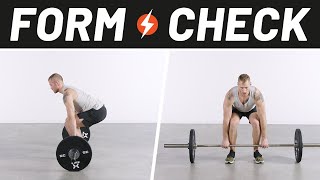

Deadlift: The Most Badass Exercise
41sHigh-energy intro hooks viewers by promising they'll move more weight on deadlifts than any other exercise.
▶ Play Clip"Title accurately promises a deadlift form guide, and the video delivers clear, expert instruction."
This video from Men's Health fitness experts Ebenezer Samuel and Brett Williams provides a step-by-step guide to mastering the deadlift, emphasizing proper form to prevent injury and maximize strength gains. The tutorial covers setup, grip, back position, and common mistakes.
The deadlift is one of the most effective exercises for moving heavy weight, but proper form is crucial to avoid injury.
Feet shoulder-width apart, toes under the bar. You should be able to see your toes on the other side of the bar.
Start with an overhand grip. Mixed grip can be used for heavier weights but should be avoided initially to train grip strength.
Hips should be lower than shoulders. Avoid lifting with the lower back by keeping hips high; use hamstrings instead.
Squeeze shoulder blades together and pull the slack out of the bar to engage the lats and protect the shoulders.
Lift the weight, squeeze glutes at the top without overextending. Avoid leaning back excessively.
Set the bar down each rep; avoid touch-and-go deadlifts to maintain proper form and control.
Avoid belts initially to build core strength. Straps can help with grip on heavy sets but train overhand grip as long as possible.
Start with 3-4 sets of 6-8 reps. As you progress, you can do heavier sets of 1-3 reps for power.
Mastering the deadlift with proper form—keeping the back neutral, engaging the core, and using the legs—allows you to lift heavy safely and build significant strength. Start with moderate weight and focus on technique before progressing.
What is the recommended foot position for a deadlift?
Feet shoulder-width apart, toes under the bar.
00:28
Why should beginners use an overhand grip instead of a mixed grip?
To train grip strength and avoid relying on the mixed grip too early.
00:42
What is the correct hip position relative to shoulders at the start of a deadlift?
Hips should be lower than shoulders.
00:56
What does 'pulling the slack out of the bar' mean?
It means applying tension to the bar before lifting to engage the lats and remove any looseness.
01:08
What should you avoid at the top of the deadlift?
Overextending or leaning back; just squeeze glutes and stand tall.
01:33
What is the recommended rep and set scheme for beginners?
3-4 sets of 6-8 reps.
02:34
Why should beginners avoid using a belt?
To allow the core to develop its own strength and stability.
02:09
Deadlift as a Badass Move
Sets the tone that deadlift is a fundamental strength exercise.
Hips Lower Than Shoulders
Critical form cue to avoid lower back strain.
00:56Setting Lats and Pulling Slack
Key technique to engage back muscles and protect shoulders.
01:08Avoid Touch-and-Go Deadlifts
Emphasizes control and proper form over speed.
01:45Avoid Belts Initially
Encourages natural core strength development.
02:09[00:00] Hey guys, I'm Ebenezer Samuel, fitness director for Men's Health. I'm Brett Williams, associate fitness editor at Men's Health. Today we're going to teach you guys the deadlift. The deadlift is one of the most badass moves in the gym. Once you master it, you're going to move more weight on this exercise than you do on any exercise in the gym.
[00:15] I guarantee you that. The key to doing the deadlift though, you have to do it right. A lot of people mess this lift up, but we're going to show you all the things you need to know about it right now. So Brett let's get right into it.
[00:28] So he's going to step up to the bar, feet shoulder width apart, toes are across the bar. You should be able to count your toes on the other side of that bar. Now Brett, go down, let's go get that bar. Using a nice overhand grip here, you want to stay in that overhand grip.
[00:42] You're going to see a lot of people use what's called a mixed grip. That's fine. When you get very heavy and weight, it's going to let you move larger weight, but you don't want to do that to start out. You want to train from this overhand position as much as you possibly can.
[00:56] Now know also his back position. His hips are lower than his shoulders. The one thing you're going to see a lot of people do, you're going to see their hips higher than their shoulders. Then you're lifting with your lower back. Remember we never want to do that.
[01:08] You want to really use your hamstrings to get this lift to happen. Now he's going to set his lats. Think about squeezing your shoulder blades together. He's going to pull the slack out of the bar next. This is another little way to help set your lats.
[01:20] Keep your back involved in this because remember, you don't want your shoulders hanging out to dry to lift this weight. You want everything nice and tight. Your core needs to be hugely involved in this lift. Again, you want to protect your lower back. So he's got that nice core position,
[01:33] and now lift that weight right up. Squeeze his glutes at the top. Note that you're going to see a lot of people over extend. Show them what that looks like, Brett. You don't want to do that. You want to stay nice and smooth.
[01:45] Just squeeze your glutes at the top. Stand up in a good position. That's a deadlift. Put it right back down, Brett. Also, he comes down. He sets that bar. We're not doing touch-and-go deadlifts.
[01:57] We're trying to teach you a nice, fundamental deadlift that you can use to lift heavy weight. This is the kind of exercise you can get a lot out of it. If you're just doing one, two, three rep sets because you can go real heavy, build that power on your back side,
[02:09] build a lot of strength. There you have it, the basics of the deadlift. As you progress in this move, as you start to learn more, you're going to see people starting to use belts and straps. Try to avoid belts in particular. You really want to create that force by yourself.
[02:22] Let your core be its own belt instead of trying to go down that road with the belt straps. As you start to use more resistance, you're going to want some of that. That can help you. It is going to take a little bit away from your grip.
[02:34] So again, try to train with that overhand grip without the straps as long as possible. Start to integrate the mixed grip. And then as you get really heavy, you can start using straps a little bit as well. We'd love to see you guys doing six to eight rep sets,
[02:46] three or four sets. This is also a move that, as you get better at it, you can get a lot of benefit out of one, two, three rep sets going really heavy. So work towards that. But again, start with three sets of six to eight for now.
⚡ Saved you 0h 03m reading this? Transcribe any YouTube video for free — no signup needed.