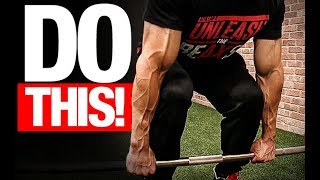

The Deadlift Prep Nobody Does
60sReveals a unique pre-lift warmup that prevents injury and improves form, making viewers want to try it.
▶ Play Clip"The title accurately promises a checklist to avoid mistakes, and the video delivers a detailed, step-by-step guide with clear cues and warnings."
Jeff Cavaliere from ATHLEANX.com presents a comprehensive deadlift checklist, breaking down the exercise step-by-step to ensure proper form and prevent injury. The video covers preparation, setup, grip options, and the two-phase movement pattern, emphasizing safety and effectiveness.
Jeff demonstrates a quick routine to loosen adductors and groin by using the plates for stretching, and then performs a hip-hinge movement to engage hamstrings and achieve anterior pelvic tilt.
He introduces a movement pattern drill: hip-hinge to knee level, then bend knees to drop hands, then reverse—leg press up to knees, then hip-hinge to finish. This grooves the correct mechanics.
Feet should be hip-width apart, with the bar about one inch from the shins. A cue: see your laces on the other side of the bar. Avoid rolling the bar; set it directly in position.
Three grip options: double overhand (balanced), mixed grip (stops bar rotation but may cause imbalances), and hook grip (strongest but uncomfortable initially). Hands should be just outside hip width to avoid shortening arms and increasing risk of bicep tears.
Drive chest forward and hips down to achieve a flat low back. Engage lats by thinking of a straight-arm push-down. The torso angle varies by individual anatomy, but the low back must remain flat.
The deadlift starts as a standing leg press: push the floor away until the bar reaches knee level. This prevents early hip rise and lumbar rounding. After the knees, the hips and back take over.
Once the bar passes the knees, drive through with hips and back. On the descent, reverse: hip-hinge to knee level, then bend knees. Keep the bar close to the body throughout.
The deadlift is a safe and effective total-body exercise when performed correctly. Jeff emphasizes that proper technique, especially starting with a leg press and maintaining a flat back, is crucial to avoid injury and maximize benefits.
What is the correct foot width for a deadlift?
Hip-width apart.
02:33
How far should the bar be from your shins at setup?
About one inch.
03:01
Name three grip types for the deadlift.
Double overhand, mixed grip, and hook grip.
04:08
Why does a wide grip increase the risk of bicep tears?
It shortens the arms, requiring a deeper position and often causing elbow flexion under load.
06:21
What is the key to avoiding lumbar disc issues in the deadlift?
Keeping the low back flat (not rounded) throughout the lift.
08:53
What should be the first movement when pulling the bar off the ground?
A leg press—pushing the floor away with your legs until the bar reaches knee level.
10:07
How do you engage the lats during the deadlift setup?
Think of a straight-arm push-down to pull the bar into your shins and keep the upper body tight.
09:09
What is the correct descent pattern for the deadlift?
Hip-hinge to knee level, then bend the knees to lower the bar straight down.
13:24
Deadlift as a Leg Exercise
Emphasizes that the deadlift must start as a leg press to protect the lower back, a key insight for safe lifting.
10:07Wide Grip and Bicep Tears
Explains that wide grip shortens arms and increases bicep tear risk, debunking the common belief that mixed grip is the main cause.
06:21Low Back Safety Cue
Provides a simple cue (drive chest forward, hips down) to maintain a flat back, critical for preventing injury.
08:53Grip Options and Their Trade-offs
Details three grip types with pros and cons, helping lifters choose based on strength and safety.
03:55[00:00] What's up guys, Jeff Cavaliere, ATHLEANX.com. We're talking deadlift today, one of the best exercises you can do if you do it right.
[00:14] So we're breaking out the checklist so we can break this down step by step and make sure that you do. Okay, any good deadlift starts with how you prepare your body to do it before you even do the exercise. So a couple of things that I do, there's two considerations here.
[00:27] Number one, you got to have the feeling that you can actually get to this bar and do this exercise properly. So what I do is just a quick little routine to feel nice and loose, is I put my feet up against the insides and the plates and I use them to stretch out my adductors and my
[00:41] groin. Because we know if you're going to be driving your knees out as you should be, as you'll see, when you press this bar off the ground and pull it off the ground, and I say press because that's a key difference, too, you're going to want to make sure that you have adequate
[00:53] flexibility here through your adductors. The next thing I do is I feel as if I want to keep my hamstrings engaged and I also want to have my pelvis in the right position. So I lean forward here to grab the bar and I try to get myself into an anterior pelvic
[01:08] tilt. So I'm trying to rotate my pelvis all the way down to its face in the ground. All the way down, point your junk down to the ground, keep your hands on the bar and then keep your head up, look straight ahead and just feel the stretch in your hamstrings and
[01:23] feel the stretch here in all those attachments to your pelvis so that we know we feel like we're in that good position. Once I do that, just for a couple of minutes so I feel nice and loose, the next thing I'll do is this pre-dead lift sort of movement pattern.
[01:37] And that is, I stand here, I keep my hands on my thighs and you're going to see why this is very important in a second, and I let them slide down until the level of the knees by doing nothing but hip-hinging. If you just did what I showed you, that hip-hing should feel really easy now.
[01:51] So right down to here, no bending the knees. From here, once I get to the level of the knees, then maintaining this low back, I just let my hands drop straight down by bending nothing but the knees. Then I work on going back up and feeling the first few inches of this to be nothing but
[02:07] leg press as I get to the level of the knees and then driving through with nothing but the hips. So it's hip-hinges to the level of the knees, drop the knees down, push through the knees, hip-hinges and finish it all the way here through extension.
[02:21] Just use that movement pattern until you feel as if you've got it down and then you're ready to start lifting the bar. Now we're ready to actually approach the bar and there's something you want to focus on here. There's actually two things you want to focus on.
[02:33] First of all, how far under the bar are you're freaking to go and how far apart should your feet be? First of all, let's deal with the easy one. The width of your feet should be the width of your hips. Now for someone that doesn't have a really wide physique like me, that could be pretty narrow.
[02:48] You can see mine on actually inside the non-neural areas of the bar here. For you that could be a little bit wider but it doesn't matter you just want to be hip width. As far as how far under the bar the feet should actually go, there's a little cue I like
[03:01] to use here. I want to just see my laces on the other side of the bar. So you can see right now I can't. My laces are actually being covered by the bar. If I sneak them out just to the other side here, now I've actually set up the right position
[03:15] for this bar, which should be about one inch away from my shin. Because when I go down to the bar, my shins will go forward to meet that bar and that is a proper position. Now a lot of people will try to roll the bar away and then roll it back.
[03:30] That's sort of a pre-lift ritual. But ultimately what they're doing is they're getting that bar back to that position and they're just using a lot of experience that they have and being comfortable with moving the bar to get it there ultimately in the right position.
[03:43] If you're new and you're just learning this exercise, take one of those variables out. Get set to the bar and don't change anything else. Get yourself about one inch away, get ready to do the, to perform the lift and just go ahead and do it. Okay.
[03:55] Now with the feet in the proper place, when we've got to get the hands in the proper placement and there's two elements we want to cover here. It is the type of grip that we're going to use because we've probably seen a lot of different grips being used on this exercise as far as, as well as the width of your hands on the
[04:08] bar when you perform the lift. So first of all, let's talk about the type. You have three different options here when it comes to how you're gripping the bar. Most commonly you probably see this double overhand grip. Okay.
[04:20] Now there's a great advantage to this that we're going to get into when we actually talk about performing the lift. But at the surface level here, this is giving you the most balanced distribution of your upper body and how you're gripping the bar so you don't create muscle and balances by gripping
[04:34] the bar. Because the second option that you'll see is often the choice when you feel as if this is two week of a grip because the bar starts to roll out of your hands. So what do we do? We see people do a mixed grip and the mixed grip is one under one over and the one under one
[04:49] over allows the bar to stop rotating because as it starts to fall out of this hand, it's actually turning more into this hand. So you're creating more stability. It's the same way you would grab a baseball bat. Your dominant hand would be on the top here and be underhand.
[05:03] You just take that baseball bat and turn it. That's what you're doing here on the bar. However, in order to, again, try to eliminate some of the muscular and balances that could be created from doing this, especially up in your shoulder girdle, you would want to alternate
[05:15] the grips here. So you have a third option and this is the option chosen by more of the advanced lifters that perform this lift and that would be a hook grip where you take your thumb, you wrap it around and then you wrap your fingers over your thumb.
[05:27] So if it looks at it, you look at it here, they wrap their fingers around that thumb. Now I'm going to tell you if you're going to do this, number one is going to be very uncomfortable and feel like you're snapping your thumb off. But in order to alleviate that, you want to grip on that first digit here, that first knuckle
[05:42] right here. If you go on top here, you really are going to feel like you're snapping your thumb off. From here, I still would advise, if you're going to do this, you're going to want to build up to this by starting with lighter weights, accommodating to this discomfort that you might
[05:55] feel on this the first time you do it and then over time, of course, your body is going to become resilient to it and it will be your overall, your most effective grip, your strongest grip and it will also not lead to those imbalances that the mixed grip would.
[06:07] Now as far as the width and how wide I want my hands in the bar, it actually brings up a point from the last topic and that is a lot of people think that the mixed grip is what is responsible for leading to bicep tears during the deadlift. A lot of people are scared about tearing a bicep during a deadlift.
[06:21] More so, it actually comes from what you're doing with your arms in terms of width and I'll show you why. First of all, people sometimes want to grab the bar wide but what you're doing when you grab wide is you're effectively shortening the length of your arms because if we know
[06:34] that if I let my arms hang straight down, right about the width of my hips or just outside, there as long as right here to this point my thigh but if I widen them, you could see that they lift up and I've just shortened them by about two or three inches.
[06:48] So the shorter that my arms become because I widen out the now on the bar, the lower and deeper I'm going to have to become on every single rep of the lift and I'm not necessarily concerned about that from the strength benefits because that would be a good thing.
[07:00] I'm more concerned by the fact that most of us don't have the mobility to go those extra two or three inches down. So you're causing yourself an increase in likelihood that you're going to screw the lift up by going wider. So the ideal position here is to have your hands just outside of those hip width feet.
[07:16] So just to the outside by about an inch. Now you want to have enough room here for two reasons. Number one, you don't want to have your hands dragging up the sides, the sides of your thighs. Okay? Here you want the bar dragging up your thighs but you don't want your hands dragging up because
[07:30] the extra friction can make the exercise a more uncomfortable that it could be and b, just to become a little bit more awkward. But more importantly, the tendency as I said is when you start to push you're going to want to have your legs pushing out and if your arms are too close what happens is people will
[07:46] create an inadvertent elbow bend here as they perform the lift and no matter whether you're doing it this way or whether you're doing it this way with a mixed grip, you might get some flexion here of the elbow as you perform the lift which places a high degree of unnecessary
[08:03] tension on the bicep. That is what leads more often to the ruptures of what you see happening in the biceps. The same thing would apply. If I already go do a dead hang on a pull-up bar, I could hold there for a very long period
[08:15] time. But if you want to me to do a flex arm hang, that time would be cut drastically. So we can actually become more efficient by just letting the arms hang straight down, keep the tension all the way through here, even though it's more elongated, it's less likely
[08:28] to tear in this position because it's a more stable position. Okay, we've got the feet in place, we've got the hands in place, now we've got to get our body in place and if you follow what I said to this point, as you lower yourself to the ground,
[08:40] if your feet are the proper distance away from the bar, your shins will make contact with that bar. Now you grip as you said we talked about and from here, the only goal that you should have is to get your low back in the right position to execute this lift because when people
[08:53] talk about the dangers of this lift, it's because they're doing it with the wrong positioning of the low back which can cause a lumbar disc issue if you don't do it right. So from here, you only have two cues. You've got to drive your chest forward, up and out and you want to drive your hips down.
[09:09] So from here, chest goes out, hips go down, okay? And what you'll also find is that your arms will get the lats activating to actually pull you into that position. Think about doing a straight arm push down, you're literally doing that.
[09:24] Straight arm push down which will bring the bar further in contact with your shins, chest goes out, hips go down, and I'm ready to rock and roll. Now, the key is I said the position of the low back being flat. You don't want that rounded low back.
[09:38] Don't worry about how angled your torso is to the ground. As long as the low back is in the right position, you may see people that are really far bent over like this here, or more people that are more upright, that's a factor of their
[09:51] leg length and torso length. Whatever is right for you as long as your low back is there, then you know you're in the right spot. So now, when we get ready to actually pull guys, this is where I call this a leg exercise and it better be a leg exercise first if you want to avoid all the problems with your low back
[10:07] that you can potentially run into with this exercise. It has to start with a push of your legs off the ground until your hands are at the level of the knee. So back to that warm up that I was showing you, grooving that pattern, that's exactly
[10:20] what we were trying to do. I'm going to show you why here, I'm going to break this down into literally two parts from the ground to the knee and then from the knee up. So now, when we get in this position here, what you want to do, once that chest is out and
[10:32] those arms are engaged and the low back is down, what you're trying to do here is do a standing leg press. I'll show you exactly why this is exactly a leg exercise. You're going to stand in the leg press from here to here, here to here, right from your
[10:46] hands from there, from the floor to the knee. Once they get to the knee, that's when the hips will start to kick in and this will become a tremendous back exercise. But from here to here, you're doing all the initiation with a push of your legs into the ground as hard as you possibly can.
[10:59] And I talk about all the time why this is a standing leg press because the mechanics are the exact same. If my hands were down here on the handles and my feet were on the pushing the plate and I push away, all that is happening right there from the legs.
[11:13] I do not bring my body closer to my thighs in order to feel like I'm pushing. I take my feet and I push them away. So the same thing would apply here. You're not going to bring your body closer to your thighs here because what that does is
[11:31] it lifts with the hips. The first move is hip. The first move is hip. Lifting with the hips throws your low back into a round of position which again is asking and begging for a lumbar disk issue.
[11:43] This is an incredibly safe exercise. One of the best exercises you can do is you have to get this part right. So again, when we're in here, the position is down, chest out, hands in, here, we're going to do a leg press straight to here, okay, down.
[11:59] Leg press straight to here, yeah, I'm going to show you now what happens to the bar once it reaches that level of the knees. So now if we can get that bar to the knees, we want to make sure that it's dragging up those
[12:11] shins every inch of the way, right, staying in contact because if you start to see space between the bar and you, it's likely that you're not doing what I said before which is keeping that lat and gauge. Keep that straight arm pushed down and going to keep the bar close, it's going to keep your
[12:25] whole upper torso tight and stable also. So now when it gets to the level of the knees right here by using just the legs to power it up, now we let the whole rest of the back kick in.
[12:37] Now it becomes an incredible back exercise and posterior chain exercise as we drive through using the strong muscles of the hips and our low back extensors in our traps to stabilize the bar.
[12:49] So we're going from here and driving through. You'll notice if you do this right, the timing is simple because you're using your knees as the visual cue of when to kick this in. As soon as your hands are at the level of the knees, boom, the hips kick in and the bar
[13:03] will continue to travel up and that efficient straight path. So right against your shins and right against your thighs, that should be the goal on every single rep. So it looks like this, from here down, set it up, here, drive through with the hips, okay?
[13:24] Here engaged, drive through with the hips. Now on the way down, you want to reverse the motion, hip hinge, hip hinge, hip hinge, right to the level of the knee, straight knee bend, okay?
[13:38] Very simple. So we're up, here, down, and then on the way down, hip hinge, hip hinge, hip hinge to the level of the knee, then let the knees bend.
[13:50] Come straight down, you'll see that in that back, same as right in the position you need it to be. Guys, this lift has a lot of components to it but when you put them all together, it's actually very, very simple. This should become a staple of your training for many, many reasons, most of which it's
[14:07] one of the best, total body exercises, yes for training legs, most importantly for training legs, because it sets up the safety of the entire rest of the lift and of course has a post derailleur chain, overall, awesome exercise, not there's none better than this.
[14:21] Guys, it's not the exercise. You can tell people, I'm dead lifting and you think you're doing things right. It's doing the exercise right that matters the most and actually in this case, doing the exercise wrong, it actually leads to an injury that will keep you away from the gym for a long,
[14:35] long time. I don't want to see that happen to you. I want to make sure you get these all right. I hope you found this checklist exhaustive, but very, very helpful. If you want me to cover more of them, I'm happy to do that for you in future videos.
[14:47] Just leave your comments down below. Let me know. In the meantime, if you're looking for a program that cares, not just what exercise we do, but more importantly, how we do them, head to ATHLEANX.com. Use our program selector using the link below this video to find the program of mine that is
[15:01] the best suited to your current goals. All right, guys. We'll be back here again for a future video. See ya.
⚡ Saved you 0h 15m reading this? Transcribe any YouTube video for free — no signup needed.