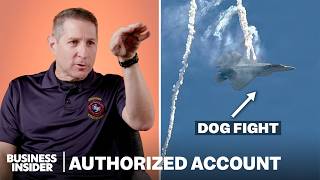

Fighter Pilot's 0-0 Landing Terror
45sThe intense, first-person description of a blind carrier landing in a snowstorm is gripping and emotionally charged.
▶ Play Clip"Delivers a genuine insider account of Top Gun and fighter pilot life, though the title oversells the 'how it works' aspect."
A retired Marine Corps fighter pilot with 23 years of experience flying F-18s, F-16s, F-22s, and F-35s shares his career journey, from Top Gun training to combat missions in Iraq, and the personal challenges of transitioning back to civilian life.
The pilot flew F-18s, F-16s, F-22s, and F-35s over 23 years, including time as a Top Gun instructor and in combat.
Carrier landings are described as controlled crashes, with a descent rate of 800-900 ft/min and a short runway of only 300 ft, requiring precision and immediate go-around if a wire is missed.
A harrowing night landing in a snowstorm over the Sea of Japan, where the pilot had to rely on ship radar and LSOs for a 0-0 landing, highlighting the terror and reliance on teamwork.
The movie Top Gun (1986) inspired the pilot at age 13, but the real Top Gun (Navy Fighter Weapons School) focuses on training instructors, not trophies or rankings.
Top Gun is located at NAS Fallon, Nevada, with long days of planning, short missions, and extensive debriefs (up to 5 hours) to identify all errors and set high standards.
The pilot's call sign 'Chip' came from knocking out his two front teeth with a G-suit hose, a common tradition of call signs based on embarrassing moments.
During Operation Southern Watch (2000), the pilot dropped a JDAM on an SA-3 missile site, a 4-hour mission with 30 seconds of excitement, but a career highlight.
Despite the ego boost of being a pilot, the pilot emphasizes that carrier operations depend on thousands of crew, and controlling ego is crucial.
Fighter pilots need controlled aggression to push jets to extremes, but this doesn't translate to risk-taking in personal life.
The pilot flew the F-18, F-16, F-22, and F-35, noting the F-22's thrust vectoring and the F-35's sensor fusion, and believes he may be the only one to fly all four.
On 9/11, the pilot was preparing for a live missile mission, and the world changed, leading to deployments to Afghanistan and Iraq.
A low-level show of force over a town in Afghanistan, without dropping bombs, was memorable due to the risk and the difficult situation of the ground team.
As a Top Gun instructor (2002-2005), the pilot taught air-to-air and air-to-ground tactics, and became the training officer, a coveted position.
Volunteered to be a FAC, leading to a deployment in Ramadi, Iraq (2006), the most violent city, where he controlled air strikes for ground troops.
Ground combat is intimate and terrifying, with a close call during an ambush where bullets passed overhead, leading to a realization of mortality.
The worst experience was losing his radio operator, Chris, in combat, and returning home to San Diego was marred by PTSD-like symptoms and nightmares.
The pilot solved his nightmares by listening to his own thoughts and feelings, a simple but effective approach, without seeking professional help.
Flying the F-22 and F-35 revealed that information and awareness, not speed or weapons, are the key to dominance, changing the nature of warfare.
Despite a promising career, the pilot felt stale and left to join Echelon Front, a leadership consultancy founded by Jocko Willink and Leif Babin, and wrote a book.
The pilot's career highlights the importance of teamwork, controlled aggression, and adaptability, and his post-military life focuses on teaching leadership lessons from combat experiences.
What is the descent rate for a carrier landing?
800-900 ft per minute
00:44
What is the length of the runway on an aircraft carrier?
About 300 ft
00:57
What does '0-0 landing' mean?
A landing with zero visibility, relying on radar and LSOs
02:23
What is the call sign tradition in the Marine Corps?
Call signs are based on embarrassing or dumb moments
09:01
What is a JDAM?
A GPS-guided bomb
11:19
What is the F-22's unique capability?
Thrust vectoring
18:37
What is the key to dominance on the battlefield according to the pilot?
Information and awareness
45:43
What is the name of the leadership consultancy the pilot joined?
Echelon Front
49:38
Carrier Landings as Controlled Crashes
Provides a vivid, technical description of the extreme precision required for carrier landings.
00:44Top Gun Movie Influence
Shows the cultural impact of the movie on a real career path.
04:31Call Sign 'Chip' Origin
Illustrates the humorous and humbling tradition of call signs.
08:48Ego vs. Teamwork
Highlights the importance of humility in high-stakes environments.
13:29Loss and PTSD
Reveals the personal cost of combat and the struggle to reintegrate.
38:47Information as Dominance
A forward-looking insight on the changing nature of warfare.
45:43[00:02] was a Marine Corps fighter pilot for 23 years flying F-18s, F-16s, F-22s, and F-35s. And this is everything I'm authorized to tell you. I spent my entire life fantasizing and dreaming and working towards being a
[00:16] fighter pilot to fly off carriers. And the day I leave Top Gun, I blink my eyes Marines in the most violent city in the world is something I never ever thought of, I never expected, and I never considered,
[00:31] never expected, and I never considered, and I never pursued. and recovering, taking off and landing from an aircraft carrier than from a
[00:44] regular runway. It's It's It's almost impossible to even try to compare the two. Landing on a carrier, you're kind of like smashing into the flight deck at about 8 or 900 ft per minute. So, it is what they call a controlled crash, but
[00:57] also you have a very small landing area. An aircraft carrier is about 1,100 ft long, but the runway is only about 300 ft long. More importantly, there are wires that a hook on your jet have to catch to slow you down. Those wires only
[01:11] take up about 100 ft. So, you have to be really really precise. Every carrier landing that you attempt, you expect to not land, meaning you prepare to miss. going to miss, but the runway is so short that the second you touch down,
[01:27] you go to full throttle to take back off. Now, if you catch a wire, the wire fast you're going or how much power you have in the jet. But if you don't, about a second. So, you need to be getting back airborne right away. You're
[01:40] coming in at about 140 knots, maybe 170 mph. You'll slow to a stop in maybe 2 seconds. So, these things are violent. They're tons of fun, at least during the day, but they're nothing like regular airports. Carrier landings at
[01:54] night in bad weather are always the scariest experiences that most most scariest experiences that most most pilots have. We're in the Sea of Japan. I'm coming back to land and the ship had essentially steamed into a a snowstorm.
[02:09] And I remember being up on the catapult getting ready to launch thinking, "This launch." Boom, off off I go. I go, "Wow." And it was bad, but it also deteriorated while I was airborne. And so throughout
[02:23] the clouds coming down, things are getting worse. We all knew coming back not going to be able to see the ship. We call it a 0-0 landing. I've only had two of these in my whole career. Any naval aviator hearing this knows what that
[02:37] means. It is going to be terrifying. And I'm going to have to rely on the ship's radar and eventually the LSOs to talk me into landing on the carrier cuz I'm not going to be able to see it myself. I was panic-stricken.
[02:50] Tons of fear. And so I'm up in what we call holding. Uh I'm like probably 10 mi behind the ship, maybe 15 mi behind the ship. I'm up at around 6,000 ft and I'm just circling waiting for my turn to come down to land knowing I'm going to
[03:04] fly into a essentially a storm. And I am totally freaking out. I'm exercise of calm down, relax, shake out your hands, shake out your neck. That's not doing anything. You're just waiting for your turn. In retrospect, I'll
[03:19] even do this?" But once you're airborne, there are no got to get back aboard the ship. There's snow on the jet, there's snow on the aircraft carrier. The LSOs talk me into the wires and I land. People were
[03:32] amazing job it was. They're watching it on camera and people are telling me I did an awesome job and I felt I felt so good. I felt like I had accomplished And I remember going back to my room that night after this unbelievable
[03:46] career-defining event, and I went to bed and I had this nagging feeling. I felt It was an odd thing because looking back, I didn't really felt like I did instructions. I did what other people told me to do, but if I was doing it by
[04:01] myself, it wouldn't have happened. And that changed my trajectory of my carrier pilot. There's an old saying in aviation that said, "It's better to be on the ground wishing you were in the air than in the air wishing you were on
[04:16] understood what that meant even though I heard it a hundred times. And it was like, "Ah, come on." That was the first time I'm like, "Now I know why people time I'm like, "Now I know why people say that."
[04:31] called the United States Navy Fighter Weapons School. I would absolutely be lying if I didn't tell you that the movie Top Gun completely changed the trajectory of my life. So, the movie comes out in 1986. I'm 13, almost 14
[04:44] years old when it comes out. And on the full screen of this movie, you were seeing the F-14 Tomcat jets off carriers, dogfights, missiles. I owe a lot of my career to being captivated by that movie. The original also and the
[04:57] also didn't get everything right. Um when you get to Top Gun, there's always you and your counterparts. There's no trophy at Top Gun. They don't rank you. The goal of Top Gun is to train you as a student so you can go on to be an
[05:13] instructor of a high caliber to prepare other students and other pilots to go to war. The chance to go to Top Gun as a student is a pretty rare event. It's pilots want. It just doesn't happen for most pilots. Every squadron sends on
[05:27] average one pilot per year. Squadron has somewhere between 17 to 20 pilots. I think we had 19 when I was there. Me and another pilot I got brought into our down. And he just said, "Hey, you two are going to Top Gun.
[05:41] He was a pretty demanding guy, really good um in training his pilots. He was happy to send them to schools. Everybody in fighter aviation knows what Top Gun is. They also know, aside from the movie,
[05:55] what it truly represents is the pinnacle of your craft. Top Gun is located at Naval Air Station Fallon, Nevada. It's kind of in the middle of nowhere. It's not an ideal place to be stationed, but it's a really good place to fly and
[06:08] train an aircraft. You can fly supersonic, you can drop bombs, you can the middle of nowhere because it gives you the best opportunity to do the most local population. Typical day at Top Gun is a long day. You spent hours the day
[06:23] before and hours the morning of planning, preparing, rehearsing, coordinating. You'll do training missions that last less than 30 minutes. You are burning gas in full afterburner doing one against one dog fighting, and
[06:36] crazy. Come back and you're going to debrief sometimes 5 hours, sometimes even longer, but a very long debrief. Every flight, every evolution, there's
[06:48] only way to do that is to set a obscenely high bar of expectation and then demonstrate that you can actually identify all the errors, all the
[07:00] shortcomings, all the failures, no matter how small they are, and that takes time. If you take four or six people on a mission, you got to go through every single one of the those pilots' mission, how they flew, their
[07:12] radar, their communication, their formation, their flow, and so you can Everything about being a Top Gun is humbling. Everything. My first mission fighting mission where I was flying against another instructor, just one
[07:27] against one. I did such a bad job when we landed, he's like, "Don't get out of fly again." And we called it an immediate refly, which meant I was so wasn't even going to be a good use of the time. I was totally in over my head
[07:42] at the beginning. The instructors fly airplanes to such a degree of precision that my mistakes got magnified to a point where he was like, "Hey, it easy." And it was, you know, a little embarrassing, but Top Gun is not a place
[07:55] where you're expecting to outperform anybody on the instructor side. You just and show that you're receptive and open-minded to it. Uh you get humbled humbled from the time that you leave, without doubt. So, the word mastery does
[08:08] not enter your mind at Top Gun as a student. I literally you finish Top Gun, you graduate, you get your Top Gun patch. I climb back into my my same airplane, that was my jet, and I flew home and landed at Miramar, back to my
[08:20] squadron as the uh the most recent Top Gun in the Marine uh Top Gun graduate of had a tradition in our squadron that Top Gun graduates didn't wear their patch. differentiate that Top Gun graduate, so we didn't wear patches. And so, I knew
[08:35] Gun patch. So, on this flight home, I'm like, "I'm wearing it. I'm going to come my Top Gun patch. I'm going to get my one day wearing that patch." And I got But honestly, guys were pretty happy for me. It's a really cool qualification.
[08:48] me. It's a really cool qualification. It's a highlight of my career, for sure. everybody gets a nickname. We call it a call sign.
[09:01] In the Marine Corps especially, there's a tradition that call signs are not very call you something that's really cool. So, most of the nicknames and call signs in the Marine Corps typically come from you doing something dumb, something
[09:14] embarrassing. I am no exception to that. It's in 1996. I'm flying at the advanced jet trainer called the T-45. I am getting dressed to something called a G-suit. And all a G-suit is is kind of like a pair of
[09:27] hose on the end of it that connects to the jet to fill up uh in case you pull really important piece of gear. The very end of the G-suit that plugs into the It's a big round metal buckle. I was having a conversation with someone as
[09:43] arms around and as I'm moving my arms around I hit my helmet off the table and that helmet started to fall over the table and I reached down to grab the helmet and as I reached down my hand hit the hose. The hose flew up and hit me in
[09:55] the face and it knocked out my two front teeth. Holding them them in my hand I two chipped teeth. My instructor walks around the corner, looks at me and says, medical." The student I was talking to I was supposed to go flying with looked at
[10:09] me in horror and I got undressed in my flight gear and went to the doctor's Dumb and Dumber and you've seen Jim Carrey's character with these two giant chips in his teeth, he had one, I had two. It could have been a lot worse,
[10:23] because I had two big giant chips in my teeth. Uh again, it's not flattering. I'm not excited to tell that story, but that's how I got Chip and it stuck.
[10:40] mission. I put combat in quotes because it wasn't necessarily the most harrowing mission. It was actually before September 11th. It was a mission in 2000 that we called Operation Southern Watch. We were patrolling the southern portion
[10:52] of Iraq to make sure that they weren't flying in that area and they had actually moved in a surface-to-air missile, an SA-3 missile couldn't. We got assigned what we called a response option which meant we were
[11:05] going to go out and take out this surface-to-air missile system. I had in my squadron the newest jets in the fleet, these highly capable we call them lot 18 F-18s with GPS and this new at the time bomb called a JDAM which is a
[11:19] joint direct attack munition which is a GPS guided bomb, something that was really new at the time. Hours before we launched on this mission, we knew it was preparation was we call it mission planning is knowing where the target is,
[11:32] into the jet, into the weapon. This is about a 2-hour flight from launching off have enough gas to get there, and flying deep into territory the entire time
[11:44] Obviously, I was nervous. It was night. It was dark. I was definitely amped up. When you get close enough to drop the bomb, you're only maybe 5 10 miles away. It's really not that far. So, you're really going a long way for a relatively
[11:58] short window to release this. Quite frankly, it's pretty You get good feedback that all the systems are working correctly. There's a master arm switch. You turn that thing on. Everything comes alive. You get this
[12:11] indication that everything is working correctly and it's ready to go. You get hold down something called the pickle control stick. And then in about a second later, a 2,000-lb bomb drops off
[12:24] your jet. It's a big drop. It's a big clunk. The jet makes a lot of noise. And then the bomb goes and does its thing. I had what's called an infrared pod, which is basically just kind of like a camera that watches this. And I
[12:37] the bomb hit it. It went exactly where it was supposed to go. Huge explosion on the on the camera on the pod. And then a 2-hour flight home. So, it was probably a 4-hour mission for about 30 seconds of excitement. It
[12:50] was worth every second, though. I came back. I was like a celebrity on the boat for a little while cuz dropping bombs is pretty uncommon. And for someone that junior in their career for the opportunity, at the time it was a huge
[13:02] deal. I remember being excited. I was honored. I felt lucky to be able to do it. But I was also just really pumped that I had the chance to do that on my September 11th, our carrier probably dropped maybe total 10 or 15 bombs.
[13:16] Really relatively small amount of bombs. That's over a course of about 6 months.
[13:29] enjoy a status is the wrong word, but there's definitely a uniqueness to being a pilot. Uh and they kind of cuts both ways. It's a bit of a double-edged really hard not to think you're the center of the universe when you're a
[13:42] control sometimes. Carriers are billion-dollar machines that are manned by thousands, 4, 5,000 function. All with the sole purpose of launching
[13:58] and recovering aircraft to go to war. And on the boat, there's maybe only 150 pilots total on the entire carrier. And when you are the one in the cockpit doing that, sometimes your ego tells you like this whole thing is about me.
[14:13] That's not even remotely true. I literally could not do anything on that carrier without anybody else's help. Forget taking off and landing. I without 10, 15, 20 other people
[14:25] learn to keep that ego in check. Fighter pilots are are often pretty type A. They're pretty strong-willed. They're pretty disciplined, meaning they're willing to do the work. Becoming a fighter pilot is not all just flying
[14:39] missions at Top Gun. In fact, it's mostly just a lot of disciplined effort might not seem all that fun. You know, how the fuel system works and engine systems work. But to be good in a jet, you have to build some aggression. And I
[14:52] uncontrolled aggression. I mean the ability and willingness to put your jet into a very extreme scenarios and extreme environments. That's the type of of aggression I'm talking about. You can't be passive. Uh you can't be slow.
[15:06] You can't be hesitant. You have to learn that aggression, when controlled, is probably one of your best assets. I am not a big risk-taker in my private life. In my personal life. If I look back on things I did in an airplane,
[15:21] I chose to do and some of the dumb things I did in an airplane. I am not like that in my my private life. things you did? >> Um let me just think for a second cuz
[15:33] definitely would not want on camera. I of the dumb things. What kind of people marry fighter pilots? I got to be careful with this answer cuz my my my wife may watch this. Um
[15:50] absolutely understand that there is a uniqueness to what we're wife. I met my wife when I was at Top when I was an instructor there. She got to see kind of the full range of combat
[16:05] sad to say this, but at certain intervals there are going to be accidents, mishaps, and fatalities. It's going to happen. I I knew it was a possibility. I understood that objectively. I saw it
[16:19] happen. I've been to a lot of funerals. I don't and didn't at the time certainly never really understood the burden that a spouse would carry knowing that your spouse is going to go do something that might produce that outcome. And I think
[16:34] spouses, for the people that marry fighter pilots, than for the pilots fighter pilots, than for the pilots themselves.
[16:46] started an aircraft called the F-18 Hornet. I first started flying the F-18 in 1998 all the way till 2002 when I went to Top Gun as an instructor and started flying the F-18 and the F-16. So, I had dual qualification in both of
[17:00] Top Gun to be an instructor, I was in the very first class of Marine Top Gun instructors to fly the F-16 cuz it had just arrived up at Top Gun and then transitioned to what we call the fifth generation fighters. I started flying
[17:13] the F-22 Raptor, flew that for almost 4 years, and completed my career flying the F-35B for 3 years. In the exchange with the Air Force to fly the F-22, time that I was available for that exchange, they were looking for a former
[17:27] Top Gun instructor with F-16 time to fly at the F-22 Raptor. And then ultimately, my time flying the Raptor coincided with the Marine Corps buying the F-35B, and I operational pilot to fly that airplane as well. I can't promise you this, but
[17:41] I'm pretty sure no one else has flown those four jets. If they have, it's a in my career, I was definitely the luckiest guy. I was reason I got to fly so many different aircraft, I have to admit, is a real
[17:56] combination of luck, timing, circumstance, and of course some preparation. So, the F-18 is really the Marine Corps's primary backbone for conducting operations in the full spectrum of capability.
[18:08] On the Air Force side, the F-16 is pretty similar. The F-16, like the F-18, is a really capable multi-mission, multi-role aircraft that does kind of everything. When you start talking about fifth-generation aircraft like the F-22,
[18:23] the origins of that jet really were just what we call air dominance. They wanted the Raptor to be this highly capable stealth fighter to control the skies. But that aircraft has also it's evolved into a multi-mission,
[18:37] multi-role capability aircraft that does a pretty wide range of things. The F-22, there, is it has what we call thrust vectoring. So, it's an incredibly powerful airplane, 35,000 lb of thrust per engine. So, you got 70,000 lb of
[18:53] thrust, and you can do things like cartwheels and pedal turns and these unbelievable things. You just can't do that in a four-chain airplane. We have you're essentially spinning around like a top. You'll watch it do things that
[19:05] just seem to defy the laws of physics. It's nothing but just it's just pure fun. It is just the most ridiculous thing. And then you lead into the F-35, the newest fighter in the world, by far the most capable when it comes to the
[19:18] range of missions. It's also a stealth aircraft, really hard to find. The F-35 pretty much does everything. The attributes you need to be successful in there is no airplane better than the F-35 that represent that. You need to
[19:32] know what's going on, where it's happening, when it's happening, who's doing it, who are they doing it to, in a sensor fuse network-centric communication with all sorts of resources, space, cyberspace,
[19:45] sorts of resources, space, cyberspace, surface, subsurface, land, sea, air, radio frequency, infrared, laser, electro-optical. They all conduct a whole wide range of missions, really to make themselves available to do whatever
[19:58] is necessary, really as warfare evolves. These aircraft are not cheap. You know, the F-18, you know, started as probably a 30-40 million-dollar jet. Now the modern versions of the Hornet probably 70-80 million dollars.
[20:10] Same thing with the F-16. When the F-16 was designed in the '70s and the Air Force bought that in the late '70s, it was intended to be a low-cost, pretty simple, single-seat fighter. That thing has evolved. Our newest block aircraft
[20:22] are pretty expensive jets. The F-22 and F-35 at its origin were well over a hundred million dollars each. To the American taxpayer who spent a hundred first thing I wouldn't say is this thing's untouchable and unbeatable. I
[20:35] deadly and war can be dangerous. What I would tell you is that airplane is worth every penny. Because everything that has preceded that thing, every other fighter that we have, the threat, if they so choose,
[20:49] depending on where we operate, has the potential to make them irrelevant.
[21:01] when September 11th happened and our squadron went off to war. The expectation is right away you become one of the key tactical leaders to start training other pilots and prepare them. I had this routine I'd get up, I'd
[21:14] day, and I would lace up my boots and my flight gear and my my flight suit I'd in the morning. And you know, I'm probably it's probably 5:00 I'm in West Coast time, so maybe 5:30 something around that time. Uh and
[21:27] I'm watching the news and and like, "Holy cow, what's going on here?" I only lived a little a little ways from the base. It took me hours to get on the base. They were inspecting every vehicle. They got the dogs. I mean,
[21:39] clearly the world had been upended. By the time I get on on the base, uh you know, it took me like I said a couple hours. I am briefing as the flight lead of four F-18s of the potential of launching with live missiles cuz we had
[21:52] jets flying from like Asia Pacific, Japan into San Diego, LA to the West Coast. The idea of civilian airliner being a threat of that is very much a blur. Four of us
[22:07] on a live of a live missile mission, the potentially thinking about what airliners might be doing. Obviously, thank God it didn't happen, but the world turned upside down that day, and everything changed after that. And I
[22:19] expectation that we really didn't know exactly what to do or what we were best. Uh and within a matter of days, our squadron embarked aboard an aircraft carrier parked off the West Coast. I
[22:32] went back to Afghanistan in October of 2001. My second deployment was much more robust, much busier. But ultimately, the carrier, even though you might not be flying a combat mission every day,
[22:45] pier and the aircraft come aboard, it's all business. One of the most memorable missions that stands out to me was a mission where I didn't even drop any bombs. I was on a mission with a relatively young guy in the squadron,
[22:58] and we're flying essentially over a town in Afghanistan. A team had gone in a folks to get them and get out of there and they're essentially in a difficult There's a lot of civilians involved. It was in a in a small city and what they
[23:13] were looking for was were some some help from us. They didn't want us dropping support and we were flying around at really low level. I'm talking hundreds of feet doing a circular pattern and trying to find their location and it was
[23:25] really tough to find them and it was incumbent on us to find them and fly over the top of them as a kind of a show of force. 100% you're nervous. You're totally aware of it. It's a foreign environment. You're close
[23:37] things out. You're trying to find the other aircraft. Like there's a lot going on down at low altitude. There's a huge difference between hundreds of feet and flippant when I say this, but thousands of feet off the ground is very easy.
[23:50] It's very low risk relatively to what you're doing. When you start talking, you know, 500 feet, sometimes lower, 300 feet, which is pretty uncommon, those are very very risky missions. You have to be uniquely qualified to do
[24:04] The margin for error is very small and the time to hit the ground is seconds. So, you got to be on your game when you start talking hundreds of feet, not the most close and personal. I think the most risky to the people on the ground
[24:17] and our contribution wasn't dropping bombs. It was doing a show of force over the top of them. That one surprisingly stuck out and I think it was because of how difficult the situation they were in.
[24:35] billet. I was a Top Gun instructor from August 2002 until August of 2005. instructor is kind of like, you know, the ultimate full circle moment. Like a fantasy, basically. You still don't ever
[24:48] think it's going to happen. You know you got there through performance. You you there and there's some part of you thinking like, "Hey, you must be pretty good at this, right?" >> When I got there as an instructor in the
[25:00] some of my very, very earliest flights are with the commanding officer at Top just out there doing things in an airplane that even at that stage I'm I'm just at the very bottom of this mountain. The bottom of the bell curve
[25:16] of Top Gun instructors are better than almost any other pilot is not enough. You have to be able to teach. Every instructor there has what's called a subject matter expertise area, but across the board, we all teach all
[25:30] surface-to-air missiles and counter tactics, how to defeat SAMs and getting shot at from the ground. We're teaching one against one, two against two, two against many, four, eight. So, we're teaching all the different phases of
[25:43] instruction, air-to-air, air-to-ground, reactions, things like that. So, the instructor's job isn't really just his subject area, it's teaching the skill of flying and teaching. I showed up to Top Gun as an instructor with a lot of
[25:56] was the only fighter I was ever going to fly. The day I show up to Top Gun, they start receiving brand new F-16s as training aircraft to to replicate threat. The F-16 was there essentially to pretend to
[26:10] be a bad guy aircraft, and right away, they started sending guys to get didn't even have to volunteer for it. It just happened. In a lot of ways, it's similar to the F/A-18, but it's much more powerful, it pulls more Gs, it's a
[26:23] faster jet. The training officer job at Top Gun is kind of like it's like the job. When I was told by the by the commander of Top Gun that I meaning I was going to be the senior instructor, and I was going to run Top
[26:36] Marine, which is a pretty rare opportunity. Oh my god, I am going to run Top Gun as the training officer. That's a really coveted position. It's it's a lot of fun, it's very
[26:50] My CO at the time was a legendary instructor that had this incredible reputation. I knew I was going to work directly for him. I went through, I think, 13 classes.
[27:02] And I was a training officer, I think, for the last three. So, probably about 9 >> How often did you hear the theme song from Top Gun as an instructor at Top Gun? >> You do not play the theme of Top Gun as
[27:14] an instructor at the real Top Gun. Anything that references the movie at the actual Top Gun, the movie's Fighter Weapons School, it's a $5 fine. So, we're not playing the music, we're not quoting the lines at the real Top Gun.
[27:32] I had this nagging sense that I wanted to do something uniquely Marine Corps. I going to out lead Marines on the ground in a totally different role. So, I volunteered to be a FAC. A forward air controller is just someone who's
[27:46] qualified and certified and specially trained helicopters, and jets, uh to call in air strikes to drop bombs, and to use the aircraft in close proximity to ground troops. The Marine
[27:59] Corps trains pilots to be forward air controllers. And I had a pretty good sense of those things cuz I had done combat from the air in an F-18. The rightly or wrongly, for better or for worse, that pilots have unique
[28:13] which I totally subscribe to, and I understand that. The Marine Corps is the only service that does this. The other services have what's called a JTAC, a is essentially the same qualification, but it's not a pilot. It's a pilot uh
[28:28] FAC school, which is called TACP school, terminal air control party school, the airplanes to drop bombs. It wasn't that hard for me cuz probably 90% of what they were teaching I knew cuz I'd done it from the sky. So, I was
[28:43] perspectives, but ultimately a pilot going through that school, straightforward. I was going to go to Japan for a year and stand up a new unit that was being built. It's going to be a year. I go
[28:57] right back to San Diego, back to the F-18. That's not how it worked out. Within days of getting there, mid-September, there were other units of the same type. They called them
[29:10] ANGELICO units. Air Naval Gunfire Liaison Company. It just meant a team of terminal attack controllers that were supporting combat operations in Iraq. And they were short-handed. When they asked for volunteers, I was a highly
[29:24] air controller, I had to volunteer for that. So, I put my hand up and said I will go and they selected me as one of the uh pilots to go be a FAC for this other unit. I deployed to Iraq from February of 2006
[29:39] to September of 2006. The commanding officer of my unit essentially brought in a piece of paper to me as the senior FAC with all the different locations we he goes, "You need to have this thing filled out. We have 25 teams or
[29:53] locations. Fill this thing out by the end of the day." I had this sense of knowing that I should I volunteered myself to go to Ramadi. I was there. And Ramadi, in all the cities in Iraq,
[30:07] was the most violent city. It was the epicenter of all the fighting. I could list. I did it because I thought I should. I I was a well-trained pilot. The Marine Corps invested a lot in me. I understood
[30:20] how these machines worked. I also knew that if there was one place that was the most violent and the most deadly place, it just doesn't make sense to ask someone else to take that risk. It doesn't make
[30:32] sense to do that. Plus, my best friend was there and I just in good conscience I could not imagine asking someone else to do it and not asking to And listen, I was volunteering me and my entire team. It wasn't just me. I had a 13-person
[30:45] team I was responsible for. So, I think eight of them were on their very first deployment. We had heavy weapons, we had Humvees, and the most important thing we the ability to control aircraft and use
[30:58] those resources. So, we had F-18s, Harriers, Cobras, and Hueys that were the Marine Corps aviation were all right there or just on the outskirts of aircraft. I controlled A-10s, I
[31:10] drawbacks of that is you've made this massive investment in time and money to teach them to fly airplanes. That is a huge expense that the military absorbs. And there's some question like, why would you want to put
[31:23] combat? Well, the Marine Corps's belief is they're the best person for it. learning at the very beginning of my career at the basic school when I was "Hey, look around. These are the people that you're going to go to war with. And
[31:39] friends and your counterparts, your buddies, are people you're going to rely paint this picture that's kind of ethereal. It's hard to imagine, but it and and you think, "Oh, that that would be kind of neat." We're going towards
[31:53] this position. And as we're moving and we're I picture we're moving south into like a two-story building. And as my team is going to enter the building, we get lit up by by machine gun fire. It goes directly
[32:06] missed me and and a couple guys by by a foot. I mean, we are so lucky to not get right over the top of us. I'm like, "Oh my god." By the time we run in the building and my job as a FAC was always to get up to the roof as best we could
[32:20] airplanes, I could use my radio. That was a good vantage point to be. Up on the roof, as we're getting up to the roof, we start taking what's called RPG fire, rocket rocket-propelled grenades. That's hitting the wall outside of this
[32:34] crazy." It was a crazy situation. And I'm with my army patrol leader, the guy in charge was an army lieutenant, and I'm there supporting him. us that we're taking fire from a position. It's really like a vehicle,
[32:48] between two buildings, kind of cut us off, and they're hitting us. And I had us. Um I hadn't checked in with them. I aircraft were assigned to us. There's these very specific procedures. You
[33:01] check in using the exact phraseology, the the right terms. It's all sequence. almost like robotic how you check in. Well, this guy didn't check in using any of those procedures. He said He said, "Chip, this is Boo. What do you need?"
[33:14] This guy, Boo, I'd been in the squadron with him in VMFA-314 before. I had deployed with him. This is one of my closest friends. This is somebody I'd been in in uh flying with hundreds of times. He was a
[33:26] unbelievably amazing guy that I knew personally. And so, And I looked over to the lieutenant, and I go, "We're going to be fine." When you tell an aircraft to follow the checklist to
[33:40] follow what's called a nine-line, which is nine lines in order that you're communication is perfect, that all the uh risk has been mitigated. I needed Boo and his F-18, and I go, "Hey Boo, uh south to north, call wings level. We
[33:56] runs. It's like close enough that you can see they're right there in front of you. Uh and Boo strafed this vehicle. They awesome. Um he ran down to like the absolute
[34:09] of barely made it home on fumes. And it was like this unbelievable culminating event of like, "Oh, this is why the Marine Corps does this. This is why they relationships matter. This is why you got to take care of your teammates and
[34:23] your counterparts." Because at one point you're going to find yourself in combat, And if it was a stranger, it would have taken a lot more time to figure out taken a lot more time to figure out what's going on.
[34:40] life. Ground combat is different and the intimacy, the closeness of it is really hard to capture. Um the missions I did in an airplane, there's an arm's length to that. Uh a separation from that. There's a
[34:54] comfort of the confines of a cockpit. It's a place you're very comfortable. I asked myself repeatedly during those 7 months in Ramadi, "What am I doing here? Why did I volunteer for this? How did I get myself into this mess?" I certainly
[35:08] facing like near-death experiences. One of the missions they would do was called movement to contact, which is exactly how it sounds. We would move in a patrol and the patrol is about 20 Army soldiers and three or four of us from my Angle Co
[35:20] team and we'd move until we made contact with the enemy. Our job and our goal was to draw the enemy out so we could fight them. So the enemy had set up on the >> [snorts] >> uh two heavy machine gun positions and
[35:32] they kind of baited us into this through some mortar fire and I had been mortared They shoot these high-lob, very inaccurate uh essentially little little tube and they detonate. They kind of get your attention.
[35:45] And when the mortars were going off, they were originally pretty far away and this is this is closer than normal." We get lit up by two heavy machine gun positions on our perimeter pointed right at and I am in the absolute dead center
[36:00] of this uh ambush. And the bullets are coming in from my direction and I'm forced to kind of lay position. I have to I have to essentially lay down. And the reason I
[36:12] essentially going over the top of our heads. I'm there with uh uh two other radio operator who's with me all the time. He's probably 10 ft away and he ground staring at each other with eyes as big as saucers.
[36:26] scenarios of what you should do. How should I handle this? How should I react Um you know, what you want to do is you want to get up and run to a safer place. And about 30 ft in front of me was like a essentially a drainage ditch, like a
[36:38] little canal. And a lot of guys had positioned themselves in there were safe come over here, you know, yelling. But I knew that if I'd gotten up, I'd stood up that if I had reached out my arm, my arm would have gotten hit cuz the dirt
[36:51] between me and my radio operator was getting hit by these bullets and it kicking up and kind of hitting me in the face. You can feel the heat and the movement and the sensation of the bullets. And I could see and feel the
[37:03] trajectory shifting towards me. Uh which was an awful feeling and as probably 20 thoughts in in in milliseconds and everything was you can't move, you can't roll, you have to just stay right there. It's the only
[37:17] just stay right there. It's the only place you can be is I I accepted that I was going to get married a couple months earlier. Last words out of her mouth her mouth were
[37:32] don't be brave. And that was her way of telling me don't Just please come back. You got to come back. It was about 2:00 in the morning back home in San Diego. And I had this image of like
[37:45] knocking on her door, waking her up 2:00 in the morning telling her that I was And as the bullets got within maybe an arm's length, they shifted up and over. almost like the hand of God and you can picture someone on the gun on the heavy
[38:00] little bit and kind of tilting up and over. And the bullets go over the top of my head and start impacting the dirt to my right. And shifting off a little bit to the right just by a matter of feet. And that gave me a very small window for
[38:12] me and and Mo, my radio operator, to run to that ditch. I'd never been that close to that outcome before and um it was a reminder of what war is, what combat is, and what I was doing, and some recognition that I probably
[38:29] should have been better prepared. I was really good in an airplane. I was really good in that portion of my of my leadership life as a Marine. was I was working really hard just to keep up.
[38:47] 2006. Undeniably, the worst thing that ever happened to me was losing a Marine in combat. And, uh, my radio operator, a young 2006, uh, was killed in Ramadi. And,
[39:02] uh, was killed in Ramadi. And, um, home to San Diego. And I come home to, the best weather in the world. I come home back to the amazing beaches. I come
[39:18] back home to an F-18 squadron. I come back home to my wife, my favorite person married to and hadn't seen for almost a year. And I come back home to my life in San Diego. But, I don't bring home Chris with me. Uh,
[39:32] that I didn't bring home all my Marines. I fly into San Diego International, and I get picked up by my mom and my wife, my two favorite people. You know, my mom kind of when he comes in to meet me, my my mom kind of like is outside at the
[39:46] curb, you know, waiting for me. So, I had this amazing reunion with my wife. kind of a blink. Before I know it, I'm in my car You know, it's probably a 15-minute drive from San Diego International to my
[40:00] sitting next to me, and my mom is in the back seat. I kind of lose track of what's going on, and I I'm I'm I'm realizing like I'm looking in like the gutters and stuff for IEDs, and I'm kind of having this very odd moment of like
[40:15] I'm looking around and scanning like I'd been doing in a Humvee for 7 months at people. I'm in the side streets of my community and I'm looking for things that stand out as a problem. And the like the din of my wife and my
[40:28] mom talking to me is an is an annoyance, is a frustration and I scream at them. I tell them to shut up. And I'm like I said like stop talking. shouldn't be talking, you should be scanning for threats, which is how I
[40:41] operated with my Marines. And it was a very um startling thing for cuz I'm screaming at them and I kind of startled myself out of whatever mindset that I was in. Super embarrassing, super um insecure
[40:57] for having done that and I don't even know why it happened. I just I just I just lost my place in the world. First night I'm home, uh I'm with my wife and remember we got married uh in May and I left in September, but we really hadn't
[41:12] ever really lived together, you know, like that. The future is ours to how are as a family? Um and I woke up the first night at home
[41:26] nightmare. I'm I'm on a patrol and I can I can see environment around it. It's just kind of a weird thing, but I've on the ground way, this never happened to me. This is a totally made up scenario. It's not a
[41:40] And I'm kind of using my rifle the the the the barrel of my rifle. I'm trying up and I wake up. I mean, I'm not reliving an experience, but I'm having crazy nightmare that is um
[41:54] becomes like a daily thing. And it got to a place got pretty corrosive cuz going to happen. It was a really rough start to my life post combat in Ramadi see me just you know, cold sweat. I had learned in
[42:11] my career to to talk. When you're a flight lead, you talk all the time. was the one with the challenges and the problems and like things had to be my way. I had this very rigid narrow sense of of trying to deal with my
[42:23] bunch of people around me talking to me, which is not a good way to have a had to defer to me. I was the one with the challenges and the problems and like I got to a place probably three or four, maybe five months after getting home was
[42:36] This is this is not You can't have a relationship like this. It's not a me." And I know how ironic and how simple it sounds, but I was able to solve my own problem
[42:49] by just changing that approach, which is I shouldn't talk. I should listen. Who am I to be the How come I get to be the primary talker should control the environment. These nightmares are a reflection of something
[43:03] that was bothering me, a frustration, an anxiety, a fear, a a a um a a memory, something that was bad. And what I was doing was ignoring it. set you off, that's triggering this. And it's in my head somewhere, and what I
[43:17] it. And and I I am aware of how simple this solution sounds to other people. Just listen. But what I literally did, I started listening to my own thoughts, my own brain, my own feelings. And
[43:33] shockingly, shockingly, it helped. I won't say that I'm path went from getting worse to getting better to a place where I am so much wider and wider, but things will trigger, and I'll I'll kind of revert
[43:47] back to that a little bit. It's very rare now, but it's not zero. You've got the playbook, you know what to do here. It's okay. I think veterans come home flaws and shortcomings. And I think embarrassment and shame are two of the
[44:00] bigger ones that I struggled with. And you just want to sequester those. And I think that makes them even worse. There's a lot of embarrassment that that you feel and some shame that you feel when you
[44:16] them to stop talking. Or if I get startled by a loud noise, or if I watch something then and I start crying, what you feel more than anything training officer at Top Gun, you don't get embarrassed very often. You feel
[44:29] You have a lot of control over your life. I never sought professional help. want those resources. The Marine Corps and the military, they should provide those. I love that they do that. For me, it wasn't easy, but it was very simple.
[44:50] F-18s. Very quickly, I got the opportunity to transition to fifth-gen airplanes, and I started flying the F-22 Raptor. And the F-22 is what made me realize the world and warfare was changing.
[45:03] could ever have in an airplane is that jet. I very quickly ended up as the very first operational commander and the very F-35B. The F-35B
[45:17] is what exposed me to the reality that the world, aviation, warfare, and the future were changing. And and many of the things that I was were going to become irrelevant very quickly.
[45:31] Now, I don't mean the ethos of fighting and using aircraft as part of a tool for future warfare, but certainly the tactics, techniques, and procedures, the world was going to change. And the F-35 is what told me that because it gave me
[45:43] the insight for the first time is that the commodity that guarantees dominance on the battlefield is information and awareness. Not how many bombs you carry, not how much fuel you have, not how fast
[45:56] pull. And so, even today in the modern era, if I look back at what I knew at Top Gun, it doesn't work today. The lessons that I learned, how to teach, how to fly, how to train, all
[46:10] that is exactly the same and extremely relevant. But the world of how airplanes support warfare is totally different and it's changing dramatically before our eyes. The future of warfare and how aviation
[46:25] is central to that is so different from the from when I where I grew up in And the future of fifth and sixth generation fighters, think about just the world with AI and information and all that, that's the
[46:38] world we're operating in. This is a very dramatically different world than it was in the one I grew up in. We've already moved in this direction. A major shifts, brand new wingmen that are just learning to fly
[46:50] massively more responsibility than we had. When I first learned to fly the F-18, they told me to join up and shut up. That meant just fly formation, be anything, don't lose sight of your lead, do what he does. Now we are flying in
[47:05] have 10-15 airplanes out there and you can't control who's where and what, so your most junior person has to have the skills of a seasoned flight lead. So the burden of responsibility is shifted. It's much more heavier for a younger,
[47:20] which means they have to be a masters of their systems, their capabilities, their equipment and understanding what's going on. The the mentality, the mindset and the skillset that's required for that and
[47:33] how we change to that is very, very different than how I grew up.
[47:46] I was about 3 months away from promoting to colonel and I'd been selected to go back to command and fly the F-35 again. So on paper it looked like an unbelievable life experience and another opportunity
[47:58] flying modern fighters for the Marine Corps. And there's a little nagging voice inside me that was saying like this kind of seems stale. It seems a little familiar and a little routine. And you can imagine throughout
[48:10] my career everything I did was different. And this is the first time I had a sense of of kind of recycling some things. To be a stand at the ladder of the jet to climb up
[48:23] And you want to be passionate, and you want to be invested in that. And there's of that, a little bit. And even a little bit to me was enough to say there's no way I can imagine for the next 3 years. And if I took the promotion to colonel,
[48:37] I was going to owe 3 more years of doing something that felt more like a chore than a passion. Which for someone who spent his entire life fantasizing about flying fighters, even 1 degree of that was not okay. The
[48:49] day I submitted for those all those things, I get a call from my old friend. air control with my team, uh a group of SEALs came from SEAL Team 3. They were called Task Unit Bruiser.
[49:01] The leader of Task Unit Bruiser is a man named Jocko Willink. I essentially worked with Jocko and his SEALs in my entire deployment. Embedded is probably a strong word, but it's kind of how it worked cuz every major operation Leif
[49:13] and his platoon of SEALs from Jocko's Task Unit went on, I was with them. I him in Iraq. Uh I held him in the highest of regard. He and Jocko had wrote a book called Extreme Ownership.
[49:26] That book uh had led them to have a leadership consultancy of teaching the lessons from their experiences that I was with them to companies and off and grow. Leif said, "Hey,
[49:38] going to go, but there's a chance this company might take off. We'd love to have you be part of it again." I'm at Echelon Front. I've been with them since it was just the two of them. We're now probably the world's premier leadership
[49:50] consulting company. Uh we are all over the world taking the lessons that they Ownership. They wrote a follow-on copy a follow-on book called Dichotomy of of to let me write the third book in that series
[50:04] of Extreme Ownership called The Need to Lead which took my lessons from personal stuff. And I'm out there teaching leadership to companies to help their leaders get better, which is the coolest thing ever.
[50:17] Account. If you like this episode, then you should check out our new podcast. And comment below with the names of people you'd love to hear us interview.




⚡ Saved you 0h 50m reading this? Transcribe any YouTube video for free — no signup needed.