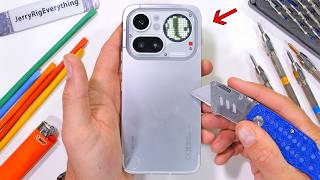

Nothing Phone 4a Pro: Hidden Flaw Revealed
46sThe mystery of a hidden design flaw immediately hooks viewers, especially tech enthusiasts looking for exclusive insights.
▶ Play Clip"The title hints at a flaw, and the video delivers a clear warning about the SIM tray design, but the overall tone is more impressed than worried."
The Nothing Phone 4a Pro is a sub-$500 smartphone that competes with flagship devices, featuring a unique transparent design with a Glyph LED interface, a metal unibody, and impressive durability. However, a design flaw in the SIM tray area compromises water resistance if the wrong hole is used.
The Nothing Phone 4a Pro is a $499 smartphone that competes with high-end devices. It features a unique industrial design with a Glyph LED interface and includes games like Space Invaders in widgets.
The screen has a pre-installed plastic screen protector (scratches at level 2-3). The glass underneath scratches at level 6 with deeper grooves at level 7, similar to mainstream flagships.
Nothing discloses the carbon footprint: each 4a Pro produces 50 kg of CO2, equivalent to driving 150 miles or eating 25 hamburgers.
The SIM tray hole is directly aligned with the waterproofing mesh, making it vulnerable to puncture if the wrong tool is used. This compromises IP65 water resistance. A secondary mesh provides backup.
The phone has a metal unibody, making it the strongest Nothing phone ever made. It survives bend tests on par with iPhones.
The 6.8-inch display is 10-bit, billion-color, 5,000-nit, and 144Hz. It lasts about 20 seconds under extreme heat before turning white.
The plastic camera plateau is removed with heat. Underneath are CNC-milled aluminum camera lens bodies.
The screen is glued and requires heat. It is removed from the side between the plastic edge and metal frame.
The battery has pull tabs and is 5,080 mAh (US version) or 5,400 mAh (India version). The loudspeaker is large and high-quality.
The primary waterproofing mesh is directly behind the SIM hole, making it prone to puncture. A secondary mesh is present as backup.
The main board has thermal paste and a large vapor chamber. The 8MP ultrawide and 50MP main cameras have OIS; the 50MP telephoto and 32MP selfie do not.
The Nothing Phone 4a Pro is the best-built Nothing phone at an affordable price. Repairability is moderate due to the need to remove the camera plateau for screen access.
The Nothing Phone 4a Pro offers flagship-level durability and a unique design at a competitive price, but users must be cautious with the SIM tray to avoid compromising water resistance.
At what level does the glass of the Nothing Phone 4a Pro scratch?
Level 6 with deeper grooves at level 7.
01:31
How much CO2 is emitted during manufacturing of each Nothing Phone 4a Pro?
50 kg of CO2.
01:49
What is the battery capacity of the US version of the Nothing Phone 4a Pro?
5,080 mAh.
07:27
What is the battery capacity of the India version of the Nothing Phone 4a Pro?
5,400 mAh.
07:40
Which cameras on the Nothing Phone 4a Pro have optical image stabilization (OIS)?
The 8MP ultrawide and 50MP main camera have OIS; the 50MP telephoto and 32MP selfie do not.
09:28
What is the IP rating of the Nothing Phone 4a Pro?
IP65.
02:32
Why is it important not to insert the SIM tool into the wrong hole on the Nothing Phone 4a Pro?
Because the primary waterproofing mesh is directly behind the hole, and puncturing it compromises water resistance.
08:07
What is the display refresh rate of the Nothing Phone 4a Pro?
144 Hz.
03:55
What material is the camera plateau lens cover made of?
Plastic.
03:02
What is the price of the Nothing Phone 4a Pro?
$499.
Carbon Footprint Transparency
Nothing publicly discloses the carbon footprint of each phone, a rare practice in the industry.
01:49SIM Tray Design Flaw
The direct alignment of the SIM hole with waterproofing mesh is a unique vulnerability not seen in other phones.
02:18Metal Unibody Durability
The metal unibody provides exceptional rigidity, matching iPhone-level bend resistance.
03:29Waterproofing Mesh Vulnerability
The primary mesh is easily punctured, but a secondary mesh provides backup protection.
08:07Best Built Nothing Phone
The 4a Pro is praised as the best-built Nothing phone at an affordable price, balancing durability and design.
09:44[00:00] Before something, there was nothing, and Nothing just came out swinging against the big boys with a $499 smartphone that competes with the best. However, I did discover a subtle design change—a flaw, if you will—that's present here on the Nothing 4a
[00:17] Pro that is not present on other smartphones. It is just something you should be aware of, and we'll get to it more in depth here in a second, literally. And here she is. It looks kind of like an industrialized, cyberized iPhone 17 Pro, and I'm here for it, especially
[00:33] because Nothing appears to just be having fun with the whole thing, like adding literal games into the widgets on the main screen. Blasting some Space Invaders is always a good time. But I'm sure you can imagine my disappointment when I saw a pedometer
[00:46] widget and realized it only counts how many steps I take and is not, in fact, displaying how many of Epstein's buddies are in jail. The answer to that question is still, unfortunately, zero. The cool part about the back camera shelf, though,
[00:59] is the circular LED dot matrix. This can display information like notifications, timers, and music visualizers. Nothing has a very unique aesthetic across all of their devices, and I'm a fan.
[01:11] Jumping into the scratch test: on a sub-$500 smartphone, it could really be made of anything. Plastic would scratch at a level two or three. And here, indeed, we do see scratches at a level two with deeper grooves at a level three. Thanks to a pre-installed screen protector, which I'll remove,
[01:31] glass would be a five or six, and sapphire—like we've seen on the back panel of the Red Magic phones—would scratch at a level eight or nine. Here on the Nothing 4a Pro, we do see scratches at a level six with deeper grooves at a level seven, just like most of the mainstream flagships.
[01:49] One really cool thing that Nothing has done this year is tell us exactly how much carbon was emitted during the manufacturing of each phone. Each 4a Pro produced 50 kg worth of CO2, which is the equivalent of driving about 150 miles or eating about 25 hamburgers.
[02:06] but Americans will use anything but the metric system. The aluminum does feel fantastic, though, and I think this is the best-feeling phone that Nothing has ever made.
[02:18] It's down here at the bottom where we start to have a problem. One question I get asked an unreasonable amount of times is: "Will my microphone be okay if I put my SIM card removal tool in the wrong hole?" And up until now, with every other phone in existence,
[02:32] the answer has always been yes; it'll be just fine. But with the Nothing 4a Pro, it's very important that you do not put the SIM card removal tool in the wrong hole, or it will compromise some of your IP65 water resistance. And I'll show you exactly how here in just a second.
[02:48] I'm also curious if this circle on the bottom-left corner has any uses or if it's just copying the design language from the CMF phones. And we'll only find out when we go to take it apart. Making our way up to the camera plateau, we find that the clear lens over the transparent
[03:02] hardware and glyph interface is actually made from plastic, which I'm totally okay with. Yeah, it might scratch over time, but I would 100% prefer my phone to have scratches instead of shattering into a million pieces. So, thumbs up for that. And the camera lenses
[03:16] themselves are still glass. The top is the 8-megapixel ultrawide. Then we have the 50-megapixel main camera. And to the right of that, we have the 50-megapixel telephoto.
[03:29] And I'm not going to lie: having a completely metal phone again is super refreshing. Even if we lose wireless charging, just knowing I don't have to deal with shattered glass ever again would be so nice. Durability is paramount. And also, fun fact:
[03:42] this drawing is actually the scientific symbol for nothing. It is literally called the null sign, and it signifies an empty set. Now I have a "nothing" on my Nothing. Double nothing. Where was I?
[03:55] Ah, yes, the screen. For a sub-$500 smartphone, Nothing really threw in the whole kitchen sink. The 6.8-inch, 10-bit, billion-color, 5,000-nit, 144-hertz display lasts at
[04:07] about 20 seconds before turning white and then semi-recovering. What really matters, though, is the structural integrity, which, with a metal unibody, Nothing might already have in the bag.
[04:19] And indeed, they do. The Nothing 4a Pro is the strongest phone Nothing has ever made. On par with the rigidity of iPhones, both when bent from the front and when bent from the back, the 4a Pro survives the durability test with flying colors.
[04:34] However, while it's nice that the outsides can handle the test of time, it's time to scope out the insides. Starting with the back plastic plateau, since it does need to come off before the screen can be removed. I'll just start a little timer with the glyph interface. This turns the
[04:49] 137 LEDs into an hourglass, which is kind of fun. The camera plateau is plastic, so it can melt if my heat gun gets too hot. But since the plateau is recessed down into the aluminum and glued, heat is our only way of softening that adhesive. Thankfully, we don't have to be ultra-gentle,
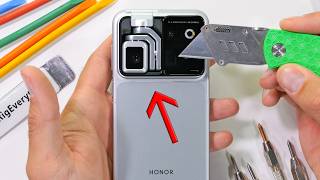
[05:05] though. Since the plastic is not brittle like glass would be, with the plastic plateau gone, we can see the CNC-milled aluminum camera lens bodies that are holding the glass lenses. To release the screen on the other side of the device, we now have to remove four
[05:19] silver decorative T3 screws, which then allow the layer of decorative plastics and the red-light recording indicator to be taken off. Then, six more black Phillips-head screws can be taken out before we can get to work on the screen. The screen also needs to
[05:37] be warmed up since it's glued in tight just like the back. This time, we do enter in from the side between the plastic edge and the metal frame. This is both easier and harder than it looks. While I work on that, I do assume that if you're interested in inexpensive,
[05:51] flagship-killing smartphones, you also might be interested in an unlimited-everything smartphone plan for just $25 a month. In an economy like this, you kind of have to look at the numbers. And today's sponsor, Tello, might be good news for your wallet. I'll explain more as
[06:06] I try to get the screen off in one piece. Tell is able to take unlocked phones like this Nothing 4a Pro and add them to the least expensive smartphone plans I've ever seen, starting at just $5 a month. Even if you want unlimited everything, it's just 25
[06:20] bucks—50 gigs of which are high-speed—and that includes 10 gigs worth of hotspotting, free Wi-Fi calling, free international calls to 60 countries, and international roaming. Getting 4 and 5G coverage without a soul-crushing price tag is rather refreshing. You can usually
[06:36] keep your own phone if it's unlocked and your same phone number when you switch over, is down in the description. Tello does have a massive deal going right now where you can
[06:48] get three months worth of unlimited for just 30 bucks. So, if you're thinking about switching, And also, thank you to myself for getting the screen off in one piece. I always like when a
[07:01] phone survives. With the back panel off, we can see the ribbon that goes to the rear LED matrix and NFC coil. There's no wireless charging, and there really isn't a reason for that circular design on the bottom corner either. I'll take out three more screws that
[07:14] hold down the silver bracket over the battery and screen ribbon cables. With that gone, I'll unplug the battery just like a little Lego. There are seven Phillips-head screws holding down the loudspeaker over the charging port board. Before it can be released completely, though,
[07:27] the battery needs to come out, which thankfully does have pull tabs that work surprisingly well. The 4a Pro phone that gets released here in the USA has 5,080 mAh worth of capacity,
[07:40] but the version that gets released in India gets an extra 6% capacity boost and sits at 5,400 because why not? Lucky them. Now we have room to remove the loudspeaker and its antenna wire. And
[07:52] I guess I could have unclipped it from this end as well. But the good news is that, even at $500, this speaker has a whole lot of balls. So far, it looks like Nothing hasn't pulled any punches. I'll unplug the optical fingerprint scanner along with the extension ribbon. And remember how I said
[08:07] earlier that it's important you use the right hole when inserting your SIM card removal tool? Well, here's why. The waterproofing mesh that keeps this phone IP65 water-resistant can be seen over the loudspeaker opening and the microphone opening. Except for this time,
[08:21] for the first time, it is right behind the hole. Meaning that if your tool goes in, the first layer of mesh will be punctured. And as you can see, the tool is indeed the right size for the hole in the frame. However, it's not the end of the world if it does get sliced,
[08:35] since Nothing does have two layers of mesh, as we'll see in a second. But making that first line of protection so vulnerable to punctures is an interesting move. For reference, every other phone we've ever seen has its main mesh off to the side of the shaft,
[08:49] like on this Samsung S24 Ultra. If we take out the charging port board on the 4a Pro, we can see the 50-watt USB-C port that can reverse-wireless charge at 7.5 watts, along with the SIM card tray slot and the rectangular microphone. And thankfully,
[09:03] we also see the other secondary moisture barrier on the side of the shaft. Backups are good, but two is always better than one. So, if you want to make sure your first layer of water protection remains intact, just make sure your tool goes in the right spot.
[09:16] Moving up to the main board, we can get a closer look at the cameras. It has two silver screws holding it in place. With the board up and out, we can see copious amounts of thermal paste as well as an extremely large vapor chamber that helps disperse heat
[09:28] out through the thin front screen. The top 8-megapixel ultrawide camera does have OIS. The main 50-megapixel camera also has optical image stabilization, but the 50-megapixel telephoto camera does not. Neither does the front-facing 32-megapixel selfie camera.
[09:44] Overall, I'm genuinely impressed with the Nothing Phone 4a Pro. It is the best-built Nothing phone ever made at a price that doesn't break the bank. And yeah, the repairability isn't all that great since you need to remove the camera plateau to get access to the screen. But as long as you
[09:58] have a case and a screen protector on, nothing should break on the Nothing in the first place. Let's see if it still works. Nothing. Hit that subscribe button if you haven't already. We are
[10:10] almost to 10 million subscribers. Thank you so much. And of course, don't forget to save some money with the Tello link in the description. And thanks a ton for watching. I'll see you around.

⚡ Saved you 0h 10m reading this? Transcribe any YouTube video for free — no signup needed.