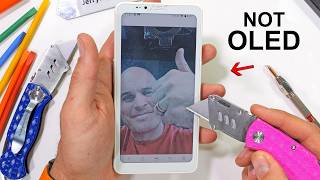

World's First Color E-Ink Smartphone!
45sThe stark visual difference between a color e-ink screen and a standard smartphone screen is immediately shocking and curiosity-piquing.
▶ Play Clip"The title is slightly exaggerated but the video does show the world is not ready for a color e-ink smartphone due to its limitations."
The video reviews the Bigme HiBreak Pro, the world's first color e-ink smartphone, comparing its display to traditional smartphones and testing its durability. The host demonstrates the unique properties of e-ink technology, including its low power consumption and pixel structure, while also highlighting the device's limitations in color vibrancy and refresh rate.
The Bigme HiBreak Pro features a color e-ink display with 150 pixels per inch, compared to 460 on an iPhone. The screen is always on and requires no power to maintain an image.
The e-ink screen refreshes at 21 Hz with noticeable ghosting. It runs full Android and can load apps like YouTube, but colors are less vibrant than LCD or OLED.
Under a microscope, red, green, and blue pigment pouches are visible. The screen retains the last image even when the battery dies.
The plastic screen scratches at level 2 with deeper grooves at level 3 on the Mohs scale. A plastic screen protector is pre-installed.
The frame is polished plastic, buttons are metal, and the back is glass. There is no water ingress protection.
Not all apps render well on e-ink. NordVPN is highlighted as a sponsor, showing how map lines appear differently on the e-ink screen.
Black and white text/images have 300 PPI, while color has 150 PPI because color pouches take up more space.
The plastic screen melts after 30 seconds of heat. The phone cracks during the bend test and becomes non-operational.
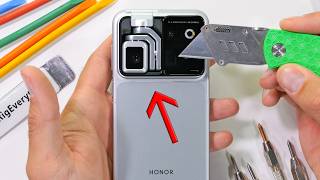
The back glass is removed with difficulty due to foaming adhesive. The display remains on even after removing the battery and motherboard.
After removing multiple layers, the colored pigment pouches are visible inside a flexible rubber membrane on top of black and white e-ink pouches.
The Bigme HiBreak Pro showcases innovative color e-ink technology but suffers from low refresh rate, ghosting, and poor durability. It may appeal to those seeking a low-distraction device, but it's not ready for mainstream use.
What is the pixel density of the Bigme HiBreak Pro color e-ink display?
150 pixels per inch for color, 300 PPI for black and white.
What is the refresh rate of the Bigme HiBreak Pro e-ink screen?
21 Hz.
01:30
At what Mohs hardness level does the plastic screen scratch?
Level 2 with deeper grooves at level 3.
03:30
What happens to the e-ink display when the battery is removed?
The last image remains displayed permanently because pixels require no power to maintain their position.
08:30
What is the battery capacity of the Bigme HiBreak Pro?
4,500 mAh.
09:00
What type of adhesive is used for the back glass?
Foaming permanent adhesive.
08:30
Does the rear camera have optical image stabilization?
No.
09:00
Screen retains image after power loss
Demonstrates the unique e-ink property where pixels stay locked without power, even after removing the battery.
02:30Phone breaks during bend test
The phone cracks catastrophically and becomes non-operational, failing the durability test.
07:30Close-up of pigment pouches
Reveals the inner structure of color e-ink pixels, showing the flexible rubber membrane and pigment pouches.
10:00[00:00] So, this is what it looks like to watch a video on the world's first color e- in smartphone. Feel free to come a little closer. It's quite a bit different than your iPhone or Android. For reference, the shirt I'm wearing is orange. This smartphone case is green. And these JerryRrier knives are blue and pink, respectively. For reference, an iPhone has about 460 colored pixels per inch, while this color e in screen only has 150. All right,
[00:25] you can back up a little bit now. This is the Big Me Highreak Pro, and there might be a little bit of foreshadowing since the word break is literally in the name, but there's only one way to find out for sure. E- in displays are fascinating, and I've been looking forward to the technology traversing over from tablets into the smartphone world for quite a long time now, and it's finally here. As you can tell, it definitely
[00:49] does not have the same vibrance or sharpness of an LCD or an OLED, but that's kind of the whole point. Right out of the box, the Big Me Hyre Pro is shipped in a clear plastic case. You might have noticed that the screen is already turned on, and it says BigMe just for you, like some kind of stone age pickup line. It's allowed to be turned on all the time because the screen's pixels require no power
[01:14] to maintain their position, like an etch sketch. And when it comes time for the pixels to switch colors, they can individually wipe themselves. Also, just like an etch sketch, this brings a different color to the surface rather quickly. E-readers have been around for about 30 years now, but the ability to have colored pixels or pixel pouches is relatively new. The Big Mi Hybreak Pro is running full Android and can load all the normal apps. As we
[01:38] open up YouTube, you can see that while other smartphones might have 60 Hz or 120 Hz refresh rates, this colored e- in refreshes at 21 hertz. But I think that with the ghosting, even that might be a little too generous. Pulling in our microscope, we can take a closer look at the pigment pouches. Remember, the color white appears in the presence of all the other colors in the visible light spectrum, which is why you can see
[02:03] a red, green, and blue portion of each pixel on the white background. If we swipe on the screen, you can see how fast the pixels change with pretty minimal ghosting all things considered. The craziest part though is that if the battery dies or the phone turns off, the last image you looked at will be on the screen forever since once the pixels flip, they don't require power to stay locked in. You'll see what I mean in
[02:27] a second. What's even more fun though is that if we zoom into the eating pixels as a video is playing, we can see that it works, but not in an overly flashy kind of way, which might be exactly what our feeble human brains need to overcome our smartphone addictions. Truth hurts. Speaking of feeble, let's get into the durability test. I'll remove the pre-installed plastic screen protector to see what the screen is actually made from. As you
[02:52] know, plastic screens would scratch at a level two with deeper grooves at a level three. And that's exactly what we see here on the Big Mi Hybrid Pro. There is a plastic laminate layer underneath the temporary plastic screen protector that is getting damaged. Plastic is totally okay, by the way. That's just what these tests are for. Now that we know, we can just keep keys and smartphones in separate pockets and it all should be just fine.
[03:17] It looks like everything is plastic, including the large bezels that surround the screen, as well as the earpiece up at the top of the phone. But luckily, the 5 megapixel front-facing camera does have a little circle of glass in front of the lens, so it won't get scratched up like everything else. And honestly, even at 5 megapixels, the front-facing camera is surprisingly good. But when we swap to the back, it's like the 20 megapixel rear camera
[03:41] got slathered in Vaseline. To be fair, though, I haven't done any software updates, so this is just what we're getting straight out of the box. Making our way to the Hybrid's body, we can see that the whole frame is made from polished plastic. The buttons are metal, including a red fingerprint scanning power button. And up at the top, we have more plastic and a red IR blaster. On the left, we have our volume rocker and a
[04:06] whole lot more plastic. At the bottom, we get our lower loudspeaker, an 18watt fast charging USBC port, as well as a metal SIM card tray, which does not have a rubber ring, nor any water ingress protection to speak of. Interestingly enough, though, there is real glass on the back. The glass does add some weight to the phone, so it does feel normal. But with plastic everywhere else, it does seem weird to randomly add some glass, especially
[04:30] since, as we know, glass is glass and glass breaks. One thing to keep in mind, though, if you plan on switching over, not all apps will behave equally on an e- in screen, especially with the lower pixel density when it comes to colors. For example, take a look at NordVPN, which is also today's sponsor. As I'm sure you already know, NordVPN allows you to be anywhere you want to in the world without ever leaving your house.
[04:55] And while the app does indeed work on the Big Mi Hybreak Pro, how it visually looks is entirely different. For example, right now the government thinks I'm in Vienna, Austria, which you can see mapped out on my Samsung, but the thin lines of the map don't quite render as well on the e- in screen. NordVPN scramles my internet traffic, so from the outside, no one can see what I'm doing or where I'm located. And with more
[05:19] than 9,300 servers in more than 211 locations, I can literally be browsing from anywhere in the world, all while securing up to 10 devices with a single account. I can even go to Mexico. I hear they're getting universal healthcare, which sounds nice. I can ask NordVPN if my text messages or screenshots look like scams, which is definitely helpful. And you can get 4 months extra with my link, nordvpn.com/jerryrig. Just like you would protect the outside of
[05:44] your phone with a case, you can protect the data inside of your phone with NordVPN. You don't got to take my word for it, though. There's a 30-day money back guarantee with the link in my description. nordvpn.com/jerryrig. Peace of mind is totally worth a few bucks a month. I've mentioned that the color resolution of this e- in display is 150 pixels per inch, and that's true. However, when it comes to the black and white images or
[06:08] text, it doubles to 300 pixels per inch, almost on par with the resolution of a regular smartphone. These colored pouches just take up more space than the black and white pouches do. And we can see that the plastic screen lasts for about 30 seconds before going white and melting that top plastic layer a bit. Now, the bin test. Will the Highreak Pro break? Wait, sorry. I just discovered more images here. stock images, of course, pre-loaded onto
[06:33] the phone, probably to show off the colored e- in. I should have checked for these earlier. However, it's looking a little too much like Elon's Twitter feed in here for my taste. So, let's go back to the bending. With a bin from the front, we hear a cataclysmic crack. However, nothing visually appears to be damaged. No cracks or kinks, except for that the phone is now not operational anymore. So, something has definitely failed on the inside.
[06:58] And the Hyere Pro is officially highly broken. It has failed my durability test. But on the bright side, now we get a tour of its insides, as well as we get to see how the pouches of pigmented pixels come together underneath that plastic screen. Removing the back glass is rather difficult. Instead of the normal watertight adhesive we see on Samsung's or iPhones, Bigme is using a foaming permanent adhesive, which makes repairability quite a bit more messy.
[07:22] But with enough of the shards removed, we can unscrew about 15 Phillips head screws. And this allows the back plastic to pull away from the screen and motherboard portion of the phone. I'll unplug the large battery, the extension ribbon, and display ribbon. And surprisingly, just like I told you earlier, the screen is still on. Dead to be sure, but the last thing we looked at is still permanently displayed. Watch. I'll completely remove the battery, all 4,500
[07:47] mAh of it, so we can be sure there is zero power to the display. I'll even remove the motherboard with its thermal foam and demenity 1080 octaore processor. The rear 20 megapixel camera does not have optical image stabilization. And the lower rear mono speaker does not have any balls inside either. The 18 watt charging board does have a red rubber ring around the opening, but even with all of the hardware removed, the display remains displaying its
[08:11] colored e- in pixels in the exact position they were left before the power went out. Let's dig them out. Apparently, the plastic layer we melted earlier is a permanent laminate layer over a slab of glass, similar to how some of the ultra rugged phones are manufactured. And surprisingly, even if we remove this glass, the pixels are still intact. Thumbs up for that. At this point, we've removed two plastic layers and cracked off a glass layer, and
[08:36] the pixels are still doing work. Kind of cool. It's only after we remove one more plastic layer that we're able to get a look at the colored pouches. These are inside a flexible rubber membrane which sits on top of the normal black and white e- in pouches. These can now be disturbed since they are unprotected. Pretty crazy and it's amazing to see how it all works from the inside. Would you ever rock an e- in smartphone?
[09:00] Let me know down in the comments and hit that subscribe button. We are so close to 10 million. Thanks a ton for watching. I'll see you around.
⚡ Saved you 0h 09m reading this? Transcribe any YouTube video for free — no signup needed.