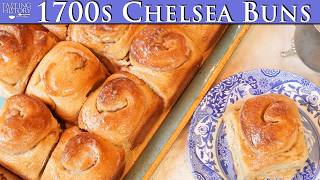

The Impossible Chelsea Bun Recipe
59sThe host's dramatic realization that the original recipe is lost and mysterious sparks curiosity and challenge.
▶ Play Clip"The title promises recreated lost buns, and while a version is made, the creator admits the true original can't be recovered."
In 18th century London, the Chelsea Bun House was famous for its buns, but the recipe was never shared and lost when it closed in 1839. This video attempts to recreate the original Chelsea bun using historical descriptions and an 1884 recipe, despite the many unknowns.
The video sets out to recreate the original Chelsea bun from 18th century London, a seemingly simple task that becomes a deep mystery.
The original Chelsea Bun House never shared its recipe, and after 150 years in business, it closed in 1839. No one successfully imitated the buns.
The creator uses an 1884 recipe claiming to be the old style, along with descriptions from 1880, to approximate the original bun.
Old descriptions say the buns were square, rich with butter and eggs, flavored with sugar, lemon, and spice, but without fruit.
On Good Friday, thousands would gather at the Bun House, leading to massive crowds and eventually police intervention.
After the last Hand family owner died, the business closed and was torn down in 1839. The recipe was lost forever.
The attempt to recreate the original Chelsea bun yields a delicious, buttery, and spiced bun, but the true original remains lost to history. The video highlights the challenge of recreating a recipe when so many variables are unknown.
When did the original Chelsea Bun House close?
1839
00:59
What shape were the original Chelsea buns?
Square
02:33
Did the original Chelsea buns contain fruit?
No, they were without fruit
02:45
Who was the owner of the Bun House known as 'Captain Bun'?
Mr. Richard Hand
09:54
Which king frequented the Chelsea Bun House?
King George II
09:41
What famous artist designed the Bun House's business card?
William Hogarth
10:19
On what day did huge mobs gather at the Bun House?
Good Friday
11:33
Approximately how many people were in the Good Friday crowd one year?
50,000
12:11
What did Mrs. Hand announce in 1793 regarding Good Friday?
That she would not sell cross buns on Good Friday that year
12:31
What book inspired this episode?
Insatiable Appetite by Peter Ross
06:35
The Mystery of the Lost Recipe
The core challenge of the video: the original recipe was never written down, making recreation nearly impossible.
00:30Royal Patronage
King George II and his family were regular customers, showing the bun's high status.
09:41Good Friday Mob Scenes
The immense popularity led to dangerous crowds and police intervention, a fascinating slice of social history.
11:33The End of an Era
The Bun House closed in 1839 after the last Hand died, marking the loss of the original recipe.
17:13Taste Verdict
The creator declares this may be his favorite recipe ever on the channel, validating the historical approximation.
20:10[00:00] In Georgian London, crowds would fill the streets of Chelsea in the hopes that they could get their hands on some hot buns fresh out of the oven from the Chelsea Bun House. Now, these Chelsea buns are still made today, but the recipe is very different than it used to be.
[00:14] So, I am going to try to recreate what the original Chelsea bun of 18th century London was like. So, thank you to my Patreon patrons for their continued support of this channel as I try to recreate the original Chelsea bun, this time on Tasting History.
[00:30] So when I decided to make this video, I thought it was going to be a breeze. I was going to find an old recipe and recreate it like I do every week here on the channel. Simple as that.
[00:42] I was cocky. I was a fool. A fool, I tell you, because it turns out that this little bun is actually one of the most mysterious baked goods I have ever come up against. The original Chelsea Bun House, which was at its peak of popularity in the mid-18th century, closed in 1839.
[00:59] 1939. And then they were approximately 150 years in business. They never shared the recipe, which they were so famous for. Even while it was still in business, other bakeries would try to come
[01:11] around and recreate their buns. But it is singular that their delicate flavor, lightness, and richness have never been successfully imitated. And those unsuccessful imitators had the actual bun that
[01:23] they could go taste to compare it. I don't have that. So what hope have I? None, it turns out, I think. I think that there are just too many unknowns to truly recreate the original bun.
[01:37] However, I'm going to still try to do it because there are descriptions from just after they closed and even some recipes in the next few decades that give us some insight into what that original bun
[01:50] might have been. Now, one issue with these old recipes is that none of them actually agree. It's not like the recipe started to appear and was like, oh, well, that's it, because all of them are ever so slightly different. So, I'm going to take from a few of them and kind of mash them
[02:05] together, but most of it is based off of an 1884 recipe, which claims to be the old style of Chelsea bun, and it's filled with butter and sugar, milk and egg, and then describes the shape of the bun,
[02:18] which is a square swirl shape, which is rather iconic for the bun today. It says, And this jives with a description from 1880 that was written by someone who had talked to people
[02:33] who had actually tried the original bun. He said that old people say they were very rich and seemed full of butter. They were square in form and were made with eggs, with the kind of sugar, lemon, and spice, but without fruit.
[02:45] Today, they are almost always made with fruit, but all the old descriptions say no fruit. So, for this mash-up recipe, what you'll need is 4 cups or 500 grams of bread flour,
[02:57] then 2 1⁄4 teaspoon or 7 grams of dry yeast, 2⁄3 cup or 150 milliliters of warm milk, a half cup or 115 grams of salted butter, softened, and if you're going to use unsalted butter, I'd add about 3⁄4 of a teaspoon of salt,
[03:10] Then a heaping half cup or 115 grams of sugar plus a teaspoon for getting the yeast started. And you'll need even more sugar for the filling, but we'll get to that later. Then one and a half teaspoon cinnamon, three quarters teaspoon nutmeg, three quarters of a teaspoon of ginger,
[03:22] a half teaspoon coriander, the zest of one lemon, and three eggs plus another egg for the egg wash. So start by proofing the yeast. Just add a teaspoon of sugar and the yeast to the warm milk, give it a good stir, and then let it sit for about 10 minutes.
[03:36] And while it does its thing, you can whisk together the spices, the cinnamon, the nutmeg, ginger, and coriander, and then whisk those into the flour. Then do the same with the lemon zest, as well as the sugar. And once all of the dry ingredients are mixed together, you can add in the yeast mixture and work it in.
[03:53] Then add the eggs. Now at this point, the dough might seem a little too dry. You will be tempted to add in more liquid. do not do that because once we add the butter it will be plenty liquid enough and will actually be
[04:06] very sticky. So start by mixing the dough without the butter either by hand or if you have one in a stand mixer and after a minute or so start adding in the butter just one tablespoon at a time. Now once all the butter has been added the dough will be quite sticky so let it mix for another
[04:21] five minutes before you determine if you need to add a little bit more flour or not. Eventually it should come together enough that you can dump it out onto a floured surface and finish the kneading. You do want to knead it by hand just for another minute or so, just to make sure that it's nice
[04:35] and smooth. And set it in a bowl and cover with plastic wrap or a wet towel to rise. Now with all that egg and butter and milk, it is going to make the rise slower, so it actually took me in a warm place two hours to double in size. But once it has risen, then punch out all the air and set it on
[04:51] the counter and either use a rolling pin or your hands and roll the dough out into a rectangle trying to make the sides and corners as even as possible. It should end up being about 18 inches or 45 centimeters wide. Now today the Chelsea buns usually have a mixture of different spices and
[05:08] melted butter and more sugar, very often brown sugar, as well as currants or different candies kind of candied fruits on the inside. None of the old recipes have that. Really I don't start
[05:20] seeing that until the middle of the 20th century. Most of the old recipes actually say nothing You just roll it up Part of the problem with that is that then you lose the swirl because all the dough just kind of melds together
[05:36] So I did find some recipes that have you sprinkle sugar on it, and that's what I'm going to do. So once you've sprinkled about two tablespoons of sugar all over the dough, you can roll it up lengthwise. And this should make about 12 big buns.
[05:50] So divide the dough into 12 pieces, making them as equal as possible. Then take a 9 by 13 inch cake pan and line it with some parchment and set the buns in, making sure to leave space between them as they will grow into each other while they rise and bake.
[06:04] Then cover this and let it rise for yet another hour. Once they've risen, brush them with an egg wash using that last egg and give it another sprinkle of sugar and then set the pan in the oven at 375 degrees Fahrenheit, 190 Celsius and bake for about 20 minutes.
[06:20] Now, I wanted to take this opportunity to say that I was inspired to make this episode by reading this really awesome book called Insatiable Appetite by Peter Ross. It is all about food in Georgian London.
[06:35] I actually already gushed about it in the Tasting History newsletter for June. So I'll put a link in the description to where you can check that out, as well as to where you can sign up for the Tasting History newsletter, where every month I will send you a little tidbit of history like the one I'm about to tell you right now.
[06:54] Georgian England was a bun lover's paradise. It seems that every corner of Britain had their own special bun. Heck, in London, practically every neighborhood had their own bun recipe.
[07:06] Dozens, if not hundreds, of different sweet buns were to be had by all members of society, or at least those who could pony up a penny for the privilege. Now, most of the buns of this era have been lost to history.
[07:18] We don't really know what they were, but a few have survived. In fact, one of the very first episodes that I did on this channel was on the Sally Lunn bun, which is still served today and is absolutely delicious.
[07:30] I also did the bath bun that was so beloved by Jane Austen. So I guess this Chelsea bun is kind of the third installment of a bun trilogy. Now, the Chelsea Bun, unsurprisingly, gets its name from Chelsea in London, which is an area in West London.
[07:46] But it was specifically made at the Chelsea Bun House, also known as the Royal Bun House. Now, exactly when this establishment opened is up for debate, but most people place it in the last decade of the 17th century.
[07:58] And their buns were already quite famous by the early 18th century. In 1711, the Irish author Jonathan Swift wrote a letter to a friend saying, A fine day, but begins to grow a little warm, and that makes your little fat presto sweat in the forehead.
[08:14] Pray, are not the fine buns sold here in our town? Was it not the rare Chelsea buns? I bought one today in my walk. It cost me a penny. It was stale, and I did not like it. So that quote comes from a series of letters that he wrote to a woman named Stella, though her real name was Esther Johnson.
[08:31] And some of the letters were actually addressed to her companion, Rebecca Dingley, even though it was very clear that the letters were meant for Esther. Now, the exact reason for this is unknown, but one of Swift's friends, after Swift had died,
[08:45] said that it was because Jonathan Swift and Esther were secretly married, and that would have caused an absolute scandal. I don't exactly know why, but it would have. And so it needed to look like they weren't that close,
[08:59] so he would write the letters sometimes to her companion, knowing that they would get to her. Anyway, I just love 18th century scandal. Now, in the 19th century, there were several magazines that commented on the fact that Jonathan Swift did not like his Chelsea Buns,
[09:14] because everyone liked Chelsea Buns. And the reason was probably because it was stale. For to be good, it should be made with a good deal of butter, be very light, and at hot. Another writer postulated that the bun was actually given to him on purpose.
[09:28] A stale bun, because the proprietor probably heard Jonathan Swift's Irish accent and was like, you get a stale bun. Now, there's no way to prove that, but it seems absolutely plausible.
[09:41] Who did not get a stale bun, I promise you that, was King George II. Yes, sometime after ascending the throne in 1727, King George, who had a heavy German accent, was said to frequent the bun house,
[09:54] which was owned by a Mr. Richard Hand, known to most as Captain Bun. Even in 1718, before George became king, Richard Hand's business card stated that they were the oldest original Chelsea von Baker,
[10:07] who has the honor to serve the royal family. What I find frankly remarkable about this business card is actually down at the very, very bottom. It seems that it was designed by William Hogarth,
[10:19] who would later become one of the greatest artists and engravers in British history. I have used his art many, many times on the channel. He's one of my favorites. but it turns out that he cut his teeth making business cards and signs for bookstores.
[10:34] I guess everybody has to start somewhere. Anyway, George II, his wife Queen Caroline and their daughters were regulars at the Bun House as were the family of his grandson, King George III. In fact, his queen, Queen Charlotte, that's the queen from Bridgerton,
[10:47] gave the then owner of the Bun House, a missus hand, a silver cup that was filled with five guineas which would be about today So quite a tip for enjoying some buns Now the Bun House a famous image of which was also created by William Hogarth though well after he become famous
[11:05] was a one-story building in the area of the Ranelagh Pleasure Gardens. This was a massive entertainment venue for London's elite and gave the Bun House a constant stream of well-to-do patrons. Now, the inside of the house was known for being chock-full of antiques,
[11:19] paintings, and other curiosities, so that it had the air of a museum, A perfect spot to sit down and have a nice relaxing time while eating your bun. Unless, of course, it was Good Friday. Because on Good Friday, the bun house was lit.
[11:33] See, Good Friday was the day for bun lovers across London. Because London was awash in peddlers selling hot cross buns. But it wasn't just cross buns, because Chelsea buns were also on the menu.
[11:48] The Chelsea Bun House sold both every Good Friday, and there would be crowds outside of the Bun House at 4 a.m., and those crowds kept getting bigger and bigger and rowdier and rowdier until the streets were impassable.
[12:03] Sometimes there would be thousands of people out there. It was said that one year there were 50,000 people on the streets of Chelsea all waiting to get a bun, so they would often close the doors and just sell them out of a window.
[12:17] Now, in 1792, the mob was so great that the following year, Mrs. Hand just, she had to put a stop to it, and so on Ash Wednesday, she released a notice saying,
[12:31] Royal Bun House, Chelsea, Good Friday, no cross buns. Mrs. Hand respectfully informed her friends and the public that in consequence of the great concourse of people which assembled before her house
[12:43] at a very early hour on the morning of Good Friday last, by which her neighbors have been much alarmed and annoyed, she was determined, though much to her loss, not to sell cross buns on that day to any person whatever,
[12:57] but Chelsea buns as usual. But as it turns out, it wasn't the cross buns that did it, but just buns themselves. People kept coming. The mobs kept coming. In 1796, police had to be brought in to arrest people for their conduct,
[13:14] and the neighbors would get so mad that they would start throwing trash and dead animals at the mob just hoping that they would leave, but they wouldn't leave. The mob just kept growing every single year and it went into the 19th century.
[13:31] As late as 1828, newspapers described the scene on the most solemn and sacred of all the days in the Christian's year. We mean Good Friday. There has prevailed such a scene of drunkenness, uproar, and riot
[13:46] that it is a perfect scandal and shame to the parish and to the age. We have seen on that sacred day groups of besotted creatures, almost dead drunks, taggering along Grovesner Place,
[14:00] and this before ten o'clock in the morning. I think my favorite newspaper clipping that I came across that had to do with these Good Friday bun enthusiast mobs was actually somebody who had read the newspaper the day before,
[14:15] and the newspaper had talked about the mob and said that it was in St. Luke's Parish, Chelsea, and the person said, no, that's not correct. And just like today where people comment on things,
[14:27] this person just loved correcting them. To the editor of the New Times. Sir, as an inhabitant of Chelsea, I am anxious to set you right with respect to the statement which appeared in your paper of yesterday.
[14:42] I wish to inform you that the Bun House does not stand in the parish of St. Luke Chelsea, but in that of St. George. And further, that the respectable inhabitants of Chelsea have done all they can to put a stop to these abominable proceedings,
[14:56] but, as you are aware, have no power out of their own parish. I do not mean to say that the magistrates of either parish could not effect this, if they thought proper, but I do mean to say that they are very lukewarm in their business,
[15:11] at least the Chelsea magistrates. I have the honor to be, sir, your most obedient servant and old parishioner. I don't know if you know the Nextdoor app, but if you ever read it, it's just filled with things like that, but not nearly as well written.
[15:27] Anyway, even if the police were unwilling to stop the mobs outside the Chelsea Bun House, Oh, capitalism was willing to stop the mobs because, while Good Friday remained a very good business day,
[15:42] the other 364 days of the year did not. First, in 1803, the nearby Pleasure Gardens, which many of the Bunn houses' more well-to-do customers frequented, closed. And from there, while it was still popular, the Bunn house's business slowly declined.
[15:56] And now, by this time, the house was run by one of the sons of the missus' hand, who had kind of shepherded the place through its glory days. And he was an eccentric character who dealt also largely in butter,
[16:11] which he carried round to his customers in a basket on his head. Hot or cold, wet or dry, throughout the year, the punctual butter man made his appearance at the door and gained the esteem of everyone by his cheerful aspect and entertaining conversation.
[16:24] A charming fellow but it seems that butter delivery was propping up the old Chelsea Bun business by this time Now in 1821 he died and left the business to his older brother
[16:36] Also, side note, the younger brother's name was Gideon Richard Hand. The older brother's name was Richard Gideon Hand. I'm guessing that the mom was just too busy running a business to give her children unique names.
[16:52] Now, Richard was a military man, a former military man, and was at that time one of the poor knights of Windsor. And so he'd never found time to marry and have children. So when he died at the age of 84 in 1836, there were no more hands to leave the business to.
[17:13] And so it was actually taken over by the crown. And then in 1839, the business was shuttered and the old bun house was torn down. Now, it tried to make a comeback under different owners in a different location, but in the words of one paper, the olden charm of the place had fled.
[17:31] The old Chelsea Bun House was gone, and while other bun houses sold their version of the Chelsea Bun, it was not the same. First off, the recipe clearly had been lost to time, because even by the 1850s, when recipes were being written, none of them can agree on what a Chelsea Bun was.
[17:48] and they just kept changing, and then by around the early 20th century, you start to see the version that you would find in modern British bakeries today, with currants and brown sugar and sometimes cinnamon and other things like that kind of swirled into it.
[18:05] But should you want to try the original Chelsea bun, the bun that London mobs went mad over, well, then you'll have to make them yourself, or hurry up and come on over to my house
[18:18] and hopefully try one before I eat them all because they smell delightful. So after the buns are fully baked, you'll want to pour a glaze over them. Now, some of the old recipes call for just melted butter.
[18:30] Some are melted butter and powdered sugar, which kind of creates a mess. But there are others that say milk and powdered sugar, and that's what I did. It was a third cup with 75 milliliters of milk whisked into one cup or 120 grams of powdered sugar.
[18:45] You brush this over the buns, or just pour it all over them, and then serve them up hot. And here we are. My approximation of the original Chelsea bun of 18th century London.
[18:57] It smells so good. The spice is there. You know, it's not in the swirl. It's actually in the dough, but you can really smell it. Also, the glaze just gives it this nice kind of sheen on the top.
[19:10] Give it a go. so soft
[19:30] I'm so sorry usually I take one bite and then tell you what I think but I'll put straight for another bite it is so soft and buttery it does match the
[19:44] original descriptions. Soft, buttery, lemony, just a little bit. It's not lemony, but it is there. And then spiced. The spices are all there, but again, since they're in the
[19:57] dough, they actually give the dough some color. And it is sweet without being cloying at all. It's not like a cinnamon bun, which I do love a cinnamon bun, but it's not like that at
[20:10] all. Nowhere near as sweet. I often get asked, one second, I often get asked what my favorite recipe that I've ever done on a channel is, and I have trouble answering. This may be
[20:28] it. This may be it. This is so good. Remember when I said you'd have to rush on over here before I eat them all, you're going to have to get here pretty quick because I have 12 of them.
[20:41] I think by tomorrow, they'll all be gone. Also, something I found really, really interesting while researching this, I was looking for old recipes, and I tried to stick to the 19th century,
[20:53] but I ended up moving into the 20th century, and I'm so glad that I did because I found one. The recipe itself, not interesting, but just below it, on the newspaper page, is an advertisement for the new White Star Line steamer Titanic.
[21:09] It tells the fact that people will be able to take their meals in the open air, first class, of course, and that if you have the money, and it is a lot of money, you'll actually have a private promenade so that other passengers can't look at you. It was just cool to see that before it sank.
[21:24] You know, most of the stuff in the newspapers was after it sank. This is before it sank. I thought that was really cool. Anyway, you've got to make these. You've just got to make these. There is no way that you can't. If you don't bake, start, because these are so worth it.
[21:37] Seriously, I'm not going to eat all 12. I'm going to take some maybe to my neighbors. I usually don't do that, but they're so good. If I don't, I will eat them all, and I will see you next time with Tasting History. Hmm.
⚡ Saved you 0h 22m reading this? Transcribe any YouTube video for free — no signup needed.