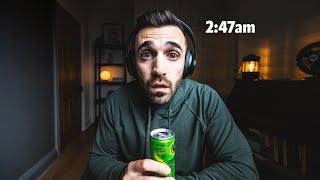

The 5 AM Routine Myth
60sChallenges the popular morning routine trend by questioning its universal validity with examples of successful early risers.
▶ Play Clip"The title accurately describes the swap experiment, but the sponsor segment and some fluff lower the density of actionable insights."
Two online creators with opposite sleep chronotypes swap routines for a week to explore whether morning or night productivity is superior. The experiment reveals the role of genetics, procrastination, and societal bias in shaping our daily schedules.
Sara is a night owl (bed ~2-3 AM); Matt is a morning person. They swap schedules for a week to test if one routine is inherently better.
Sleep researcher Matthew Walker explains that chronotypes (morning vs. evening preference) are genetically determined by at least 22 genes, with roughly a third of the population being morning types, a third evening types, and a third in between.
Since the invention of electricity, it's harder to identify your natural chronotype because artificial light disrupts the body's sleep-wake cycle.
The best way to determine your chronotype is to sleep and wake without an alarm when not under pressure, noting your natural sleep-wake pattern.
Winston Churchill and Barack Obama were known night owls, working late into the night and keeping mornings free, proving that evening types can be highly successful.
Biology researcher Christoph Randler notes that early risers have an advantage in careers and education because society (schools, work hours) is structured around morning schedules.
Matthew Walker argues that society deliberately discourages sleep because a sleeping person neither produces nor consumes, which conflicts with capitalist values.
After the experiment, Sara initially reverted to her 2 AM nights but later stuck with waking naturally at 8:30 AM, showing that gradual change is possible.
The swap showed that extreme shifts are unsustainable, but paying attention to your body's signals and adapting your schedule to your natural chronotype (rather than forcing a 'perfect' morning routine) leads to better productivity and well-being.
What percentage of the population has a morning chronotype?
Approximately one third.
05:04
How many genes are linked to determining your chronotype?
At least 22 different genes.
05:20
Who is the sleep researcher that emphasizes sleep timing based on chronotypes?
Matthew Walker.
04:50
Which two world leaders were mentioned as night owls?
Winston Churchill and Barack Obama.
06:48
According to Matthew Walker, why does society discourage sleep?
Because from a capitalist viewpoint, sleeping people neither produce nor consume.
10:23
What is the best way to figure out your natural chronotype?
Sleep and wake without an alarm when not under time pressure.
06:17
Which researcher noted that early risers have advantages in careers and education?
Christoph Randler.
10:09
Chronotypes Are Genetic
Cements that morning preference is not purely a matter of willpower but has a biological basis.
05:04Societal Bias Against Night Owls
Explains why many night owls feel pressured to conform to morning schedules despite their natural rhythm.
10:23Successful Night Owls
Provides examples that defy the stereotype that success requires early rising.
06:48Slow Adaptation Works
Shows that even a confirmed night owl can shift routine gradually if motivated.
13:29[00:00] And that's Sara, and she's a night owl. (upbeat music) we wanna see if there's anything we can learn
[00:14] waking up before sunrise? (birds chirping) - Are we more creative working late into the night? Is there something that we can all learn
[00:26] that we'll become happy and successful? This video is sponsored by Squarespace, more on them later. (upbeat music) (bed sheet rustles)
[00:40] It's actually just wild seeing you here. 'Cause that's what Andrew Huberman says. (door clicks)
[00:54] What did I say? - I said no cameras in the morning. (comforter rustling)
[01:07] when it comes to our routines. - Everything is unstructured. This past week was pretty bad.
[01:21] That was pretty bad. (laughs) we've both found some success as online creators to the point of swapping routines.
[01:34] to help minimize the extreme shifts in her schedule. with the flow is just a very difficult thing for me to do. at work at 12:00 PM, what's the point?
[01:48] And I think especially as I go into this phase of having a child, I think my schedule is gonna be - And so this might allow me to build some resiliency,
[02:00] When you look at the conversation online it's hard not to think that there's a right way to do it. with people sharing their morning rituals and routines.
[02:15] Tim Cook wakes up at 4:30 AM and so does Jocko Willink. - Bill Gates gets up at 5:00 AM along with Richard Branson. People share their exact recipe for doing it right.
[02:31] with a splash of lemon juice, And crush a 60 minute hit workout, Whether or not people do these routines
[02:44] What is clear though, is that our obsession But is this a universal truth for everyone? if we could just find the willpower to plow
[03:00] - Okay, so I just got done working out Oh, my God. Hey. Anyways, so I just got back from my workout
[03:12] about waking up early is I actually have a chunk On a normal day, when I wake up at 10:00 AM, I really don't get anything done.
[03:26] have some coffee, scroll on Twitter, to do creative work when today, during the day, the sun was up.
[03:40] and hopefully not go to bed at 3:00 AM tonight. (crickets chirping) I'm going to bed before midnight for the first time.
[03:55] I think I'll be able to wake up at 7:00 AM on day two. - Hey, if you like this video, You won't regret it. I promise.
[04:09] (suspenseful music) that I'm being incredibly unproductive I mean, for the past 10 years,
[04:21] getting my most important things done first thing. trying to figure out how to make this all work. At this point, it's 12:47 AM
[04:36] and I keep rereading the same emails (laughs) (table thuds) So I'm struggling. about the science of sleep and daily routines.
[04:50] should be waking up should really be based Sleep researcher, Matthew Walker, has emphasized for sleep timing, which are known as chronotypes.
[05:04] It's about a third, third split across the population. You know, this notion of these go-getter type A's
[05:16] You go to the gym, you blast out a workout for an hour, You have no choice if you're an evening type, at least 22 different genes that dictate what you are.
[05:33] - Since the invention of electricity it's harder to know what our chronotype actually is. on morning routines?
[05:46] because we've been putting off that important project. without even realizing it. to procrastination because there's always more time
[06:01] I can always work until two, 3:00 AM where I won't work past five or I won't work past six. strongly influenced by procrastination.
[06:17] to begin working? is just at the door and it's like I have to get it done - The best way to figure out your own chronotype
[06:33] This is probably best done when you're not under pressure with an alarm clock. You don't have to look far to find examples
[06:48] Winston Churchill was notorious for working late is known for being a night owl, a late night work schedule, keeping his mornings free
[07:01] The night owl life has clearly worked for world leaders I mean, that's the real question. into my work, but since I'm a night owl now
[07:15] Not really sure what to do, I got some advice from Sara. I'm kind of a sloth. Like I'll get my yogurt parfait and my coffee,
[07:31] And I ease into the day. There is no hit the ground running. (upbeat music)
[07:44] - This is the most ridiculous show I've ever seen. (laughs) I'm gonna be reading more, going to the gym, making my smoothies meal, prepping everything that I can do
[07:57] and I'm not just making my entire day about work. (upbeat music) Yes.
[08:13] I woke up at 7:00 AM. Having that chunk of time, you know, in between 7:00 AM and go do things.
[08:27] (yawns) Okay, let's keep doing this. of work that I would typically do in the in a day, Natalie's been asleep for a little while
[08:43] so I can kind of get into that flow state. late into the night are updates to my website. for this week's video, Squarespace.
[08:58] for the past decade for three main reasons. and making changes to my website Changing my bio is easy as
[09:13] (mouse clicking). (mouse clicking). From there, you can buy your new domain name,
[09:27] That means that if you're an aspiring creator or a programmer to get started. Visit squarespace.com today for a free trial
[09:43] go to squarespace.com/mattdavella It's easy as... this video, you're helping to support the content
[09:56] And so if you're ready to make a website, do me a favor, Regardless of when you naturally wake up, that advantages early risers.
[10:09] for people who wake up early And that means that morning people According to researcher and biologists, Christoph Randler,
[10:23] which gets them into better colleges, And that's why sleep researchers like Matthew Walker with how employees and students work best.
[10:38] that society does not want you sleeping. Because what society wants from a capitalistic point of view is that you are either producing or you are consuming.
[10:51] and you're neither consuming. And so there are lots of ways that I think society and the modern world has conspired willfully or not,
[11:06] to decrease and try to diminish sleep. of the extreme wasn't gonna work for either Sara or myself.
[11:20] Almost 1:00 AM. I am so done with this. I can't wait to get back to my structure and my routine Everything that I had to sacrifice and give up
[11:33] staying in the flow state a little bit longer (screen whooshes) - So, my hope for the outcome There's no way I'm gonna normally wake up
[11:47] at 8:00 AM every morning. and that's because we have very different personalities in the years to come.
[12:01] and so I feel like I'm gonna need to adopt In a lot of ways, this was just a trial run for me. that have been eating into her sleep
[12:16] - I started off actually very optimistic, No, the thing that I do take from this experience and lunch is actually a really great time to be productive,
[12:34] about what works for each of us. has helped me switch off from work later in the day. in her life.
[12:48] is I was doing that productive procrastination. what's this final cut thing about? And so a lot of my passions were formed
[13:02] not wanting to do things. that have now informed my life today. and I just got an update from Sara here.
[13:16] She messaged me saying that she literally went right back to her 2:00 AM nights the day after the experiment. I'm gonna work on it.
[13:29] - But she decided to stick with it and said naturally at 8:30 AM. in real change, which is pretty cool.
[13:46] One, pay attention to the signals and work schedules. Thanks for watching. (screen clicks)

⚡ Saved you 0h 13m reading this? Transcribe any YouTube video for free — no signup needed.