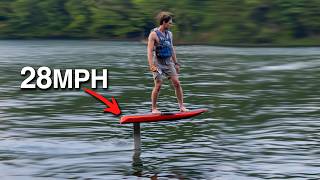

The $9,600 Flying Surfboard
60sHigh curiosity factor about an expensive and unique product, perfect for hooking viewers.
▶ Play Clip"Delivers exactly what the title promises: a detailed, honest review of a flying surfboard with practical insights."
The video reviews the SeaFlyer Stellar S electric hydrofoil surfboard, a $9,400 device that lets riders fly above the water using an electric motor and underwater wings. The creator shares his experience learning to ride, the five-step learning process, performance details, safety considerations, and practical pros and cons.
The device is a surfboard with an electric motor and wing underneath, allowing flight above water. It's described as the coolest tech tested this summer, combining quiet kayaking with thrill of water sports.
Unlike skiing or wake surfing, you can ride alone without a boat or others. Works on calm or choppy water, alone or with friends.
It's not a pump-powered hydrofoil; it has a propeller, motor, and two underwater wings. A large battery inside the board allows several hours of riding. Foiling occurs when speed creates lift from the wings.
The creator was foiling within 15 minutes, aided by surfing experience. Most people can learn in 30 minutes to an hour using a five-step process.
Step 1: Start on knees at low speed, lean to steer. Step 2: Go on all fours, get used to balance. Step 3: Increase speed and plane on the board. Step 4: From knees, lean back to lift off, then shift weight forward to land. Step 5: Stand up and practice foiling.
Despite the complexity, it's extremely fun. Even just level one is enjoyable.
Top speed is about 28 mph for experts; comfortable cruising is around 15 mph. The remote has gears (1-6) controlling speed; gear 6 is needed to lift off.
Ride time up to 120 minutes, depending on speed and riding style. Battery recharges in about 2.5 hours. Real-world use: over 1 hour to 1.5 hours.
Similar to surfing but requires focus and balance. Flying above water makes you immune to waves; you can ride low or high, with some wobble at high heights.
The propeller stops when you release the trigger. When falling, jump away from the board. The propeller is behind the wings, so it's hard to hit. The biggest risk is hitting the sharp wings, so wearing a life jacket is advised.
In the 1970s, the US Navy used similar technology for the Pegasus class hydrofoil ship, the fastest surface combat ship ever made by the US Navy.
The board is all carbon construction, with a battery inside. It has a stem separating wings from the board by 2-3 ft. The board is 5'4" and comes in three colors. It connects to the C-Fly app for battery monitoring and has safety features.
As battery drains, you need higher gears to maintain speed, reducing top speed. Price is high: $9,400 for this setup, $6,000 for foam tops. However, prices are coming down from $12-15k a few years ago.
Most fun thing on the lake, even compared to jet skis. Offers progression for beginners and experts. Battery life of 2 hours is long, and battery is swappable. It's silent, can be ridden alone, and is a new niche with less regulation.
The SeaFlyer Stellar S efoil is an exhilarating and innovative water toy that delivers on its promise of flying above the water, with a manageable learning curve and impressive performance. Despite the high price and some practical downsides, it offers a unique and enjoyable experience that stands out in the water sports market.
What is an efoil?
A surfboard with an electric motor and underwater wings that allows the rider to fly above the water.
00:06
How long does it take to learn to ride an efoil?
Most people can learn in 30 minutes to an hour; the creator learned in 15 minutes with surfing experience.
01:24
What is the top speed of the SeaFlyer Stellar S?
About 28 mph for experts; comfortable cruising is around 15 mph.
03:22
How long does the battery last and how long does it take to recharge?
Up to 120 minutes of ride time, with a recharge time of about 2.5 hours.
04:14
What is the biggest safety risk when riding an efoil?
Hitting the sharp wings, not the propeller, which is behind the wings and stops when you release the trigger.
05:35
What historical ship used similar hydrofoil technology?
The Pegasus class hydrofoil ship used by the US Navy in the 1970s.
06:54
What is the price of the SeaFlyer Stellar S?
$9,400 for the carbon model; foam models are $6,000.
10:46
Efoil as a unique water sport
Introduces a novel device that combines quiet kayaking with the thrill of water sports, appealing to adventure seekers.
00:06Learning curve is manageable
Demonstrates that with a structured process, beginners can learn to foil quickly, making the sport accessible.
01:24Speed and gear system
Provides concrete performance metrics (28 mph top speed) and explains the gear system, helping potential buyers understand capabilities.
03:22Safety considerations
Highlights the importance of safety gear and understanding crash dynamics, which is crucial for new riders.
05:35Historical precedent
Connects modern efoils to naval technology, showing the evolution of hydrofoil technology.
06:54[00:06] asking, "What is that?" And basically, it's a surfboard with an electric motor and a wing underneath. It lets you fly above the water and and it's completely few months now, and this is the absolute coolest piece of tech I've tested this
[00:19] summer. Riding on just calm, glassy water like at sunrise, it's honestly the with boats and motors and and water sports, and this is just an incredible combination of the quiet peacefulness of kayaking combined with the thrill of
[00:34] best part is, unlike skiing or wake surfing, you can do this alone without around. You can ride on calm water, choppy water. You can ride alone, you can ride with friends. This just such a cool thing to have. So, how does this
[00:47] question people were asking when I showed them this was, "Oh, is that one of those things you have to pump your legs to go?" No, you don't. What you're thinking of if you thought of that was a regular hydrofoil. So, this is like a
[00:59] propeller, it has a motor, it has a underwater, you got these two little wings there. Behind them, you've got a propeller, and you have a motor. Inside the board on the top, you have a pretty
[01:11] large battery. You can ride this for several hours. And foiling or flying happens when you go fast enough and the wings underwater create enough lift to you're going too slow, instead you rely on the buoyancy of the board. So, to
[01:24] little trigger on there. Trigger just means go, basically. I'll explain the speeds in a minute, but learning this was surprisingly easy. I was foiling within just 15 minutes. Now, I have some experience surfing, so that helped, I
[01:37] think, but anyone really could learn this within maybe 30 minutes to an hour bunch of my friends to ride with the same five-step process. So, step one, and you keep like a really low speed, like level one. You lean to the right,
[01:52] to how that kind of steers you around. You do this for a couple minutes until go up on your knees. So, you're on all fours and you're doing the same thing, getting used to the steering, but you're a little bit higher, so you get a little
[02:05] bit more used to the balance and you can go slightly faster. Level three then, you go up a little bit faster again and this time you go up from your knees to foiling, you're still just kind of planing around or, you know, driving
[02:17] around the water like that. And then step four, you go back to your knees. This time, you're ready to actually try flying. You go faster and instead of you need to steer, definitely still do that, you just lean a little bit back
[02:30] what it feels like to start lifting out water. Then you shift your weight forward and you come back down and land. on the water and try to go longer and longer between each time you touch the
[02:44] water until eventually you can just stay up the entire time. And then step five, when you're standing. And when you're standing, steering is a little bit right, I mean, I ride with my left foot forward. So, to go to my right, I lean
[02:57] on my toes. To go to my left, I lean a little bit on my heels. And again, start getting you up to foiling. Once you get it, it really is like riding a bike. If that sounded complicated, just keep in mind that was like a 30-second
[03:09] explanation. Once you actually go out in the water and try this, like, it's just so fun. Even if you start with just level one and you never change from around. Now, the next question I kept getting was how fast can this thing go?
[03:22] And the answer is about 28 mph if you're really bold and really good at it. Usually, I top out around like 15 mph. I think that's really comfortable. You're you know, if you really want to push it and go wild, yeah, this thing can go way
[03:35] faster than I ever take it. There are different speed buckets. Uh they're called gears on here essentially on the remote. There's no actual gear changes, something different gears you can go through. So, gear one is going to be
[03:47] like just putting around. Gears two and three and four are going to be good for, on your knees? That would be good. And then gear six is probably where I start to actually lift out of the water and foil. Most of this video, however, was
[04:00] say. And once you're good at riding, honestly, like just take a look around. Everyone loves watching these. I had so many people filming me, asking me what it was. Like, you make a lot of friends. It's a good conversation starter out in
[04:14] wherever you might take it. And honestly, I had a good time teaching my friends, too. Now, how long does the battery actually last, though? We can ride for up to 120 minutes. Obviously, depends on how fast you go and how
[04:26] you're riding. The battery is easy to remove and it recharges in about 2 and 1/2 hours. Not a bad ratio. I don't think I was getting a full 120 minutes definitely doing well over 1 hour, maybe an hour and a half between charging. And
[04:41] many times, obviously, it's it's really, really fun. It's a lot like surfing, but like you have to focus and balance and it's kind of a combination of like exhilarating and really fun. You can either just ride around casually or you
[04:56] do some carving. And flying above the water also makes you immune to waves. So, if you're riding in choppy water, because the wings are underwater and you're above the water, the waves don't
[05:08] affect you really at all. Also, you could ride really low the entire time if you want. You could ride really high. The higher you fly, the board does height. You can feel a little bit of wobble there as you start to lose some
[05:21] the water. You're going to hear that. If you do that too much, you lose thrust you get used to it, that pretty much never happens. But let's talk about when you're learning and it does happen. What is it like to crash this? People ask,
[05:35] propeller?" I actually asked the same thing when I first tried using this. But interestingly, it's Well, let me explain this. So, when you're riding this, the have the trigger on there and that is the only way the propeller is going to
[05:48] go. If you let go, it turns the propeller off. So, if you're up and all balance and you're going to fall, there's two things. One, you first let away from the board, not forward or behind. You try to jump away from the
[06:02] board so that it doesn't hit you. But, the propeller is interestingly not the biggest risk. It's actually pretty hard to hit the propeller because it's behind the wings. You'd kind of have to like go underneath and behind the board to even
[06:14] probably not spinning anyway. I think the biggest risk is actually going to be know, fairly strong and fairly sharp. So, if you fall the wrong way, there is a risk that you could potentially like hit your leg on there and and get a cut
[06:28] videos of people riding these with like no life jacket, looking really cool. I think that's foolish. Even though I think this is very safe to ride, it's I probably won't fall, but why would you risk it? One slip and if you like just
[06:42] happen to hit your head on the board or something, like you're in the water be bad. By the way, not to get too dark here, let's shift to something kind of fun and interesting. Fun fact, in the 1970s the US Navy used the same
[06:54] technology to make the Pegasus class hydrofoil ship, which remains to this day the fastest surface combat ship ever made by the US Navy. It was a big ship that would literally foil and lift itself out of the water. Now, let's talk
[07:07] a little bit about how it works, what it's like to ride, how you learn it. This board that I'm showing you is the Sefly Stellar S board. There's a couple buy this, they it wasn't gifted to me. This video is not sponsored. I'm just
[07:22] borrowing this board to make the video. Honestly, I'm almost definitely going to so fun to ride. But, Sefly, like I said, has a couple different models. I'll talk about pricing in a minute. But, looking at the board, on the top you have this
[07:34] is an all carbon construction. There are cheaper models that are made out of foam or even inflatable ones. Inside that you've got your battery. This is really lake house that happens to be on a pretty steep cliff. So, carrying this
[07:47] annoying. It's bulky, it's kind of heavy, it's annoying to, you know, transport it. So, I just leave it down closer to the water and take the battery That's a big positive. Below that, you have a stem that separates the wings
[08:03] from the board by about 2 or 3 ft. And then on that, you have the propellers Now, you can choose how far apart the wings are, you can choose the size of Uh and when you're buying one, you could just buy a set that has everything as it
[08:18] is and you can screw things around and change them. Or you could get fitted for you could buy these and and honestly upgrade them in the future as you get really nice cuz it's durable, it's lightweight, but it can get scratched if
[08:31] careful here. Now, of the three different materials they use, they Stellar series, is going to be more advanced. Uh but that's what I learned on and it's not really like that that advanced. I think beginners have no
[08:44] you're on a really short board and you just can't do it. But if you want to the main reason that the other boards are for beginners is because they're a little bit more durable. But if you're in an open lake, I really think you're
[08:56] if you're walking in from the shore, it's really important that you start off don't want to break the wings on the rocks, the propeller, stuff like that. upside down, I would carry it into the water and it floats upside down really
[09:10] probably like waist deep and then you flip it over and then you can go from scratched. Uh and of course, the top of the board is not just carbon fiber. padding on there, which is pretty durable, but also nice for grip. This
[09:25] one is a 5-ft 4-in board and it comes in three different colors. But talking about the size of this, uh when you're transporting it, you can take the stem off of of stem, uh and you can of course take the battery out and everything has
[09:38] transport. And you put it together with like seven simple torque screws. Um honestly, pretty easy to do. Interestingly, the battery, the board, connects to the C-Fly app. So, I really do like that. Uh you're able to see like
[09:52] how fast things are charging, what the battery level is. The battery itself uh when you're charging it, uh which by the way, when you charge it, you have to set enable that. There's safety features and redundancies throughout the design that
[10:05] it'll tell you what it is. Also, in the winter or in the off-season, you can go protection health mode, where it only charges the battery up to 80% for more longevity. So, let's talk about some
[10:18] Starting off with some of the downsides, as the battery drains, you need to go to higher gears to achieve the same speed. I ride this typically down to about 20% just take it in. You could ride it more, but again, you keep going up higher and
[10:33] higher, so your top speed I remember I said it was like 28 mph. Once you get down to like, you know, 40, 20% battery, something like that, you're probably not going to achieve speeds anywhere near that high. Another downside is
[10:46] unfortunately the price. These things are awesome, but holy crap, they're $9,400 for this setup. The foam tops are a lot cheaper at $6,000, and the cheap. It's pretty new tech. It's
[11:00] lot of it's like smaller batch manufacturing, so it makes sense you're The prices are also coming down. A couple years ago, the cheapest one you could get was like 12 to 15,000 dollars, so they're moving in the right
[11:12] direction, and the prices do fluctuate. There are sales on these all the time. interested in buying one, please consider checking out those links. It costs you nothing, helps to support the channel. You can find out, you know, if
[11:24] let's talk about the positives of this board. One, this is the most fun thing on the lake. And I and I've been riding jet skis. Like even compared to that, the opportunity to go to a lake or a river or whatever, it's just so fun to
[11:39] use this thing. Uh and it also gives you like a nice progression. As a beginner, it's really fun to use. And as you get better, it remains fun to use and the the kind of wheel base, if you want to call it that, between the wings, carve
[11:51] around a little bit more. You can ride in, you know, choppy in choppy water, in in, you know, choppy in choppy water, in calm water. This is just so fun. Another You can take it either way. The battery life being 2 hours, or really I'd say
[12:04] think is a pretty long time to ride. That's That's an awesome, you know, duration. And because the battery is swappable, if you had the budget and you bought a second battery, you could technically swap it out and keep riding
[12:16] charging time is not terrible at 2 and 1/2 hours, but nonetheless, it's not like a a gas jet ski, for example. You just gas up for 2 minutes and you're down time. Another huge positive, as I mentioned before, unlike other water
[12:30] sports, one, this is totally silent. Two, you can ride this alone. You don't tow you around on the boat to go wakeboarding. And three, this is kind of right now. It's just kind of
[12:43] I like sometimes it's a paddle board, sometimes it's like a small electric places don't really have legislation on this. So, obviously call your local, you know, state parks or whatever and ask if you can use it there. But, generally,
[12:57] really fun to ride cuz there's not really anyone else around doing this. So, those are my thoughts on the SeaFlyer Stellar SE foil. This thing is little different than my usual content on this channel, but leave a comment
[13:10] down below and let me know, one, have you ever tried an efoil? And two, what watching, guys. If you want to see more like this, be sure to subscribe to the channel and I'll see you in the next video.



⚡ Saved you 0h 13m reading this? Transcribe any YouTube video for free — no signup needed.