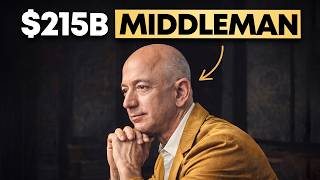

How Bezos Kills Bad Product Ideas Before They Cost Money
53sA one-page press release is a surprisingly simple way to kill bad ideas, and viewers love actionable framework secrets from Bezos.
▶ Play Clip"Delivers solid Bezos principles with actionable steps, but the long Shopify/Zip Store sponsor segment dilutes the impact."
This video breaks down five rules Jeff Bezos used to build Amazon, and explains how e-commerce entrepreneurs can apply them today. It covers customer-first product validation, market selection, reinvestment, decision-making frameworks, and the flywheel model, ending with a practical store-building demo using Shopify and Zip Store.
Bezos requires a one-page press release for every product idea, including a headline, launch date, and problem description. It's read aloud, and if it doesn't interest the room, the idea is killed.
Before testing any product, ask: Who is the customer? What problem are they trying to solve in their own words? Why is your solution the best for them? Be specific, e.g., a 29-year-old software developer needing noise-blocking headphones.
Bezos listed 20 product categories and picked books based on: SKU depth (many products to choose from), supply fragmentation (no dominant giants), retail difficulty (supermarkets can't stock everything), and shipping economics (books are cheap to ship).
Use the Meta Ad Library to find 15-20 ads running for over 3 weeks as demand validation. Check saturation for 8-10 competing brands that don't dominate, and look for active communities like subreddits with more than 1,000 members.
Amazon went public in 1997 but wasn't profitable until 2003. Bezos reinvested every dollar into warehousing, infrastructure, and Prime, creating a snowball effect: better warehouses → cheaper shipping → lower prices → more customers.
Bezos' shareholder letter describes one-way doors as consequential and irreversible, needing slow, careful decisions. Two-way doors are changeable and reversible, so they should be made quickly. Beginners often treat two-way decisions (like store design) as one-way.
Use Shopify (get $1/month for 3 months) and Zip Store to import a product URL, choose an audience, and get a fully designed store in under 2 minutes. You can customize fonts, sections, and add products without slowing down.
After the dot-com crash, Bezos applied the flywheel effect: lower prices → better customer experience → more traffic → third-party sellers → bigger selection → lower costs → lower prices again. Every initiative had to plug into this loop. Most e-commerce stores run funnels that die when demand drops; a flywheel compounds.
Bezos' five rules — start with the customer, pick a fish-filled pond, feed the winner, separate one-way and two-way doors, and build a flywheel — are timeless e-commerce principles. The video demonstrates how to apply them, including a fast store build, so you can test ideas without wasting time or money.
What three questions should you ask when validating a product idea?
Who is the customer? What problem are they trying to solve in their own words? Why is your solution the best for them?
01:48
What four signals did Bezos use to evaluate product categories?
SKU depth, supply fragmentation, retail difficulty, and shipping economics.
03:22
Why did books win as Amazon's first product category?
Books had a massive catalog, fragmented supply, were impossible for physical stores to stock entirely, and were cheap to ship.
04:29
What is the one-way vs two-way door principle?
One-way doors are consequential and irreversible decisions that need careful research; two-way doors are changeable and reversible, so they should be made quickly.
08:15
What are examples of one-way doors in e-commerce?
Choosing your market, community, and suppliers.
09:08
What are examples of two-way doors in e-commerce?
Store theme, design, pricing, and which creators to work with.
09:23
What is the flywheel effect?
Great companies build momentum over time through a loop of reinforcing steps, rather than relying on one magic move.
15:00
What are the six steps in Amazon's flywheel?
Lower prices → better customer experience → more traffic → third-party sellers → bigger selection → lower costs → lower prices.
15:00
When should you kill a product idea according to Bezos' process?
If you can't describe the product in less than 10 minutes, or the press release doesn't interest the room.
03:09
What are the modern signals for market validation?
Demand validation (15-20 ads running 3+ weeks), saturation (8-10 brands competing without a monopoly), and community strength (active subreddits with >1,000 members).
05:08
Start with the Customer
Inverting the typical 'product first' approach reduces wasted effort and aligns offers with actual demand.
01:48Data-Driven Market Selection
Bezos' four signals show a repeatable way to evaluate a market before committing resources.
03:22Delayed Gratification for Compounding Growth
Amazon chose to skip profits to reinvest, creating a snowball effect most businesses miss.
06:29One-Way vs Two-Way Doors
A powerful mental model for speed of decision-making and avoiding analysis paralysis.
08:15Flywheel Over Funnel
Explains why short-term funnels die while compounding loops build durable businesses.
15:00[00:01] thousands of years old, applied it to the internet, and turned it into one of did it by following five specific rules, and every one of them applies to business world is louder than it's ever been. New distractions every single day,
[00:16] no clear way to make decisions. You'll spend years working, but never actually building anything. Bezos built Amazon on these rules in 1994. They still work the same way today, and that's not a coincidence. So, let me break them down
[00:28] and show you how to apply each one to your own business today. Echo, Amazon Prime, Kindle, each one of these Amazon products started on a piece of paper. For every product idea, Bezos tells his employees to create a one-page
[00:41] has a headline, it has a launch date, a description of the problem that the team reads it out loud in the room, and if the press release doesn't interest the room in the product, it dies right there at that moment. Now, believe it or
[00:54] has been released went through this process before they invested in anything else. But, here's what most people miss. Hundreds of other Amazon products died never going to see, and that's the whole point of the press release system, to
[01:07] customer before the product. So, to kill the bad ideas before they cost anything. But, most people, they do the exact opposite. They find a product that looks figure out who to sell it to. And that's why their whole business dies after a
[01:21] few weeks, because they built backwards. Working in reverse means starting with going to serve. Things like who are they, what's keeping them up at night, why do they want the product? Those are the things that you should focus on, not
[01:34] now or going viral. So, the next time that you see a product, apply the same obviously, you don't need to write a whole press release [music] yourself, three questions before you test anything, and you're doing basically
[01:48] what Jeff Bezos does. So, the first thing you need to know who is actually you're selling noise-canceling headphones. So, instead of writing a silence, your answer should be very specific. So, here's a example for you.
[02:02] A 29-year-old software developer in an open-plan office with noise and people that's going to be the person that you're selling to. The next question is, what's he actually trying to solve in his own words? People search for
[02:16] solutions, not features. And let me just explain exactly what I mean by that, but he's not going to Google something like premium acoustic isolation technology, like headphones that block voices and noise. So, your answer should be
[02:30] his co-workers won't stop talking. And then the final question is, why is your solution the best one for him? Chances are there are a ton of products that are you're trying to solve, but most of those products won't work for him. Now,
[02:44] that don't block speech or he tried foam few hours, right? So, think about why your product is different and what makes it the best option for that person. Now, an answer here could be something like,
[02:57] technology that specifically block human speech. They're so comfortable that you'll never forget that you're even using them." Now, what you want to do is product in less than 10 minutes. Now, if you can't do that, simply kill the
[03:09] that's how you kill bad products before you waste a dime testing them, but even market. So, let's talk about how to pick the right one. Now, before Amazon was Amazon, Bezos sat down at his desk and he made a list of 20 product categories
[03:22] he didn't pick one based on what was trending, he picked the one that was the best at four detailed signals. The first one was the skew depth. So, this is basically how many unique product exists in the specific [music] category. So,
[03:36] the more depth a product has, the more reasons a customer has to keep coming the one place that has everything that the supply fragmentation, which is how many sellers are in the market. Now, if
[03:49] three giants own 80% of the market, he knew that he couldn't compete with them simply push them out of the market. But if the market share was spread across chance to become that giant in the market. The next signal was retail
[04:03] difficulty. Now, Bezos was asking whether regular supermarket could stock they couldn't, that meant that the buyers would already be buying online. And finally, he rated the shipping economics. Shipping books is obviously
[04:16] something like a couch is not [music] going to be cheap. So, the product cost is let's just say $30, but the shipping cost is $15, it's not even worth trying. Now, in the end, books ended up winning on all four signals. They have a massive
[04:29] catalog in a fragmented supply. It's also impossible for physical store to very easy to ship. So, Bezos didn't fall in love with books, he fell in love with in love with the product before they even looked at the market it lives in.
[04:43] or Instagram and they get super excited and they're like, "Okay, I'm going to start selling this." Then, they lose money and they have no idea why, but the reason's pretty simple. They picked a pond without a fish and they only
[04:55] fishing gear. Now, everything could be perfect, their product, their ads, their store, but if the market is dying or it's saturated, none of that matters. you choose a pond full of fish. You're going to rank your current market based
[05:08] on these three signals. These are basically the modern equivalent of what Bezos did. Fish is demand validation, so you can pull up the Meta Ad Library and market. Then, you want to look for anywhere from 15 to 20 of them that have
[05:22] been running for more than 3 weeks. Now, if there are only a couple of ads or they've been running for less than three or so days, that's just not enough to go on because they could be in the early testing phase and either way, that's
[05:34] need to check for saturation, so that's how many brands that are running ads in brands that are competing, but none of them completely dominating the market. So, if there are only two or three massive stores owning the whole space,
[05:48] push everyone else out. But, if you're seeing eight to 10 different brands that are all getting a slice, that means that there's probably room for another there's a strong community around it. So, look for how many active subreddits,
[06:02] exist for this market. And then you want to see how active those groups are. Now, if the only community that you can find is a dead forum with fewer than 1,000 members, there's probably not an actual community for you to sell to. Now,
[06:15] of these signals. Now, let's just say two of these signals are weak, you are looking for a pond with more fish. The third rule that Bezos followed is what decided if Amazon was going to become an actual business, and that is feed the
[06:29] winner. When Amazon went public in 1997, they didn't have a fully profitable year until 2003. So, Amazon reported six the model didn't work. It was because Bezos chose not to make a profit, at
[06:44] least on paper. So, every single dollar that Amazon earned was reinvested back into better warehousing, better infrastructure, and obviously faster two-day Prime, their one-day, same-day Prime. Now, the investors weren't happy
[06:57] Amazon was going to die after just a few years. What they didn't realize is that Bezos was creating a snowball. Essentially, every single dollar that he put back in made the next dollar even easier to earn. So, better warehouses
[07:10] meant cheaper shipping, cheaper shipping meant lower prices, lower prices brought customers gave them more cash to reinvest. And then when that happened, not a single retailer could match what Amazon [music] had. So, in the first
[07:23] bigger than most of its online [music] competitors. And right now, most people are acting like most of those competitors. What do they do? They find money, and then they go find another product to sell. And honestly, I did
[07:35] months of building my online business. I kept hunting new products instead of working. And in the end, I basically built nothing. So, that's a clear reason why you should follow Bezos' rules and feed the one that's already working. So,
[07:49] pick the one product or store that's working best for you right now and list reinvest into this month. Could be better suppliers, custom packaging, better creators, more ad spend. You don't need to do all of them, just pick
[08:02] next rule is the one that gets the most beginners unstuck and I'm going to show you exactly how it applies to building your own online business. So, Bezos introduces in his letter to shareholders that said the following, "Some decisions
[08:15] are consequential and irreversible, one-way doors, and these decisions must be made methodically, carefully, slowly, with great deliberation and consultation. But most decisions aren't like that. They are changeable,
[08:27] reversible, they're two-way doors. These decisions can and should be made quickly." So, basically, every single decision that you make can be separated problem is that most people treat two-way doors like they are one-way
[08:41] Beginners, they do this constantly. They obsess over their store, their theme, their font, the images, the ad copy, pretty much everything. But none of single one of these things can be changed in less than 24 hours. Now,
[08:55] there are still one-way doors in e-commerce and those deserve a lot of research and time, but everything else can be done right now. And if you don't Here's how you can start applying this rule today. Make two columns. In the
[09:08] So, these are decisions that you can research properly and take your time to decide. So, these are things like your markets, your community, your suppliers, you can obviously not change without hurting your monthly income. Now, in the
[09:23] left column, you're going to put the two-way doors. So, these are decisions less. Things like your store theme, your design, your pricing, which creators you should build and finish within the next 24 hours. And the biggest one that most
[09:38] beginners I see waste time on is their store. So, they'll be spending days trying to make it perfect before a single person has ever seen it. So, let me show you how fast you can get one live, and one that actually looks very
[09:51] you need to do is get Shopify. So, if you click this link right here, it's going to get us access to Shopify for a single dollar for the next 3 months. So, pretty straightforward, all you have to do is insert your email just like so.
[10:05] So, as you can see here that $1 per month offer is attached. So, instead of month. So, I'm going to insert my credit card info, and then we will be good to go. Then you just need the basic, should be fine. All right, so this is what our
[10:19] dashboard should look like. Now, let's just say that this is a brand that we want to emulate. It's a good example. What I can do is take the link right here, and then we're going to go back into the description of the video, and
[10:31] here. This link is then going to take us to Zip Store, and this is what makes all the magic happen. So, all I have to do is take this link right here, and copy build my store. What it's doing is it's scanning the product. It's coming up
[10:46] press English. From here, we can choose our target audience. So, this is who going to go with the crafty millennial. The communication style, so how it's this one right here, create your own penguin pal. Then it's going to start
[11:01] after, I mean, less than a minute, this is what the store looks like. So, what's cool is that we can go in and change up things however we would like. I minimal look like this. You can change the fonts as well. That looks fine. I'll
[11:16] change this to brick. Buttons will be brick. Then I can add in emojis just brick. Then I can add in emojis just like that. That already looks a lot well. So, let's change first one to this. I can also add in sections that
[11:29] could be useful. So, let's see, image gallery, can do promos, banner, customer reviews. Let's try this image gallery. So, it adds this cool little image gallery right here. This is what it looks like on mobile. Looks super clean.
[11:45] I mean, we didn't do anything, really, and it already looks ready to go. So, it also builds out a homepage just like this, which, honestly, isn't going to be too useful, nor is the reviews page right here. It's nice to have, but
[11:58] all of our traffic to the product page anyway. Mind you, it also builds out a if we go to the catalog right here, we press add product, and if we have, you want to import, so let's say we have another product. Let's go into best
[12:13] like this is another variant that I want to sell. What's cool is I can copy the URL up here, go back, add manually, and then simply copy and paste, and it's did from the start, and build out a product page catered toward this
[12:27] product. So, it's going to ensure that the writing style, all the contents, along with the imaging, is going to be built out for, you know, obviously, the useful if you guys have multiple SKUs on your store, and you want to add in
[12:42] different products, and not only just have one. So, that's super useful. But of your traffic, or pretty much all your traffic, to this product page. So, this want to make this look as nice as possible. You play around with it, but
[12:55] the main thing here is speed, efficiency, and also just presentability, and it hits all three of those, which is amazing. With us doing been less than like 2 minutes, and we already have a store that's presentable.
[13:09] Can change all the images, I can add in images. But if I'm happy with what I perfect, all you have to do is press connect store up here. Now, because we have already signed up for Shopify, we simply go back to our Shopify dashboard
[13:24] here, we copy the URL at the top, we go into connect my existing store. We paste in right here. We install the app. We install again. It's going to be connecting our Shopify store like so. And then it has been connected just like
[13:37] that. We just press publish store if we are happy. It's publishing store right here as you can see. All the products were uploaded successfully. Nice. We can go back into Shopify and then here go into products and just double check.
[13:51] Make sure that we got it. Yes, we do. We can change the title here any of the reflect on our store. But if we go to online store right here and then go into editing our theme, we will see that this is the store that has properly been
[14:05] pasted over. We can just double check the catalog right here. We'll press this the catalog right here. We'll press this guy and then yes, we do have our product page that we built with AI in less than 2 minutes ready to go and ready to test.
[14:19] getting and it's just going to make it so much easier for us. separates every store that you've ever seen succeed from the ones that disappear after 6 months. And that's build a flywheel. So in 2001, Amazon
[14:33] stock went down around 90% during the dot-com crash. So what Bezos did was he with a business consultant. And this room only had one purpose and it was to solve the question, how do we grow sustainably and profitably? Now they
[14:47] spent hours thinking of a solution until Bezos remembered an idea from a book that he read. Now the idea is called the flywheel effect. Now the idea basically explained how great companies build momentum over time instead of relying on
[15:00] one magic move. So Bezos applied this idea and drew something on a napkin. It was a loop with six steps for growth. So lower prices lead to better customer experience. Better customer experience drives more traffic. More traffic
[15:13] attracts third-party sellers. Third-party sellers expand selection. Bigger selection drives down costs. And then lower costs let Amazon offer even experience. And the cool thing is that for the next several years, every single
[15:26] Amazon initiative had to plug into one of those [music] steps. So, if a project wouldn't get funded. Now, here's the thing. Most people, they're not running a business. They're basically running a funnel, right? They create an ad or
[15:39] content to drive traffic to the product page, they make a sale, and that is it. while, but when the product demand lowers, the funnel dies and everything have to find another product, they have to build another funnel until it happens
[15:54] what you need to understand is that funnels don't work to build a real not the end, they're just the middle step. So, here's what your store should serving is always going to be in the center. Then, we start the loop with the
[16:08] you access to creators who actually believe in what they are promoting. And in the community drive more sales because the community trust them. And up, they give you leverage with manufacturers and customers. So, that
[16:23] with both of them. Strong relationships get you better margins because you can manufacturers. And then, you can also go back to customers who already bought and cost you anything. So, better margins means that you can reinvest into the
[16:36] [music] better content, better assets. And when your brand actually looks the part, customers notice that. And that's what's store that's selling the same thing. So, the more customers that you have inside
[16:48] that you can sell back to that same group. And that's what good e-commerce business looks like. So, draw each step into your own business. Now, if you can sale, you don't actually have a
[17:02] These five principles tell you how to think, but they don't tell you how to you've never built a brand, the principles are useless until you have video that walks you through how to build everything from zero. It has
[17:17] you can apply the rules that I just told you. I really hope this was useful to you and I'll see you in the next one. Peace.


⚡ Saved you 0h 17m reading this? Transcribe any YouTube video for free — no signup needed.