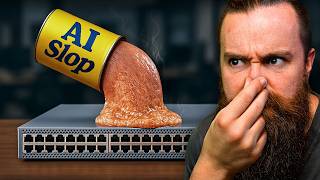

AI Hype is Out of Control
45sStarts with a strong, relatable frustration about AI being slapped on everything, which resonates with viewers tired of tech buzzwords.
▶ Play Clip"Title promises a critical take on AI hype, and the video delivers a substantive analysis with real examples, though it includes sponsor segments and some fluff."
The video critically examines the AI hype in the networking industry, contrasting the approaches of major vendors like Cisco and Juniper. It highlights Juniper's decade-long head start in AI-native networking through its Mist AI platform, which integrates data into a single cloud for proactive, self-driving network management. The presenter shares insights from Cisco Live and Juniper's event, including customer testimonials and a practical scenario demonstrating how Juniper's AI can quickly diagnose and resolve network issues.
The presenter expresses fatigue with the AI hype, noting that many products are adding AI stickers without solving real problems. He questions whether AI in networking delivers real results.
At Cisco Live with 22,000 attendees, the presenter also visited Juniper's event a mile away, where Juniper emphasized their commitment to building the industry's first self-driving network.
Sudhir from Juniper stated they are not confused about their goal: to build the industry's first self-driving network, contrasting with other vendors' broad AI announcements.
Juniper's CEO claimed they've been leading AI and network convergence for over 10 years, dating back to Mist Systems' founding in 2014, which focused on specialized machine learning for Wi-Fi.
Mist Systems was acquired by Juniper in 2019 for $450 million, integrating their AI capabilities into Juniper's portfolio.
The co-founder Bob Friday emphasized that great wine starts with great grapes, meaning AI's effectiveness depends on the quality and context of data it's trained on.
Many vendors like Cisco are bolting AI onto existing products, feeding LLMs with massive telemetry data, whereas Juniper has built its platform from the ground up with AI in mind.
Juniper stores all network context in the Mist AI cloud, including wireless, switching, routing, and client telemetry, using a microservices architecture to ingest and correlate data.
Marvis Minis are AI-native digital twins that act as virtual clients, simulating client journeys to detect anomalies before users do, especially during configuration changes.
The presenter contrasts how Cisco and Juniper would handle a CEO's complaint about a bad Zoom call. Juniper's Marvis AI can instantly access the network context and identify the root cause, such as a bad patch cable, without pulling data from multiple sources.
Juniper's AI can predict cable or optic failures before they occur, allowing proactive replacement and avoiding downtime.
Existing Juniper Mist customers at the event confirmed the AI's effectiveness, and a partner named Allan shared how Marvis AI helps him quickly identify issues and add value through programming.
Juniper's ultimate vision is self-driving, auto-healing networks, with enterprise campus and wireless networks already there, and data center capabilities coming soon.
Juniper's approach offers a single source of truth for network data, unlike other vendors with many moving parts, making troubleshooting simpler.
The video concludes that while AI hype is prevalent, Juniper's AI-native approach, backed by a decade of development and customer validation, appears to deliver real value in networking. The presenter remains cautiously optimistic, noting that AI is beginning to automate parts of a network engineer's job, potentially reducing stress and improving uptime.
What year was Mist Systems founded?
2014
03:06
What was the main focus of Mist Systems' AI?
Specialized machine learning for Wi-Fi, trained on wireless LAN data.
03:34
How much did Juniper acquire Mist Systems for?
$450 million
04:01
What are Marvis Minis?
AI-native digital twins that act as virtual clients, simulating client journeys to detect anomalies.
10:14
What is the key difference between Juniper's AI and other vendors' bolt-on AI?
Juniper has a single data source (Mist AI cloud) with full network context, while others pull data from multiple sources.
12:40
What does the acronym MOS stand for in the context of the video?
Mean Opinion Score, a quality score for calls.
13:17
What is Juniper's ultimate vision for networks?
Self-driving, auto-healing networks.
17:26
Self-Driving Network Vision
Clearly defines Juniper's unique goal, setting them apart from other vendors.
02:09Great Wine Starts with Great Grapes
Memorable analogy emphasizing the importance of data quality in AI.
04:42Marvis Minis as Digital Twins
Innovative concept of virtual clients proactively testing the network.
10:14Predictive Cable Failure
Demonstrates AI's ability to predict failures before they impact users.
14:13Single Pane of Glass
Highlights the practical benefit of having all network data in one place.
18:35[00:02] enhanced, AI slot. I'm getting tired of this. This is what we're seeing with every product we use since Chat GBT broke everything in 2022. Now that is it AI? Is it glittery machine learning? Thank you, Alan. Yes, every
[00:17] slapping on that AI sticker because that's all investors care about right now. Everyone's jumping on this AI hype train, and I want to get off. I mean, come on. Is adding AI to all of our products actually solving real problems?
[00:31] for IT and network engineers, are we seeing real results? That's what I want to figure out in this video. Is this all just AI slop? Or are there real use engineer, I want to see this happen. Maybe the network is up all the time.
[00:45] Maybe I don't receive a call at 3:00 a.m. And while AI is kind of scary for begging for the things it's promising us, like this Reddit post here. Where is help us? But first, get your coffee ready. This is a journey. And my journey
[00:59] networking conference in the world, Cisco Live. With over 22,000 people, I But what's funny is the interesting story didn't actually happen there. About a mile and a half away, 10 minutes, another event was held by
[01:14] another large networking vendor, Juniper Networks. Now, Juniper heard I was going you know all this AI stuff people are talking about, we're actually doing it also said something about making networking sexy again. Now, it's no
[01:27] wonder that networking has become sexy again. So, I'm like, "All right, let's Juniper for inviting me to their event and helping make this video possible. By the way, this video was made prior to the recent news about the HPE
[01:41] out the links to the press releases, but I just wanted to give you that bit of context before we continue. All right, let's take a quick coffee break. And here we go. I arrive at the Juniper event just after Cisco announced all
[01:55] their major AI stuff. So AI was already kind of top of mind and I'm like man how's Juniper going to beat this? But then Sudhir said this today across the street you heard a lot of announcements AI canvas AI this agentic AI all kinds
[02:09] of stuff. We are not confused about what we are trying to build and who we are trying to be. We are trying to build the industry's first self-driving network. Period. end the story. So I was like, okay, they're not worried. They're not
[02:24] scared. But then I heard something crazy. Rammy, their CEO, said, "We've been leading the AI and network convergence for more than 10 years now." Uh, excuse me, sir. Chat GBT came out in November 2022. There was no AI before
[02:39] that, right? That is kind of how it feels, but AI was very much a thing before Chat GBT. Back then in the early to mid2010s, it was not about generative text or chat interfaces. It was about machine learning and it was more about
[02:52] being very focused at being good at one thing so it could find patterns and data that's exactly what the founders of Miss Networks did. Miss Networks, who's that? it's coming. The founders, Sujay Hija, Bob Friday, which is an awesome name,
[03:06] former Cisco employees by the way, founded Miss Systems in 2014. Uh, we were responsible for Cisco's wireless business. We did the acquisition of Moroi in December of 2012 and it
[03:20] inspired uh the creation of Mist with the goal of reinventing enterprise Wi-Fi with cloud computing powered by artificial intelligence AI. And this is 2014. Now the main difference with their AI versus what we see now is that it was
[03:34] trained very specifically on wireless LAN data. What a good network looks like, what a bad one looks like, how to troubleshoot things. Very specialized. strawberry. They didn't care about that. All it cared about was Wi-Fi. They
[03:47] coined the concepts AI for IT or AI is in the air. Kind of cheesy, but I like They wanted to deliver a self-driving network. One that could proactively detect and adapt to issues in real time, saving it teams money and time. Kind of
[04:01] with AI now, except this was over 10 years ago. Now, were they successful? Um, yeah. They were purchased by Juniper in 2019 for $45 million. See the
[04:13] of Juniper and Juniper's like, "I love your AI stuff. Let's make it part of all for a second. Juniper has had AI in their portfolio, their stuff since 2019, miss system since 2014. The thing I'm wondering is, does that matter? Like,
[04:28] for what we have now, does that 10-year head start make a difference? That's the co-founders, Bob Friday, again, amazing name, said this about grapes or tell people, you know, great wine starts
[04:42] with great grapes. You know, AI has the data. So, it's like getting getting your first step on the journey to mastering AI. Now, one thing I've learned about AI so far is that it all depends on the data you feed it, the context you
[04:55] for anything. You can ask an AI like ChatB. Hey, what should I have for Hawaiian Sunrise Pizza with pineapples and cashews. Perfectly fine answer. But you might hate pineapples and you're allergic to nuts. Context and data is so
[05:10] can't ask an LLM about our network unless it has the context of our context? How is it learning about our vast, massive, complex networks? Well, what we're seeing right now is a lot of bolt-on AI again slapping that sticker
[05:25] on. We're feeding our LLMs a ton of data about our network, telemetry data from captures, and just everything. Here you go, friend. Figure it out for me, seeing with vendors like Cisco. Now, I'm going to pick on Cisco first because
[05:39] they are one of the largest networking vendors. No hate, I love Cisco. But pull data from. They've got thousand eyes, which when you really think about it is a scary, scary name for something. Makes me think of one of those angels
[05:51] from Revelation. You know what I'm talking about. It's watching you. And stuff. So, they're getting telemetry from that. They also have Splunk, Catalyst Center, App Dynamics. Now, it's not important for you to know what all
[06:03] they have a lot of things, a lot of data pouring into an LLM. And while they do have this really neat DPM or deep network model, specially trained on all their networking stuff, they are relying on its ability to take all of that data
[06:17] fed to it and just kind of figure it out, which this might work, but it's demo. But if you've been using AI for any amount of time, you know how tricky make sure the AI doesn't like hallucinate. Now, this right here is how
[06:32] a lot of vendors handle adding AI to their products. Here's all the data and just please figure it out. Juniper, because it had a head start, doesn't do it this way. And if that looks a little bit gnarly and complex with a lot of
[06:46] bit gnarly and complex with a lot of hardware and software and clouds that you have to stitch together, maintain, upgrade, say a prayer when you do it. they've been doing this for a minute, they've structured things a bit
[07:01] question I want you to have in your mind is, does that matter or does this Juniper claims that they are AI native. They've been building their platform from the ground up with AI in mind. And for me, I was like, okay, what does that
[07:16] mean to be AI native? And again, it all comes down to data. Now, real quick, it's time for a coffee break, and I want to tell you a scary story. Get ready. As Cisco Live and visit Juniper, I'm walking out the door about to catch my
[07:29] flight. Boom. Power outage. No big deal. Power comes back on. But you know what servers. Both of them just would not power on. Running on those servers were my Twin Gate connectors. I was devastated because Twate is what I use
[07:42] while we're traveling and we were about to do that very thing. Now, I was in a I can only think to do one thing. In just a few moments, I was able to log into another computer at the studio and deploy another Twing connector. And just
[07:55] like that, I had connectivity back to my studio from wherever I go. And I was back up and running. I could remote into everything I have except for my Proxmox But seriously, that's one of the reasons I love Twin Gate is it's simple but
[08:09] anywhere in your home network. It's free for home labers or as a business owner. Man, they make it so easy, but also it's zero trust. It's not your dad's VPN where it's just a big tunnel that everyone can access everything. No, I
[08:24] can allow my editors to connect back to my NAS, but not to my AI server. I can restrict the ports they're able to access on a server. I get detailed logs you're not using Twate for your remote access, try it out. Just right now, try
[08:37] literally take you 5 minutes to deploy it. And honestly, it's the best remote to Twing for helping make this video and my trip to Cisco Live and Juniver sponsors of my channel, helping me do what I do. So, please show them some
[08:51] scary story. Proxmox servers were still down until I got home, but that's a story for another time. Back to learning about AI stuff. Now, keeping in mind, data is the most important thing with AI. Juniper's data is stored inside the
[09:05] Mist AI cloud. The entire context of your network in one spot. wireless APs, switches, routers, clients, the Zoom and Teams APIs, the config, the state, their telemetry is being consistently fed to the Mist AI cloud. And since the
[09:20] microservices architecture. So, think Kubernetes that will ingest all that it means, how it all relates to each other, so it can do a better job at patterns, and zeroing in on the root problems so you can fix them faster. But
[09:35] didn't forget about him. Juniper also throw all their data center stuff up handle that data is interesting. They hoping the AI will figure it out. They have an intentbased networking
[09:48] technology called Abstra. And it's built around this, their contextual graph everything you need to know about the current data center, how it's connected, elements and data points are related to each other. And it's that database that
[10:01] is thrown up into the Mist AI cloud. This is everything about your network, the current state of it. I'm talking RF stats from your APS, cable metrics, optics, what's the current state of spanning tree, what about BGP and OPF,
[10:14] how's the jitter on Zoom calls? And they have these things called Marvis minis. They are AI native networking digital experience twins. These little guys are like virtual clients. They're spun up automatically by the Marvis AI. And they
[10:26] learn your network via unsupervised machine learning. And like legit, they are clients. They will authenticate. They will get IP addresses. They will hit your DNS servers. They'll get your SAS applications and part of their job
[10:39] is to map client journeys. Essentially, they're always trying to simulate what your clients are doing on the network and they will try to find anomalies or issues before your users do. This happens all the time and especially when
[10:51] you make configuration changes. These little guys go in and like make sure the DHCP pools messed up. And you may have heard of the concept of an SLA, a service level agreement where someone like your ISP might guarantee you a
[11:04] thing called SLES or service level expectations, the expected performance of an application or experience. And monitor that pretending to be clients.
[11:16] Marvis AI. And this would be more what you would think machine learning is. networking. Eat, sleep, breathes wireless data centers. This is what was running the Marvis minis and doing all the unsupervised learning. This sucker
[11:31] we have the Marvis AI assistant. Just keep in mind the assistant at the top is That's already been done. It just knows how to ask Marvis AI good questions. Translating your human speak. Now, the star here is still the data and how it's
[11:45] handled in the Miss Cloud. You might be thinking, "Okay, Chuck, so what? One let's do a scenario real quick. Let's say the CEO of Hackwell Industries, Bernard Hackwell, calls in. He said on Friday at 3 p.m. his Zoom call was
[11:58] terrible. He says, "Tell me why and fix it." He's a CEO. You got to do it. Now, you would answer that question. For me, I'd be like, "Oh, um, tell you what, CEO, let me know when it happens again. Give me a call and I'll come like see
[12:12] captures or something. Try to help you try to correlate some stuff with my Cisco where you have a lot of different sources you might have to pull data network model your problem. And I'm sure it's going to do a great job in
[12:25] but it's going to have to go out to all these different sources, pull telemetry, of what's happening with your network and what happened in that moment. And it answer. Contrast that with Juniper and how they handle data. And at this point,
[12:40] I'm not saying if one or the other is better. I'm just contrasting how they access data and the context of your network. You would tell Marvis the same thing. Here's my problem. But it wouldn't have to go out to a number of
[12:52] sources and try to figure it out. No, it would simply go boom to Marvis AI and Marvis AI looks at the current state of the network. It would already have the context that Bernard Hackwell's laptop was connected to AP03 which is connected
[13:05] to switch one and it's a router for I'm just making stuff up. Just trying to move fast here going out ISP2. This would already be the context. Accessing that context would be like this. And there might already be a node created.
[13:17] We don't have time for that. But this node might be a quality score known as MOS for that Zoom call of like 2.4, which is bad. And that was already correlated with a switch port on switch one that had a very high increase of CRC
[13:31] errors on port 1024. And so instead of the AI coming up and saying, "Oh, we things." It goes, "No, no, no. We found the uh problem. We think it's going to be a bad patch cable between AP03 and switch one port 24. The recommended
[13:46] what I want to hammer home here is that it didn't have to go out to any other data source to find this information. It went to one spot, the Mist AI cloud, and it already had that client journey mapped out. And let's say they do go out
[13:58] mark that ticket as done. Then a little Marvis Mini might be spun up to test out that client journey to hit DHCP to hit DNS to simulate that Zoom call and then come back with a good MOS score and go, you know what, it's good now. Now I was
[14:13] was telling me about how Marvis will be able to predict cable failures or optic failures before they become a problem. So we have enriched data that we talked all the relationship and the context information of it. So let's take a
[14:28] example of a common data center issue an optic failure and we can start looking at trend analysis and that's where AI and and machine learning models come into play to predict with a level of confidence that this optic is going to
[14:41] fail in a couple weeks. You need to order a part now before it goes bad and impacts your applications that you are providing as a service. Now, at this point, it's like, okay, all this sounds really cool if it works, right? Like,
[14:56] we've heard promises. It looks shiny. I'm excited. I'm also like grain of bold in saying, you know what? Ask our customers. We already have this stuff deployed in our campus and wireless stuff. Anybody wearing a green lanyard
[15:11] today is an existing Juniper Mist customer. If you call on anything I'm saying, they're right here. they they will not lie to you. They are the same as you. They will they will carry the story for you. Speak to our
[15:24] talk to one of them." So I talked to Allen. And while Allan is not a customer directly, he does work for a partner, Nexum, and they deploy Juniper Stuff to customers. So I work for an integrator. And so I work with a lot of different
[15:36] customers and their their level of technical ability is varied. And it's go in and say, "Hey, Marvis, who's having a bad day?" and it says, "Hey, day. Here's what you need to look at." And with clicks, you can investigate and
[15:52] this is the problem they're having. It's because they need to install this patch actually from my Discord. I didn't realize this. So cool to get to meet you. And I asked him some questions about his experience with Juniper's AI
[16:04] or Mist AI. So, it's able to look back and for all the clients, it's keeping client state um you know, hundreds of pieces of client data every minute. And so I can go back and when the CEO calls and says, "Hey, last Thursday at 3 PM I
[16:18] dropped for a second. What happened?" I can back up to that, I can look at it happened." What that's allowed me to do is now offer those services above and beyond. So I've gotten a lot more into programming, a lot more Python
[16:31] scripting, that kind of stuff to add value. Um, which is where the AI stuff here, very demo-ish example of the CEO call. If you want to ask why the CEO had a bad Zoom call last Tuesday, you can actually do that. I asked Allan like,
[16:46] "Can this really be done right now with Marvis AI?" And then are we at the point now to where it can actually fix things? Like fix it before we even realize it's a problem. Marvis will never send you in on wild goose chases. We've gotten to
[16:58] can start to trust it to make more decisions. So, okay, here we are. Juniper is saying and their customers are saying the same thing that AI is it and it's awesome. The way they've integrated their AI has been more AI
[17:12] native. They're not new to the space and the way they deliver the context or the data of the networks of their customers is the unique proposition here. We're portfolio with their enterprise campus networks, wireless networks where
[17:26] self-driving autohealing networks are here on the data center side that is coming soon according to Kyle. So where our ultimate vision is going is we want to get to self-driving you know I think we're we're you know close to it um and
[17:42] the direction we want to get to and I think we're we're near that and that that possibilities are very close on what we can do um and obviously we'll start with the right use cases um and
[17:55] and be able to provide that that confidence and and still that that you detection and troubleshooting stuff is built right in. And if you look at other vendors right now, let's pick on Cisco once more. Right now, they're slapping
[18:07] get all their legacy components to work together with AI, dumping a lot of data it probably does a great job at correlating all that data. But it's still a lot a lot of moving parts. And when if you've been in it for any amount
[18:23] parts, the more complex, the more often it breaks and the harder it is to troubleshoot. And let's be honest, we know LLMs, even the greatest ones right now, get very confused with too much data. So, I find Juniper's approach very
[18:35] interesting. Now, I have not played with it or used it myself, experienced an outage or anything like that, but their customers have. And conceptually, it sounds cool. That one single place, the single pane of glass that we always talk
[18:47] about, the unicorn in it, seems to exist in Juniper's world. And it's not just Juniper stuff either. They do have support for third-party routers and vendor. they can interface with their APIs or even legacy monitoring
[19:00] protocols. So, what do you think? Do you think we're at a point now to where AI Do you think it's all marketing glitter shiny tools or is it real? Maybe you are in the comments below like what your experience is like or maybe you're using
[19:15] in an amazing way and it's saving you so much time. I would love to hear that story. Also, I would like to know if this concerns you because let's be honest, this is starting to automate and do parts of a network engineer's job,
[19:28] you think about the job of a network engineer. I don't do the job now, but stressors were the network goes down. I have to figure it out fast. And that stress is insane. Or you get that 3:00 a.m. call. You're just groggy and you
[19:44] you're trying to figure out a very very complex issue at your worst state. If we can avoid those situations and bring an AI to bring better uptimes, that's going Juniper again for inviting me out to their event. But whatever the case, my
[19:58] what the landscape is right now. It was kind of a deeper dive into Juniper what they have. I only got a brief keynote from Cisco. And right now, Cisco stuff is still pending. We should see it later this year, but Juniper stuff has
[20:12] this stuff is kind of exciting. Anyways, that's all I got. I'll catch you guys that's all I got. I'll catch you guys next time.



⚡ Saved you 0h 20m reading this? Transcribe any YouTube video for free — no signup needed.