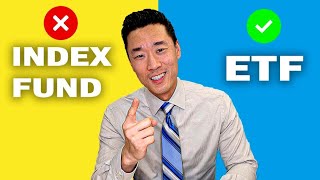

Index Funds vs ETFs: The Truth
45sDirectly addresses a common investor dilemma with a promise to reveal the truth, sparking curiosity.
▶ Play Clip"The title accurately reflects the content, delivering a clear comparison for beginners."
This video compares index funds and ETFs, highlighting their similarities and differences to help investors choose the right option. The presenter explains that while both offer low-cost diversification and passive management, they differ in liquidity, minimum investment, fees, and tax efficiency. Ultimately, the presenter favors ETFs as an upgraded version of index funds.
The video aims to compare index funds and ETFs, explaining their similarities and differences to help viewers decide which is right for them.
Index funds and ETFs have more in common than differences, but awareness of the differences is important as they could be deal breakers.
An index fund is like a pool of money from multiple investors used to buy securities. When an investor wants to cash out, the fund sells holdings to pay them.
An ETF is a bundle of securities traded between investors like a stock. You buy shares from another investor, not from the fund itself.
Both index funds and ETFs are passively managed, resulting in low expense ratios and diversification. They generally outperform active fund managers over the long term.
ETFs can be bought and sold throughout the trading day like stocks, while index funds only trade at the end of the day. This makes ETFs more liquid.
ETFs typically have lower minimum investment requirements, allowing purchase of a single share or even fractional shares. Index funds may require $1,000 or more.
Both are low-cost, with expense ratios around 0.02% to 0.05%. The gap between ETF and index fund fees has narrowed significantly.
ETFs are more tax-efficient due to their structure. When selling an ETF, the buyer pays you directly. With index funds, the fund manager sells holdings, potentially creating capital gains taxes for all investors.
John Bogle created the first index fund in 1975. The first US ETF (SPDR) launched in 1993. ETFs have grown rapidly, with nearly 10,000 available today.
The presenter prefers ETFs due to lower minimums, better tax efficiency, and intraday trading. However, if a specific index fund has no ETF equivalent, they would buy the index fund.
Index funds and ETFs are both excellent low-cost, diversified investment vehicles. While ETFs offer advantages in liquidity, minimum investment, and tax efficiency, the best choice depends on individual circumstances and investment goals.
What is the main structural difference between an index fund and an ETF?
An index fund is a pool of money from multiple investors; when you cash out, the fund sells holdings. An ETF is traded between investors like a stock.
01:08
How does liquidity differ between index funds and ETFs?
ETFs can be bought and sold throughout the trading day; index funds only trade at the end of the day.
03:12
What is a typical minimum investment for an index fund?
Index funds may require $1,000, $2,000, or more.
03:43
Why are ETFs generally more tax-efficient than index funds?
When selling an ETF, the buyer pays you directly, avoiding capital gains for other investors. With index funds, the fund sells holdings, potentially creating taxable gains for all investors.
04:49
Who created the first index fund and in what year?
John Bogle (Jack Bogle) created the first index fund in 1975.
06:04
What was the first US ETF and when was it launched?
The SPDR S&P 500 ETF, launched in 1993.
06:36
What expense ratio range do index funds and ETFs typically have?
0.02% to 0.05%.
04:29
More Similarities Than Differences
The presenter emphasizes that despite common belief, index funds and ETFs share more similarities than differences, setting a balanced tone.
00:26History of Index Funds and ETFs
The story of John Bogle creating the index fund in 1975 and the later invention of ETFs provides context for their evolution.
06:04Presenter's Verdict: ETFs Are Index Fund 2.0
The presenter clearly states a preference for ETFs as an upgraded version, but acknowledges index funds are still valid.
07:45[00:00] In today's video, we're going to compare index funds versus the ETF. Which one is the best? I'm going to answer for you, how are index funds and ETFs similar, how are they different, and how do you know which one is right for you?
[00:13] So essentially, are you an ETF type of person or are you an index fund type of person? I'm going to help you answer that. Okay, so I'm going to tell you the truth. The truth is that they are more in common than that. They are more similarities than differences.
[00:26] But I want you to be aware of the differences that could make an ETF or an index fund a deal breaker for you. First, I want to say this. I'm going to get this out of the way because this is very important. If you don't know about index funds or ETFs, then you wrote the wrong video, my friends.
[00:44] I'm going to leave a link down below to an index fund for beginners video, so please check that video out first. Otherwise, in this video, you're going to get confused. You're going to get discouraged like a lost puppy really quickly.
[00:56] And I do not want that to happen to you. Okay, with that being said, if you're still here, that's good. I want to demonstrate to you what is going on with an index fund. So you can think of it like this.
[01:08] Let's say that you, me, my brother, your neighbor, and my Uncle Bob, we're all pooling money together. And with this pool of money, we're going to buy all the stocks in the S&P 500.
[01:21] is. Let's just say we do that, and let's just say that you want out. When you want to cash out your portion, the fund has to sell some of its holdings to pay you out. Now, let's compare this to an ETF.
[01:36] So, with an ETF, an exchange-traded fund, you could think of it like this. Let's just say that you bought all the stocks in the S&P 500, and you packaged them all up into one bundle, and you did
[01:50] that 10 times. And I say to you, hey, can you sell me one of those? And you're like, yeah, sure. And I buy it from you. So it's simply traded from you to me like a stock. So I hope it helps to
[02:04] clarify what is going on. An index fund is a collection of securities that are financed by a pool of investors An ETF is a collection of securities that are traded between investors So that it that the difference But there are a lot of similarities and let me tell you what those are Both an index fund and ETF offer you a low solution diversification and a proven track record
[02:31] So index funds and ETFs are both passively managed. This means that there's no human that is actively choosing what to invest in. Therefore, index funds and ETFs are low-cost. They have a lower expense ratio.
[02:44] Now, both index funds and ETFs, they will give you diversification because they hold a variety of assets. And index funds and ETFs generally outperform active fund managers over a longer period of time.
[02:57] Now, I want to tell you the differences, and this will help you determine which one is better for you. So, the four biggest differences between an index fund and ETF are liquidity, minimum investment requirements, expenses and fees, and taxation.
[03:12] So let's get started with liquidity. You can buy and sell ETFs throughout the trading day like a stock. With an index fund you can only buy or sell at the end of the day. Therefore an ETF is more liquid. So this probably will not make a
[03:29] big difference for most long-term investors but it does matter if you're going to do any day trading or shorter duration moves. Now moving on to minimum investment requirements. So generally an ETF will have a lower minimum investment
[03:43] requirement when you compare it to an index fund. So for example you can buy as little as a single share of an ETF. In some cases you can even buy fractional shares of an ETF. But with some index funds they're going to impose a minimum
[03:59] requirement. It could be a thousand dollars, could be two thousand dollars or even more. Now when it comes to expenses and fees both index funds and ETFs are low cost investments. That's because both are passively managed. Previously, ETS were
[04:14] known to carry lower expense ratios compared to index funds, but that gap has been closing. And the expenses for index funds and ETFs are now quite similar. So you're going to see expense ratios in the 0.05% to 0.02%
[04:29] range, which is a fraction of 1%, which is a very low-cost solution. And of And of course you have to consider taxation ETFs are more tax efficient compared to index funds That because of their structuring So I previously demonstrated to you how they structured and that structuring
[04:49] It has tax consequences. So essentially with an ETF, you're selling to another buyer, and the cash comes directly from that buyer. To cash out of an index fund, you have to redeem it from the fund manager.
[05:03] And the fund manager will have to sell some of the holdings to get the cash to pay you out. So if there is a gain on the sale, that gain is passed on to all investors of the fund.
[05:16] That means that you can end up with a tax bill even if you don't sell a single share. So ultimately, assets are bought and sold every time an investor enters or leaves an index fund. And anytime there's a capital gain, every investor that's part of the funds will need to pay capital gains tax.
[05:34] Now, I want to be very clear with you on this topic of taxation because I don't want this to scare you. So this is going to be in relation to how much money that you have in the index fund. So if you have very little money in the fund, then don't expect the tax consequences to be significant.
[05:50] But if you do have a lot of money in the index fund, then yes, it could be a decent amount. Now, let me give you my opinion on which one is better, an index fund or an ETF. But I want to tell you the story to help you understand the situation, the whole situation.
[06:04] So the index fund was created in 1975 by John Bogle, who went by the name of Jack. So Jack Bogle was the founder of the Vanguard Group. Bogle created the index fund in 1975 so that everyday investors could compete with the pros.
[06:20] So that was 1975. It took a few years for index fund investing to catch on, but eventually it gained traction. The 18-year passed by. It's 1993. St. Street Global launched the S&P 500 ETF, called the SPDR.
[06:36] It's referred to as the SPDR. But this wasn't the first ETF. This was pursued by the Toronto ETF in 1990, among others. But ultimately, the ETF is an improvement of an index fund.
[06:49] It's like an index fund 2.0. And that's why ETFs have been gaining in popularity very quickly. 1993 the ETF market basically didn exist 2002 there are over 100 ETFs 2009 over 1 ETFs
[07:08] Currently, we're close to 10,000. And right now, there's a competition for your money between index funds and ETFs. So Jack Bogle, the inventor of index funds, he scoffed at ETFs.
[07:20] He said that they're for speculators and that they're for rapid trading. Bogle said that financial institutions use ETFs to hedge and that less than 20% of ETFs are held for the long term.
[07:33] And there's a lot of truth to that, but honestly, you're free to use your ETFs and or your index funds however you please. I'm not going to judge you. Now, let me tell you what I think.
[07:45] My opinion is that an ETF is an upgraded version of an index fund. Here's why. If you're on a tighter budget, an ETF may be better for you if you have less money to invest up front.
[08:00] So I'm referring to the higher minimum requirements. The ETFs, yes, they do have a better tax structuring, and that's going to give you greater control of claiming gains or losses.
[08:13] And because you can sell, so you can buy or sell an ETF throughout the day, if that need ever arose, I'm guessing in most situations that it would not, But if it ever did, then you could take advantage of that situation of any major price movements throughout the day,
[08:29] and that is a benefit that you cannot have or do with an index fund. However, some of these ETF advantages, they might not make a meaningful difference to you, especially if you're a long-term investor. So I want to be clear that I do like index funds, but if I had to choose, then I would go with an ETF.
[08:46] But that is just my opinion. But if there's a particular index fund that does not have a competing ETF, then yeah, I would buy that index fund.
[08:58] That's just the way I see it. So that's my opinion. And let me know what you think. And please read the comments to see what other people are saying or thinking as well. I hope that this has been helpful. And please check out our other videos, including Index Funds vs. Stock Picking, Index Fund for Beginners.
[09:13] and we'll also give an updated list of the top index funds and ETFs. Please subscribe. I thank you for all the support and I wish you a very nice day. Take care.



⚡ Saved you 0h 09m reading this? Transcribe any YouTube video for free — no signup needed.