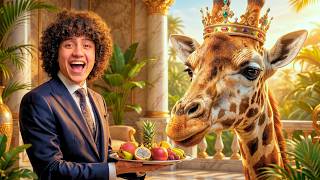

Only 1 in 4,000 Giraffes Has This Condition
44sReveals an extremely rare genetic condition that sparks curiosity and awe.
▶ Play Clip"The title promises a dramatic bath failure, but the bath is just one small part of a broader caregiver experience."
The video follows a YouTuber as they attempt to become a caregiver for the only giraffe in Colombia, a unique animal named Otun who suffers from alopecia, a rare genetic condition. The experience involves cleaning his habitat, feeding him a strict diet using a pulley system, and performing health checks, culminating in a difficult bath that doesn't go as planned.
The giraffe, named Otun, was born in a sanctuary in Mexico and arrived in Colombia 8 years ago. He has alopecia, a rare condition affecting 1 in 4,000 giraffes, causing him to lack the typical spots.
The caregiver cleans up Otun's poop, which is surprisingly small and rabbit-like, not the horse-sized droppings one might expect from such a large animal.
The feeder is cleaned and the leftover leaves are weighed to track how much Otun ate. The feeder uses a pulley system because it's too high to reach by hand, and the giraffe's strength requires a chain and padlock to secure it.
Otun's diet is strictly measured. The caregivers weigh the food given and subtract leftovers using a spreadsheet. In this case, he consumed 3,950 grams of food.
Otun's favorite food is a plant called matarratón. The food must be hung without touching the ground, as he refuses to eat if it touches the dust. The food is weighed and then lifted into the feeder.
The creator promotes an upcoming book signing at the Bogotá Book Fair on April 26th, urging viewers to attend.
Otun undergoes a podiatry procedure. He is trained to place his hoof on a stand for inspection. The hooves are cleaned, filed, and a cream is applied to prevent infections.
To stimulate Otun's intelligence, treats are hidden in a jar for him to find with his 50 cm long tongue. This encourages natural foraging behavior.
The caregiver cleans Otun's indoor habitat, picking up poop that is described as smelling like rabbit droppings. Otun is very particular about cleanliness.
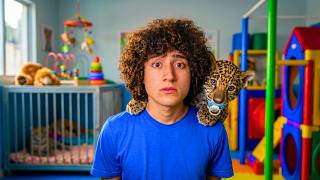
The team attempts to bathe Otun using special shampoos to treat his scabs, but he becomes distracted and tries to lick the creator's hair. The bath is partially successful but challenging due to his size and reluctance.
Caring for a 5-meter giraffe with alopecia requires immense dedication, from precise diet management to health checks, and even the simplest tasks like bathing can become complicated. The video highlights the unique bond between zookeepers and their animals, and the behind-the-scenes effort required to keep a rare creature healthy.
How rare is alopecia in giraffes?
It occurs in 1 in 4,000 giraffes.
00:13
What is the giraffe's favorite food called?
Matarratón.
04:13
Why must the giraffe's food not touch the ground?
Because if it touches the ground, he refuses to eat.
04:42
What size is the giraffe's tongue?
Approximately 50 cm (20 inches) long.
10:42
What is the pulley system used for?
It is used to lower and raise the feeder because of the giraffe's height and strength.
01:49
What are the horn-like structures on a giraffe's head called?
Ossicones.
11:58
How much food did Otun consume according to the diet calculation?
3,950 grams.
03:31
Alopecia in a Giraffe
This is an extremely rare condition, providing a unique case study for zookeepers.
00:13Pulley System for Feeding
Illustrates the engineering required to accommodate a large animal's height and strength.
01:49Hoof Conditioning Training
Shows that even large animals can be trained for medical procedures using positive reinforcement.
07:08Environmental Enrichment
Demonstrates how zookeepers stimulate natural behaviors in captive animals.
10:42[00:01] today I'm going to tell you about a legend, the only giraffe in Colombia. And today I'm going to be their caregiver. Oh, I'm looting myself. He was born in a sanctuary in Mexico and arrived in Colombia 8 years ago. What is most striking is its appearance
[00:13] because it has alopecia, an extremely rare genetic condition that causes typical spots of its species. This is something that only happens once in every 4,000 giraffes, which is why here at the biopark there is a team of experts who monitor him every day
[00:28] are in perfect condition. He's always the baby of the house. The first thing to do before feeding is to clean up. And the truth is, I don't know what find out. Now I want you to see the difference in the structure where
[00:41] Look at the height of all this. It is designed for an adult giraffe over 7m tall. The thing is, it still measures a little less than five, and it doesn't really grow much more. It was unanimous. First we're going to pick up all the poop from its
[00:55] the idea is to do it outside so that once it comes out it goes inside. So right His poop is like a rabbit's, but a little bigger. That is, and not even much bigger, only four times the size of a rabbit's poop. One
[01:09] imagine the poop similar to that of a horse, much bigger [music], but no. Look, it makes tiny little balls of poop. I'd like to smell it, but it looks so blow it away. We need to do this quickly because he's already
[01:21] Then, I pick it up and when I'm finished I show them its habitat so they can get to know it. We that not much came out, just look at this little bit that did. I mean, I say this 5 meters long, you imagine it's much bigger, but no, the truth is that it didn't come out very much. And
[01:36] now I'm going to show you their feeder. We also need to clean it up and remove these leaves that it ate yesterday. Go weigh them to find out how much he ate. But had a lot of doubt about how they did this [music] like the caretakers put
[01:49] no. It's a whole pulley system. Look, we have this box here that if you lift it up , it lifts up, it has this [music] lock, it's secured and over here is the pulley, which is what it does is lower it, much
[02:03] straps on, but rather that it goes down, everything is done down here and that's it. and I'm lowering it little by little. Yes, little by little. I couldn't. It's gone. Here is all the food that was given to him yesterday. So, basically, he grabs the
[02:17] key, everything is locked so that he can't undo it and he can pull really stuck to the tree. It has a chain. Because? I suppose it has a lot of strength, so if it puts a rope on it, it can break it.
[02:36] rest out and then I'll remove the chain to put it in there. There are only two bunches.
[02:50] very strict diet, [music] so everything is very measured. So what he does is weigh himself to know how much he consumed and to have all the statistics right. In this case it left 5g with 20g, but be careful, it has the chain. What should we do?
[03:04] The chain is removed and now only this is weighed and this weighs 1 kg. So, -1 kg 4.20 [music] was what it left. We have here this spreadsheet with the animal's entire diet . So, what we have to do is calculate how much was given and
[03:18] subtract how much he left, which in this case is 4.20 g. Therefore, if he was is 4.20 g. Therefore, if he was given 14g and 200g minus 4kg, that means no. You just did this calculation wrong. Just do this.
[03:31] The other one is that you're doing the 14,000 one. He tells you that it weighed. See? How important it is to have a professional by your side. Yesterday they gave him 8g 150g less 4,200, which is what he left. In total he consumed 3950, so that's what he
[03:47] left. Oh no, the spirit got confused. In other words, you've already taken the weight off his shoulders. Ah, the mess. So, this number goes here. Oh, sorry, I got confused. But in short, you
[04:00] calculate what was given yesterday minus what was left today to do this. It doesn't have a giraffe, but learn from it. Now we're going to bring him his favorite breakfast food, which is this plant called matarratón, and he
[04:13] that's eaten, but we also have this one called the golden button, which even say this from experience. It needs to be put together and weighed again. questions, I just listen to the caregivers.
[04:28] weigh him up. Let's see how many kilos they're going to be given right now. It weighs 13,600 g. I'm going and placed in the feeder without touching the ground. What's happening? This man is quite spoiled, and if
[04:42] , the earth, he can touch the grass, but if we put it on the ground, he feels that and stops eating. He is very spoiled. Well, I suppose it's because logically in their natural habitat the leaves of the trees don't touch
[04:54] similar as possible, right? Don't put it on the floor, tie it down and lift it up without letting it floor, tie it down and lift it up without letting it touch the dust. Otherwise, no. As fit us really tight because remember, he has a lot of strength in his neck and it's
[05:07] a huge neck, several meters long. So, that's why it's going to pull quite a bit. The chain goes in here, the hand is fastened, the hand is held tightly, it continues to be and remember that it has a padlock, so you have to close it. We have this other one
[05:21] keep it closed so he can't eat it. Dangerous. Then it turned out very well. Now it should be facing upwards. Because? Because you see them naturally. Oh, sure, yes, sure, sure. No, I just
[05:34] answered it correctly. Of course, I stopped looking up because the If it stays down, it would be unnatural. And it's also for his convenience so that he can break from here and it doesn't fall. If it's turned upside down
[05:46] , these can continue straight inside the chain and fall, and if it falls it tightened, you have to lift it up because remember, this was up there when we arrived. It's the hardest part. This thing is heavy and I didn't say why
[05:59] because I said I'd get scolded, but I got stuck here. Nothing, we're men, we're going to stuck here. Nothing, we're men, we're going to do this hard.
[06:16] Wait, wait, wait. Before we continue with this video, I have some very important information for you: you remember my book, right? Well , this April 26th I'm going to have another book signing at the
[06:28] book fair in Bogotá. So anyway, I hope to see you all there, all the people are around, well come so we can meet. That's in the 4th signature area . So anyway, you know, if you're around . See you at 10 a.m.,
[06:41] April 26, Bogotá, book fair, signing area 4. I love you all very much. male of this size requires impressive logistics. Being a based primarily on large quantities of foliage, branches, and bark.
[06:56] Daily, he consumes a balanced pellet mix designed with the exact vitamins and minerals his skin condition requires. In addition, it uses its nearly 50 cm long tongue to select the best leaves
[07:08] process allows you to make the most of every nutrient. Before taking it out, we're going to do some processes to it. His helmets will be cleaned, his when compared to other animals, because
[07:21] so the structure changes a lot. For example, to clean his face we're going to use this scaffolding here so we can be level and see it more closely condition where he has less hair, so we'll be able to analyze it more
[07:33] really. I've never seen, I mean, well, I have seen giraffes up close, but he's special. Yes, he's pooping, and look at him up close. You have to smell it. The podiatry procedure. What does this mean? We're going to check their hooves. What a
[07:46] a cow's hooves. You'll see it up close in a moment. And they just explained to me, we have this protective barrier and these enos are placed here because the idea is to give him the command to put his paw up here so we can check him. It sounds very
[07:59] simple, but we're talking about training a giraffe that's almost 5 meters tall out of the ordinary, but look, he's already there , well, he already wants to, I'm not saying he's very curious, he's very spoiled, so I feel it's going to be easy or well
[08:12] people don't know, and that is that giraffes bang their heads really hard, very hard. Not only can also headbutt them, but in this case he is calm. As soon as you see him restless, you can leave, but it's not
[08:27] Oh, look at him. And they haven't asked him to do it. He already knows what he's here for. I'm not saying he's extremely spoiled . Yes, it literally currently undergoing is a conditioning exercise to allow for a
[08:40] thorough inspection of his hooves from below. What I mean by this is that many times what he would do was simply put his paw up here, but you couldn't see check him. In this case, the bottom part is folded down and it understands what it
[08:53] driven. What we do there is clean it and check that everything is in calm. One would think that such a large animal, which honestly is very , [music] would be very difficult to carry out this process, but no,
[09:06] In this case it's pretty good, but if you notice, there's a small gap here, meaning there's extra wear. He'll probably have a place where he spends overgrowth, the same thing is done with horses. It's filed down, it
[09:19] cleaned so that it's really clean, because remember that the life of every animal begins with its paws, it's the most important thing. So, honestly it's incredible, it's very hard, it's enormous, I mean, it's three
[09:33] impressive. We wet the brush a little and clean it with water. Now doing to make him stay still? In other words, he loves being brushed. Well, maybe so, but there's food in the back, which is the incentive. It is used as a
[09:47] favorite food. So, they keep him there happy while we do this to him. It's nice and clean now. It smells, it smells like a horse's hoof. Yes.
[10:02] ruminants, just like cows. Do you know what a ruminant is? Leave it in the comments. Finally, it is brushed. And now we have this special helmet cream that says topical use, that is, for health, [music] that
[10:14] clean. So, you see, that's how it is. Now it's time to undo it here and smear it all over the helmet. So, look, over here, in the center, nice and spread out. That's it, well, well applied so that it protects your hooves from infections.
[10:28] told you we were going to give it a facelift. What's happening? We're running a bit behind schedule, afternoon and that process will take place then. For now, we're going to give him an environmental stimulus with this jar here. So the idea is to put all his
[10:42] find it with his tongue and, well, strengthen his skills. 've already done with all their food. We're going to weigh it, chop it up, and put it in weigh it, chop it up, and put it in here.
[11:00] tied with the chain. Once it's secured with the padlock, it's made safe. It remained. Everything's ready inside, nice and clean, good food, reinforcements, everything's awesome. And Kotúon is already waiting for us to open it. So, I'm
[11:15] open it. This one also has a lock, but you just lift this up and pull. It good bearings, so you can pull it by hand. Tacamos autún. Oh, did for you. Try their jam, their carrot, their celery, their concentrate.
[11:29] Now let's see how it goes. Wow, no. This is very impressive. Let's see, hopefully, what we prepared for him. I didn't prepare anything, the veterinarians did. You caretaker, told us, "He's a gossip. Since we're here, he's not going to come
[11:44] here gossiping about who's here." It's amazing to know that we're on a wall and yet he's still taller than us if he finishes craned his neck. n't actually called horns, they're
[11:58] oscicones and they're part of the bone. The thing is, theirs is covered in skin, it notice, it has one in front and one in back. And look at it, it's there. No, no, no. He is very spoiled . He is 8 years old. At this point, it's just a matter of waiting for him to eat. We're going
[12:12] matter of waiting for him to eat. We're going to stay for a while.
[12:30] daily challenges that force him to think, whether by hiding his favorite treats different heights for him to use his 50 cm tongue. Each of these your intelligence. This way we make their environment a controlled place and
[12:44] And well, like the rest of the videos you've already once he's outside enjoying his external habitat is to clean the internal habitat. It's time to pick up a lot of poop.
[13:03] Poop. I haven't forgotten, kid. You have to smell his poop. I have to admit that I was really disgusted to pick it up at first but I've picked up so much now that I'm used to it and I don't mind picking it up with my hand anymore. Man, did you see what celery, apple, carrot, and little tree eat? I do
[13:17] ugliest, most horrible, disgusting [ __ ]. So far, the elephant is winning. Let's see the poop of the otú, the only giraffe in Colombia with alopeces colbito. Look, it ca rabbit poop. Giraffe poop smells like rabbit poop.
[13:35] clean, or rather, that has taken me the longest , but for the simple reason that he is very spoiled, very curious, very pampered, very beautiful, but what happens if you don't pick up every little ball of poop? Oh no, I'm not going in. If the
[13:47] water isn't completely drained and new water isn't put in, no, no, I'm not going in. If leaving no residue, and then replaced, oh no, I'm not going in. If people don't like the video, I'm not going to go in. And if they don't subscribe, neither do they. Okay, okay,
[14:02] no. Give it a like. The only giraffe in Colombia said it, so listen to her. This animal is very demanding, believe me, because with others you would give it its diet, clean up after it, and leave, and then you'd have to come back and do things again until the afternoon. No,
[14:14] already ate what we left for him this morning on top. Now it's time to open the door for him, let him go out to his patio and stay there while we go, bring him more of the little tree, hang it up, and basically do what was done this morning, but it has to be
[14:27] done. Here I go. There's the man waiting for us. We opened the door for him and let him into cleaned. Once he enters, he'll probably go and gossip about who close it off here because otherwise we'll be entering its habitat and it would be in the same place
[14:41] mean, you just told me that they've already subscribed, so you can already enter, I mean, there's no problem anymore.
[15:01] see him. No, not that either.
[15:15] . Look, I had to try it too, I mean, the caregiver did it, want everything supervised by professionals? To end the day, we're going to do what I talked about so much this morning. We're going to bathe Otun, but
[15:30] you already know, Otun has a skin problem, so what we're going to several shampoos that will help with that problem. He already has alopecia, that is, as such, his hair will no longer grow, but he still stimulates it so that the
[15:43] way, because if you notice, he has quite a few scabs. So, the idea is to be able to brush that off, to be able to remove it, and well, logically with a vet, a well, logically with a vet, a caregiver, all professional people, and I
[16:03] right? But it's generating a lot of curiosity. water. This is a similar, let's see, complex process. If you see that there are complications, it's normal because we're talking about
[16:16] performing a procedure on the face of a 5m tall giraffe. In other words, the concentrated form we have. The problem is that he's not licking my hair. He's obsessed with my hair. Thank you very much.
[16:29] Yes, something strange for Bueno, well yes, because I haven't seen it. Oh, I got a scratch. This is completely normal. So sometimes the animals don't want to have a procedure done on them and they won't let it be done.
[16:42] because it doesn't bother them. In this case, it may not be something that bothers him; he may have done many things all day, and be tired and want to go to sleep. We tried adding water to it little by little. He's not leaving, is he
[16:55] adding water to it little by little. He's not leaving, is he ? How do you explain to a 5m giraffe that this is good for him? Very difficult. that kid is letting himself go. If the extraction is my hair, then it works.
[17:08] Very good, kid. The idea is to be able to clean his entire face. Great progress. The entire left side has been left. I tried to do it up here and he inside my eye. It was time to bring more food to his favorite rat poison. Let's
[17:21] more. He gets a little more distracted while eating. And let's see if he lets us eating. And let's see if he lets us approach and brush him. That. Good. The whole cheek is already there. We just added a special shampoo to the brush
[17:33] to remove and moisturize scabs, which is what he has, it's his problem. So, let's apply it to him. That. Good. That. Come on, we'll apply it this way . Very good. That. Look how cool this is! You.
[17:46] Okay, let's make a taratú. I let him bite my hair and he lets me brush it. We're going to remove the shampoo we just put on it . That's it . That's it , kid.
[18:02] incredible experience and these spectacular animals. So I'd like to take this opportunity you farmers, if you'd like to come and learn about how amazing. Believe me, you're going to enjoy it a lot. And again,
[18:15] thank you so much for trusting me to record and show you all a little bit of all the work that goes into all these animals. And remember, if you liked this video, you can like, share,
[18:27] forgot any, well, you know. Goodbye farmers.
⚡ Saved you 0h 18m reading this? Transcribe any YouTube video for free — no signup needed.