
LL Cool J's DNA Surprise
45sCelebrity DNA revelation that challenges family identity, sparking curiosity and emotional engagement.
▶ Play Clip"Delivers on the promise of answering DNA questions with expert insight, though some answers are brief."
In this video, investigative genetic genealogist CeCe Moore answers a range of questions about DNA, genetic genealogy, and the use of DNA in solving crimes. She explains how DNA can be used to trace ancestry, identify relatives, and even solve cold cases, while also addressing common misconceptions about ethnicity estimates and the accuracy of DNA tests.
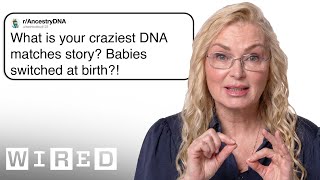
CeCe Moore shares a story about LL Cool J, who discovered through DNA testing that his biological grandparents were not his grandparents, as he had been partly raised by them.
Explains that in investigative genetic genealogy, DNA is used to identify ancestors and piece together family trees, which can help identify unknown DNA contributors in criminal cases.
Discusses that the three largest DNA databases (Ancestry, 23andMe, etc.) are owned by private for-profit companies, and their terms of service determine whether law enforcement can use them. Some databases like GEDmatch and DNA Justice have opted to allow law enforcement use for identifying violent criminals and Jane/John Does.
The craziest stories are baby switches, where people were switched at birth and lived lives intended for someone else. Moore has worked on dozens of such cases, including some where babies were purposely switched.
Genetic genealogy combines DNA testing with traditional genealogical research to trace ancestors back in time, helping to break through 'brick walls' where paper records are missing.
Over the last eight years, more than 400 cases have been solved using genetic genealogy, including the identification of John Miller, who murdered a girl in 2018.
Yes, because of exponential growth of family trees and pedigree collapse, any person living in Europe over a thousand years ago is an ancestor of all Europeans today.
The ease of tracing lineage depends on the population group; for example, Iceland has records going back 30 generations, while some regions have poor records due to historical events like WWI paper shortages.
The term 'ethnicity' is not accurate; genetic genealogists prefer 'Ancestral Origins' or 'Biogeographical Ancestry' because ethnicity is a social term related to culture, not genetics.
A user asked about a potential relationship with a grandma's uncle; Moore explains that there is only about a 10% likelihood of issues in offspring of first-degree relatives, and many such cases occur without problems.
Mitochondrial DNA is passed from mother to child, while Y-chromosome DNA is passed from father to son, allowing tracing of maternal and paternal lines respectively.
The longest it has taken to identify a DNA contributor is for a little girl from a population with less representation, due to a genealogical brick wall at the 1870 census where African Americans were not enumerated by name.
Genetic family trees only include people from whom you have inherited DNA, which is about 50% of your ancestors from your third great grandparents onward, due to recombination.
Siblings inherit different DNA from their parents (about 50% shared), so their ethnicity estimates can differ because they inherit different segments of DNA.
DNA tests are highly accurate for identifying relatives (e.g., half-siblings), but ethnicity estimates are a developing science and less precise, especially at a granular level.
First cousins share a significant amount of DNA, but third cousins might not share any DNA at all due to recombination.
Genetic genealogy is a powerful tool for both personal ancestry discovery and solving cold cases, but it requires understanding the limitations of DNA testing, especially regarding ethnicity estimates and the importance of paper records.
What is genetic genealogy?
The combination of DNA testing with traditional genealogical research to trace ancestors back in time.
04:26
How many cases have been solved using genetic genealogy in the last eight years?
Over 400 cases.
05:08
Why are all Europeans descended from Charlemagne?
Because family trees grow exponentially and due to pedigree collapse, any person living in Europe over a thousand years ago is an ancestor of all Europeans.
06:04
What is the difference between ethnicity and ancestral origins?
Ethnicity is a social term related to culture, while ancestral origins (or biogeographical ancestry) is a more accurate genetic term.
09:05
What is the likelihood of issues in offspring of first-degree relatives?
About 10%.
09:47
How is mitochondrial DNA inherited?
It is passed directly from mother to child.
10:30
Why might siblings have different ethnicity estimates?
Because they inherit different DNA from their parents, sharing about 50% of their DNA.
13:09
Are DNA tests accurate for identifying relatives?
Yes, they are highly accurate for identifying close relatives like half-siblings.
13:51
LL Cool J's Discovery
Shows how DNA can reveal surprising family truths, even for celebrities.
00:16400 Cases Solved
Demonstrates the significant impact of genetic genealogy on criminal justice.
05:08Charlemagne Ancestry
Explains a common misconception about ancestry and exponential family tree growth.
06:04Ethnicity vs. Ancestry
Clarifies the difference between social and genetic concepts of ethnicity.
09:05Accuracy of DNA Tests
Distinguishes between highly accurate relative matching and less precise ethnicity estimates.
13:51[00:00] I'm here to answer your questions from the internet. [upbeat music] "What's the most interesting discovery
[00:16] One that comes to mind is, and she didn't know it. with her parents at all.
[00:28] her biological parents through her DNA alone, because LL Cool J had been partly raised so it was very significant to discover
[00:43] that they were not his biological grandparents at all. just from A DNA sample?" in Investigative Genetic Genealogy,
[00:56] to when we're working with law enforcement, from their DNA alone. is inherited from all of your ancestral lines.
[01:11] And so if we can identify your ancestors then we can piece your family tree back together, who the DNA contributor is,
[01:25] we can start piecing their family tree back together, So if you share DNA with four people we know that's one piece
[01:40] and he must also be a descendant A Quora user asks, through genealogy tests like ancestry.com?"
[01:55] 23andMe, the three largest DNA databases, for using their services for criminal research.
[02:09] are owned by private for-profit companies, procedures and terms of service. and those services
[02:23] not for law enforcement to find criminals, have made a different decision. and DNA Justice have specifically decided
[02:37] and to help us identify violent criminals, and Jane Doe's are people who have died who have not been returned to their families.
[02:49] and we're not even allowed to use Over 54 million people but for law enforcement cases,
[03:03] and try to identify the contributor of that DNA. "What is your craziest DNA matches story?" The baby switch ones are probably the craziest to me.
[03:18] at all with their family tree, One is they were adopted but another one that we're actually finding many of,
[03:30] I have worked on dozens of those cases where people were switched at birth and lived a life intended for someone else.
[03:44] but we also have some cases was purposely switching out the babies.
[03:56] had a very ill baby, and a poor single mother for instance, Sometimes they would purposely switch those out
[04:12] to keep the rich customers happy. "What is genetic genealogy?" Well, genetic genealogy is the combination
[04:26] where you're tracing your ancestors back in time, So, DNA has been used for genealogical purposes
[04:38] and that really has helped to inform our genealogy. which means they can't get further back who your great-great grandparent is
[04:54] and you're unable to find the paper trail records So if you turn to DNA testing, that were formerly your brick walls.
[05:08] "What cases have been solved Well, over the last eight-years, have now been identified through genetic genealogy.
[05:21] solve over 400 of those cases One case that comes to mind She was walking to her friend's house
[05:34] and murdered by a man named John Miller, and I helped to identify him in 2018. that had been identified through genetic genealogy.
[05:50] he pled guilty to the crime and he ended up dying in prison. "Are Europeans really all descended from Charlemagne,
[06:04] The answer to that is yes! Charlemagne was the king of the Franks from 768 and he had at least 18 known children.
[06:17] it's actually true for any person who lived in the ninth century in Europe And that is because our tree grows exponentially
[06:31] to the point where we would have more ancestors at that point of time. we would've had over a billion ancestors,
[06:45] at that time in history. So any person living over a thousand years ago in Europe is actually the ancestor of all people
[07:00] And that would also be true, or any part of the world really, because our family trees grow out like this
[07:12] it's called "Pedigree Collapse", it looks more like a diamond. why it's often difficult to trace your lineage
[07:25] on your population group, because some places have much better records than others. For instance, if your ancestors are from Iceland,
[07:40] to trace your family tree back 30-generations. Or Switzerland has records going back over 700-years. to the 1400's on my Finish lines,
[07:55] and that is because they have such fantastic records. that either didn't keep records, For instance, in World War I,
[08:08] due to a severe shortage of paper, and used that raw material for other purposes. there may be scrolls that traced your family tree,
[08:24] back thousands of years. and to be able to find those. from the Southern United States,
[08:37] And so you might have family records as they're called, or if you have Ashkenazi Jewish ancestry for instance,
[08:51] during World War II. "Can someone explain the whole idea of ethnicity to me?" not to use the term "ethnicity"
[09:05] Instead we use terms like "Ancestral Origins" And that is because "ethnicity" someone's culture or traditions.
[09:20] in your family. And so "ethnicity" is more of a social term or "Biographical Ancestry"
[09:34] Now, ethnicity is used for these tests because it's easily understood by the public, but it's really not the most accurate term
[09:47] Potential-Stop-5998 asked, is his grandma's uncle, No, you don't have to be worried
[10:02] There have been many typically without issues. there's only about a 10% likelihood
[10:16] on offspring of that couple. that their parents were first-degree relatives, NeuralStardust asked,
[10:30] For example, the family tree Well, it depends which type of DNA you are utilizing. directly from mother to child.
[10:44] your mitochondrial DNA from your mother, and her mother, If you're using the Y-chromosome
[10:58] called "Y-Chromosomal Adam", that all of men descend from, to 300,000 years ago.
[11:13] and Chromosomal Adam were a couple, although they both did come from Africa, A Quora user asked,
[11:28] using high-tech sleuthing to help law enforcement solve a case And, the longest it has taken,
[11:43] I've been trying to identify a little girl and that is because she comes from
[11:55] of which we have less representation. that genealogical brick wall at the 1870 census, were not enumerated by name prior to that.
[12:11] "I'd bite the bullet they can trace my ancestry." not fossil DNA.
[12:24] can be traced back at least 150,000 years. is really inherited
[12:38] We have Genealogical Family Trees Genealogical Family Trees are all your ancestors Genetic Family Tree is just the people
[12:52] from all of our third great grandparents, But when you get further back in the tree, and so now you're only inheriting DNA
[13:09] EngineeringLumpy asks, So he's referring to the ethnicity portion And the reason that siblings
[13:24] is because they inherit different DNA on about 50% of the DNA. from both parents.
[13:37] where we inherit the same DNA from one parent, where we don't inherit the same DNA User MandoMonroe00 asks,
[13:51] but how accurate is it?" of the results you receive One of those is to find relatives,
[14:05] that someone is your relative, they are. I see a lot of people who think it's a mistake that says it is a half-sibling.
[14:19] that can never happen by mistake, that is a very close relative to you. is the ethnicity estimate,
[14:35] it is a developing science. what parts of the world you come from meaning the Americas versus Africa,
[14:48] That is relatively easy to do. very granular results, And that's because there's been so much migration
[15:01] "Do you realize how much DNA you share So with your first cousins, and your third cousins,
[15:15] and you might not share any DNA Well, that's all the questions we can cover today. [upbeat music]


⚡ Saved you 0h 15m reading this? Transcribe any YouTube video for free — no signup needed.