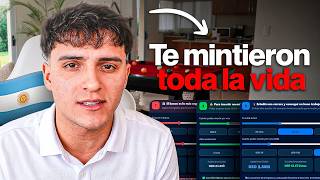

Why Everyone Is Wrong About Money
43sChallenges the common belief that popular opinion equals truth, sparking curiosity and debate.
▶ Play Clip"Delivers on the promise of debunking five money myths, but includes some filler and a sponsor plug that slightly dilutes the value."
This video debunks five common financial myths that are widely believed in Argentina, such as the idea that buying dollars is a good investment, that you need a lot of money to start investing, and that a university degree guarantees a good retirement. The speaker uses real-world examples and simple calculations to show why these beliefs are misleading and offers practical alternatives for building wealth.
Just because a belief is repeated by many people (e.g., buying dollars is the best investment) doesn't make it true. Argentinians tend to give opinions on everything, including finance, often without real knowledge.
Due to Argentina's history of bank freezes (corralito) and forced bond conversions (Bonex plan), people distrust banks. However, the speaker argues that keeping money in the bank is still safer than commonly believed, though returns are low.
While the dollar rises in nominal terms due to inflation, in real terms (adjusted for US inflation) it often loses value. The speaker shows that from 2023 to 2026, the dollar rose only 300% while inflation was over 30% per year, meaning dollar holders lost purchasing power.
Leaving 1 million pesos in a bank for 5 years yields 190,000 in real terms; Mercado Pago yields 430,000; staking yields $981 (almost zero); S&P 500 yields $1,317. The speaker recommends investing in the S&P 500 for better returns.
While money itself doesn't bring happiness, lack of money causes stress and unhappiness. Money, when managed well, provides freedom of time, which indirectly generates happiness.
You can start investing with small amounts (1,000–5,000 pesos). Consistent monthly investments of $20–$100 can grow significantly over time due to compound interest. Examples: $50/month for 30 years yields $250,000; $100/month for 30 years yields $500,000.
Consumer debt (for clothes, trips) at high interest rates is bad. However, good debt (e.g., a mortgage for a house, a loan to invest in a business) can be beneficial if the return exceeds the interest rate.
A degree no longer guarantees a good job. Retirement systems are underfunded due to demographic changes. The speaker recommends investing early (e.g., $200/month from age 25 yields $3.8 million by age 65) and planning your own retirement.
The speaker encourages viewers to question common financial myths, start investing early with small amounts, distinguish between good and bad debt, and take personal responsibility for their retirement planning rather than relying on traditional systems.
What is the main reason Argentinians distrust keeping money in banks?
Due to historical events like the 2001 corralito (bank freeze) and the Bonex plan (forced bond conversion).
01:50
Why is buying dollars not necessarily a good investment in real terms?
Because the dollar also loses value over time due to US inflation, so its real purchasing power may decline.
03:22
What was the approximate real return of leaving 1 million pesos in a bank for 5 years?
190,000 pesos in real terms.
05:20
What is the key factor that makes small, consistent investments grow significantly over time?
Compound interest.
09:49
What is the difference between good debt and bad debt according to the speaker?
Good debt is used to buy something that generates income (e.g., a house, business investment), while bad debt is for consumption (e.g., clothes, trips) at high interest rates.
11:29
What is the 4% rule mentioned in the video?
A rule of thumb for withdrawing 4% of your investment portfolio annually as passive income without depleting the principal.
09:09
How much would investing $100 per month for 30 years in the S&P 500 yield according to the speaker?
Approximately $500,000.
09:37
Dollar is not a guaranteed investment
Challenges the common Argentine belief that buying dollars is always a safe investment by showing real purchasing power loss.
02:55Comparison of savings options
Provides concrete numbers comparing bank savings, Mercado Pago, staking, and S&P 500, showing the superiority of the latter.
05:20You can start investing with small amounts
Debunks the myth that investing requires large capital, showing that $20–$100 per month can grow to hundreds of thousands over decades.
07:48Good debt vs. bad debt
Introduces a nuanced view of debt, distinguishing between consumption debt (bad) and investment debt (good), which is rarely discussed in personal finance.
11:29University degree no longer guarantees success
Highlights the changing job market and retirement landscape, urging viewers to take personal financial responsibility.
13:37[00:02] take for granted and treat reality is that even if something is repeated many times, even if a phrase, a thought, or a situation is repeated many times, it doesn't mean that it's
[00:17] true. Just because your parents, your grandparents, your friends, or acquaintances say that buying dollars is the best investment doesn't mean that buying dollars is the mean that buying dollars is an investment. Just because a lot of people are talking about something
[00:31] doesn't make it true. And this is something that we all have inside us. If everyone thinks one thing and we think differently, we feel like we're being left out because most people think one thing and we don't think that, we immediately start
[00:45] 's rotten. Because? What is the justification? Well, if everyone thinks that, they must be right. And the reality is that it's not. We Argentinians think we have it all figured out . In fact, Argentinians are
[00:57] opinion-givers. We think and give our opinions about everything, and we know little or nothing about most things. Yes, very good. You're specific about one topic, but what do you know about football? Well, maybe you know about football, well, livestock farming, what do
[01:10] No, well, but I do know something. Well, when it comes to car mechanics, cars, everyone always gives their opinion as if they know everything. And the financial sector is a sector Argentinians have an opinion on because we've always had high inflation, because the
[01:24] lot of things like that that make us Argentinians very clear about it. But then, if you start chatting with someone who really people are just selling opinions from Argentina. Now, in
[01:37] this video we're going to talk about [music], five myths, about five things in thinks one way, because in reality interested, stay tuned to the video. Firstly, and as the first lie about
[01:50] cheat a little and start by saying that having money in the bank is the Argentinians are already completely traumatized by banks because of what happened in 2001, the famous corralito, where you couldn't withdraw your money; you deposited
[02:04] money and could only withdraw 200 pesos per week or something like that. In other words, if you actually invested money, they entrusted it to you, gave you bonuses, and that's it. The same thing happened when Menem's government began . Alfonsín left behind
[02:16] rampant, extremely high inflation, and to lower that inflation, the famous Bonex plan. They have a 30-year bond. Yes, it value the economy, but the people who had money in the bank, boom, in
[02:29] and that's it. Moving on. Now, we already know this. We already know that having money in the bank makes no sense because of the history of Argentine banks. While it is very unlikely that we will have a bank run at the moment due to the reserve requirement rate
[02:42] and other factors, there is always a small possibility because it is Argentina. Now, I'm going to add that people respond, "Yes, yes, you're absolutely right. a reality. You can't keep money in Argentine banks; what people think they have to
[02:55] money is buy dollars, and that's all they do with their money. dollars is an investment because the dollar always goes up, and that's understandable because Argentina is a very unstable country and the dollar always rises in
[03:09] nominal terms. What does this mean? It's 10,000, then it's 1,300, then it's 1,500. But in a country like Argentina, with so much inflation, it doesn't make any nominal terms, because since you have inflation, everything is going to go up, but that doesn't
[03:22] goes up is a good investment. What you 're doing, which is very important, is transferring your savings from a very weak currency, which is highly undervalued, like stronger currency like the dollar, but which also devalues over
[03:37] time. The United States has inflation, and as the years go by, those services because all countries in the world have unsustainable currencies that they print in droves, and inevitably, you have more or less that inflation in every
[03:51] country in the world, and all countries devalue their currency. If you want to know more precisely whether you're making or losing money with the dollar, you should have a graph like inflation, because the dollar is just another asset in the economy. For example, you'll
[04:04] beginning of M's government, the dollar was around 11,200 pesos; it reached 1300 or something like that. If at that time you bought dollars at 1200 pesos, you had rampant inflation throughout 2024, 2025, and in 2026 you
[04:19] also had inflation above 30%. So the dollar only rose 300. So in real terms, we should have a I'd use a dollar of approximately 4,100 lost or gained money in real terms. Now, as you can see,
[04:34] you lost a ton and saved dollars. Yes, you have the same amount of dollars, but you're buying fewer goods and services in the overall economy. The same would apply if you had bought dollars during the famous " dollar of 20 pesos" exchange rate. Back then, the
[04:46] dollar didn't stop rising until the end of 2023, and we could consider that dollar purchase an investment, but in the long run, it doesn't make much sense to gamble on whether the
[05:08] expensive is pointless. And let's not forget another super important point: having make much sense because the returns the bank gives you just on the money are practically nonexistent or zero. In fact, build A calculator
[05:20] the video. And in this case, the bank is the safest option. If you leave 1 million pesos in the bank for 5 years, in real terms you'd end up with 190,000 for leaving it there. In Mercado Pago you'd have 430,000 pesos because today
[05:34] is still below the inflation rate of around 30%. But if we do, for example, staking X, we'd get a very good return in dollars, so we could have the money in dollars and with returns
[05:47] we'd have $981, which is 1 million pesos today. That's almost $0. And in the S&P 500, which are the 500 largest companies in the United States , we'd have $1,317, much better. Before we get to the video, I'll give you a little plug. If you want to
[06:00] the description where you can... You'll get an 8% return in dollars and 5% in USDC, with the link I've left in the description, you can participate in the buy S&P 500 from US companies, you can create an
[06:15] the CNB, the National Securities Commission, and has 25 years in the market. I've also included continue. Regarding lie number two, we might encounter many clashes of me and others who agree. Where could we start a debate in the
[06:28] comment, I'll be reading all of them. The point is that money doesn't buy happiness. And while I'm in a good financial position and you start earning money, the reality is that money itself, luxuries, and things it provides
[06:41] don't inherently bring happiness. Just because you bought a car doesn't make you having money does generate tremendous unhappiness. Earning 500 or 600 thousand living you want, or simply not making ends meet,
[06:55] creates tremendous stress and insecurity that having money doesn't. What having money does generate is that if you manage it well, invest it, it will give you much more freedom of time. What are we
[07:09] looking for? For me, time is much more important than money, and in that way, money gives you more freedom, more time to be with your family, friends, do things you enjoy, and in that indirect way, it does
[07:22] generate happiness. So money isn't inherently bad. I believe it's we use it as a means. Therefore, if you're investing it consistently and intelligently, I recommend that you subscribe to this
[07:35] and obviously, like this video. And in the coming days, I'm going to... Record a opinion on this topic, about whether or not money buys happiness, providing data and a relaxed conversation. So, wait for it. Lie number three has to be one
[07:48] of the ones that annoys me the most because it has the greatest impact on people's lives in the invest you need a lot of money." And this is a complete lie. you can start investing with 1,000, 5,000, 10,000 pesos and buy things. You might
[08:02] say, "Okay, but in practice, can you actually go and buy 5,000 pesos worth of things?" Buying a small amount of money won't make any difference in the long run money, like I said." The reality is that you don't. If you create a consistent plan,
[08:15] don't. If you create a consistent plan, invest $20 or $50 every month, and you can $100 per month, which isn't a huge amount of money. Any Argentinian who... If you have a roughly average salary of 1,200,000 pesos, you can aim to
[08:28] save 20, 50, or even 100 pesos per month in the best- case scenario. And in the long run, that will generate a drastic change in your personal finances, allowing you to buy your own house, your own car, or even have 300, 500, 700 thousand dollars
[08:42] generating interest. You might say to me, "Seriously, what are you talking about?" "$50 a look at it on a calculator because otherwise people won't believe me. That's what we want to be lot of money. What happens if we invest $50 a month for 10 years out of
[08:55] our own pocket? We put in six grand and we have $12,500 over time. In the S&P 500, right? In staking, $ 8,650. But what happens if we month, we invest $2,000 over time and we have $60 grand that we can
[09:09] withdraw using the 4% rule, $200 per month. If we do it for 30 years, we already have $250 grand, having only put in $18,000. I won't even tell you if you do it for look that up yourself, because of
[09:22] 40 years, I'd say it would be close to the mark. Now, what happens if we do this with $100 per month instead of $50? In 10 years, you have $25,000 having invested $ 12,000. In 20 years, you have $1,000 having invested $ 24,000. And in 30 years, you have half a million
[09:37] dollars having invested $36,000. If you use the 4% rule, you have a passive income of $16,600 per month. Not to mention owning a home and things like that. And this is doing it for 30 years, from age 20 to 50.
[09:49] If you do it from 20 to 55, or from 20 to 57, or from 20 to 60, you'll be compound interest, it's not the amount of money you invest that matters, but the time. The four percent is extremely important, and I think most of Argentine society should
[10:03] see it. Debt is a bad thing, and in most cases, this is a reality. In fact, nowadays all the kids of 16, 18, 20, 25 years old, even apps like Mercado Pago and say, "Uh, Mercado Pago, I'll lend you 200,000
[10:18] pesos, right now." Ta-da, great. And they go into debt at extremely high rates, with total financial costs of 400, 500, 600, 1000%, which they then don't pay back, and for owing three and a half million. And this is a reality; I'm not
[10:33] look up a little data, there are more and more young people going into debt 500,000 pesos right now for free." In fact, let's see how much Mercado Pago will lend me. Actually, they never asked for anything. A lot of people, oh yeah, I use Mercado Pago and I pay it back.
[10:48] transfer to my Mercado Pago account because Mercado Pago will eat it all up. It's completely out of control now. Look, right now I'm borrowing 1,154,000 pesos, a personal loan to use however I want,
[11:02] . And the reality is that today, with Mercado Pago, you go in and say, "Hey, , no problem, maybe you don't earn money, you don't have a job and people are completely in debt. Now, this is a topic for another video, because I was actually
[11:16] record a video about this, but not all debt is bad. While most people are indebted, it is very bad. And if you can't distinguish between bad debt and good debt, it's best not to get into debt. But if
[11:29] you go into debt to buy clothes, you go into debt to go on trips, you go into debt minimum, all debt that is debt, the famous consumer debt, which usually you can have. And don't do it. But I'm going for another good debt. For example,
[11:45] you're renting, [music] you're paying 600 grand in rent and that 600 grand U loan. And with a lot of sweat and tears you have 10,000, 15,000 or $10,000 saved up mortgage or your family lends it to you, you see how you do it that
[12:00] way. You're going to go from paying 600 grand in rent to paying 600 grand on a UBA mortgage loan and you're going to have your own house, which here takes 15, 20, 30 years in prepay, which prepaying is the best thing you can do with
[12:13] you only prepay the principal, so the interest goes down. That's another topic for another video. In that case, you'll be paying the same amount between rent and mortgage payment, part of what goes to the bank is interest and part is the principal. But
[12:27] capital because we live in a capitalist society where accumulating capital is the home. Not to mention, you'll have greater peace of mind, and instead of spending or , on the killer, you're putting it, so to speak, into a
[12:42] house. That's why it's important to know the difference between bad debt and good debt. And for that I also created an interesting calculator where we'll assume you have an amount to buy of 500 grand from here to 3 years, a bad debt they
[12:56] in the best case you end up paying three grand, impressive. half sticks, that's what happens to people. And to be good for investing, let's assume you get a loan at a rate of 8%, which is still high, but you can
[13:10] invest it at around 13.5%, giving you a positive spread of 5.5%, meaning you can take on debt to invest in something better. There is very little of this in Argentina. In the you, move this way, that way. In Argentina it's very difficult, but all
[13:24] debt that is used to buy something that generates income, whether it's training buying a house, or investing more in a business to have higher profits, all of that is good debt. all the rest of the
[13:37] consumption and bad of one. And the last lie is, "Hey, go to university, university you'll get a good job and then you'll have a good retirement." Sadly, this worked 30 or 40 years ago for
[13:50] Today it's much more complicated, and a degree doesn't guarantee you anything completely. And let's not even talk about retirement. Retirement is a completely fewer children. An inverted population pyramid is going to be formed
[14:04] . Our retirement is going to be meager, we won't have one, so you have to not to mention starting your own business elsewhere, continue training with master's degrees and the market, because otherwise, the job market is an environment that we all know
[14:18] 're watching this video at 25 years old, meaning you're only 40 years old when you can retire. Today you can invest $200 per month. Well, for your retirement in 40 years you're going to have 3.8 million dollars. If you
[14:32] use the 4% withdrawal rules, you can withdraw $1,600 from a minimum pension of 480,000 pesos or a pension of 1.5 million . That's why it doesn't make much sense to relax and say,
[14:47] no, no, no. You have to start at 20 end up retiring with three million, 700, that's right, after 40 years. Do you want to retire earlier? You can do that too. In fact, my plan is to be able to live until I'm 45 or
[15:00] 50 years old; I already have a very large and considerable capital, but they are different realities and different plans. But if you're realistic, retire at 50, how much do I need to save and how much money am I going to
[15:12] involved and plan your own retirement, which is what you'll most likely like, subscribe if you haven't already, love reading your feedback! I hope you enjoyed it and see you in the
[15:24] enjoyed it and see you in the next video. Ah. Bye.
⚡ Saved you 0h 15m reading this? Transcribe any YouTube video for free — no signup needed.