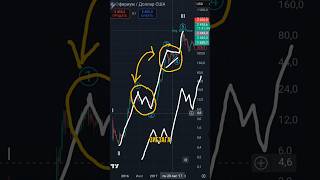

Elliott Wave Rule: Sharp vs. Sideways Corrections
45sThis segment clearly explains a core Elliott Wave principle with a concrete example, making it highly educational for traders.
▶ Play Clip"Title promises a clear explanation of alternation and delivers exactly that—concise and on-topic, though it lacks depth for advanced traders."
This video explains the rule of alternation in Elliott Wave theory, a key norm for identifying five-wave impulse structures. It describes how the type of correction in wave 2 (sharp vs. sideways) predicts the likely type of correction in wave 4, helping traders confirm wave counts and anticipate future price action.
Alternation is a norm of the five-wave structure, meaning it holds in most cases but not always. It helps verify whether the observed structure is indeed a five-wave impulse.
If wave 2 is a sharp correction (zigzag), wave 4 is more likely to be a sideways correction (triangle or flat). Sharp corrections are always zigzags (single or double), while sideways corrections are flats, triangles, or rare combinations.
Conversely, if wave 2 is a sideways correction (e.g., a flat), wave 4 is more likely to be a sharp correction (zigzag).
Using this norm helps traders confirm a five-wave impulse and anticipate the type of correction in wave 4, improving trade planning.
The rule of alternation is a valuable tool for Elliott Wave practitioners, offering a probabilistic edge in identifying wave structures and forecasting corrections. It is not absolute but serves as a strong guideline.
Sharp vs. Sideways
Clearly defines the two correction types and their typical structures, forming the core of the rule.
00:13Practical Use
Explains how the norm aids in wave counting and forecasting, making it actionable for traders.
00:59[00:00] Чередование. Одна из норм пятиволновой структуры, правило которой мы уже разбирали в плейлисте волновой принцип. Норма это то, что соблюдается в большинстве случаев, но не всегда.
[00:13] И по нормам той или иной структуры мы можем определить на графике, действительно ли перед нами та структура, о которой мы думаем. Что значит норма чередования? Если мы увидели, к примеру, в волне 2 острую коррекцию, то есть зигзаг, то в волне 4 с большей вероятностью мы увидим боковую коррекцию, то есть треугольник или плоскость.
[00:38] Острая коррекция это всегда зигзаг, либо одинарный, либо двойной, а боковая коррекция это либо плоскость, либо треугольник, либо редкая структура комбинация. И наоборот, если вторая волна является у нас боковой коррекцией, то четвертая волна с большей вероятностью будет являться острой коррекцией.
[00:59] К примеру, если во второй волне образовалась у нас плоскость, боковая коррекция, то в четвертой волне мы уже можем увидеть образование зигзага. Благодаря данной норме вы, во-первых, сможете понять, что перед вами с большей вероятностью 5-волновой импульс.
[01:15] И во-вторых, если вы заранее сумеете распознать формирование 5-волнового импульса, то вы уже будете знать, какая коррекция с большей вероятностью будет в 4-й волне.
⚡ Saved you 0h 01m reading this? Transcribe any YouTube video for free — no signup needed.