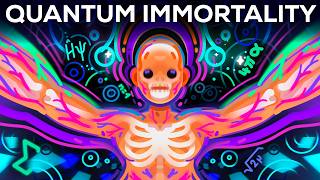

Are You Unkillable?
45sThe provocative idea of quantum immortality and a nuclear bomb in your living room immediately grabs attention.
▶ Play Clip"Title is dramatic but accurately reflects the thought experiment about quantum immortality."
This video explores the concept of quantum immortality, a provocative idea derived from the many-worlds interpretation of quantum mechanics. It uses a thought experiment involving a nuclear bomb to test whether an observer could survive improbable events, suggesting that if many worlds exist, a version of you always survives.
The video introduces the idea of quantum immortality, suggesting you might be unkillable if the many-worlds interpretation is true.
At the quantum level, particles like electrons behave randomly; kicking an electron the same way can lead to different outcomes, unlike everyday objects.
Quantum mechanics describes particles as probability waves, not physical waves, with values between 0% and 100% indicating likelihood of location.
Quantum mechanics has been tested extensively and works incredibly well, explaining phenomena from microchips to stars.
Two main schools of thought: 'shut up and calculate' (linguists) and many-worlds interpretation (literary critics).
This view holds that quantum mechanics is just a tool for prediction, not a description of reality. No need to visualize electrons.
All physically possible outcomes coexist simultaneously in branching universes. Each quantum event creates new branches.
A nuclear bomb is connected to an electron detector. If the electron lands in the living room, the bomb explodes; if in the kitchen, you survive.
In many worlds, each time the experiment is run, only the version of you that survives experiences it. You would always survive from your perspective.
If many worlds is true, there is always a version of you that survives incredibly unlikely events, but you should still care about all versions of yourself.
The many-worlds interpretation is elegant but unproven. No one has tested it with a nuke. If false, you only have one life.
Quantum immortality is a fascinating but untestable idea. While it suggests you might always survive from your perspective, it remains a philosophical speculation rather than established science.
What is quantum immortality?
The idea that if the many-worlds interpretation is true, a version of you always survives any event, making you effectively immortal from your perspective.
What is a probability wave?
A wave of probability that describes the likelihood of finding a particle at a given location, with values between 0% and 100%.
01:06
What is the 'shut up and calculate' interpretation?
The view that quantum mechanics is just a tool for predicting experimental outcomes, not a description of reality.
03:00
What does the many-worlds interpretation claim?
That all physically possible outcomes coexist simultaneously in branching universes, each equally real.
04:14
In the quantum suicide thought experiment, what happens if the electron lands in the living room?
The nuclear bomb explodes, killing that version of you.
06:14
According to many worlds, why would you always survive the quantum suicide experiment?
Because only the version of you that survives experiences the outcome; the dead versions cannot experience anything.
07:11
What is the probability of surviving 100 rounds of the quantum suicide experiment in a single universe?
About 1 in 10^70 (a 1 followed by 70 zeros).
07:43
Quantum Immortality Concept
Introduces the provocative idea that you might be immortal due to quantum mechanics.
Probability Waves Explained
Clarifies the non-intuitive nature of quantum probability waves.
01:06Shut Up and Calculate
Summarizes a major philosophical stance on quantum mechanics.
03:00Many-Worlds Interpretation
Explains the many-worlds view in an accessible way.
04:14Survival in Many Worlds
Key logical consequence of many worlds: you always experience survival.
07:11[00:00] You might be unkillable, impossible to delete out of existence – if one of the most exciting ideas about physics, quantum immortality, is true. To test this idea, we will put a nuclear
[00:13] bomb in your living room. But more on that later. This is real science happening around To understand why, we need to tell you a story.
[00:25] The story of the smallest parts in the universe, With everyday objects things intuitively make sense – if you kick a marble ten
[00:37] times with the same force and at the same angle, it always lands in the same spot. But if you kick an electron ten times exactly the same way, it shows up in different places. On the most fundamental level of reality, randomness is the rule.
[00:54] The story that solves this is called quantum mechanics. Simplified it goes something like this: A particle like an electron is not like a tiny marble but like a shapeshifter – a diffuse thing
[01:06] we call a wave, that ebbs and flows. But to make it much weirder: It’s not a wave of matter or energy, but a wave of probability – an immaterial essence that has values between 0% and 100%.
[01:21] Quantum mechanics doesn't really tell us much about the electron. It only tells us how this entity that we call an electron behaves on average.
[01:34] Say you shoot an electron gun at your apartment. You shoot it 100 times – 80 times the electron shows up in your living room, and 20 times in your kitchen. So the probability wave of our electron is 80% in the living room and 20% in the kitchen.
[01:51] What is deeply annoying is that this story of probability waves works insanely well in reality. Scientists have tested it in countless experiments and it works every single time.
[02:06] It explains how a lot of real things work, from information passing through microchips to the atoms fusing in the center of stars. And yet how can this story make sense?
[02:18] All of our other scientific stories give us a mental picture of the things they are describing – a sphere of iron at the center of earth, an elastic fabric of space. But a wave of probability? What’s that even supposed to look like?
[02:32] Quantum mechanics doesn’t tell us anything about the electron itself – what it looks like, how it moves, or how it tastes. But if our story doesn’t describe the electrons themselves, what does it describe
[02:45] What Is the Quantum Story Really About? Scientists have been debating this for a century. They’ve come up with tons of ideas we can’t cover here, but there are two popular schools of thought. We’ll call them
[03:00] They are screaming and arguing over what the quantum story really means. The position of the linguists is “shut up and calculate”. They basically claim that quantum
[03:13] mechanics is not a story about reality, but just a kind of grammar for the theoretical language of the universe. With this language we can predict experiments. Nothing else.
[03:25] If there is no story, there is no point in asking what the story says about the electron. Whether electrons are tiny marbles or clouds, waves of negative charge or Detective Pikachu is missing the point. Quantum mechanics doesn’t enable you to visualize any electrons.
[03:41] All you can do is to run experiments. And physics is all about experiments, not about creating mental pictures for us. So shut up, stop imagining fairy tales, and just use the probability wave to calculate things. Follow the grammar, ignore the plot.
[03:58] “Nooooo!” scream the literary critics: Read between the lines, there’s a hidden meaning here! They are “many-worldians” and they are convinced that quantum mechanics is a story about reality. And they want to interpret the story.
[04:14] The many-worlds interpretation of quantum mechanics is not the same as the multiverse by the way, which is a whole different can of worms, but we’ll get to that another time. The many-worldians think that the universe is an infinitely complex quantum state,
[04:27] where all physically possible outcomes coexist simultaneously. If the probability wave of your electron is split 80% to 20% between your living room and the kitchen, that means that the electron is split in a similar way. That there are 5 versions
[04:41] of the electron – 4 of them are going to the living room, and 1 to the kitchen. But it isn’t just the electron that splits. You are observing the electron, Four of them see the electron in the living room, and one in the kitchen.
[04:58] Each of these different versions of you and the electron are equally real, equally true. And all of them exist at this moment, in your house. But they can’t communicate or interact in any way, so they are totally invisible to each other. Which means that,
[05:13] whoever “you” are right now, you are just one of your versions, experiencing just one thing – either seeing the electron in the living room, or in the kitchen. Many-worlds means that all physically possible worlds are coexisting right here, right now,
[05:28] but independently of each other, like the branches of a tree. And there are a lot of them. Every possible quantum process means there are other possible worlds. A radioactive atom decays? Another world exists where it didn’t. A cosmic ray hits one of your cells?
[05:45] Another world exists where the ray just passed through. Each second, bazillions upon bazillions of new worlds exist on top of each other. “Stop it!”, shout the linguists. “If these worlds can’t interact with each other,
[05:59] we can't check whether they exist! This is not science. So please shut up and calculate…” But to do it, you’ll have to die a few hundred times. And maybe prove that you are immortal!
[06:14] All we need are two electron detectors connected to a nuclear bomb in your living room. If the detector in your living room is activated the nuke explodes. If the one
[06:27] in the kitchen is activated you are safe. Now sit on the nuke and have your brave assistant shoot the electron gun. There are two ways this can go. There is a 20% chance the electron lands in the kitchen and you survive, and an 80% chance you die.
[06:42] Beep. Oh, lucky you! The electron landed in the kitchen. Let’s try once more: And another 100 times!
[06:58] If there is only one universe, you’ll die fairly soon. Sooner rather than later the electron will trigger the nuke and you’ll be instantly vaporized.
[07:11] But if the many worlds interpretation is true, then every time your assistant shoots the gun, there are five versions of you and four instantly die. Only one of your versions is alive and there’s only one thing you can experience – your survival.
[07:26] It doesn’t matter how many times you try. From your perspective, you will survive every time. At first it will seem like luck. But at some point your “luck” will become near-impossible. In a universe with just one reality, your odds of surviving 100 times in a row
[07:43] are about 1 in ten duovigintillion – a 1 followed by 70 zeroes. So if you did the experiment 100 times and you are still here, the universe just whispered
[07:55] its deepest secret to you. Yes, you killed hundreds of versions of yourself. But you now know for sure that the many worlds are true. Because you are still here experiencing things.
[08:07] Okay, well, all that might be a bit overwhelming - let’s break it down again. If every possible quantum process always happens in some branch,
[08:21] infinite versions of you – but there is always a “you” that gets insanely lucky. A tumor starts, but a cosmic ray kills it before it spreads. A bolt of lightning strikes at you,
[08:36] but a quantum fluke makes it miss by a meter. A washing machine falls from a roof, but all its atoms quantum-tunnel through your body. No matter how extremely high the likelihood is that you will die,
[08:48] So should you start wingsuit-flying today? Well, not so fast. For every version of you that survives, bazillions don’t. And all those versions of you are just as real as you are right now,
[09:04] watching this video. So if you care about the current version of yourself, you should care just as much about all the versions still waiting to be and their loved ones. In other words – if you see a washing machine falling, better move away and save as many of your versions as you can.
[09:21] The more universes exist with you in them the better, your existence makes the universe richer. While the many-worlds interpretation of quantum mechanics feels beautiful and elegant,
[09:34] that doesn’t make it true. We don’t know if it’s true and so far no literary critic sat on a nuke to risk being wrong. If the “shut up and calculate” people are right, there is just one world. Just one version of you. And if the washing machine hits you, you are done for.
[09:51] But wouldn’t this be nice to know? If the many worlds idea is true, then no matter how unlucky you get, you will always know that somewhere, you are lucky.
[10:07] Quantum mechanics is an amazing tool to explore different realities. But what about this reality? Ground News, the sponsor of this video, can help you navigate our media universe, In a nutshell, Ground News is a website and app designed to make reading the news easier
[10:25] and more data-driven. Every day, they collect articles from around the world and break each story down visually. You see reporting bias, reliability and ownership; all backed by three independent media monitoring organizations.
[10:38] Take this story about a new concept for a quantum computer. Right away you can see that over 90 news outlets reported on it. Then, you can see where these outlets lean politically and how reliable they generally are - you can even compare headlines to see how these potential biases
[10:51] might affect framing. Some media outlets frame it as a major leap forward for IBM as a business, and highlight the commercial potential for quantum computing. Others focus more on the science itself, and use precise language to emphasize the technical challenges that
[11:04] your perception and decide for yourself if this finding is the future or just a fad. If you’d like to give them a try, go to ground.news/KIN, or scan the
[11:16] QR code on the screen. Using this link saves you 40% off an unlimited access subscription, and directly supports our channel. We think the people at Ground News do a really important job - if you can never know all quantum versions of yourself,
[11:29] better make sure this version has the full view of the horizon.
⚡ Saved you 0h 11m reading this? Transcribe any YouTube video for free — no signup needed.