
AI Summary
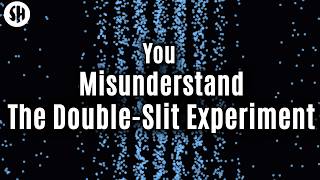
The video clarifies common misconceptions about the double slit experiment, emphasizing that the real mystery lies in the instantaneous wave function update when a measurement is made, not in particles losing wave properties. It also critiques Elon Musk's simulation hypothesis interpretation and addresses other misunderstandings about consciousness and momentum conservation.
Chapters
The double slit experiment is famous but misunderstood. It demonstrates that particles have wave-like properties, forming an interference pattern when both slits are open.
It's wrong that observing which slit a particle goes through makes it behave like a ball. Instead, the particle still behaves as a wave, but only through one slit, producing a diffraction pattern.
Interference arises because the probability is the absolute square of the sum of wave functions, not the sum of squares, leading to an extra interference term.
The surprising part is that you can decide to measure which slit after the particle is sent. Turning on the detector causes an instantaneous update of the wave function on both slits, faster than light.
This instantaneous update is what Einstein called 'spooky action at a distance'. It implies either faster-than-light influence or superdeterminism.
The major misconception is not that measurement destroys wave properties, but that the particle must know whether it will be measured before the decision, or there is spooky action.
Musk's claim that the experiment supports simulation is flawed: simulation hypothesis is unfalsifiable, video games use pseudo-randomness, and measuring momentum gives certainty in momentum, not position.
Measurement does not require consciousness; any measurement apparatus works. Also, momentum is conserved in each run because the particle entangles with the slit, transferring tiny momentum.
The genuine research problem is reconciling the instantaneous wave function update with the speed of light limit, a topic largely ignored.
The double slit experiment's true mystery is the non-local update of the wave function upon measurement, which challenges our understanding of causality and locality. The video urges focusing on this real problem rather than popular misconceptions.
Mentioned in this Video
Study Flashcards (8)
What is the common misconception about observing which slit a particle goes through?
easy
Click to reveal answer
What is the common misconception about observing which slit a particle goes through?
That the particle stops behaving like a wave and forms two stripes. Actually, it still behaves as a wave but through one slit, producing a diffraction pattern.
01:08
Why does interference occur in the double slit experiment?
medium
Click to reveal answer
Why does interference occur in the double slit experiment?
Because the probability is the absolute square of the sum of wave functions, not the sum of squares, leading to an extra interference term.
02:20
What is the truly surprising aspect of the double slit experiment?
medium
Click to reveal answer
What is the truly surprising aspect of the double slit experiment?
You can decide to measure which slit after the particle is sent, causing an instantaneous update of the wave function on both slits, faster than light.
03:01
What did Einstein call the instantaneous update of the wave function?
easy
Click to reveal answer
What did Einstein call the instantaneous update of the wave function?
Spooky action at a distance.
04:13
What are the two possible explanations for the instantaneous update?
medium
Click to reveal answer
What are the two possible explanations for the instantaneous update?
Either faster-than-light spooky action or superdeterminism (the future is fully determined).
05:00
Why is Elon Musk's simulation hypothesis critique flawed?
hard
Click to reveal answer
Why is Elon Musk's simulation hypothesis critique flawed?
It's unfalsifiable, video games use pseudo-randomness, and measuring momentum gives certainty in momentum, not position.
07:04
Does measurement require a conscious observer?
easy
Click to reveal answer
Does measurement require a conscious observer?
No, any measurement apparatus works.
08:39
How is momentum conserved in each run of the double slit experiment?
hard
Click to reveal answer
How is momentum conserved in each run of the double slit experiment?
The particle entangles with the slit, transferring a tiny momentum kick to the slit, so total momentum is conserved.
09:21
💡 Key Takeaways
Delayed Choice is the Real Surprise
This is the core insight that distinguishes the actual mystery from common misconceptions.
03:01Spooky Action at a Distance
Einstein's term highlights the non-local nature of quantum mechanics.
04:13Critique of Simulation Hypothesis
Provides a clear, logical rebuttal to a popular but flawed interpretation.
07:04Momentum Conservation via Entanglement
Explains a subtle point that even physicists often misunderstand.
09:21Full Transcript
[00:00] The double slit experiment is the probably most famous experiment ever and also the most misunderstood one. In this video, I'll tell you why it confuses even physicists. What the
[00:12] double slit experiment has to do with Einstein's spooky action, what Elon Musk got wrong about it, and why Sabine is permanently grumpy. The typical illustration of the double slit experiment looks
[00:24] something like this. If particles did not have quantum properties, they'd behave like little balls and just form two stripes on the screen. But if they do have quantum properties, they form an interference pattern which builds up from single particles. Okay,
[00:40] but so what? All this shows is that particles have wavelike properties. Particles aren't little points. They spread out like waves. So they can go through both slits at the same time. And that's
[00:55] why the parts of the wave coming from each single slit can overlap even for a single particle. That's what creates the pattern. The only thing that's weird is that some people think elementary
[01:08] particles should behave like little balls. Well, the explanation goes the weird part is that if you observe which of the slits the particle went through, then the particles stop behaving this
[01:21] way. They form just two stripes on the screen. That is partly wrong and partly right. The wrong part is that the particles allegedly stop behaving like waves or form two stripes on the screen. This
[01:35] just never happens. If you observe which slit the particle goes through, say the right one, then the particles still behave like a wave. It's just that it's now a wave that goes through only
[01:47] one slit. It'll then form a defraction pattern on the screen which is also an interference effect. And likewise for the right slid. If you observe the particles, they will not give you two stripes on the screen. Instead, you'll get an overlap of the two defraction patterns. What's correct
[02:03] is that if you know which slit the particle went through, you do not get an interference from both slits. You get a sum of left slit and right slit. So what happens in the double slit experiment is that if you take the result of only the right slit and add it to the result of only the left slit,
[02:20] you do not get the same as having both slits open at once. The mathematical reason for this is rather simple. If you have two slits, you add the wave functions from each slit. But the
[02:32] probability is the absolute square and the square of the sum is not the sum of the squares. So for the double slit, you get an extra term. That's the interference term. But then the double slit
[02:45] experiment just seems to say that if you know the particle only goes through one slit at a time, then you get the pattern from only one slit at a time. And again, I'd like to ask, well, what's surprising about this? Here is the part that's actually surprising about the double slit
[03:01] experiment. It's that you can decide whether or not to measure which slit the particle goes through after you send the particle on the way. Suppose you sent the particle from here. There
[03:14] are always some particles that hit outside the slits, but these are not relevant, so we can just ignore them. And you put a detector in one of the slits, let's say the right one. You can either leave the detector off or you turn it on after the particle left the source and before it appeared on
[03:31] the screen. Now, we've just seen that to explain what happens on the screen. If we don't know which slit the particle went through, it needs to go through both slits. And if we do know which one
[03:43] it goes through, it goes through only one. The issue is then that if you turn the detector on, the wave function of the particle must suddenly update on both slits. It must jump from a wave
[03:59] function that goes through both slits at once to one that either goes left or goes right, but not both. And that update is instantaneous, faster than night. This is what Einstein called a spooky
[04:13] action at a distance. You make a measurement at one slit and the wave function on the other slit changes immediately. And note that this is the case even if the particle does not trigger the
[04:30] detector. If it doesn't go into the detector, you know it must have gone through the other slit. But if the particle went through the other slit, you never interacted with it. You didn't touch
[04:43] the particle. It just knew you were trying to. The only way that you can avoid this faster the light update is that the particle knows whether you'll measure it before you've made the decision whether
[05:00] to measure it or not. This is what's called super determinism. And this is what's so weird about the double slit. You either have to accept a faster than light update of the wave function, the spooky
[05:13] action, or you have to accept that the future's fully determined already. And no, this actually has nothing to do with what happens on the screen. The screen is just the evidence for what happened
[05:25] at the slits. I know you've been making fun of me for biting into my armrest each time someone gets quantum mechanics wrong, which is why I'm happy to say that I have a new chair from today's sponsor,
[05:41] FlexiSpot. This chair is called the C7 Max, and it's absolutely great. For one thing, it's super comfortable to sit in even during a heat wave. You don't stick to the chair, and you
[05:54] can adjust everything about it. the armrest, the headrest, the seat on the back, and of course, the height. I actually had a pillow on the old chair most of the time because the cushion was so thin, it was basically sitting on steel. Now, what do I do with a pillow? But the coolest part is this. It
[06:11] has a footrest. Only downside is that now my kids want one, too. I'm happy to recommend the chair from FlexiSpot. It's simply a great product, and it comes with a 5year warranty and a 30-day return
[06:25] policy. And yes, of course, I have a special offer. Head to flexispot.com and use my code for an amazing discount. And now back to the physics. So this, I think, is the major misconception about
[06:39] the double sit experiment. It's not that if you measure which slit the particle goes through, it loses its wave properties. It's that the particle must have known whether you'd measure it or not
[06:51] before you yourself knew that or faster than light spooky action. Speaking of misconceptions, here is what Elon Musk recently had to say about the double set experiment. It's consistent with
[07:04] the simulation hypothesis. Like a video game, objects are randomly generated with positional certainty only when observed. The simulation hypothesis is the idea that the entire universe,
[07:18] including us, is a computer simulation. The problem with the idea is that no one knows what this means. This is why everything is compatible with it. It's not even wrong, as Pi said so aptly.
[07:33] The second problem is that objects in a video game are usually not truly randomly generated. While this is possible in principle, in practice it's rarely done because the only truly random
[07:46] processes are quantum mechanics. Usually video game algorithms are pseudo random, which means they're created algorithmically just by an algorithm that's very hard to predict. If
[08:00] it were the case that particles in a double set experiment were indeed generated like in video games that is following a deterministic algorithm that it contradict the current
[08:14] standard interpretation of quantum mechanics and I'd really like to know the algorithm. And third it's not true that measuring an object gives it positional certainty that depends on what
[08:27] you measure. If you measure momentum, then it's the momentum that obtained certainty, not the position. While I'm at it, though, there are two other common misunderstandings about the
[08:39] double sit experiment. One is that it's something to do with consciousness. That just isn't. So, the measurement doesn't have to be done by a conscious observer. Some operators will do. The other thing that even physicists are often confused about is momentum conservation.
[08:56] Because suppose the initial particles you sent went straight ahead and at the plate, but then you measure a particle over here. Clearly that's changed its direction. But that should be
[09:09] impossible. It violates momentum conservation. Now if you look at the average of all the particles, then the total momentum again goes straight ahead and that's fine. But it still seems
[09:21] that in single runs it isn't conserved. That is wrong. What actually happens is that the particle becomes entangled with the double sit itself. If the particle gets a small momentum
[09:33] kick into this direction, then the screen gets a little kick into the other direction and the other way around. Momentum is conserved in every single run. It's just that because the double slit
[09:46] is so much heavier than a single particle, you can't measure this tiny kick. And the coral is if the slit was so small that you could measure its momentum then that would at least partially
[09:59] destroy the interference. Again you can do this if you use individual atoms as the slits. Indeed this was done in a recent paper which I talked about in an earlier video. So the reason why Sabine is
[10:12] constantly grumpy is that most of the talk about why quantum mechanics is supposedly weird is just nonsense. And each time I look, there are more nonsense. And all this nonsense is why we aren't
[10:25] making any headway on the one real problem. Namely, how is the instantaneous update of the wave function compatible with Einstein speed of light limit? This is a perfectly obvious
[10:37] research problem that basically no one's working on, despite the fact that it's the one topic that could actually return the foundations of physics to relevance. But at least I have a new chair
[10:49] now. Life is good. So head to flexispot.com and grab yours. By the way, this t-shirt is available in my store. It's an easy way to support this channel. Thanks for watching. See you tomorrow.