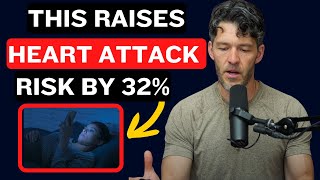

32% Higher Heart Attack Risk from Night Light?
54sThe shocking statistic of a 32% increased cardiovascular risk from artificial light at night immediately grabs attention and challenges common assumptions.
▶ Play Clip"The title accurately reflects the study's findings, though the presenter's heavy sponsor promotion and repetitive emphasis slightly dilute the content."
This video analyzes a large-scale study published in the Journal of the American Medical Association (JAMA) that links artificial light exposure at night to a significantly increased risk of cardiovascular disease. The study, involving 88,000 participants and 13 million hours of light exposure data, found that high nighttime light levels are associated with a 32% higher risk of coronary artery disease, a 47% higher risk of heart attack, and a 56% higher risk of heart failure. The presenter emphasizes the importance of reducing light exposure in the evening to mitigate these risks.
A study published in JAMA analyzed light exposure data from 88,000 subjects wearing wrist light meters, collecting over 13 million hours of data. The study aimed to assess the association between daylight and nightlight exposure and the incidence of cardiovascular disease.
The investigators found a 32% increased risk of major adverse cardiovascular events in individuals exposed to high levels of artificial light in the evening. This risk is more pronounced in women and young children.
Comparing individuals with high light exposure at night to those with low exposure, the study found a 32% increased risk of coronary artery disease, a 47% increased risk of myocardial infarction (heart attack), a 56% higher risk of heart failure, a 32% higher risk of atrial fibrillation, and a 28% higher risk of stroke over a 9.5-year period.
The presenter recommends getting as much natural daylight as possible during the day (up to 15,000-20,000 lux on a sunny day), keeping evening light under 100 lux, and reducing light to less than 50 lux in the two hours before bed. The bedroom should be as close to zero lux as possible.
The study found that brighter nightlight had a larger magnitude association with heart failure risk in females and younger individuals. Women exposed to bright light at night had similar heart failure risk to men, offsetting the typical protective association of being female.
The observed higher risk of cardiovascular disease with brighter night light may be explained by circadian disruption, which can lead to impaired glucose tolerance, type 2 diabetes, hypercoagulability (increased blood clotting), and higher average 24-hour blood pressure, all of which contribute to cardiovascular damage.
The study provides robust evidence that nighttime light exposure is a significant risk factor for cardiovascular disease, independent of other risk factors like diet and physical activity. Reducing artificial light exposure in the evening and maximizing daylight exposure during the day are simple, actionable steps to lower this risk.
What was the sample size and data volume of the JAMA study on light exposure?
88,000 subjects and over 13 million hours of light exposure data.
00:15
What is the increased risk of heart attack associated with high nighttime light exposure?
47% increased risk of myocardial infarction.
03:56
What is the recommended lux level for the two hours before bed?
Less than 50 lux.
09:16
Which groups are more susceptible to the effects of nighttime light exposure?
Women and younger individuals.
10:11
What are the three mechanisms proposed to explain the link between circadian disruption and cardiovascular disease?
Impaired glucose tolerance and type 2 diabetes, hypercoagulability, and higher average 24-hour blood pressure.
14:33
32% Increased Risk of Major Adverse Cardiovascular Events
This is the headline finding that quantifies the danger of nighttime light exposure, making it a concrete, actionable risk factor.
01:0947% Higher Heart Attack Risk
A nearly 50% increase in heart attack risk is a dramatic number that underscores the severity of the issue.
03:56Lux-Based Recommendations
Provides specific, measurable guidelines for light exposure that viewers can implement immediately.
08:09Gender and Age Susceptibility
Highlights that women and children are more vulnerable, which is crucial for targeted public health advice.
10:11Mechanistic Explanation
Explains the biological pathways linking light exposure to cardiovascular disease, adding scientific depth to the findings.
14:19[00:01] for your health. Let's dive into the details. This was just published in the Journal of the American Medical Association, arguably a very high impact yet mainstream medical journal. And what I like about this study involving 88,000
[00:15] subjects that wore a wrist meter to detect light exposure and the the amount of light intensity during the day and also at night. They collected over 13 million hours of light exposure data in 88,000 subjects. So, it's a large data
[00:30] set. The individuals in the study were instructed to wear light meters on their wrist for at least one week duration. They accumulated and gathered the data and ran a lot of statistics and we're going to break those down right now. The
[00:43] title of this paper is light exposure at night and cardiovascular disease interesting because we've heard over the past 13 years about blue light and why you should wear blue light filtering glasses, which I'm a huge fan of because
[00:56] if you've ever been on the fence about whether or not using your computer, your phone, or artificial lights at night, whether that's harmful or not, I think this paper will really change your perspective because in brief, the
[01:09] investigators found a 32% increased risk of having a major adverse carvascular event if you are exposed to high levels of artificial lights in the evening
[01:21] time. Also, this is more important and more delotterious for women and young children. Now, I think this is so important anecdotally, my daughter and I think you should do that, too. I advise all my clients to do at least 2
[01:35] advise all my clients to do at least 2 to 5,000 steps as a postmeal walk in the evening time. And I see people in their uh homes and so forth totally lit up. It dance party. There's just lights everywhere, screens going, computers and
[01:49] so forth. And I don't think the average person really conceptualizes how harmful artificial light exposure is at night. So, let's dive into this just published
[02:01] study. So, of importance, the investigators say light at night causes well-known risk factor for adverse cardiovascular outcomes. However, it is not well understood in terms of cardiovascular diseases. So the
[02:15] objective of the study was to assess whether daylight and nightlight exposure is associated with the incidence of cardiovascular diseases and whether cardiovascular diseases differs according to genetic susceptibility,
[02:29] age and gender and sex. So I think this is really important. So this prospective cohort study analyzed cardiovascular disease records across 9.5 years of tracking starting in June of 2013 which is about when this whole circadian
[02:45] emerge. I want to say it was actually in 2012 we started to hear a lot about blue light and artificial lights and LEDs and screens and all this sort of stuff. Uh and there was some early data in 2015 finding that the shape of children's
[03:00] eyes renders them more susceptible to the light induced suppression of melatonin. Meaning your your children should not be on the screens at night. daughter, she's 13. She likes to text her friends and all the things. It's
[03:14] there's no more. It's airplane mode. It's in the cupboard. We can't use it. well. You know, as a business owner, it's hard harder for me to do that, but I like to lead by example. And so, I think all of you should do that as well
[03:29] because it turns out, you know, when data was analyzed, comparing individuals with really low level of light at night compared with the highest percentiles uh of light. Um the the individuals that had high light exposure at night had
[03:44] significantly higher risks of developing coronary artery disease. a 32% increased risk of developing uh coronary artery disease over a 9.5 year period in time
[03:56] in terms of having a heart attack, a mocardial inffection, a 47% increase risk. This is huge. Imagine if someone said, "Hey, you can literally cut your risk of having a heart attack down by almost 50%." By just doing this one
[04:10] thing, people would sign up for that all day long. Well, that one thing is dim the lights in your home. Get the incandescent light bulbs instead of the compact fluorescent light bulbs. You know, wear wear blue light filtering
[04:22] glasses from our folks over at bondcharge.com. You know, minimize your screen uh exposure at night, not watch a lot of television, uh things like that. lot of television, uh things like that. Uh going on in terms of heart failure,
[04:34] this stat is insane. uh comparing again people who had dim light at night compared to the highest percentiles uh between the 90th and 100th percentile between the 90th and 100th percentile the risk of heart failure was 56% higher
[04:49] when comparing highlight exposure to low light exposure at night uh atrial fibrillation 32% higher risk uh stroke 28% higher risk I mean this is absolutely insane we'll talk in just a moment about the gender differences
[05:05] moment about the gender differences between uh men and women and age and you for being here. If you're enjoying the content, please hit that like button. Be sure to comment in the comments section below what you do at
[05:17] lot of people watch these videos and they learn from the comments and we have watch these videos and share these videos. So, you know, your input is as well. And also, I want to thank our show sponsor, the good folks over at
[05:32] bondcharge.com, a maker of a range of healthpromoting tools, including their new infrared toothbrush, which is phenomenal for your teeth and gum health. This uses infrared and near infrared light to help the health of
[05:45] your gums. They make amazing blue light filtering glasses that I've used since 2014. I've had numerous pairs over the years. And the cool thing is that it's currently Bond Charg's holiday sale where you can save a massive 25% off.
[05:57] Just head to bondcharge.com and your 25% off code will be automatically added to your order. So hurry and don't miss this massive chance to save big on your products that I recommend and I personally use, the blue light filtering
[06:12] since 2014. They have an amazing infrared sauna blanket that is among the hottest in the industry that you can use anywhere. So now is a good time to save on items like that. head on over to bondcharge.com or click the link in the
[06:26] description below. So, getting back to the study, as I mentioned, you know, I get excited about this because this was almost considered a conspiracy theory. A exposure at night is not that big of a deal. You know, what about counting your
[06:40] macros or exercise? Look, all of these things are important, but the human body is this multimodal tool and all these systems integrate, particularly the circadian clock system. And this is not a conspiracy theory. This is not woo
[06:54] woo. We now know that every single cell has proteins and genes that oscillate at different times of the day. And the easiest way to think about this is cortisol or or testosterone for that matter. When we wake up in the morning,
[07:07] we should have a strong robust cortisol awakening response. I think cortisol is context of light and circadian rhythm exposure because people that have disrupted circadian rhythms tend to have a weakened cortisol awakening response
[07:21] in the morning and have a paradoxical later in the day cortisol release that can compromise sleep duration and sleep quality. And so we know that hormones oscillate on this circadian clock system. But also there's proteins in
[07:33] cardiovascular system. There's proteins in your brain that also are [snorts] entrained by this intracellular clock system. And it turns out that throughout
[07:45] humanity when the sun went down, humans didn't have a lot of artificial light exposure. The only light that we would have pre Benjamin Franklin and pre-ele electricity would have would have been, of course, fire. And fire is more of an
[07:57] orange light. it's not as uh bright as say your iPhone. You know, the amount of lux that come out of your iPhone at night is 50 lux. And so lux is a way to
[08:09] enumerate or quantify the intensity of light. And what was cool about this study is the investigators found that daylight exposure helped to mitigate or offset the delletterious effects of high evening and nighttime lead exposure. So
[08:23] that's take-home number one. you know, when possible, walk outside, exercise outside. I know it's hard during the winter time when it's cold and, you you know, it gets dark uh so early and so forth. But the more even during a
[08:38] cloudy day, I have a lux meter. I recommend you get one, too. Uh you can find one on Amazon. You can even use apps on your phone. Even on a cloudy day apps on your phone. Even on a cloudy day here in the Pacific Northwest during the
[08:50] late fall, early winter, you know, you can get up to 5,000 lux even if you just take a walk outside on a cloudy day. On a bright sunny day, it's like 15 to 20,000 lux. I mean, it's really, really bright. [snorts] And, you know,
[09:03] wrote this big paper that we talked about several years ago. So, in terms of lux, you want to get as much light during the day from nature as possible. uh during [snorts] the evening time you want to keep that under 100 lux and then
[09:16] in the two hours before bed less than 50 lux and your your bedroom should be as close to zero as possible. So I know you know some of you might have a TV in the iPhone as your alarm clock. I would not recommend that because that will perturb
[09:29] your sleep and as we have talked about and will continue to talk about the risks are quite significant. You know, comparing high high evening light to low evening light is a 47%
[09:42] increased risk of having a heart attack over 9.5 years. A 28% increased risk of having a stroke. I mean, these are serious matters. You know, I was just CDC put out their [snorts] annual morbidity mortality report from 2024.
[09:57] Heart disease still claimed nearly 700,000 lives during the year 2024. Right? So, this is not insignificant. This is something that we all should be mindful of, especially women and children. It turns out, for whatever
[10:11] reason, there is a gender bias and an age bias here. So, the investigators say Ryder Nightlight had a larger magnitude association with adjusted risk for heart failure in females as well as younger individuals. Now, who's on their phones
[10:26] They're on Snapchat. They're on all the things. So this is really apppropo if you're a parent or have someone young in your life. Uh we see so many kids now they're not really
[10:39] socializing in person. They're gaming and and gaming with headsets and so forth. So we need to be much more mindful of this because as we know heart disease develops at the age of four like plaque uh the process of
[10:51] aththerosclerosis and the formation of calcified plaque starts really early in life and [snorts] it doesn't necessarily get reversed uh later unless someone really changes their lifestyle. So, we want to imprint these, you know,
[11:04] healthpromoting behaviors uh in our young people uh that are in our lives investigators say brighter nightlight diminished the protective associations of being female with risk of heart failure, such as females being exposed
[11:17] to bright light had similar heart future risk to males exposed to bright light at night. Okay, so [snorts] we know that women generally have a lower incidence of cardiovascular disease compared to men, at least until menopause. But as
[11:30] they were saying here that gender bias tended to be uh you know shrunk or you know sort of offset by light exposure. So women uh for whatever reason you know
[11:43] are a little bit more susceptible to the effects of light as well as children. Now, in conclusion, the investigators say in this cohort study across personal light exposure data and approximately 700,000 person years
[11:58] followup, individuals exposed to higher levels of nightlight had higher risk and incidence of coronary artery disease, myioardial infunction, heart failure, atrial fibrillation, and stroke. These associations of nightlight with
[12:11] cardiovascular disease risk were robust to adjustment for carvascular risk factors, including physical activity, diet, sleep, and genetic susceptibility. These findings support night light exposure as an important risk factor for
[12:24] adverse cardiovascular health. Now, again, why am I emphasizing this so much? I think it's common sense for most of you watching these videos, but the average person is still eating Wheaties and Cheerios and, you know, uh, having a
[12:39] lot of high-fiber, low cholesterol foods because that they think that that's the main way to reduce your LDL cholesterol and therefore reduce theoretically your risk of heart disease. But we have all these other ancillary factors, you know,
[12:52] such as, you know, sleep disordered breathing, light exposure that too impact the prevalence and your risk of heart disease as much or more so, especially even after adjusting for these independent risk factors for
[13:07] having a major adverse cardiovascular event including uh coronary artery disease, a myioardial inffection or a heart attack. Now the investigator is right. We observed a 23 to 32% higher risk of coronary artery disease and a 45
[13:21] to 56% higher risk of myocardial inffection for people with the brightest nights compared to those with the darkest nights. So comparing these highest percentile between the the 91st and the 100th percentile. And again
[13:35] light is being enumerated from a wrist tracker that enumerates the lux the intensity of the light. So, you know, if you you're doing yourself a major favor, you're doing your body, your heart, your future self will be very grateful that
[13:51] future self will be very grateful that you invested the $20 at Home Depot and got some old-fashioned incandescent light bulbs and you got the Flux app on light filtering glasses from the folks over at bondcharge.com. Uh, you know,
[14:04] all these things are additive and synergistic. I think this is really, really important uh for us to understand this. Now you might be wondering why why it turns out that artificial light perturbs your body's circadian clock
[14:19] observed higher risk of carvascular diseases in people with brighter nights may be explained by the disruptive effect of light on circadian rhythms which can lead to disregulation of various carvascular and metabolic
[14:33] mechanisms. They say first circadian disruption is strongly implicated as an impaired glucose tolerance and type 2 diabetes which are strong significant risk factors for endothelial dysfunction and atherosclerosis. Second circadian
[14:45] hypercoagulability which is a problem for blood viscosity, blood thickness and having a clot and increasing risks of throbo embolytic events and subsequent esmia particularly in people with atherosclerosis or atrial
[14:59] fibrillation. Third, tracadium disruption may cause higher average 24-hour blood pressure, which potentially increases the risk of vascular endothelial damage and myioardial hypertrophy. Together, these
[15:11] mechanisms may explain the observed higher risk of cardiovascular diseases with brighter light night exposure. So again, I think this is just really important for us to understand uh particularly this gender bias. So again,
[15:27] we have almost 90,000 individuals followed for close to 10 years, 13 million light exposure hours, finding up to a 54% increased risk of having a
[15:39] heart attack, a 32% increased risk of having a stroke, and uh you know, I think it was a 28% increased risk of having coronary artery disease. So my friends, now is the time during the winter time here in North America,
[15:53] during the winter in Europe, we want to be mindful of this because the risks are actually quite significant. This is something that we should all be paying attention to and I think you should take this very seriously as do I. Uh, as
[16:06] the very end. Hopefully you got some value from this video. If you did, hit you're doing and how you're being proactive about this in the comment section below. and we'll catch you on a future video down the


⚡ Saved you 0h 16m reading this? Transcribe any YouTube video for free — no signup needed.