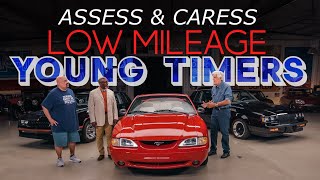

Meet the Collector with 13-Mile Mustang
45sThe story of a car with only 13 miles and the owner tearing off the plastic in a drunken fit is shocking and memorable, sparking curiosity and debate among car enthusiasts.
▶ Play Clip"The title promises a look at low-mileage young-timers and delivers, but the conversation meanders with personal anecdotes and tangents, making it longer than necessary."
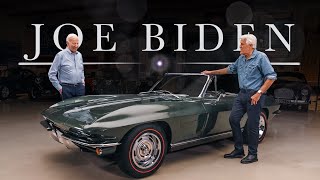
In this episode of 'Assassin's Crest and J. Lo's Garage,' host Donald and guest Gabriel discuss three low-mileage 'young-timer' cars from the late 1980s and early 1990s: a 1987 Buick GNX, a 1988 Chevrolet Monte Carlo SS, and a 1994 Ford Mustang SVT Cobra. They explore the definition of a classic car, the importance of driving and maintaining these vehicles, and the market appreciation of these specific models over the past five years.
Gabriel, a collector with a passion for late 60s and early 70s cars, brings three low-mileage 'young-timer' cars to the show. He emphasizes that his appreciation for these cars grew in the 90s when he could actually drive them.
The term 'young-timer' originates from German car collectors to describe collectible cars that are not yet old enough to be 'old-timers.' It reflects the expanding nature of car collecting, which now includes cars from the 80s and 90s.
While most states consider a car classic at 25 years old, the true definition is when an old car becomes interesting to people who didn't remember it when it was new. Nostalgia alone isn't enough; the car must be inherently interesting.
Gabriel's collection includes a 1987 Buick GNX, a 1988 Chevrolet Monte Carlo SS, and a 1994 Ford Mustang SVT Cobra pace car replica. Each car connects him to personal memories from high school and growing up.
Gabriel famously tore the plastic off his 13-mile Mustang and drives his cars regularly. He argues that cars are machines meant to be used, and not driving them leads to mechanical issues like rusted cams and dried-out rubber.
The market increasingly values cars that are driven and enjoyed. Gabriel's approach contrasts with those who buy zero-mile cars to store them, and he emphasizes that driving a car keeps it in better condition than letting it sit.
The GNX, a turbocharged V6, matched the power of a 1987 Porsche 930 turbo. Only 547 were made, and it was a collaboration with McLaren. Its black exterior and velour interior make it a menacing, cult favorite.
The Monte Carlo SS was the last rear-wheel-drive model and featured a NASCAR-inspired nose. With 188 horsepower, it was a torque monster. Its connection to Dale Earnhardt's black livery adds to its appeal.
The Monte Carlo has only 36 miles, and the Mustang had 13 miles. Gabriel shares stories of acquiring these cars, including one from twins in Ohio whose drug dealer lost a shootout with cops. Proper storage and regular starting kept them in pristine condition.
The Mustang, a pace car replica from the Indianapolis 500, is one of only 1,000 made. It features embroidered seats and a cassette player, and Gabriel plans to drive it, keeping the dog bed in the back.
Values have risen significantly: the GNX from $125k to $225k, the Mustang from $65k to $105k, and the Monte Carlo from $50k to $100k. The Monte Carlo saw the highest percentage increase, driven by the Earnhardt connection and its rarity.
Driving these low-mileage cars is like stepping back in time to experience them as new. Gabriel's goal is to double the mileage on his Alfa Romeo in a year, emphasizing that driving is the ultimate enjoyment.
The episode celebrates the joy of owning and driving low-mileage 'young-timer' cars, emphasizing that these vehicles are meant to be used, not stored. With significant market appreciation, these cars offer both emotional connection and financial value, making them a worthwhile investment for passionate enthusiasts.
Definition of a Classic
Provides a clear, memorable definition that shifts the focus from age to interest, which is a key insight for collectors.
02:35Drive Your Cars
Emphasizes that driving a car is essential for its preservation, countering the common practice of storing low-mileage cars.
05:41GNX Rarity
The limited production number of 547 makes the GNX a highly sought-after collector's item.
07:29Market Appreciation
Concrete price data shows significant appreciation, making a strong case for investing in young-timers.
23:19Time Machine Experience
Highlights the unique emotional value of driving a car as if it were new, which is a core motivation for collectors.
20:45[00:00] One of the episodes of Assassin's Crest and J. Lo's Garage brought to you by the fabulous Audrain Auto Museum in Newport, Rhode Island. We get quite a few cars there, but not these three. These three belong to a very discerning collector, a man of impeccable taste, a man when he walks
[00:16] into a room, everything stops. They're not your cars. No, these are not my cars. My cars don't stop. His stops. These cars are him. This is his childhood, and he's brought them here tonight to share it with us.
[00:28] Please welcome Gabriel. places. Gabriel, how are you, my friend? Doing good, doing good. Hey there. These are astonishing cars that you've loaned to us today.
[00:40] Yeah, you know, they're not bad. I'm a generation older than Donald, but still, we have the same taste. Late 60s, early 70s.
[00:52] It's just funny how it all just keeps moving forward, you know? Like, you're a child of the late 80s and 90s, or you're a little kid, these cars from the 80s, this was the cool thing, wasn't it? Oh, yeah, very much so.
[01:04] Very much so. But it wasn't until the 90s that I really had a different appreciation for it. Right, right, yeah. Because I was in a position to drive them, whereas before it's like, vroom, you know. Right, right. Always driving, but the driving characteristics on carpet and the street are very, very different.
[01:17] Very, very different. Yeah, exactly. I find that often is the case. And this segment is actually sort of titled, Low Mileage Young Timers. And Young Timers is this... That's like me.
[01:29] And they're actually like original cars as well, which we'll get into in a moment. The term young-timer comes from German car collectors. Antique cars are called old-timers. And they said, well, these cars are very interesting and collectible, but they're not old.
[01:41] So what do we call them? And so hence the term young-timer. Very German. Very German. It's actually young-timer cars. And one of the things that Jane just mentioned is the fact that it's so true. Collecting is like the universe.
[01:53] It keeps expanding. It doesn't stop at 1968. It doesn't stop at 1990. because these cars are now old cars. You have to face that. You know, we seem to remember them in the showroom, but nonetheless, I mean, these cars are practically your age.
[02:07] Yeah, well, you know. So what exactly is considered a classic? How old does a car have to be for it to be classic? That's a great question, and there are different definitions of that. Yeah, the motor vehicle departments in most states think 25 years old is a classic car.
[02:23] Is a classic. Brass era, then vintage, then classic. I think that's how it works, isn't it? That's generally how it works. And then just an old-ass car.
[02:35] What defines, for me, a classic is when an old-ass car becomes interesting to people that didn't remember it when it was new. And that's one of the things. Nostalgia is a great thing. Nostalgia is fantastic, but nostalgia only carries us so far.
[02:49] Most people that, like brass era cars, the people that remember those cars as kids, are long dead. And yes, they're still interesting to people because they're interesting cars. And I think that's the entire point of this.
[03:01] Well, tell us what we have here today. All right. Well, we have from Gabe's wonderful collection a 1987 Buick GNX, a 1988 Chevrolet Monte Carlo SF, and a 1994 Ford Mustang SVT Cobra taste car replica.
[03:17] So what were you looking for when you... Were you specifically looking for a 94 could have a 93 or 95 done as well. Does 94 have some significance to you? I think what he was saying about the nostalgia part,
[03:29] for me, it's like it connects me to, you know, times from the past, high school, you know, times when I was growing up with my mom. I mean, just, you know, great moments for me.
[03:41] It's the connection. Don't get me wrong, there are awesome cars too, but there is a special place in there. Like, this is a car that I always wanted. And we talked about that before. It's like, it was one of those cars where, man, of time. It didn't get better than a, you know, a Mustang. And the fact that it was
[03:55] convertible, like, are you kidding me? It's sexy. It's, you know, and I got it with such a little money. I got this car with 13 miles on it. 13. It had plastic on it. I remember I got drunk and I tore all the plastic off and I recorded it and people didn't like that
[04:09] I did that. And they're like, no. And I'm like, it's mine. They saved it for me. That is one of the points also that we do in these segments is in talking about how the market response to something. In an appraisal,
[04:23] it's about attributes of value. Finding what the attributes of value are in the car that makes it connect with people and that helps to determine the value, ultimately, in the market. If enough people respond to those attributes, then they want to pay more money for it.
[04:36] And in today's market, we've heard a lot about people who buy zero-mile cars. To put them on a shelf or put them in a garage and wrap them in plastic and do whatever. And I have
[04:49] to declare before the millions of people that are going to watch this that you are my absolute hero. Oh, thank you. Yeah, because I saved it for me. And you're going to drive these cars. That's the entire point.
[05:01] Yeah, that's the fun. And, you know, a car is a machine. It needs to be lubricated. I mean, what happens is you've got oil in the engine. Gravity, the oil seeps down. Okay, so you've got your cams exposed to air,
[05:15] which has moisture in it. And the top of your cams are all rusted. I know a Ferrari is big for this. six to 30 years, may need some recommissioning, which means you've literally got to tear into the whole thing. But if you drive it 1,000 miles a year,
[05:28] just get everything, just keep everything working, it's like an old watch, you know. You don't beat it up. You just use it for its intended purpose. You've got to use it or lose it, man. Otherwise, it's like, come on, you're just letting it die.
[05:41] Yeah. And for cars like these, too, experiential ownership is really an important part of what is in the market today. There's people that buy cars not to drive. people that buy cars to drive and you are in the latter category thank God and
[05:55] sorry I am judgmental. Gee, I had no idea. It can be told here today but it is it is one of those things that as we talk about these cars we going to start with the with the viewers in a minute it is about the driving characteristics of these cars and that one of the things that makes a difference between the pure nostalgia and we talk about
[06:18] this a lot today, that there are cars from the 30s, 40s, 50s, that people don't care about anymore because they're not cars that people want to get out and drive in today. They're the cars they might remember from their youth, but they're not a lot of fun,
[06:30] and they don't give you that emotional connection that you need to have in a car. So, speaking of emotional connections, let's talk about one of the most interesting performance cards of the 1980s in America, the Buick CNX.
[06:44] Let's take a look at it. Now, you don't think about performance and Buick. And in 1987, I can tell you this, you're too young to remember, but I remember quite clearly. I remember 87 was when I had a Nintendo.
[06:57] Think about a turbocharged V6 Buick that has the same power as a 1987 Porsche 930 turbo. Right. So this is a really incredible car.
[07:12] And so, you know, what was it about the DNX that said, I have to have one? This wasn't a car that I was looking for back in the day. It wasn't a car that I was, like, in love with back in the day. But for some reason, you know, in the last few years, it just is one of those that just kept popping up in my social media.
[07:29] And I'm like, there's something about this car. And when I got the opportunity to get one, because remember, I think there's only like 510. Exactly, 547. Yeah, I said, you know what, this would be a great addition to the collection. And when I got to drive it, I'm like, wow, this is not, you know, this is something different.
[07:47] This is something different. It's got power. I mean, it's really different. and in fact it's a V6. In the land where V8 is king, especially 70s, why would you do a V6? But they had this motor, I think it was in the Cyclone truck,
[08:01] and a few other things, right? The Cyclone truck in 91 was the fastest accelerating vehicle GM had. It was faster than the Corvette. And still today, a very scary vehicle. Two lights for heavy work and two heavies for light work.
[08:14] And that's basically this power plant, isn't it? Yes. And it's funny that it was Buick would take the mantle for this. You'd think Chevy would do it because Corvette, you know what I'm saying?
[08:27] It's really interesting, too, as we talk about these three cars that we have here today, when you look at this 1987 Buick and then we talk about the 1988 Monte Carlo, you think, okay, well, they're racing the Monte Carlo in NASCAR,
[08:39] so shouldn't it have the most powerful engine you could buy from the street? No, let's put it in the Buick instead. But we're really glad they did and also this car is a great example of something that doesn't
[08:52] happen in big corporations today. Super limited edition, built in collaboration with A.S.E. McLaren. Right. And so, you know, it's sort of one of those outsourced, actually, much like the Mustang GTD.
[09:04] Yeah, that's probably right. But the amazing thing about these cars, too, is it is a Buick. When you look in the interior, it's got this Buick interior. I mean, it is like a living room, you know, but it's an incredible performance car.
[09:18] And again, a car that I drive. And that is, I think this car is at like 3,300 miles on its way or something? It's pretty low. Yeah, yeah. I find it fascinating, too, that, you know, it's a limited number, but, you know, they're not all out there anymore.
[09:31] You know, a lot of them, and a lot of them, they went a little too fast for some. And now there's, you know, there's... And they're all black, right? Weren't all Grand Nationals black? I think they were. Yeah? I think they were, yeah. So you add that with the velour interior, which is something you don't see anymore.
[09:46] You know, I always call it Elvis's coffin, you know, the inside. But, yeah, it's really of its time. Absolutely. And just to take a little sidebar here, again, a little bit of hero worship,
[10:01] the fact that these cars have dog beds in the back. I'm a big dog guy, and it's like my dog goes with me everywhere. Yeah, I take my dog everywhere. So there's always a dog bed and a blanket and a car.
[10:14] Absolutely. She wants to go. Yeah. She wants to go. It's a fantastic place. My dog goes outside, sees a car, someone opens the door. Where are we going? We have to travel. So we're going to go from the super high-performance Buick
[10:29] to the somewhat high-performance 70SS with a wonderful story, too. Let's look at the 88SS. It's funny. You notice the dog bed. In addition to having the dog bed here in the back, because of the fact that this car has a cassette player in it,
[10:46] I have a collection of cassettes in here that I'll play in the car. So, yes. Very good. You can take it out. Full period experience. Oh, totally. Now, was this the Monte Carlo body?
[10:59] Yes. It was the Monte Carlo. But did they call this the Monte Carlo? Absolutely. It was the Monte Carlo Acta. Okay. And it's the last year of the rear-wheel drive Monte Carlo. Okay. And also it's got that NASCAR nose.
[11:11] We talked about NASCAR. And I remember in 1988, quite vividly, I was never a fan of his. Again, I'm going to get lots of hate comments on this. But you could not forget Dale Earnhardt. It was the first year that he ran his black livery.
[11:25] And he was driving his 88 Monte Carlo. He came in third in the championship that year. And he was absolutely a menace. And this car, just going down the street, all people could think of was NASCAR and Dale Earnhardt. It's a car, as I said, that is a performance car, but you have to think about the time.
[11:40] So this is, you know, 1988, so it's got 188 horsepower. Right. But back then, it was actually very respectful. It also, again, putting it into perspective, these engines were also always torque monsters.
[11:52] You and I talk a lot about torque. So you think 188 horsepower, what is that going to do? You put your foot down, it moves. It moves. Well, that's the adage we do all the time. Horsepower sells cars, torque wins races.
[12:04] Yeah. One of the things that you think about these two cars and the way they deliver performance and style is, you know, that's what I'm saying, today all cars are black, white and silver. These are two black cars but these are cars that have the presence of a Batmobile you know They menacing they look fast and mean just parked Yeah the lines on them are real just sexy and just they look real sleek it like oh look at that and it funny it not
[12:28] something you can manufacture and i like the the gm says now what car is going to be a cult favorite in a few years let's get you know they just built with and they just happen to get it right the first time that's why i i find it exciting you know because to me like the mustang gtd i don't
[12:44] think I've ever seen an ad for one but they're all sold out you can't get them because word of mouth is still the best advertising and that was the deal with these once word got out oh what fastest car then they became a cult favorite in their time and this one has ridiculously low miles
[13:04] Ridiculously. Try 36. 36 miles. I recently took the window sticker off of it because I had two. I had two. I recently gave one away.
[13:18] Is it false? Yeah, sorry. And funny, the one that I gave away had 250 miles on it. So both cars, very low mileage. We featured them on Jay's show and talked about how they belong to twins.
[13:31] They belonged to twins in Ohio that were... It's an unfortunate story. Yeah, their drug dealer's got into a shootout with the cops, and, you know, they lost. So I won the car. Unfortunately... Long story. Unfortunately, unlike Elvis' Pantera, it has no bullet holes.
[13:46] Right, right. I checked the car already for stuff, too, just in case, because you never know. Don't bring the drug-sniffing dog in. It could have had a bonus, yeah. But Jay also mentioned the fact, and this is absolutely true, the cars that are not driven need to be maintained to come back to the street.
[14:02] So I know I did hear some stories about what your mechanic did to recondition the cars, which wasn't a lot, so you were very, very fortunate, because a lot of times people don't store cars well. They think, I'm going to buy this car with no mileage, I'm going to stick it in my garage,
[14:15] and in 20 years, it's going to be my retirement. No. The plastic all dries out, the rubber dries out. Things stick to the fabric. Yeah, exactly. Gasoline goes bad. I had a crazy argument with a car person who said, no gas, gas, less rubber.
[14:29] I said, I can't go back. I don't know. It's manufactured. I mean, the crude you get from the earth, yes. But he said, no, I had my car six months. That's just about when they started.
[14:41] So I was losing that argument, you know. On the limit. And it's something, especially in cars of this age, where they started to use the plastic faces, because they will warp like crazy and all sorts of things happen.
[14:56] Looking at this car, this car is in remarkable condition. So you're incredibly fortunate because not all cars with low mileage are necessarily good cars. And I purchased a car that had very low mileage, but unfortunately, you could tell it wasn't stored properly.
[15:12] The conditions weren't right. You could see warping. You could see the paint is like, ugh. This car, they did a really good job of starting it regularly. changing the oil so even though it wasn't being driven it was still being started
[15:26] right they had to do very little in order to just bring it up so that I could change it I'll only be four miles I think that's the recommended interval every four miles or every fifty miles
[15:40] you laugh but when the Duesenberg came out they actually changed it I'll only be seven hundred and fifty miles well that's because it used to be 500 miles and they stretched it for produce work to 750 miles for you to change it because remember there were no filters
[15:53] well it was pretty crude you had big chunks of stuff floating around there yeah a whole different time today it's amazing when people actually remember to take this air and they're tired if the light doesn't go on on the dashboard like oh i don't have to do anything until the warning
[16:05] light comes on told me if i don't do this i'll die by the way that was another thing they took such good care of this car that um the wheels were original and there was no cracks in the wheels and
[16:17] So when they first looked at the Wizard, they're fine. I go, you can't, there's no numbers on them. You can't, you don't even know. It's like, they're the original. I was like, well, they look good. Yeah, yeah, yeah. And sure enough, yeah, yeah. I wasn't going to.
[16:29] Yeah, no, it's a, they have a nice original low mileage car and then have the tire blow. Yeah, yeah, yeah. If you drove it over 15 miles, that would be a really bad thing. And we're going to finish up here with one of my favorite cars,
[16:41] because I'm a Ford guy, sorry, this Mustang. I'm talking about. The dog bed car, yeah. The dog's head car. I mean, talking about performance and style, I mean, this is, you know, after Ford had come out of the, I don't think it was a debacle, but, you know, sort of the Mustang 2.0.
[16:56] Oh, yeah, yeah. And Mustang sort of reinvented itself in the Fox body, and then with this. These are cars with incredible style. I remember these cars quite vividly when they were new, and also the fact that when Ford
[17:10] used the Mustang as the pace car at the Indianapolis 500 this year, and the fact that they decided make these pace car replicas they didn't do the cynical thing of the thing oh we're just gonna say this car replica will make 22 000 of them and this is another limited edition car they made a
[17:25] thousand of these and this is also an extraordinary part an amazing condition and so obviously mustang number one the one 13 module was completely covered in plastic and all the stickers from you know the the pace car they're in the trunk so if i wanted to make it look like the actual pace car i
[17:40] could well you still have it right here the other one the seats which is not on the standard one less embroidered yeah yeah yeah they offered the choice to the owners to uh put these stickers on if they wanted to me one of these things that i also love the uh you mentioned the cassette
[17:52] i see the cassette sticking out i didn't change out the stereo you know what i'm gonna i'm gonna leave it you mentioned this embroidered we had a friend of ours who worked at tonight show and and she bought an explorer and she asked if i knew a good upholsterer i said why the seats
[18:08] gone he said no but the previous owner put his name in the seats i still want to get him out of So what was his name? Eddie Bauer. I said, Eddie, that's the Eddie Bauer. Eddie didn't own this car.
[18:20] You're okay. It actually makes it valuable. You don't have to go to an upholsterer to have it taken out. Just keep it Eddie Bauer. I could see that today in an ad somewhere This is is Eddie Bauer personal car Yeah right The special embroidery by the escort
[18:38] And this obviously is not only a Mustang, this is the SRS Mustang, Supplemental Restraint System Mustang. These cars are incredibly beautiful in my mind, and also they have great performance.
[18:52] and the fact that you do have the dog bed and your cassette box means that this is your car that actually is going to be driven. Oh, yeah. And now I have to just take a moment to talk about that whole aspect.
[19:05] We mentioned it before, the market. Right. And the fact that there are people, we all see the headlines in the market about auction prices, especially for portions with no miles and special colors, that people pay four times what they do for any car that's actually been driven.
[19:18] And when we're going to talk in a minute about what the market has seen in the last five years in these three cars will reflect their low mileage. I'll bring up a personal example. I recently bought a 1991 Alfa Romeo SC. Very limited edition car. Actually, it's fantastic.
[19:36] I loved those cars from the time they were introduced. That's the 1989 Geneva show when it was launched. I'll have to have one of those cars. 37 years later I finally found one. I didn't want a low mileage car. There's lots of them with very very little mileage and there are cars that have medium mileage and there are
[19:52] cars with high mileage that are complete crap. I said I know I want a car with one owner, medium mileage, 28,000 kilometers from new, things like that. And I looked at a bunch of cars, they all had something wrong with them, a little bit of defect, something that
[20:07] I had to deal with, didn't have documentation. There's a car for sale with a dealer and he They're asking a price higher than anyone ever paid for one. The car is 4,400 kilometers from the single owner, every dock in it.
[20:19] And I said, well, I'll just go look at the car for reference. Huh. I would look at the car, drove it, fell madly in love with it, and said, okay, I have to have this car. And people said, oh, that's great, but you're not going to drive it, right? I said, absolutely not.
[20:31] My goal is to double the mileage in a year. And the whole point is the fact that people should know you can seek out cars with low mileage that are in great condition, And as you stated in one of the videos you did here earlier,
[20:45] you are now living the time machine experience of driving a new 1988 car, a new 1987 car, and a new 1994 car. And that's what it's about.
[20:57] That, to me, is the highest form of the car to dig. Yeah, very good. Are you ready for the great reveal? The great reveal. Well, actually, should we ask, Dave, which car you're driving? Yeah, which one you're driving, which analog of mine and which of ours.
[21:11] What do you think? Okay, well, let's see. Starting with the Mustang here, this is the first year that they came out with this body, by the way. I remember what I paid for it. I remember what it started off as. But I don't think that this car is the one that has gone up the most.
[21:24] I think definitely between the three, I'd have to say the GNX is probably appreciated. I wouldn't say double, but close. I think that the Kendrick Lamar song had a lot to do with it.
[21:36] I think the fact that it's a limited number has a lot to do with it. So I'm going to go with the GNX. What's your second one? Second one, I'm going to go with this bad boy right here. Okay. Yeah. So this is the third.
[21:49] That's interesting. Okay, I would go with the GNX just because I know what it is. I would go second on this because it's a convertible. It's a stick. It's a V8. It has everything you want for a third of the price of a modern car with the same features.
[22:06] And you don't have the same horsepower, but you can have the same amount of fun with it. It handles. It's sporty. And it's a convertible. I mean, especially in California, you can really enjoy this car. I mean, that's nice, but it's a sedan.
[22:21] You know, I think if you pull up and the girls want to go for a ride, they're going to want to ride in this one. Even the dog wants to ride. It also depends on the girl, Jay. Well, that's true. But your dog likes this one the best because it's a convertible.
[22:34] My dog loves to stick his head out the window. So I would go GNX, Mustang, that one. Okie dokie. You talked about cost. The interesting thing to me about this Mustang too is the fact that it cost more than the top of the line Thunderbird in 1994, this particular
[22:50] model. More than the Super Coupe. Really? Yeah. So it was not an inexpensive car. I know the Thunderbird is fast. Was it considered a sports car or was it more of just a sedan because, I mean, personally I know it's fast. But the turbocharged Super Coupe was considered
[23:06] you know, a sporty... Right, right. It was more or less sort of a car like the GNX or the Monte Carlo SS. Okay. So, five years ago, the GNX could have been bought for about $125,000.
[23:19] Right. Today, it would be about $225,000. Okay. They're very valuable cars. Everyone knows them. They love them. The Mustang, five years ago, could have been bought for about $65,000. Today, about $105,000.
[23:32] Really? Absolutely. Okay. These are incredibly appreciated cars. The winner, however, of our sweepstakes is the Monte Carlo. It went from $50,000 to $100,000. Again, it's the percentage of increase.
[23:46] So these cars are also very much appreciated, again, because of the Dale Earnhardt connection and also the fact that it's the last rear-wheel drive Monte Carlo. So people really love these cars and really appreciate them because they're hard to find.
[23:59] And I also, again, repeat that these values reflect low mileage, pristine examples like you have. You can buy, not this, you can buy cars like these other two that have issues and problems for much less.
[24:12] But the thing that makes these cars, I think, also very valuable for the future, the fact that these are going to be low mileage, well-maintained, driven cars owned by passionate enthusiasts.
[24:25] So that's a really good value. Well, I think Gabriel and I agree on this. You heard it. You heard it. You and I agree on this one. Absolutely. I say, let's, you and I, go for a ride.
[24:37] We'll put Donald in the dog bed, and we'll still get something to eat. Let's go.
⚡ Saved you 0h 24m reading this? Transcribe any YouTube video for free — no signup needed.