
Budget Fish Secret for Spicy Stew
45sReveals a hidden gem fish that is budget-friendly and delicious, sparking curiosity and saving money.
▶ Play Clip"The title accurately reflects the content, as the video is a straightforward tutorial on making maeuntang with whiting fish."
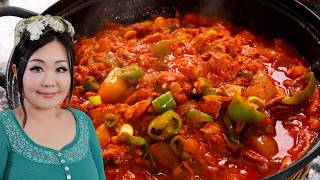
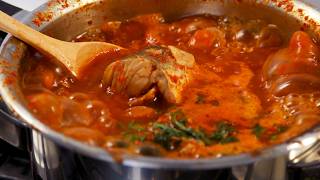
This video demonstrates how to make maeuntang, a Korean spicy fish stew, using whiting fish—a budget-friendly option from the cod family. The host walks through cleaning the fish, preparing a radish base, making a spicy seasoning paste, and assembling the stew with vegetables and optional chrysanthemum greens. The result is a flavorful, comforting dish reminiscent of traditional Korean spicy pollock stew.
Whiting fish is a budget-friendly option from the cod family, available at seafood markets.
Remove fins with scissors, take out intestines, rub salt to remove black film and scales to avoid bitterness and fishiness.
Boil Korean radish in 4 cups of water for 15 minutes over medium-high heat to create the base.
Mix 3 tbsp gochu-garu, 1 tbsp fish sauce, 1 tbsp soy sauce, 1 tbsp doenjang, and 4 cloves garlic into a sticky paste.
Add fish and paste to the radish base, cook 15 minutes, then add onion, green onion, and chili pepper for 5 more minutes.
The fish head and bones are essential for flavor; filleted fish won't produce a tasty stew.
Optional chrysanthemum greens (ssukgat) are added at the end for color and flavor.
What type of fish is used in this maeuntang recipe?
Whiting fish, from the cod family.
0:13
Why is salt rubbed on the fish during cleaning?
To remove the black film and scales, which cause bitterness and fishiness.
1:45
What vegetable is boiled first to create the stew base?
Korean radish.
2:20
How long is the radish boiled before adding the fish?
15 minutes over medium-high heat.
2:50
What are the ingredients for the maeuntang seasoning paste?
3 tablespoons gochu-garu, 1 tbsp fish sauce, 1 tbsp soy sauce, 1 tbsp doenjang, 4 cloves garlic.
3:08
Why is the fish head included in the stew?
Because the head and bones add the best flavor; filleted fish doesn't make a nice maeuntang.
5:23
What vegetables are added after the fish has cooked for 15 minutes?
Onion, green onion (daepa), and green chili pepper.
6:05
What optional garnish is added at the end for color?
Chrysanthemum greens (ssukgat).
6:27
Whiting as a Budget-Friendly Fish
Highlights an affordable alternative to traditional fish for maeuntang, making the dish accessible.
0:13Salt Rub to Remove Fishy Taste
A practical tip to improve flavor by removing the black film and scales.
1:45Importance of Whole Fish for Flavor
Explains why using the whole fish (head and bones) is essential for a rich stew, countering common fillet preferences.
5:23Using Ssukgat as Garnish
Introduces an optional ingredient that adds visual appeal and a unique flavor to the stew.
6:27[00:03] Hi everybody. Today let's make maeuntang, Korean
[00:13] any fish. But today I'm using a very hidden
[00:22] find this fish at any seafood market, and it's
[00:28] family and the taste is so good, especially when
[00:36] stew that I used to enjoy back in Korea. Let's
[00:43] to make maeuntang with one pound. I have two
[00:52] and I kept them in my refrigerator. But I just
[01:00] have a fish monger! I just buy whole fish!", then
[01:06] you how to clean it. Just to show you, I brought
[01:28] I use my scissors to cut off instead of
[01:39] Put some
[01:45] salt here and rub it. So remove the black kind the
[01:53] film because it makes it fishy and
[02:06] Oh, I forgot. The scales have to be removed,
[02:16] It's cleaned. After cleaning this,
[02:20] radish is in my refrigerator all the time.
[02:26] because whenever I make stew or soup, it
[02:36] I need 5 or 6 oz.
[02:42] I make a really small portion for two servings.
[02:50] six ounces. Add four cups of water. I'm going
[03:01] Now let's make maeuntang paste, spicy
[03:08] gochu-garu, three tablespoons, 1 tbsp
[03:16] And 1 tbsp doenjang.
[03:29] Last one, garlic. Four cloves of garlic
[03:49] And mix together.
[03:56] It's kind of a sticky paste.
[04:08] Okay, set aside. This is
[04:16] Let's cut vegetables. Onion first. I will use
[04:28] And daepa, large green onion, just half.
[04:40] This is optional, chrysanthemum
[04:44] We need this one or two. Now cut the fish.
[04:54] Okay. Now it's time to add my fish and
[05:03] half-translucent. Add the fish here and
[05:12] bit. I'm going to cook this around 15
[05:17] "Oh, the fish head! I saw the fish head
[05:23] we always use the fishy head because the fishy
[05:30] So we need to boil it together. Without the fish
[05:37] the bones add the best flavor. So filleted fish
[05:48] fish except for intestines. Now I cracked
[06:05] Now it's time to add onion, green onion,
[06:13] these guys so that they make the stew really
[06:27] I'm going to cook five more minutes. I left
[06:34] it really pretty. Mauntang
[06:43] So good. I love this broth. Ssukgat. Yes. Like
[06:55] ssukgat is going to be blanched.
[07:01] Let me taste!
[07:08] Oh my. Smells so good. Chrysanthemum greens
[07:27] Whiting fish stew we made today. Eggplant,
[07:30] kind of stir-fried eggplant, and mushrooms,
[07:45] I will have some broth.
[07:51] Oh my! good.
[07:57] Oh, there are lots of flavors. So
[08:23] Oh my god. Very soft, tender, and a little
[08:34] Today I showed you how to make
[08:40] fish. Enjoy my recipe. See you next time. Bye.
⚡ Saved you 0h 08m reading this? Transcribe any YouTube video for free — no signup needed.