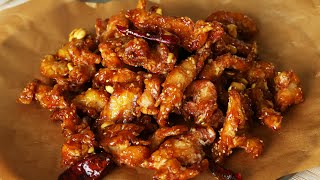

The #2 Most Popular Recipe on My Channel
45sThe claim of being the second most popular recipe after kimchi creates curiosity and authority.
▶ Play Clip"The title promises a crunchy chicken recipe, and the video delivers exactly that with detailed steps."
Maangchi demonstrates how to make dakgangjeon, a sweet and crunchy Korean fried chicken dish, using boneless chicken tenderloins at a beach house. She shares tips for achieving juicy, crispy chicken through milk marination and a double-frying method, along with a savory-sweet sauce.
Dakgangjeon is the second most popular recipe among hundreds, right after kimchi.
Marinate 1 pound chicken tenderloin strips in 1/2 cup milk for at least 30 minutes to make it juicy and remove gamey smell.
Mix 1/2 cup dark corn syrup, 1 tablespoon sugar, 1 tablespoon soy sauce, 2 teaspoons apple cider vinegar, 1 tablespoon yellow mustard.
Use 1 tablespoon or 2 teaspoons ginger, 2 garlic cloves, and 7 small dried red peppers.
In a Ziploc bag, combine drained chicken with 1 cup potato starch and shake to coat evenly for crunchiness.
On medium heat, sauté garlic, ginger, then red pepper; add the sauce mixture and simmer on low heat until bubbling, then set aside.
Heat 4 cups oil to 350°F (7–10 minutes). Fry chicken in batches for 4 minutes, then double-fry all together for 3 more minutes at 330°F.
Add peanuts (or favorite nuts) for 10 seconds, reheat sauce, toss chicken with sauce and sesame seeds.
The result is crunchy, sweet, and savory boneless dakgangjeon that pairs perfectly with a cold drink and pickled radish.
What is the second most popular recipe on Maangchi's channel?
Dakgangjeon (sweet crunchy chicken).
00:14
Why does Maangchi marinate chicken in milk?
To make the chicken more juicy and remove any gamey smell.
01:21
What are the ingredients for the dakgangjeon sauce?
1/2 cup dark corn syrup, 1 tablespoon sugar, 1 tablespoon soy sauce, 2 teaspoons apple cider vinegar, 1 tablespoon yellow mustard.
01:47
What starch is used to coat the chicken, and how is it applied?
Potato starch; the chicken is placed in a Ziploc bag with 1 cup potato starch and shaken to coat evenly.
03:48
What is the recommended oil temperature for the first fry?
350°F (175°C).
06:34
How long does Maangchi fry the chicken in the first batch?
4 minutes.
07:03
What is the key frying technique that makes Korean fried chicken special?
Double frying – frying twice to achieve extra crunchiness.
07:51
How long is the second fry (double fry) performed?
3 minutes.
08:20
What optional ingredient does Maangchi add for crunch in the final step?
Peanuts (or other favorite nuts).
08:44
Milk marinade benefit
Explains a simple technique to improve chicken texture and flavor.
01:21Efficient coating method
Using a Ziploc bag for starch coating is a fast, mess-free tip for even coating.
03:48Double frying for crunch
Highlights the hallmark technique of Korean fried chicken for superior crispiness.
07:51[00:00] 안녕하세요, 여러분! 오늘 I'm going to make 닭간정 Sweet Crunchy Crunchy 치킨. 해볼부, my sweet Crunchy Crunchy 치킨, 닭간정.
[00:14] 그니까, number 2, most popular recipe among all hundreds of recipes, right after my kimchi recipe. 사실, I'm traveling now, and then I met the beach house.
[00:26] until yesterday, I ate a lot of seafood, but today I feel like some sweet Crunchy 치킨. I stopped by a local grocery store, found some ingredients that I use.
[00:38] Today, I'm going to use boneless chicken, very, very fast. You know why? Because I'm using boneless chicken. Cooking time is very fast. Let's get started.
[00:50] One pound, chicken tenderloin, around 2 inch strips.
[01:05] So good is in milk and half cup, for one pound chicken.
[01:21] The reason I use milk is that milk makes the kind of more juicy, and also sometimes, like, the chicken has a little gamey smell, but all gone.
[01:33] Now, I'll keep this in the refrigerator. At least 30 minutes, keeping the refrigerator. Okay, I'm going to wash this and then come back again.
[01:47] I always use rice syrup, but I forgot to bring it. So, yesterday, I went to a local store, and I found this corn syrup, dark corn syrup. We need half cup,
[02:05] and one tablespoon sugar. And soy sauce, one tablespoon. This is the apple cider vinegar, two teaspoons.
[02:20] This is optional, but I always use this. Yellow mustard. So, one tablespoon. And mix.
[02:36] Mix well until this sugar is well melted. Next, when I stir fry, I need this guy. There's a ginger. Ginger is around one tablespoon or two teaspoons,
[02:50] kind of this size, and two garlic cloves. We can mix or just slice and ginger.
[03:10] These are small dried red pepper. So, this is around seven. So, syrup and we're going to stir fry first. So, chicken is marinated in milk.
[03:23] Drain the milk and still wet. Pull it back into my bowl. Half teaspoon salt. Black pepper. Around the quarter teaspoon.
[03:36] And mix.
[03:48] Now, it's time to coat with starch. Another method to coat very easily efficiently and fast. This is the Ziploc bag. So, one cup potato starch.
[04:03] First, add this here. And chicken.
[04:17] And coat evenly. Each piece of chicken should be coated nicely so that it will turn out very crunchy.
[04:29] Now, I'm going to make just the sauce, the cooking sauce. Then, after that, we are going to fry. There's the medium heat.
[04:44] And a little bit of oil. This is vegetable oil. I'm going to use this oil for frying today. See, garlic and ginger and red pepper.
[04:56] First, garlic and ginger. Wow, nice.
[05:09] Frying garlic and ginger already make this a house of smells good.
[05:21] And then, red pepper. Red pepper, so once I put it, it's just burnt. So, that's why I didn't stuff right together. Okay, now, it's a little brownish.
[05:36] Then, sauce. Sauce will already make. Stir gently.
[05:53] Slow the heat. Over low heat. Wow, it's bubbling and the nice cooking.
[06:09] Very hot, be careful when you cook. Now, the sauce is done. Set aside. Let's fry the chicken. Four cups.
[06:22] Oh, cooking oil. Corn oil, vegetable oil, canola oil. So, we are going to wait until this is hot enough for the chicken to be fried.
[06:34] Seven to ten minutes until this reaches the 350 Fahrenheit. I'm wearing these gloves. The massage right chicken.
[06:46] The chicken like this is one by one. A lot of bubbles, right temperature. Cooking for cooking.
[07:03] Let's split this. I got to make two batches. So, this is, I cooked four minutes.
[07:22] Let's split it.
[07:35] My second batch is fried. Look at that. This is the first fried. So, as you know, one makes Korean fried chicken very special.
[07:51] Double fried. So, I'm going to double fry. And then, but let's check out the temperature. 330. So, I'm going to wait a little longer. I just wait around one minute.
[08:04] This time, I don't need to do batch by batch. Just hold together.
[08:20] These days, in Korea, three food cells, this type of chicken, so boneless chicken, boneless
[08:32] chicken. I fried three more minutes. And now, very nice crunchy.
[08:44] I'm using peanuts. You guys can use your favorite nuts. Just 10 seconds. Make it crunchy.
[08:57] And, turn off the heat. So, look at this one. A little sticky. Just reheat this sauce until bubbling.
[09:09] Chicken. Sesame seeds.
[09:28] Boneless chicken. Around 10 minutes later, split this side. Easily, you can split this. And then, just not stick to each other. I'm not a coke person, but today is exceptional.
[09:43] Because of the dakgangjeon. And once in a while. And, chicken, and also, be sure to make this move pickle. Ready to see pickle.
[09:55] So, it go well together. Did you hear that sound? Crunchy. Cheers, everybody.
[10:08] So, it's crunchy crunchy. Enjoy my boneless dakgangjeon. See you next time. Bye.
⚡ Saved you 0h 10m reading this? Transcribe any YouTube video for free — no signup needed.