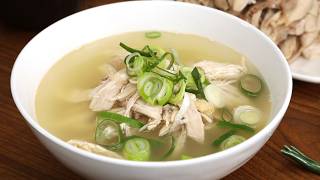

What Makes Dakgomtang Different from Samgyetang?
47sEducational comparison between two Korean soups with a cute intro that hooks viewers.
▶ Play Clip"The video title perfectly matches the content, providing a thorough tutorial on how to make Korean chicken soup (Dakgomtang)."
This video provides a detailed recipe for Dakgomtang, a Korean chicken soup. It differs from other Korean chicken soups like Samgyetang by separating the chicken meat from the bones after initial cooking, then simmering the bones to create a light, clear, and flavorful broth. The soup is served with the tender shredded chicken and various side dishes.
The video introduces Dakgomtang, a Korean chicken soup, and distinguishes it from Samgyetang (ginseng chicken soup) by explaining that the chicken is cooked until tender, the meat is removed, and the bones are simmered further to infuse flavor into the broth.
The chef washes the chicken thoroughly (insisting on this step despite common advice against washing poultry), removes excess fat and the tail to prevent unpleasant smells, and trims the wingtips.
The recipe uses one whole chicken, one gallon of cold water, 12 garlic cloves, about one tablespoon of sliced ginger, one medium onion halved, and a large Korean green onion (daepa) or three regular green onions.
The chicken is cooked in the broth: first over medium-high heat for 30 minutes, then reduced to medium heat for 40 minutes, for a total of 70 minutes of cooking.
After cooking, the chicken is removed from the pot and allowed to cool. The meat is separated from the bones, with the breast meat shredded and the dark meat kept in pieces. The bones are returned to the pot to simmer further.
The shredded chicken breast is mixed with cooked garlic from the broth, half a teaspoon of salt, and about one tablespoon of sesame oil. The dark meat is served separately.
A dipping sauce/instant pickle is made with 2 tablespoons soy sauce, 1 tablespoon vinegar, chunks of onion, sliced garlic, and green chili pepper. A seasoning paste is made with 1/4 cup gochugaru (Korean chili flakes), 1/4 cup chicken broth, 2 tablespoons fish sauce, and 1 teaspoon of ginger.
After simmering the bones for 30 minutes, the broth is strained through a fine-mesh strainer lined with a cotton cloth (or cheesecloth) to remove impurities, bone fragments, and fat, resulting in a clear, slightly milky broth.
The recipe yields about 10 to 12 cups of broth, sufficient for four servings. The broth is kept hot but not boiled further to avoid reducing it. The soup is served hot with rice, shredded chicken, and assorted side dishes.
Dakgomtang is a refreshing Korean chicken soup, perfect for hot summer days as it provides energy and revitalization. The recipe emphasizes a clear broth achieved by simmering chicken bones after removing the meat, resulting in a light yet flavorful soup that can be enjoyed year-round.
What is the main difference between Dakgomtang and Samgyetang?
In Dakgomtang, the meat is removed from the bones after cooking, and the bones are simmered further to create a clear broth, while Samgyetang includes ginseng and rice cooked with the whole chicken.
0:18
How long is the chicken cooked in the initial boiling step?
The chicken is cooked for a total of 70 minutes: 30 minutes over medium-high heat, then 40 minutes over medium heat.
3:19
What ingredients are used for the dipping sauce?
The dipping sauce is made with 2 tablespoons soy sauce, 1 tablespoon vinegar, chunks of onion, sliced garlic, and green chili pepper.
8:06
What ingredients are used for the seasoning paste?
The seasoning paste is made with 1/4 cup gochugaru (Korean chili flakes), 1/4 cup chicken broth, 2 tablespoons fish sauce, and 1 teaspoon ginger.
9:00
How many cups of broth does this recipe yield?
The recipe yields 10 to 12 cups of broth.
11:11
What is the purpose of straining the broth through a cloth or cheesecloth?
To remove impurities, bone fragments, and fat, resulting in a clear broth.
10:13
What is the chef's stance on washing the chicken?
The chef insists on washing the chicken despite advice against it, stating she never felt comfortable not washing it.
0:58
What is the recommended serving size for the broth per person for four people?
The broth should be 10 to 12 cups total, so about 2.5 to 3 cups per person.
11:52
Dakgomtang vs. Samgyetang
Key distinction between two similar Korean chicken soups, highlighting the bone-simmering technique for a clear broth.
0:18Personal Preference on Washing Chicken
Reveals the chef's personal stance despite common food safety guidance, showing practical cooking decisions.
0:58Controlling Broth Concentration
Emphasizes avoiding further boiling to maintain the desired broth volume and concentration.
4:06Making Instant Pickles as Dipping Sauce
Shows a creative use of pickling ingredients for a quick side dish, adding variety to the meal.
7:54Dakgomtang as an Energizing Summer Soup
Links the dish to cultural beliefs about food providing energy during hot, tiring summer days.
14:04[00:03] Hi everybody. Today's recipe is Dakgomtang. Repeat
[00:11] it? This is a Korean chicken soup. Chicken soup. I
[00:18] One of them is samgyetang, Korean ginseng chicken
[00:25] add some rice and then cooking. This dakgomtang
[00:32] is just cooked until the chicken tenders. After
[00:42] into the pot. So just simmer a little longer. And
[00:50] Serve with rice and meat. Let's get started. First
[00:58] I'm going to wash this. Some of you guys,
[01:05] tried to do a couple of times, but I never felt
[01:17] Inside. Oh, that's empty. Sometimes
[01:23] remove it if you find that kind of a
[01:32] because when I cook this together, it will be
[01:55] This chicken doesn't have much fat, but sometimes
[02:02] yellow fat. So, you got to remove
[02:22] Okay, nice shower done! This is my eight
[02:36] Garlic. 12 garlic cloves. 7.. 12. And ginger
[02:51] One medium-sized onion just cut in half.
[03:00] But if you can't find this, use regular green
[03:13] and cover. Let's cook!
[03:19] I'm cooking over medium high heat for
[03:25] my chicken is vigorously boiling. I'll show you.
[03:37] Turn down the heat to medium. Cook 40 minutes
[03:43] going to be fully cooked. See you soon. So 40
[03:51] aroma! I'm going to fish out my chicken. Wow, this
[04:06] It looks very tender.
[04:18] I will add 1 tablespoon salt.
[04:25] Cover. I turned off, then I'm
[04:31] So stuff like this green onion, all throw
[04:42] I'm going to separate meat from the
[04:54] This is chicken breast meat.
[05:09] You can actually wait until it's a little
[05:17] Chicken breast, this white meat. And then we are
[05:26] We cooked this chicken 70 minutes
[05:37] Oh, this is oyster meat stuck around this area. Look at
[05:46] Some people love to eat the
[05:55] And let's throw away.
[06:01] And let's put this bone back into the pot.
[06:20] Take off some fat.
[06:27] Okay. Turn on the heat again. Simmer over
[06:45] Chicken breast. Shred like this.
[07:01] Looks like a lot, doesn't it?
[07:08] Okay. And here some cooked garlic, very soft!
[07:18] Half teaspoon salt. Sesame oil, about
[07:32] I want to keep this white color. So I'm
[07:41] before just you eat, you can add it to your taste.
[07:54] Look at that! This is a plate of dark meat.
[08:01] I'm going to make two things. One is a
[08:06] seasoning paste. Two tablespoon soy sauce, one
[08:21] Maybe 1/4 cup amount. Make chunks like this.
[08:29] Three garlic cloves. Slice.
[08:36] Large green chili pepper. Maybe this amount is
[08:46] good.
[08:47] Mix together.
[08:53] I said this is a dipping sauce but
[09:00] And next, make seasoning paste, 1/4 cup
[09:10] 2 tablespoons fish sauce.
[09:22] I like to add some ginger, just a little
[09:33] Here.
[09:43] clear broth really enhances the flavor.
[09:52] This is a large green onion, slice it.
[10:05] I simmer this for 30 minutes. We have to strain
[10:13] mesh strainer. I’m using a cotton cloth, but you
[10:25] The reason is that we remove all this kind
[10:32] So I'll just make it this way. And I'm going to
[10:45] See this kind of a brown stuff, also
[10:53] The broth is
[11:02] very clear and a little milky.
[11:11] And also we added salt. So it already tastes
[11:22] You don't have to heat up right now. Just before
[11:27] already hot. I don't want to boil down this broth.
[11:35] if you have time, you can simmer the broth for 1
[11:43] Then you can add more water. So whatever method
[11:52] so that four people can enjoy nice soup. Right?
[12:02] fermented squid. This is fermented pollock
[12:15] seasoning paste. And dark meat. Just a plate of
[12:31] This is eomuk-bokkeum (stir-fried fish cakes).
[12:39] This is my table. I'm going to show you how
[12:45] Heat up the soup. This soup is just salty enough.
[12:53] So,
[12:54] add some
[13:07] black pepper and mix.
[13:19] I love this!
[13:25] chicken.
[13:33] Mhm~
[13:54] Just mix like this.
[14:04] Fermented squid.
[14:09] Chicken is very tender and the broth is
[14:16] you will feel very refreshing. During the
[14:23] tired and don't feel like doing anything. Then
[14:31] dakgomtang is one of the dishes like that.
[14:37] I showed you how to make dakgomtang.
⚡ Saved you 0h 14m reading this? Transcribe any YouTube video for free — no signup needed.