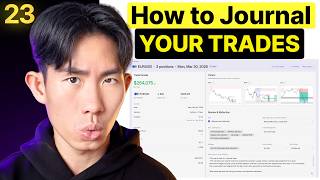

Are You Repeating the Same Trading Mistakes?
42sEinstein quote about insanity resonates with traders who feel stuck in a cycle of losses.
▶ Play Clip"The title is accurate but generic; the content delivers a solid, practical guide to journaling, though it's essentially a product demo for Edge Flow."
This video explains why journaling is essential for trading success, emphasizing that it helps separate luck from skill and build discipline. It then demonstrates how to use the Edge Flow trading journal to document and review trades effectively.
Journaling is not for today but for your future self; it captures truth while fresh, before rationalization.
A green trade can be bad execution (luck), and a red trade can be good execution (followed the plan). Without journaling, you can't tell the difference.
Discipline means overcoming resistance to boring, repetitive tasks. Edge Flow reduces friction to make journaling easier.
Journal immediately after exiting a trade, or at least by the end of the day, while emotions are fresh.
Upload chart screenshots for higher, medium, and lower timeframes to refresh memory and revisit thought process accurately.
Tag entry confluences, trade management details, and mistakes. Be brutally honest to make progress.
When green, ask if you followed your plan or got lucky; when red, ask if it was a good loss (followed plan) or bad loss (neglected plan).
A good trade is one executed according to your plan, not necessarily profitable. Grade execution, not P&L.
Why is journaling important for your future self?
To capture truth while it's fresh, before you rationalize it, so you can introspect and improve.
00:31
How does journaling help separate luck from skill?
A green trade can be bad execution (luck), and a red trade can be good execution (followed the plan).
01:00
What does becoming more disciplined mean in trading?
To overcome the resistance that stops you from doing the hard, boring, repetitive tasks required to succeed.
01:41
When should you journal a trade?
Journal right after you exit a trade, or at least by the end of the trading day.
03:21
What three chart screenshots should you upload for context?
Higher timeframe (bias), medium timeframe (location), and lower timeframe (entry trigger).
07:20
What is the difference between a good loss and a bad loss?
A good loss is when you follow your plan and still lose; a bad loss is when you neglect your plan.
14:12
What defines a good trade, regardless of profit?
A good trade is one in which you executed according to your trading plan, especially when you didn't feel like it.
15:48
Journal for your future self
Shifts the purpose of journaling from immediate gratification to long-term improvement.
00:31Separating luck from skill
Highlights the core value of journaling in evaluating trade quality beyond P&L.
01:00Use chart screenshots for context
Provides a practical method to refresh memory and avoid rewriting history.
07:20Execution over P&L
Reinforces that self-worth and performance should be graded by adherence to the plan, not by profit.
15:48[00:03] without journaling. It's repeating the same mistakes with It's repeating the same mistakes with more confidence. Einstein famously said, "Insanity is doing the same things over and over again and expecting different
[00:15] results." It's the exact same concept in here. If you trade the same way, you repeat the same mistakes, you are going to get the same results, which means until you change, your trading results will not change. Okay? So, I believe
[00:31] that journaling is important not for your present self. You don't journal for today. You journal for your future version of yourself. Right? The goal here with journaling is to capture truth while it's fresh, not after you
[00:45] rationalize it. It's to capture truth so that later you can introspect on truth and you can think about how you can improve your existing strategy to make yourself, your technical edge, your mental edge. And to me, like, journaling
[01:00] is just how you separate luck from skill. Because a green trade, a winning trade, can be bad execution, right? Could just be you got lucky and you won the trade. And similarly, a red trade, a losing trade,
[01:13] could be a good trade because you executed your trade plan flawlessly in that trade. Which also means that if you do not journal your trades, you will never ever know the difference. It is your duty to journal your trades not for
[01:27] today, but for your future self. So, you can look back, see the progress you've made, and thank you for not wasting years repeating the same mistakes. And profitability is to become more disciplined, right? But what does it
[01:41] that mean? To become more disciplined, what it essentially means is that you need to overcome the resistance that stops you from doing the hard, boring, repetitive tasks that are required to succeed. Things like journaling,
[01:54] reviewing, refining, following a trade plan. And the thing is you can do all of that by increasing reps until you adapt, or you can just reduce friction. And that's what Edge Flow does. It lowers
[02:07] the resistance to the boring, repetitive tasks that actually make you profitable. Okay, so let me show you how to actually use the trading journal inside Edge Flow to journal and review your trades. So, after you have closed a position
[02:22] itself, right? You can just go and journal that trade by going to your trading journal function in Edge Flow. So, over here, this is where every single position that you have closed, will appear over here, right? They get
[02:37] auto imported immediately right after you exit a trade. And you can also add a manual trade entry if you want to do so, right? Like this is outside of this trading account and you want to document it on your Edge Flow
[02:52] account, you could just add a manual trade and just fill in the details in trade. And then once you do so, the manual trade will appear here, right? trade. Ta-da, right? Manual trade, as simple as
[03:06] trust me, nobody likes journaling, all right? Nobody likes journaling. The only difference between professional traders and amateur traders is that they do the anyways because they know that it helps them in the long term, right? So,
[03:21] them in the long term, right? So, my rule, my non-negotiable is I journal right after I exit a trade. Okay, you want to make this a habit because that's the only way this thing can feel fun. That's the only way you
[03:33] can reduce the amount of willpower needed to do this mundane task is to needed to do this mundane task is to make it a habit. So, journal right after come in here, I trade trade trade trade. Today I lost $2,000. Cool. Press this
[03:47] button right here, view in journal, straightaway go and journal the trade itself, right? Like once again, when you build it into a habit, now you are doing Okay? So, if you can't do it immediately because like let's say you are still
[04:00] continue trading, then what you want to do is to do it at the end of the trading session, at the end of the trading day. But, you must get it done no matter what within the same day, okay? Because this
[04:13] is where your emotions are still fresh. You just got off the trade, you kind of understand the trade idea, and you can like really just document the reality of the trade itself. It is different if you journal right now
[04:27] compared to if you journal the trade a few days later, right? So, try to do it as soon as humanly possible, and just do more reps, right? automatic it becomes, and the more easier it is for you to journal in the
[04:39] future. And to me, what I like to do is to once that is needed to journal, right? So, I like to get into a flow state. And I get into a flow state by putting my headphones on,
[04:52] and also having like a green tea right by my side, productivity beats, you know what I'm saying? And then like I just coming in here and just start journaling, right? So, this is where
[05:05] only 5 minutes, and it can save you thousands of dollars by preventing trading for the day, first thing you want to do is to go to the trading journal, and I click the day that you're on, and glance at the daily stats first,
[05:19] right? It just give you quick context at a high level. And this is where you can positions of the day, how many trades you have taken, what is your win rate like, did you follow your trading plan, did you violate any guardrails? If so,
[05:32] it'll be documented right here. Did you complete the pre-market routine, and how journaled so far, right? So, if you come here, you will notice there's like this gray dot beside each trade itself. What it pretty
[05:45] much means is that the journal is missing, right? That means you haven't once you start journaling the trade, it will look something like this. You can see the the greater just disappeared, right? So, this kind of indicate, okay,
[05:57] right? If you're able to journal all the trades that you've taken, then this let's begin the journaling process, right? So, let's click on this trade itself. And what you want to do is to scan from left to right. Okay? Because
[06:10] the left side, what we have over here is all your trading data, which is once again automatically imported from your trading broker. This is where I can see on P&L, what instrument do you trade, what was the direction, what lot size do
[06:23] you use, what date was this on, like what session was this trade in, what was the trade duration, right? Whether it's 5 minute, 1 hour, 45 minutes, and what is the entry price, and what is the take profit, stop loss, so on and so forth.
[06:39] And what is your risk and reward in terms of R multiple, and what was the fees that cost you in this trade itself. Okay? So, on the left-hand side, just review the trading data, see whether it's correct or not, and then on the
[06:52] right-hand side, this is where you have the space, you have the time to actually introspect on the trade idea itself. Okay? Introspect on the trade that have journaling, the first thing you want to do is to actually add your chart
[07:07] screenshots, right? So, you have context over the trade itself. So, on the trading panel itself, you can just come in here and just press download image. can just come back here to the journal, and then you can just upload the image
[07:20] one of these boxes right here. But you basically just want to upload a chart screenshot for the higher time frame, on medium time frame, and a lower time frame. The higher time frame, this give you context as to like why this trend
[07:34] direction, you know, what was your initial bias, what was the structure like, what was the key levels. And then the medium time frame could answer the next question, why this location, why the higher and lower display the month
[07:46] zone or flip zone, like where was the available liquidity? where I can see your entry trigger, right? What was the entry confirmation that triggered that appeared in the market that causes you to enter for the
[07:58] trade itself. Okay? So, the reason why we actually put these chart screenshots in here for you is so that we can refresh your memory, right? To just remind you of what happened a few hours ago, a few minutes ago when you were in
[08:11] the position itself. And once you visually see the trade that you just exited, you can revisit your thought process accurately instead of rewriting process accurately instead of rewriting history, right? Because we all know how
[08:24] inaccurate memory is, right? So, it's important that you actually do this. And here's a tip for you, right? If you press this focus mode over here, what you essentially go is literally focus mode where we literally hide all like
[08:36] all the other details like this and this. So, all you have can do is to just like journal, right? Journal manually while reviewing the chart screenshots tip that you can try out if you want. But anyways, this is where I can start
[08:48] tagging your trades, right? So, once again, go from top to bottom, right? Did You can just check off this box right here and then go and tag which plan did you actually follow based on your edge, right? So, by default, you will always
[09:02] be the plan that trading plan, the edge that you have set as active in the edge go and select whatever trading plan that you have followed in this case and then So, how this works is that it's essentially tags, right? It's It's like
[09:17] a tag system. So, just list down your entry confluences, right? So, let's say in this case, we got a market shift, okay? Just type in, press enter, and it will be tagged right here. And then it'll be saved over here as a drop down
[09:32] Yeah, so you type in your entry confluences over here, I'll pick the two actually cause you to take the trade itself. You don't have to over tag, because you're just going to be lying to yourself. Just like really just enter
[09:48] And then next up you got the trade management, right? This is where you can once again write down how you manage the open position, right? Did you hold it all the way to your take profit? Or like did you take partial profits? If so,
[10:04] where did you place your partial profit at? If you move your stop loss, how did And then once done, you can go and reflect on the trade itself and think committed on this trade. Whether that's a win or a loss, there will always be
[10:17] some form of mistake. There will always be more room for like improvement, right? So, if there's a mistake, just go and tag it right here, right? Maybe I did not wait for price to mitigate my
[10:29] mistake that you have, just put it in. If you don't have any mistakes, you are flawless, then yeah, you can just uh just like leave it clean. Okay, but like you are brutally honest, right? Because this is where you will be able to make
[10:42] the most amount of progress when you actually just stare at your inadequacy and just think about solutions to overcome your shortcomings. And then over here, this is where you can take your emotion, right? So, about the
[10:55] in the trading panel, we have a feature, right? So, example, right after you enter for a trade over here, emotion pop-up model right here that appears right after you trade just to
[11:09] ask us ask you what emotion drove this entry, right? So, let's say calm. And then this is your entry emotion, right? This entry emotion will be tagged into your trading journal. And then once you close the position itself, there will
[11:22] asking you how do you feel after you got out of the trade, right? And this emotion here will be tagged into your exit emotion, right? So, whatever you're trading, like I said, it will automatically be imported in here. Okay?
[11:39] So, yeah, let's say in this case, since I didn't, you know, in select my emotion itself, I'm just going to manually choose it right now in retrospect, right? So, I can put calm, disappointed, whatever it is. Just put the emotion
[11:52] there. Okay? So, once that's done, this is the fun part, and that is reflecting on the trade itself. So, when it comes to reflecting the trade, you can either type out your reflection manually just like this, or you can record like a
[12:06] little voice thing, which will then transcribe what you are saying into text. So, this way you don't even have like do the journal itself, right? Let me just show you how this work. Okay, you can see like it literally just
[12:19] transcribed what I just said. Okay, so today I entered for a trade on EUR/USD, today I entered for a trade on EUR/USD, and I actually made the mistake of being too impatient. I rushed into the trade without following my trade plan.
[12:34] there. What happens is that it transcribed what I said into text, where you don't feel like manually typing stuff, because you just encounter a bunch of losses, you can just speak to it like a freaking human, and then it
[12:47] will transcribe what you have said to it. All right, so when it comes to reflection, there are two ways that I actually reflect based on my trading results. When I'm green, when I make money, this
[13:01] is where I'm asking myself, okay, did I actually follow my trade plan, or did I get lucky? And if I did follow my trade plan, which part of the process was clean, right? Like what worked? Okay, like is it
[13:14] up properly? Is it because um my bias was correct? And then I also ask myself, did I leave money on the table, or did I manage the position well? Right, and this is where I really just go and look at my how I
[13:28] managed the trade. Right, did I cut the profits early because I was scared that price is going to reverse? Did I take partial profit? Did I move my stop loss way too soon? And then last but not least, I ask
[13:40] myself, how can I repeat this win again next time? Okay, like what are the things that I can do more of in the future so that I can repeat a win just That's the scenario if I win, if I'm green, if I make money. Cool. Very fun.
[13:55] making money. The other scenario is when I lose money, when I'm red. The first question I ask myself after I lost a trade is, was it a good loss or a bad loss? Because a good loss is one in which
[14:12] I follow my plan and I still lose. That's part of trading, right? That's just variance, right? That's just, you know, the the probabilistic nature of trading. You can't escape good losses. But if it's a bad loss, that's alarming
[14:26] because a bad loss is a loss that I incurred as a result of neglecting my Once again, that's alarming, right? Because that just says that I haven't been disciplined on this trade itself. Let me go and investigate what went
[14:40] wrong. Like, did I let emotions cloud my judgment? Okay, if that's the case, I can go and look what was my emotion at entry? What was my emotion at exit? And then based on that, I can develop a hypothesis, right? Okay, saying that
[14:52] because I was angry when I was entering the trade, it caused me to actually neglect my trade plan, and now I'm just trading the market because I want to get back the money that I've lost. And that resulted
[15:05] So, the next time around when I actually feel this exact same emotion, maybe I should calm myself down. Maybe I should, you know, meditate before I actually get back into the market. I also ask myself, okay, what caused the
[15:18] the loss itself, right? Like, did I not follow my trade plan? Was it timing? Was it anticipation? Was it emotion? Whatever it is, identify the root cause and try to fix it next time round. Okay, what got real can prevent this
[15:33] exact mistake? What rule change do I need to do to make to like combat this myself from repeating the same mistake again. Okay? So, yeah. Basically, just remember that a good trade is not necessarily a
[15:48] profitable one. A good trade is one in which you executed according to your trading plan. Especially when you didn't feel like it. mean it's good. Just because you lost money doesn't mean it's bad.
[16:01] Execution is what we are grading here. We don't define our performance, We don't define our performance, our self-worth by our P&L. No, we define it by our ability to execute the trading system.
[16:17] trader. So, once you're done with everything, right? Let's say put a bunch of journal in here. There's no save button because it's auto save, right? So, you can just leave the journal itself. Or, if you want, you can
[16:31] just continue journaling the next trade by pressing this button right here. And trade. And then this is where you can like journal like the the previous forth. Yeah. So, that's what you can potentially do in here.
[16:45] And then this allows you to just journal trades back to back without ever leaving function that allows you to share a trade right here, right? You can use accountability. You can share it with your coach, share it with your trading
[16:59] community. Make sure that you only share it after you have journaled it, though, complete. But yeah, that's the whole point of the trading journal. Remember, you're not doing this to feel productive. You are doing this to get
[17:13] dangerous. Every trade you journal becomes feedback. Every mistake you make becomes a pattern, and every pattern you fix becomes profit over time. So, do not be that trader who keeps paying the market tuition for the same lesson again
[17:28] and again. Close the loop after every session. Break the cycle. Break the vicious cycle of unprofitability. And your future self is going to thank you for it.
⚡ Saved you 0h 17m reading this? Transcribe any YouTube video for free — no signup needed.