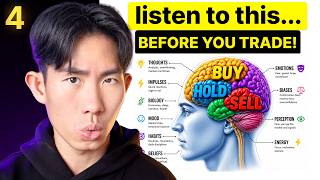

You Don't Trade the Market, You Trade Your Beliefs
45sThis segment delivers a paradigm-shifting insight that challenges common trading assumptions, making it highly shareable and thought-provoking.
▶ Play Clip"Delivers on the promise of mindset reprogramming with actionable steps, though it could be more concise."
This video focuses on the psychological aspect of trading, arguing that traders do not trade the market but rather their beliefs about it. The speaker emphasizes that a broken belief system leads to broken execution and inconsistent results, and provides a five-step method to reprogram one's mind for trading success.
Traders focus on finding better setups and systems, but the real issue is that results are shaped by identity, emotions, and underlying beliefs. If the belief is broken, execution will always break.
We only perceive 1% of reality due to sensory limitations. Our view of the market is just one of many versions, shaped by our past experiences and beliefs.
You don't trade the market; you trade your belief about it. There are as many versions of the market as there are traders, and your results are determined by your internal belief system.
Beliefs create emotional defaults, risk behavior, sense of worthiness, and actions under pressure. A broken belief leads to inconsistent execution and self-sabotage.
Beliefs lead to emotions, which drive actions, which produce results, which reinforce the original belief. This loop can be positive or negative, and breaking it requires conscious effort.
Reprogramming means deleting old beliefs and installing new ones. It's about changing your identity and breaking the vicious cycle of self-sabotage.
The five steps are: 1) Spot the belief, 2) Find the evidence trail, 3) Identify the payoff, 4) Replace it, and 5) Install the new belief. Consistency is key.
Identify repetitive negative sentences like 'I always mess it up' or 'I need to make money today.' These are subconscious beliefs that drive behavior.
Trace where the belief came from—often from childhood or authority figures. Most beliefs are old programming, not objective reality, and can be unlearned.
Every limiting belief protects you from something (pain, uncertainty, responsibility). Recognizing this payoff is crucial for change.
It's easier to replace a belief than to eliminate it. Use process-oriented, realistic replacements like 'I am becoming consistent by following my rules one trade at a time.'
Use 'I am the type of person who...' statements to shift identity. For example, 'I am the type of trader who waits for A+ setups.'
Beliefs change through repetition, emotion, and proof. Read your new identity aloud daily, feel the emotion, and collect evidence of living it.
If a new belief feels too big, break it down into smaller, achievable steps. For example, 'I can be disciplined for the next 60 minutes.'
Replace 'I need to make money today' with 'My job is execution, money is a byproduct.' Replace 'I must predict the future' with 'Trading is a game of probabilities.'
Changing your trading results requires changing your beliefs and identity, not just your strategy. By following the five-step reprogramming process, you can break the cycle of self-sabotage and achieve consistent trading success.
What is the core problem for most traders according to the video?
They focus on strategy rather than their beliefs, which drive execution and results.
00:01
What percentage of reality do we perceive?
Only 1%.
01:14
What is the belief-emotion-action-result loop?
Beliefs lead to emotions, which drive actions, which produce results, which reinforce the original belief.
04:04
What are the five steps to reprogramming beliefs?
Spot the belief, find the evidence trail, identify the payoff, replace it, and install the new belief.
07:16
Why is it easier to replace a belief than to eliminate it?
Because it's difficult to get rid of an old belief, but easier to substitute it with a new one, similar to replacing a bad habit.
14:10
What three things does a belief need to change?
Repetition, emotion, and proof.
17:37
What is the belief ladder?
A technique to break down a large new belief into smaller, achievable steps to build momentum.
21:04
What is the upgrade for the belief 'I must predict the future'?
Trading is a game of probabilities, not certainty; manage risk and play the odds.
23:44
Strategy vs. Belief
Challenges the common focus on strategy, shifting attention to the internal belief system as the root cause of trading results.
00:01Perception of Reality
Introduces the idea that we only perceive 1% of reality, framing trading as a subjective experience.
01:14The Belief Loop
Provides a clear model of how beliefs perpetuate themselves, making it actionable for breaking negative cycles.
04:04Reprogramming Defined
Defines reprogramming as deleting old beliefs and installing new ones, setting the stage for the practical steps.
06:08The Belief Ladder
Offers a practical tool to make belief change manageable by breaking it into small steps.
20:49[00:01] biggest problem is strategy. So, they spend all their time and effort looking for a better setup, a better confirmation, a better concept, a better trading system. But the truth is, you do not trade the
[00:15] market. You trade your belief about the market. Which means that your results are not just shaped by your trading strategy. They are shaped by your identity, your emotions, and the belief that is running
[00:29] in the background every single time you sit down to trade. Because if the belief is broken, the execution will always break. And that is exactly why in this lesson, I want to talk about something deeper.
[00:43] How to reprogram your mind and your belief for trading. Because until you change your inner operating system, which is driving your actions, you will keep repeating the same emotional patterns over and over
[00:58] again, the same mistakes over and over again, and just get the same results. So, with that being said, let's dive into the lesson about mindset. What if I tell you that we are only perceiving 1% of reality?
[01:14] You heard that right. Our sensory organs are only capable of perceiving 1% of Right, so we cannot right, we don't have the power
[01:27] yet to perceive the objective reality. We see our own perception of the reality, right? We can only see how the world works based on our past experiences, right? Based on the limitations of our organs. Right?
[01:43] blah, right? And if you look at the eyes, there is certain colors that you can't see, right? Because once again, our eyes is quite limited. We can only see like one sort of like color on the
[01:58] entire color spectrum. And then also our mind can only see three dimensions, the fourth dimension, the fifth dimension, the sixth dimension, the seventh dimension, because once again, we don't have the ability to actually
[02:12] perceive those dimensions yet, right? So, if you look at it fundamentally, this pretty much means that the reality that that that you perceive perceive. And it's the exact same thing with
[02:27] You don't actually trade the market. You trade your belief about the market. Which means that you need to train your mind to acknowledge the fact that the market that you see is just one of 14 million other versions of the market.
[02:43] One version for every trader that is actively trading the market itself. Right, so we all don't trade the market, we trade our belief of about the market. Which means that your results are not kept by your strategy. They are kept by
[02:56] background. This is something that I've talked about course module. So, I'm pretty sure you understand what I'm talking about right here. But I want to further like drive this point home, because I don't think
[03:09] you understand how important the belief are. Because belief actually creates your emotional defaults. It creates your risk behavior, or rather your relationship with risk and failure. It creates what you think you deserve,
[03:22] right? Are you worthy or not? It also creates what you do under pressure. Which automatically means that if the belief is broken, the execution will If the belief is broken, you will not get consistent results,
[03:36] because your execution will always be inconsistent. then guess what? The next time you actually make money, you will start to
[03:50] that is not aligned with your trade plan, and give back your profits back to the market itself. Because you didn't believe you were worthy of And this is the main loop, right? It's
[04:04] basically belief leads to an emotion, and that leads to an action, and action leads to a result, and the result reinforces the belief. Okay, so here's an example. If you believe that I'm not a consistent
[04:17] trader, I'm not a consistent trader yet. Now, the emotion that you feel is the man. After I am not a consistent trader, right? I am not a profitable trader. So,
[04:29] works or not. Okay, so that breeds doubt. And that doubt or the sense of urgency, right? You know, I need to make money today, because I'm not consistent yet. That leads you into taking the action of forcing trades, or breaking
[04:44] rules, or just not trusting your trade plan in general. And when you take these actions, which is clearly harmful to you, guess what? You get the result that you unconsciously were seeking in the first place, which is
[04:58] messy P&L. You know, sometimes you lose, sometimes you win. It's very difficult very difficult for you to end the month consistent uh end the month profitable, you know, your execution is all over the place.
[05:12] And when you get the results that is clearly showing you that you suck at trading, guess what? This reinforces the belief that you are not consistent. This makes you feel sad, makes you feel
[05:27] And once again, reinforcing this belief right here, and you are stuck in this loop over and over again until you decide to change. Okay, like majority of the traders, they don't change. So, as a result, they
[05:41] right? Because they forgot to change themselves. Like they master all the technical analysis, they learn all the concepts and strategies in the world, operating system. They don't change their belief system. They don't change
[05:54] And as a result, they get the same results over and over again, and they lose everything, and until they quit trading. trading. Right, so reprogram.
[06:08] This is why we need to reprogram, right? Reprogramming is breaking this loop. What does reprogram means? It means deleting the old belief and installing reprogramming means, and that's what
[06:23] So, there's this quote that I really love by Joe Dispenza, which he says that you cannot change your life from the same mindset that created it. You can't emotions, repeat the same habits, and
[06:37] expect a new reality. It just doesn't work that way. Change begins the moment you think greater than how you feel. When you stop rehearsing the past, and you start rehearsing your future. Like I said, nothing changes if nothing
[06:49] If you keep on thinking the same thoughts, feeling the same emotions, doing the same behavior, you are going to get the same reality. now,
[07:03] want to go. You have to change your identity. You have to change your belief. You have to break this vicious cycle. And I'm going to show you how to do it in this particular lesson itself, right?
[07:16] if you just do these five steps, and you do them consistently, right? You do them no matter what you feel, you do that regardless of your circumstances, regardless of, you know, like your old self trying to pull
[07:30] know, like your old self trying to pull you back. That is how you change. Okay? So, the step one is to spot the belief. So, you want to find a sentence, right? sentences that you keep repeating. I always mess it up. I can't be patient. I
[07:43] need to make money today. If I miss it, I will never get another chance. This is a once-in-a-lifetime opportunity. I don't deserve to win. sentences that show up when you stress. Trust me, every single day when you wake
[07:58] up, you go to the market, these three sentences are usually the over and over again, right? Like this is what your subconscious is telling you every single day. Okay, it's very obvious. For me personally, the the
[08:13] three sentences that I hear over and over again in my head in my first year of trading is, I need to make money today. I suck at technical analysis. I can't control my emotions.
[08:26] beliefs that I tend to, you know, tell myself over and over again, right? So, it was infectious, right? It was simply like a disease. It's very harmful, and it caused me to actually believe it, right?
[08:39] sentences that, you know, you keep repeating in your head over and over again. Okay, just write them down. Next thing, find the evidence trail. Where did it come from? Ask yourself, when did I start believing
[08:52] this? Who taught me this? What moment made me made this feel true? Because most beliefs are old programming, not reality. And the interesting thing is that like believe it or not, but majority of your
[09:05] years. Right? Like from the minute you pop out of the womb up until the age of seven, this is where you are observing the world around you, right? How your parents behave, um what your friends are
[09:19] doing, what your teachers are telling you to do, right? Like these people belief that they are belief onto you, right? So, whatever you believe right now is most likely a belief that you had acquired from the
[09:33] society, from your parents, from your teachers, from your peers, So, those are not your belief actually. It's just that it's the belief that the world has imposed onto you. Which also means that
[09:48] you can break out of them, right? Which also means that you can just get rid of your belief in the first place, right? So, just ask yourself, okay, where did I learn this? Okay, like what happened in this particular scenario that caused me
[10:02] to believe in this? Right, maybe let's say right now I believe that I start believing this? Well, maybe growing up my parents were always, you the importance of money, you know, like just pinching pennies and all that stuff
[10:18] and they all keep on saying that they are not worthy of success, okay, and since I keep on hearing them say that same sentence over and over again, now I feel not worthy of success as well, right? Because my parents is
[10:32] figures in my life when I was growing up, right? So, if they are saying that I believe that we are not worthy of success, right? So, I started believing was taught back to me by my parents and then it was probably like reinforced
[10:47] then it was probably like reinforced when know, like make money, but like because of my parents' lack of belief, they gave up the opportunity, right? So, that moment made that feel true and that
[11:01] moment reinforced that belief that we are not unworthy, right? So, now that I start trading, I really believe that I'm unworthy of profits, I'm unworthy of was, you know, like the origin point of like
[11:13] this particular belief itself. And like I said, if you, you know, just follow the trail, you'll realize that once again, the belief is not yours in the first place. It's some form of authority figure that have installed the
[11:26] belief into you or like society has convinced you that it's true, okay? So, once again, just follow the paper trail. The next step is to identify the payoff.
[11:38] place? Now, this is the part that people avoid, right? Because like I said, as humans, we tend to repeat the actions that we got rewarded for in
[11:51] the actions that we got rewarded for in the past. stop doing the stuff that we got punished for in the past. For example, if when you were 6 year old and
[12:05] you know, like let's say you went to a sushi restaurant with your parents and you saw like this green paste thing which looks like green tea ice cream, wasabi. But then you didn't know it, right?
[12:18] this green paste thing, right? So, as a result, you you eat a like one scoop of and then you immediately spit it out. You're like, "What the hell is this? This is not sweet. This is disgusting." Okay, so
[12:31] now after that moment, you never ever eat wasabi again because you know that wasabi is not this green tea ice cream, right? It's this like horrendous spicy right? It's this like horrendous spicy tasting thing. Okay, so
[12:44] and that belief led you into, you know, into adult years. Whenever you see like looking at it. You don't even bother like opening a packet of it because you know that it sucks. Similarly, right? Maybe when you were
[12:58] young, you were good at cooking, you know, or rather like No, let's say drawing, okay? Let's say you draw you you you did some scribbles and then like say, "Wow, good job, John. You're going to be an artist in the future, right?"
[13:12] That drawing looks majestic, right? Very very nice. Now, guess what? You got rewarded for your painting, right? You got rewarded start drawing, you're going to feel more confident to draw again and then the art
[13:28] piece is going to look even better than the first time round. And now you follow believe that you are the greatest painter in the entire world because like drawing. Right? Once again, you tend to repeat
[13:42] in the past. Okay, so avoid if I keep this belief? avoid the responsibility of being consistent.
[13:56] If I believe that the market is against me, I avoid accountability. If I believe that I need to win today, I avoid sitting with discomfort. you realize that every limiting belief protects you from something.
[14:10] Whether that's pain, whether that's uncertainty, it always protect you from something. And the next step is to replace it. very difficult for you to get rid of the old belief, but it's easier for you to
[14:24] Right? It's the same thing with bad habits. It's very difficult for you to quit smoking, but it's easy for you to replace it with vape. Right? And then eventually you replace the vape with breathing air or something
[14:37] difficult to like just completely get rid of a belief or a habit, but it's easy for you to replace it and replacing it, that's the starting point, right? When you can replace it, then you can start to install the new belief. You can
[14:50] start to reinforce the new belief. So, here's a bad example of this, right? So, right now you believe that you're unworthy of profits. And now if I tell you to believe that you are the best trader alive
[15:04] you are not going to believe it, right? It's like because once again you haven't given yourself sufficient evidence to support the fact that you are indeed the best trader alive, right? So, what
[15:17] reject it. And once again, this is something that is very outcome oriented, right? It's very difficult for you to believe that you are the best trader believe that you are the best trader alive when you don't have the evidence
[15:30] to support this belief. Good replacement is grounded. It's more process oriented, right? So, for example, the old belief is I'm not belief instead of I'm the best trader alive, it could be I'm becoming
[15:45] consistent by following my rules one trade at a time. control? Yes. Is this something that is realistic? Yes. oriented? Yes, it is. Which means that you can do it today.
[16:00] And if you do it today eventually you're going to get rewarded for it and that reward will reinforce this new belief. Okay, so I want you to use this structure.
[16:14] I am the type of person who I am the type of person who waits for A+ setups. I am the type of trader who respects stops without negotiation. I am the type of trader who can be bought and still be disciplined.
[16:27] Like I said, it's all about shifting your identity. The best way to change your belief is to change your identity. Okay, it's not to focus on the actions, but focus on the identity. Similarly, if you're trying to quit
[16:40] like I will only smoke one stick a day or I will cut down to, you know, like just maybe smoking when
[16:52] I'll finish my work. No, you're going to retain that habit. You have to say, "I am not a smoker." Once you start believing that you're not cigarettes. Same thing for if you're alcoholic, same
[17:06] thing if you're gambling addict or gaming addict, whatever it is, you must start off with the identity. I am not a consistently I am not a inconsistent trader. I am the type of trader who execute my trade plan consistently.
[17:22] accordance with your belief, with your identity, right? So, yeah, do that. The next step is to install the new belief. Once again, a belief isn't changed by logic. You can't just boom, you know, get rid of the old belief and you
[17:37] today. No. It needs It needs three things: repetition, emotion, and Repetition, you need to consciously
[17:50] install the new neurological pathways in your brain and you do that by ensuring that you repeat the same action over and over again for an extended period of time. You need to feel an emotion, right? Like I said,
[18:04] you need to really feel that you are actually changing. You need to feel the feeling of consistency. You need to feel Right? You need to really like shift your
[18:18] this, you are changing your vibration. You are changing your frequency, your energy. And then you also need to get proof to further reaffirm this belief. And guess what? Proof only comes when you have
[18:32] done the thing consistently enough for the market to reward you. Right? So it's really like this virtuous cycle, right? Where you do you believe this new thing and you do the
[18:46] doing the new thing and this further reaffirms the belief that the the new belief actually works. Right? And then you just like do this cycle this loop over and over again. That's how you install the new belief. That's
[18:59] how you install the new newer networks in your brain. So, for the next 7 days, do this, okay? Every morning, read your new identity belief out loud. Feel the emotion of it being real. Calm, certainty, courageous, discipline,
[19:15] focus, really like feel the emotion. Visualize that one scene where you acted out. Once again, remember, your brain doesn't know the difference between your imagination and reality,
[19:28] you're doing is that you're actively rehearsing your future. think greater than how you feel. When you stop rehearsing your past and start
[19:42] rehearsing your future. And subconsciously you are literally getting rid of the old you and installing the new you. And guess what? When you do that, your conscious body is going to be taking the
[19:55] actions that is in alignment with the higher self. new identity that you have installed into yourself. And then every single night, you want to write one proof that you have lived it
[20:08] Write one moment you have broke it and what triggered it. tomorrow. The goal for doing this is not to punish you. It's just to make you more aware. It's just to make you more conscious.
[20:22] Because the minute you decide to be more conscious of yourself, right? That is your unconscious self start losing control over you. Every single time you get conscious of your unconscious patterns,
[20:36] the pull that the unconscious self have over you starts weakening. Which means that you are slowly but surely taking back control of your life. That's how powerful this is. Okay, this is how you build evidence. This is how
[20:49] you build confidence. Right? Confidence comes from evidence. here's the belief ladder, right? So this is like a trick that I want you to have at the back of your pocket, right? Whenever it starts getting too hard. If
[21:04] a new belief feels too big, right? It feels too like audacious, feels too difficult to attain or difficult to install into your system, you want to just break it down by using a ladder. Okay, so for example, your belief is
[21:18] I can't be disciplined. Okay, that was your old limiting belief, which once Instead of having a new belief that say, I can be disciplined, I must be disciplined, right? Which seems very difficult for
[21:31] just go from a guy who doesn't work out at all to a guy who's, you know, working out consistently 7 days a week, two training sessions a you cannot make that 180 switch immediately. You need to slowly ease
[21:44] into it. Right? Which means that you need to break the new belief, which is I must be disciplined, into steps that you can actually take every single day and you can actually measure it. Right? For example, I can be disciplined for the
[21:57] next 60 minutes. For the next 60 minutes, I can just review and execute the trades according to my trade plan. That's it. I don't it for the next 60 minutes. This is so that I can build momentum.
[22:10] Right? This is so that I can build this belief into like a habit. I can follow that? Yes, you can, right? It's just one simple action, which once again further reinforces the belief that you are a disciplined trader. I can say one day, I
[22:24] am disciplined. Right? So you can see, it's a ladder where you start from small steps, taking baby steps, and then eventually take even bigger steps, and then eventually, slowly but surely, you do it consistently enough,
[22:37] you have just built a new belief. And a new belief have just overpowered And this is how you, you know, release the old you and the old you and integrate or walk into the new you.
[22:51] So here's some examples, right? When it comes to trading. today. Your new belief is my job is execution, the money is a byproduct. Urgency belief, if I miss this opportunity, I'm
[23:05] There will always be another setup, right? The next bus is coming in the next 5 minutes. Worthiness belief, I don't deserve to win. I don't deserve to make money. I deserve the outcome of my process.
[23:19] deserve to win. No, you don't deserve right? The market doesn't owe you to be rewarded if you execute your process
[23:31] If you actually done the preparation, it. But if you don't, you're not entitled to anything. Okay, so I deserve the outcome of my process. Control belief, I must predict
[23:44] the future in order to make money in the market. That's not how this game works. Here Here's our upgrade. Trading is a game of probabilities, not a game of certainty. Which means that if
[23:57] I can manage my risk, I can play the odds, I will win in the end. Right? So that's once again a new belief. So old belief, new belief, old belief, new belief, that's how you can slowly
[24:09] but surely rehearse the new you. And when you rehearse it long enough, you start to believe in it, you start to act in accordance with it. And suddenly, you are no longer the unprofitable trader who's inconsistent with his actions,
[24:23] the market, who's self-sabotaging all the time. And suddenly, you're just a new person who just doesn't do those behavior anymore. Right? It's like you don't even remember that old unprofitable self because now you
[24:36] have ascended. Now, this entire thing works because you stop trying to force discipline with your power, right? Notice how I didn't just do the hard things, especially when you don't feel like it, you know, come
[24:49] hell or high water, just work, you know? No, that's useless. Right? Because that's still me trying to change your actions. But I understand that I cannot change your action. Or rather, it's pointless
[25:02] change your action or I convince you to do so, the next day back to doing the same old actions which didn't serve you. So I'd much rather change the belief. I'd much rather change your identity.
[25:18] You change the identity driving the behavior. And when beliefs change, your default actions change. And when your default actions change, your results Right? So I hope you have really like understood how important this is.
⚡ Saved you 0h 25m reading this? Transcribe any YouTube video for free — no signup needed.