
You Wait a Year for This Sweet!
59sThe concept of waiting an entire year for a dessert creates immediate scarcity and curiosity.
▶ Play Clip"Title threatens a police report for bad food, but the video is just a mundane cooking demo with no payoff."
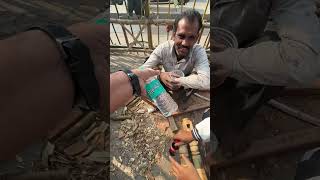
This video demonstrates the labor-intensive process of making a traditional Indian carrot-based sweet. The preparation involves mixing ice, ghee, milk, flour, and water, then stirring for over 20 minutes. The final product is a rich dessert topped with mawa and dry fruits, highlighting the cultural significance for festivals like Rakshabandhan.
The sweet is so special that one must wait a whole year to eat it, emphasizing its seasonal or festive nature.
Ice, ghee, milk, flour, and water are mixed together to form the base.
The sweet is delicious but requires ten times more hard work to make compared to its taste payoff.
10 kg of carrots yield 10 kg of ghee, indicating a rich, fat-based preparation.
The prepared butter (ghee) is filled into bottles and sealed carefully.
Mawa (reduced milk) is applied and dry fruits such as almonds are added on top.
The video discusses the price of the sweet, though the exact amount is unclear.
Oil is extracted from the mixture as part of the process, highlighting the labor involved.
The video showcases the immense effort and tradition behind a festive Indian sweet, emphasizing cultural dedication over convenience.
What ingredients are mixed at the start?
Ice, ghee, milk, flour, and water.
00:14
How long is the mixture stirred?
20 to 25 minutes.
00:14
How many kilograms of carrots are used?
10 kg.
00:28
What is the ratio of carrots to ghee?
10 kg of carrots yield 10 kg of ghee.
00:28
What is applied on top of the sweet?
Mawa and dry fruits such as almonds.
01:54
Yearly Wait
Highlights the rarity and special occasion nature of the sweet.
00:02Effort vs. Taste
Quantifies the extreme labor required, adding perspective on traditional cooking.
00:28Carrot to Ghee Yield
Illustrates the richness of the recipe with a high fat content.
00:47Oil Extraction
Shows an additional labor-intensive step in traditional sweet making.
02:56[00:02] but this is such a sweet that you have to wait for the whole year to eat it, it is you have to wait for the whole year to eat it, it is taken out in it, you keep
[00:14] eating it, you will enjoy eating it, it has become light, isn't it, here first of all ice and ghee are mixed, milk and flour and water, it will be stirred for 20 to 25 minutes, after that our sweet butter will be ready, this sweet is as
[00:28] delicious as it tastes, it takes 10 times more hard work to make it, as you can see, 10 kg of carrots come here, from it 10 kg of ghee is taken out, it is taken here with Ghevar,
[00:47] years, what is special for Rakshabandhan, this sweet, look at how many mantras are put here, our butter which is prepared is first filled in the bottle, after filling the butter well in the bottle, it is sealed well,
[01:01] as you can see how much hard work has gone into making this sweet, put in the pan, after that some of our good sweets are ready, some of our good sweets are ready,
[01:54] ready, so what all is put in it, after that mawa is applied on it, all the dry fruits are put on it, its all the dry fruits are put on it, its almonds, green etc. whatever is there and this
[02:07] bun is ready, so brother, what is going to be its price, its price is what is going to be its price, its price is [music] it is
[02:56] not a child's game to do it, oil gets extracted from it
⚡ Saved you 0h 03m reading this? Transcribe any YouTube video for free — no signup needed.