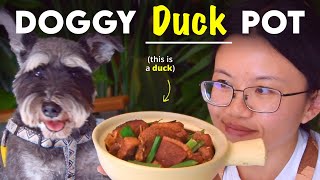

We're cooking dog meat flavor... but not dog!
45sOpens with a shocking twist that grabs attention and challenges assumptions about cultural food taboos.
▶ Play Clip"Title promises the flavor profile and delivers with duck and tofu recipes, plus cultural depth, but doesn't cook actual dog."
The video explores the traditional Cantonese flavor profile historically used with dog meat, but substitutes duck and tofu to make it accessible. It delves into the cultural and historical context of dog meat consumption in China, discussing taboos, global influence, and the evolution of culinary norms. The presenter provides a detailed recipe for a vegetarian version, highlighting key ingredients like chenpi and fermented tofu.
The dish is 'gouzaiya' (doggy duck pot), using duck instead of dog, with traditional Cantonese flavor profile.
Asian Americans and educated urban Chinese do not eat dog; dog is a traditional but declining protein source in China.
Cuisine is learned from parents and grandparents through generations of cultural evolution.
Many food taboos (e.g., cold water in Chinese medicine, halal, dog taboo) are post-hoc rationalizations of cultural accidents.
In modern society, dogs fill the void of lost tribe and human connection, unlike historical calorie scarcity.
British and American norms (language, food) became global through empire and economic influence, affecting China too.
In China, dog meat consumers are older, less educated, rural; it's a dying tradition among younger urbanites.
Presenter loves dogs but values culinary preservation; promotes doggy duck pot as a way to pass on flavor profile.
Key ingredients: dried tangerine peels (chenpi), fermented tofu (furu), dark brown sugar, garlic, ginger, green garlic.
Fry brined tofu until golden on both sides, then add aromatics liquid and red fermented tofu sauce; simmer 20 minutes.
Goose is traditional, but venison or heritage turkey also work; for vegetarian, use tofu puffs or skin.
The video successfully preserves the traditional Cantonese 'dog meat' flavor profile through accessible duck and tofu versions, while encouraging reflection on cultural food taboos and the evolution of cuisine.
What is 'gouzaiya'?
A traditional Cantonese dog meat flavor profile made with duck instead of dog.
00:17
According to the video, who are the typical dog meat consumers in China?
Older, less educated, and rural individuals; it's a dying tradition.
06:37
What are the key ingredients for the aromatic base of the doggy flavor profile?
Dried tangerine peels (chenpi), fermented tofu (furu), dark brown sugar, garlic, ginger, and green garlic.
13:25
Why does the presenter make a vegetarian version?
To avoid confronting the nature of meat and mortality while preserving the culinary knowledge.
07:16
What alternative meats does the presenter suggest for this flavor profile?
Goose, venison, or heritage turkey.
17:19
Culinary accidents
Explains food taboos as post-hoc rationalizations rather than logical origins.
01:52Modern dog role
Contrasts historical calorie scarcity with modern emotional companionship of dogs.
03:42Dying tradition
Provides demographic reality of dog meat consumption in China.
05:55Culinary preservation
Highlights the tension between love for dogs and desire to preserve traditional cooking.
06:59[00:00] So uh… don’t worry, we’re obviously not eating any dog today. The dish we’re doing is something gouzaiya – doggy duck pot – which uses the traditional Cantonese flavor profile that
[00:17] would be used with dog but with duck meat instead. It is a tasty dish, so if you just want a recipe you can jump to this point in the video… but I did kind of feel the need to say something
[00:38] crystal clear at the onset here, because the internet is the internet. Asian Americans, being Americans, do not eat dog. Educated urban Chinese also do not eat dog. But the
[00:52] core truth is that dog is a traditional, historical protein source in China, so does exist here or there, and it’s a truth that’s proven to be a goldmine
[01:06] for the more slimy breed of influencer. So we wanted to have an honest conversation. Because what can be eaten, what can’t be eaten – these are the kind of fundamental questions that
[01:20] are studied extensively by anthropologists. Because how do we learn cuisine? I mean, we learn it from our elders – our parents, our grandparents, our tribe – the result of an almost
[01:33] unfathomly long process of our ancestors throwing culinary ideas at the wall, desperately hoping the calories stuck, and passing down to us what did. It’s from this millennia of cultural evolution that we get this amazing diversity of global food, genius and often highly specific ways of
[01:52] preparing certain ingredients… I dunno, it’s kinda trippy it’s how every single one of us got here. But just like how if you talk to a biologist they’ll tell you that
[02:06] there’s all sorts random little accidents that you can find in our genetic code, I think our culinary code also has a lot of little random accidents – stuff that was passed
[02:21] on because maybe it was useful at some time, or at the very least it didn’t really harm anything. Like talk to a Chinese traditional medicine practicioner, and they’re likely to give you
[02:37] a highly developed post hoc rationalization on why cold water bad for you. Ditto with someone keeping Halal, maybe they’ll tell that of course you can’t eat pig because look at them,
[02:54] they’re so dirty… or someone from the British and American tradition that obviously you can’t eat dog because they were our hunting buddies, or they co-evolved with humans, or something along those lines. We’re often really quite good at explaining our own behavior.
[03:12] But even if we took those historical explanations at face value, now I don’t have a time machine, but I’m pretty sure that our current Anglophone behavior of doggy diapers and dropping way too
[03:27] much cash – I mean, village resources, on doggy day care might’ve been viewed as almost as messed up as eating them. Because there’s been this shift – for most of the human experience,
[03:42] the problem we had was not enough calories and infectious disease. But in our modern world, those are kind of solved-ish problems, the issues we have instead stem from loss of tribe,
[03:58] loss of clan, not enough human connection. And so for us, I think dogs often help us fill that void. And that’s also buttressed by another reality of our modern world,
[04:12] which’s that in the shadow of three centuries of the twin cultural towers of first the global British Empire followed by American economic and cultural hegemony…
[04:27] a lot of people around the world learned how to speak English. They learned to listen to rock and hip hop. They learned to eat KFC. Slowly our modern British and American norms
[04:43] and taboos became global norms and taboos – and this obviously’s happened in China too.
[04:55] And for me, for you, I think looking at those pictures of Shanghai there’s a comfort there, like most of my Chinese friends fit that kind of bill. Because to us, the spread of our own
[05:10] culture often feels… really quite natural. Like, one of my favorite little cities in Southeast Asia is Vientiane, capital of Laos… some really nice French food there by the way, and if you
[05:23] look online there’s a lot of people that’ll tell how with the new fast train, the city’s getting ruined, it’s becoming a Chinese colony, there’s Chinese characters on the street everywhere… but
[05:36] like, drop yourself into Vientiane. Look at the signs. People they seem to notice the Chinese, feels aberrant, but it’s like… we can’t even see all the English. For us, what’s become this
[05:55] internationalized educated class, it’s just… the air that we all breathe. So young, urban people, these days, in China they basically do not eat dog. Like ask an
[06:08] average educated 20 year old Cantonese native of Guangzhou about dog meat the thought would be just as abhorrent as it would if you asked it in Brooklyn. But not everyone in China is an educated
[06:24] 20 year old Cantonese from Guangzhou. And so dog meat exists in China, it’s a traditional protein, it’d be a lie to say that it doesn’t – but the consumers they lean older,
[06:37] less educated, and more rural. For better or worse, it’s a dying tradition. Now I am an American, so I love dogs, but I also really love cultural and culinary preservation,
[06:59] so I kinda have complicated feelings. And I think that’s why I really love gouzaie – doggy goose pot – or today we’re doing gouzaiya, doggy duck pot for ease of international adaptation. Again, it’s the traditional Cantonese flavor profile that would have been applied to
[07:16] It’s a way that this culinary knowledge can be passed down without us having to confront and think too hard about the nature of meat and mortality and existence... so I’ll
[07:35] hand it off to Dawei, Steph’s Dad, an old school cook who will teach us this old school dish… then for the vegetarians in the room, I’ll come back in and show you our 100% vegan doggy tofu pot.
[13:25] So right. Again, the basic mix of flavors for our tofu today is going to be from 2-3 dried and aged tangerine peels, chenpi, furu – fermented tofu, and for this one I decided to go for
[13:37] a red fermented tofu for color, twenty grams of the darkest brown sugar that you can find, powdered also good, and eight smashed garlic cloves. And just like Dawei we’ll scrape the
[13:49] bitter white pith off of the chenpi peels and then slice into thin strips… but unlike him we’ll be frying up all of our aromatics at first. So… to a hot wok drizzle in about a tablespoon of peanut oil and go in with your garlic, 2-3 inches of smashed ginger,
[14:06] and the white bits from about three green garlics. And if green garlic is not available to you, just up the garlic-garlic by three cloves. Fry those over a medium flame until they’re fragrant,
[14:21] about 30 seconds, then up the flame to high and swirl in a quarter cup of Shaoxing wine and toss in the sliced chenpi. Bring that up to a rapid boil and give it a quick 15 seconds or so to infuse, then go in with two cups of water and your dark brown sugar. Bring that up to a rapid
[14:38] boil once again to let the sugar dissolve, then transfer over to a pot and place that over a very low flame, covered, to let everything brew and the flavors come together for at least a half an hour.
[14:50] And… as that’s going we’ll get 450 grams of our tofu and slice it into sheets, each about 1 centimeter thick. Then in a separate bowl toss in a half teaspoon of
[15:02] salt and mix in a bit of hot, boiled water from the kettle to let that salt dissolve, then carefully lay the tofu pieces in, and submerge it all with more hot, boiled water from the kettle. Cover, and let that sit to brine for about twenty minutes. Then after that time,
[15:20] thoroughly drain the salt water from the tofus… and then now, we can fry those up. But real quick, before we do, in a bowl with two cubes of red fermented tofu,
[15:32] plus a half tablespoon of its red liquid, toss in a quarter teaspoon of salt and ladle in a bit of that aromatic liquid. Mix that super well, breaking down the fermented tofu, and set that aside. Then, to a hot wok, drizzle in two, two and a half tablespoons of peanut oil
[15:50] and then go in with the drained brined tofu. Let those fry over a medium-high flame for 5 to 8 minutes, or until the bottom begins to get golden brown… periodically moving the wok around
[16:02] to cook evenly if you’re working off of a round bottom like us… then, carefully flip those tofus. Give it another minute or so on the other side just to firm it up a bit,
[16:14] then toss in your aromatics liquid together with that bowl of the red fermented tofu. Keeping the flame at around medium or even medium high – we want this at a heavy simmer/light boil
[16:26] to allow for our liquid to reduce… cover with a breathable lid, and let that boil for 20 minutes. Then, after that time, taste your sauce and season everything accordingly – we added another
[16:38] ¼ tsp salt and MSG, together with a sprinkle of white pepper powder. Allow to continue to reduce on high to your desired consistency, for us this was another two minutes, and then mix in
[16:51] the green part from three green garlics… or swap that for a little cilantro if you couldn’t find green garlic. Then just serve that all up, we went with a claypot as a serving vessel but a
[17:04] normal bowl is more than fine… and then with that you’ve got yourself a vegetarian doggy flavor pot. So right! The most traditional meat to go into this flavor profile… well besides dog…
[17:19] there’s actually goose, which is a more gamey tasting meat that has a stronger flavor. And when we were filming, Chris asked my Dad if venison would work, especially a wild hunted
[17:32] one… and he said that it would be great in this kind of flavor profile. So if you’re a hunter, maybe explore this flavor profile… or maybe a heritage turkey as well? And as for the
[17:45] vegetarian version, besides fried tofu, you can also put maybe straight up tofu… or tofu puffs, or tofu skin in it… it would also be really good. So right, check out the recipe in the description box… a big thank you to everyone that’s supporting us on Patreon,
[18:01] and subscribe for more traditional Chinese cooking recipes!


⚡ Saved you 0h 18m reading this? Transcribe any YouTube video for free — no signup needed.