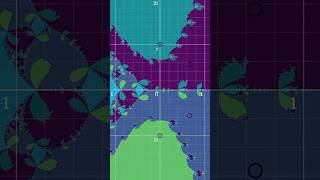

The Mesmerizing Math Behind Newton's Fractal
45sThe stunning visual of a fractal combined with the promise of a hidden math connection creates immediate curiosity.
▶ Play Clip"Delivers on the promise of beauty with a clear, engaging explanation of Newton's fractal, though it's a teaser for a longer video."
This video explores the stunning visual phenomenon known as Newton's fractal, which emerges naturally from applying Newton's method to complex numbers. It explains how the iterative process of Newton's method, when applied to a polynomial equation with complex inputs, creates an infinitely detailed and beautiful pattern when each starting guess is colored according to which root it converges to.
The video opens with the image of Newton's fractal, describing it as a beautiful, mesmerizing, infinitely detailed mess that naturally emerges from Newton's method.
Newton's method is a powerful tool for finding approximate solutions to essentially any equation by rearranging it to set a function equal to zero and finding where its graph crosses the x-axis.
The method starts with an arbitrary guess, draws a tangent line at that point, and uses the intersection of that tangent with the x-axis to get closer to the true solution. This process is repeated iteratively.
After working out the calculus, there is a specific formula for the step size. Plugging in a value typically yields a result closer to the true solution of the equation.
Instead of only real number inputs and outputs, the video considers complex number inputs and outputs. The formula still works even though the graph no longer intersects the x-axis in the usual sense.
The video shows what happens when Newton's method is applied to many different initial guesses. For a degree 5 polynomial, there are five distinct solutions in the complex plane, and each guess converges to one of them.
Each dot is colored based on which of the five solutions it converges to. By rolling back the clock, the video shows where each dot originated.
At fine resolution, treating each pixel as a starting guess and coloring it based on its eventual root, the pattern that emerges is the Newton's fractal image shown at the start.
The full video discusses why this pattern appears and how it connects to other fractals like the Mandelbrot set, but for now, the focus is on appreciating the beauty of math.
Newton's fractal is a captivating example of how a simple iterative algorithm, when applied to complex numbers, can produce infinitely complex and beautiful patterns. The video encourages viewers to appreciate the aesthetic beauty of mathematics while hinting at deeper connections to other fractal structures.
What is Newton's method used for?
Finding approximate solutions to essentially any equation.
00:14
How does Newton's method work?
Start with an arbitrary guess, draw a tangent line at that point, and use the intersection with the x-axis to get closer to the true solution. Repeat iteratively.
00:39
What happens when Newton's method is applied to complex numbers?
The formula still works, and the graph no longer intersects the x-axis in the usual sense.
01:26
How many distinct solutions does a degree 5 polynomial have in the complex plane?
Five.
02:05
How is the Newton's fractal image created?
By applying Newton's method to many initial guesses, coloring each based on which root it converges to, and doing this at fine resolution.
02:18
Beauty of Newton's Fractal
Sets the stage for the video's core message: complex math can produce stunning visual art.
Newton's Method as a Tool
Explains a fundamental numerical method that is widely used in science and engineering.
00:14Complex Numbers Extension
Shows how extending a simple algorithm to complex numbers leads to unexpected and beautiful results.
01:26Emergence of the Fractal
Demonstrates how simple rules can generate infinite complexity, a key concept in chaos theory and fractal geometry.
02:33[00:00] which is known as Newton's fractal. And aside from being this beautiful, mesmerizing, infinitely detailed mess, what's really cool about the image is how it naturally pops out from something that
[00:14] any of you who've taken a calculus class might have heard of, known as Newton's method. powerful tool for finding approximate solutions to essentially any equation.
[00:26] If you rearrange the equation so that it looks like setting some function of x equal to zero, then visually what it means to solve such an equation is to find a point where the graph of that function crosses the x-axis.
[00:39] Now the way that Newton's method works is to start by making an arbitrary guess. But if you draw a tangent line to the graph at that guess, something much easier to solve explicitly, very often it takes you closer
[00:56] If you wash, rinse, and repeat doing this multiple different times, If you do all the calculus and you work it out, there's a certain formula for how big your step size should be based on this process.
[01:10] formula and you can plug in one value, and what comes out is usually something closer to a true solution of the equation. inputs and real number outputs like we're used to,
[01:26] consider all of the complex number inputs and the corresponding complex number outputs. intersecting the x-axis anymore, but the formula still works.
[01:38] one guess to push it closer to a true solution of the equation. loves complex numbers the way I do, but here's the cool part.
[01:50] Watch what happens if we apply this idea to many many different possible initial guesses. On each iteration, each of those dots is taking a step based on this Newton's method rule. With the example I'm showing, where our function is a degree 5 polynomial,
[02:05] there are five distinct solutions to the equation somewhere in the complex plane. have zeroed in towards one of those solutions. What I'm going to do is color each one of those dots based on which of those five
[02:18] and then we'll kind of roll back the clock to see where each dot came from in the first If you do this at a very fine resolution, treating each pixel of the
[02:33] coloring it based on which route that guess would end up landing on, the pattern that emerges is the image that I showed you at the start. On the full video, I talk much more about why you see a pattern like this,
[02:49] and how it connects to things like the Mandelbrot set. But for now, it's fun to just gawk at the beauty of math.


⚡ Saved you 0h 02m reading this? Transcribe any YouTube video for free — no signup needed.