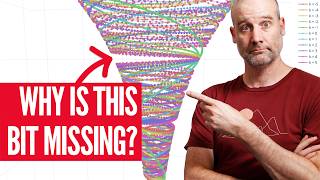

The Mysterious Math Trumpet
34sThe bizarre shape of (-2)^x sparks curiosity and confusion, perfect for a hook.
▶ Play Clip"Title accurately describes the content; delivers a thorough explanation of the strange behavior with visual aids."
This video explores the complex values of (-2)^x, revealing a fascinating 3D 'maths trumpet' shape. It explains the math behind fractional powers, roots of unity, and how negative bases produce multiple complex solutions, visualized with an interactive 3D tool and 3D printed models.
A Reddit user posted a picture of a 'maths trumpet' on r/mathpics six years ago, receiving zero engagement. The trumpet represents the complex values of (-2)^x.
Fractional powers represent roots. For positive bases, there is one principal root; for negative bases, multiple complex roots exist. For example, -8^(1/3) has three cube roots.
When taking fractional powers of negative numbers, complex numbers come into play. The roots of unity (roots of 1) form regular polygons on the complex plane: square roots give +1 and -1, cube roots form an equilateral triangle, etc.
For (-2)^x, we separate into (-1)^x * 2^x. The (-1)^x part introduces complex values, while 2^x remains real. The roots of unity help understand the complex part.
By plotting all complex roots for continuous values of x, we get a 3D spiral. The interactive tool '-2^x Explorer' by Zach allows viewing the trumpet in 3D, showing principal roots and symmetric roots.
The trumpet was 3D printed using a Bamboo Lab 3D printer. The continuous line represents the ever-changing primary root. The print shows the complex surface structure.
The original Reddit post used discrete x values (fractions), resulting in dots. This video uses continuous x, creating a smooth line. The number of solutions varies with x, creating gaps and bunches in the trumpet.
Points with fewer roots (e.g., integer x) create gaps where lines cross. The continuous version shows bunches where roots align. The 3D printed model highlights these features.
The maths trumpet is a stunning visualization of the complex behavior of (-2)^x, combining fractional powers, roots of unity, and 3D graphics. It demonstrates how mathematics can reveal hidden beauty in simple expressions.
What does a fractional power like a^(1/n) represent?
It represents the nth root of a.
01:22
How many square roots does 1 have?
Two: +1 and -1.
02:03
How many cube roots does -8 have?
Three: one real and two complex.
02:57
What are roots of unity?
Roots of unity are the complex solutions to the equation z^n = 1.
05:05
How many fourth roots of unity exist?
Four: 1, -1, i, and -i.
06:42
What geometric shape do the cube roots of unity form on the complex plane?
An equilateral triangle.
07:59
How does the number of solutions for (-2)^x vary with x?
It depends on the denominator when x is expressed as a fraction; the denominator gives the number of solutions.
16:10
Why does the original trumpet have dots while the video shows a continuous line?
The original used discrete fractional values of x, while the video uses continuous x, creating a smooth line.
16:40
Discovery of the Maths Trumpet
Opens with the intriguing origin story of a Reddit post that went unnoticed, sparking curiosity.
3D Visualization Reveals the Trumpet
Shows the stunning 3D spiral shape of (-2)^x, making complex math visually tangible.
08:293D Printing the Trumpet
Brings the abstract concept into the physical world, bridging math and engineering.
11:29Discrete vs Continuous Roots
Clarifies why the original image had dots and the video has a continuous line, deepening understanding of fractional powers.
16:40[00:00] You see, approximately six years ago a Reddit user wandered into the r/mathpics subreddit they revealed this picture of a maths trumpet.
[00:18] Sadly, they then got exactly zero community engagement ["Sat Trombone" riff plays] so there you go... Now, I forget how I came across this...
[00:34] let's not get judgy here! and that's not the only picture of The Maths Trumpet; We get different angles of The Maths Trumpet:
[00:48] (I don't care to know) I mean that's head-on towards -x. I'm like: "that's an amazing trumpet,
[01:02] but what on earth is it?" when it says the complex values of (-2)^x? (Multiple lines... something with, fractional values...) [Noir style trumpet plays]
[01:22] Right, so to recap: gives you a positive answer, still gives you a positive answer.
[01:38] from squaring something. Which means: which I'm going to write the fractional way around
[01:50] So it's just whatever the root is, and get back to 4: that answer is either -2 or 2,
[02:03] and the positive one is the Principal Main Root, And, sadly because neither of these are negative, if we had -4 to the power of 1/2:
[02:15] I'll write that down... nothing. because if we have a positive, times a positive, times a positive
[02:30] that's still positive. a negative, times a negative, times a negative I'm going to cheat this slightly,
[02:45] so I'm going to make it an 8 that if we have 8 to the power of 1/3,
[02:57] And if we have -8 to the power of 1/3, so we still got two solutions. But instead of both of them being... When it's a positive base,
[03:09] And this is the beginning of the unravelling fractional powers represent roots hence, multiple lines on The Mystery Trumpet.
[03:23] at this spot here. it's using -2! when we're taking a fractional power of a negative number,
[03:39] You may remember, from my previous video where I can move the complex number "z" around and it shows its square, z^2, move accordingly.
[03:52] if you take "z" all the way around the unit circle And that's because, for the same on the complex plane that will give, give it.
[04:07] also made by my friend Sam, and see both of its square roots. and you're seeing the squared move now.
[04:21] and they're always exactly opposite each other. not being solutions. of a complex number.
[04:36] And, nicely, if I bring "z" down to be four perfectly align with 2 and -2. "It's worth noting this is subtly different to The Trumpet:
[04:51] not different powers. you get two complex roots." cube roots, fourth power roots, etcetera?
[05:05] but for those we have to explore a fun concept I love The roots of unity are the roots of one we want when we've got -2
[05:19] Well this is just the case of: that's equivalent to -1 to whatever our weird fractional power is, multiplied by regular old 2, to the same real number;
[05:33] all of this is a perfectly normal, boring, value. This is the bit that's going to be complex However, we can just look at regular,
[05:50] I'm going to draw a dotted line, For it's not exactly the same but it will be in a moment... and we're taking some root
[06:02] some 1 / n representing the nth root of 1? if we've got 1 to the power of a 1/2
[06:14] well 1 x 1 is going to give us 1. one is always going to feature However, as we saw before,
[06:28] there's the cheeky, the non principal root over here: -1. So, square root of unity: two roots. Well, if we skip ahead; however, to the fourth root.
[06:42] and -1 x -1 = 1, And actually you can put in a -i as well
[06:54] So the fourth root of unity has four roots, they make a perfectly regular square!
[07:11] and that's because fourth roots are just so nice they give you the square. there's one down here,
[07:27] they're symmetric on -1/2; and that there is (√3/2)i, and over here is (-√3/2)i.
[07:40] I've done a video all about how much I love √3/2. sure enough, these three roots form an exact equilateral triangle,
[07:59] any nth root of 1, all the corners of which are a valid root of unity.
[08:12] We, however, want -2^x, if this was negative, it just flips the entire thing. you start at -1 and then fill in all the points.
[08:29] And as we saw before, by multiplying by this real, we can get to -2^x. So what this means is our value of x, up here,
[08:41] it'll equal 1/2, it'll equal 1/3, it'll equal all of them. I shouldn't be just drawing it as some list of values, and we can add that to the diagram,
[08:56] is now in 3D! and imagine that like coming out of the board towards you! as the roots, as x changes
[09:11] and so they will move and change If only we could visualise it in 3D... using this, The -2^x Explorer.
[09:28] and a look at that! Ahh, I'm already in love... Look at that 3D spiral. So if I just swing it around like that,
[09:42] And as you vary x, gradually up as the principal root moves around on the plane.
[09:55] ah, so the third dimension now, we get this fantastic 3D shape one spiralally thing like this
[10:12] we've now got two of them. And you can see it's a similar shape, slightly tighter coil; um, and the dots are because we're sampling it at discrete points.
[10:26] look at that. we're seeing all of the principal ones and the symmetric roots on on either side of that.
[10:38] because you can either go all the way around a circle and that's the way we've set this up. And as I turn on more and more of these different roots,
[10:50] you can see it fills in The Mystery Maths Trumpet. we have recreated it from scratch. rendering it for us,
[11:03] I'm going to go right down the trumpet, can I look back up the trumpet? Why do I keep saying that?
[11:16] we zoom out and that is The Maths Trumpet. You've got to download the code,
[11:29] I'll make that code available, if you want to check out Zach's incredible -2^x explorer it's great!
[11:42] or rather, it looks like an object at all, is all the lines for the different roots are kind of confined to the one surface And I want to see the actual surface, so I 3D printed one out: [Trumpet fanfare plays]
[12:00] and I've just put the single k=0 root on there, and it actually,
[12:12] Ready? [Jazz trumpet music stops] The question that occurred to me, once I printed this is: we have a continuous line representing an everchanging primary route...
[12:26] this video is brought to you by Bamboo Lab 3D Printers. but there's no time now - I don't know if you noticed; but before, when Regular Matt was doing all the maths on the whiteboard,
[12:41] behind it is the Bamboo X1 Printer. oops! So it's a Milestone Desktop 3D Printer,
[12:55] You can use it at home or at work, It's extremely stable, depending on how you put it down, Previous 3D printers, I didn't bother getting one
[13:09] This one, it just works, it's great! because: it is a top choice for studios like professional printing,
[13:21] every time enough of you buy a Bamboo Lab printer People send me in things to print
[13:33] a Babylonian tablet from around three and a half thousand years ago; and on my phone I can see like the live view,
[13:46] I can see the live view of what it's doing in there. and it will tell me if something goes wrong, Although, I am, um, going to pause that for now
[14:01] Once it's done, someone called Chuck sent it in, I'll show it now if that print works. First ever evidence of humans calculating the square root of two.
[14:18] Uh, normally I make like an interactive, weird maths thing that someone sent in; So everyone please do check out Bamboo Lab 3D Printers It's currently (up until the 15th of July) their 3rd anniversary celebration.
[14:35] And if you haven't got your own Chucks you can check out Maker World: here's just the maths ones,
[14:47] [Maths Matt] Thanks Business Matt, a worthwhile interruption. I'll link to this file also made by Zach below. is it's a continuous line going around the trumpet
[15:05] and that represents a constantly changing And we looked at things like the square root or the cube root;
[15:17] for all the infinitely many in between values? I pointed out x is not this discrete value,
[15:29] So it kind of makes sense that we get a continuous line slightly more subtle. [Jazz band music plays]
[15:43] so, in that case x = 2. When x equals,
[15:55] When x = 1/3, so the cube root, What if x is something, you know, how many solutions now?
[16:10] Same as 1.3. that is working out the values for -2^(17/10),
[16:26] and the denominator, 10, number of solutions. In fact: 3, 3, 2, 2 and we could rewrite that So you turn it into a fraction
[16:40] the-the bottom bit is the number of solutions. there was a single comment, I don't know if you noticed this before, on the Reddit post and that was from the user who showed us the trumpet
[16:55] In it they point out they actually set x equal to some fraction m/n So they are actually only doing discrete values,
[17:07] which is why their trumpet has dots everywhere. uh, we switched to using it as a continuous line, The comment does also talk about how you can do this, uh,
[17:22] And that's just why I've been kind of handwaving my way through, The issue now, however, is; but there's always changing numbers of solutions.
[17:39] Continuous lines and a changing number of values, [Noir style trumpet plays] Whenever there's a point with fewer roots
[17:51] so there's fewer spots at that point in the cone. And if I zoom in near the middle somewhere, see there, see how there's like a massive gap
[18:07] That's the point that corresponds to 1. there's only one value there's no fractional part, Up here, 2, that's just squaring it,
[18:19] So you can see there there's like a wedge missing from the trumpet and a single value where all the lines cross. it takes a little while to drag it around to line it up.
[18:33] So, just for fun we thought we would, uh, print them out. Now, we couldn't get the curved trumpet shape, But, you can still see all the lines
[18:46] that might be 1, so either 1 or -1, see there's no other dots at all,
[18:58] Now, here we're recreating the original trumpet Of course, Zach also made a continuous version
[19:10] So this is just, you know, filling in the continuous line and again you can see all the points where they they bunch up. When there's a single root, or sometimes there'll be a root opposite each other.
[19:25] but you can tell on the original You can, almost it looks like it's not.
[19:38] and that's what gives us a very faint line. That's The Mystery of the Maths Trumpet! how could you come and see me live on stage?
[19:52] so many shows! It's going to be a lot of fun. come to one of the shows.
[20:04] that just means you can pay extra, show up early, I'll sign your calculators ahead of the show
[20:16] And the VIP money makes the tour more fun cuz we use that money to pay for like the hotels we stay in the whole crew has a nicer trip around the country.
[20:32] I will also do a meet and greet after the show, Oh! And I got one show coming up in New York, Uh, and that's it for me,
[20:45] to find the world's best maths party hat...

⚡ Saved you 0h 20m reading this? Transcribe any YouTube video for free — no signup needed.