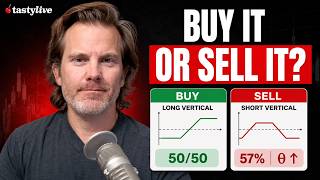

Why Long Verticals Beat Long Calls
43sExplains a key options concept in a clear, relatable way, appealing to traders looking to improve their strategy.
▶ Play Clip"The title promises a trade that lets you be wrong and still profit, and the short vertical spread indeed delivers that — though the explanation is somewhat padded."
In this episode, Jim Schultz explains the differences between long and short vertical spreads, focusing on when to use each based on market direction and time decay. He demonstrates how long verticals are directional plays with minimal theta impact, while short verticals offer higher probabilities and benefit from time decay.
Long vertical spreads are best for directional plays when you want to avoid the negative theta drag of a long call or put. They are inherently directional, regardless of strike selection, and the short leg neutralizes much of the theta cost.
A long call alone has significant negative theta, causing daily losses if the position doesn't move. By using a long vertical, the short option offsets this, resulting in near-neutral theta (slightly positive in the example).
Short verticals are also directional (bullish for put spreads, bearish for call spreads) but have time working in your favor. Theta is positive, so time decay helps the position, allowing you to profit even if the underlying doesn't move much.
Using SpaceX at $112, a long vertical (buy 110 call, sell 115 call) risks about $2 to make $3, with a 43% probability of profit. Theta is slightly positive, showing minimal time decay impact.
Deleting the short leg (making it a long call) increases the debit paid, raises maximum loss, and drops probability of profit to 30%. Theta becomes significantly negative, showing the advantage of the vertical.
Selling a 195/190 put spread collects $2 credit, risking $3 to make $2, with a 57% probability of profit. Theta is positive, and the stock only needs to stay above $100 to profit, offering more room to be wrong.
Using AMD as a clean example, a short put spread (sell 410, buy 400) shows a profit zone with the stock having room to move. The curve view illustrates how the short vertical benefits from time decay and a wider profit range.
Long verticals are ideal for directional plays with minimal theta drag, while short verticals offer higher probabilities and time working in your favor. Choose based on your market outlook and risk tolerance.
What is the primary purpose of a long vertical spread?
To take a directional position with minimal theta impact compared to a long call or put.
00:43
How does a short vertical spread benefit from time decay?
Theta is positive, so time decay works in your favor, allowing profit even if the underlying doesn't move much.
03:28
What is the typical probability of profit for an at-the-money long vertical spread?
Around 45% to 55%, though it can vary (e.g., 43% in the example).
05:48
In the SpaceX example, what was the risk/reward for the long vertical spread?
Risking about $2 to make $3, or roughly 1:1.5.
05:20
What is the inherent trade-off when selling out-of-the-money premium?
You risk more to make less in exchange for a higher probability of profit.
09:06
What was the probability of profit for the short put spread on SpaceX?
57%.
09:34
Long verticals are directional plays
Clarifies that long verticals are inherently directional, regardless of strike selection, which is key to understanding their purpose.
00:43Short verticals benefit from time decay
Highlights the core advantage of short verticals: theta works in your favor, allowing profit without a strong directional move.
03:28Theta comparison: long call vs. long vertical
Demonstrates the significant theta difference, showing why verticals are preferred for directional plays.
06:41Risk/reward trade-off in short verticals
Explains the fundamental deal of selling premium: higher probability but lower reward relative to risk.
09:06[00:01] episode number 15. My name is Jim Schultz. I am still your tour guide for this series. So, now we are going to build on what we started to talk about last time with vertical spreads. And I want to dive a bit more deeply into long
[00:14] verticals and short verticals. So, let's kind of unpack like what situations vertical and what situations would make the most sense for a short vertical the same. As we kind of alluded to in just the last episode, it's going to be
[00:30] a different set of circumstances when you might want to deploy one relative to the other. So, let's go ahead and dive in. So, let's begin with a long vertical spread. So, a long vertical spread is going to be most appropriate when you
[00:43] want to play direction, but you want to do it without the negative drag from theta that would typically accompany something like a long call or a long directional shot, but you want to do it in a way where time isn't necessarily
[00:58] working so hard against you because a long vertical spread is inherently a directional shot. So, understand like when you buy a vertical spread, you buy a vertical or a long vertical, those are synonymous for all intents and purposes.
[01:13] You are not selling premium. You are not playing the calendar. You are not a lot of the things that we love to do as premium sellers, but you are not doing that with a long vertical. A long vertical, the spirit of a long vertical
[01:26] is a directional play. No matter how you set it up, at the money, out of the money, in the money, it doesn't really matter. It doesn't really change that spirit of the strategy. This is a directional play. Okay. But, by
[01:40] spreading it off, you're able to do this with a minimal theta impact. Right? Like in the platform here in a couple of seconds. If I go in and I buy a call or I buy a put, man, I'm paying through the nose in theta every single day. And so,
[01:55] every single day that I don't get the move that I want or that I just keep the position on, like my position is hemorrhaging cash. My position is hemorrhaging cash. My position is bleeding extrinsic value by way of
[02:08] negative theta. Well, by choosing something like a long vertical spread, by spreading that guy off, I have the long option that has that hemorrhaging cash effect, but I also have the short option that effectively neutralizes a
[02:22] option. So, it can be really advantageous in that regard. So, that's vertical? Well, this is going to set up a little bit differently because now have a directional bias. You effectively
[02:36] a short vertical spread, but it's not going to be the star of the strategy. It's not going to be the thing that is driving the train, and that's what makes this strategy or this type of strategy so attractive and so appealing because
[02:49] I'm taking my directional shot, but I have to take some type of directional shot. If I sell a put spread, that's going to be inherently bullish. The spirit of that strategy is a bullish strategy. So, if the stock or index,
[03:02] going to help me. If it goes down, that is going to hurt me. So, you have to understand that. If I sell a call spread, that is inherently bearish. The spirit of the strategy is bearish. And so, if the stock or the index, whatever
[03:14] it goes down, that's going to help me. If it goes up, that's going to hurt me. So, that is baked right into the center of the Betty Crocker recipe that is a short vertical spread. So, we have to understand that. But, we now have time.
[03:28] We now have theta. We now have the calendar working in our favor, the clock working in our favor. And so, time just ticking away is going to help me now. directional play. I don't necessarily
[03:42] need the move from the stock or the index like I did with a long vertical spread. Now, the calendar is positioned to work in my favor. And so, even if I don't get the move that I would like to get, if I sell a puts, but I would love
[03:55] calls, but I would love it if the stock goes lower. If that doesn't happen, and it mostly just kind of sits still, then I still am going to be on track to hit whatever profit targets I might have for that strategy. So, let's now pop into
[04:10] both of these guys. Okay, so here I am inside of my tastytrade platform, and I've got SpaceX pulled up cuz this guy is certainly in play right now. You can see the markets are moving quite wildly today. It is Fed
[04:23] day. It is FOMC day. And I've been studying the markets for a long time, I have never, in my whole professional career, seen a more impactful and important FOMC than the one that is coming up here in just a couple of
[04:38] hours. But assuming we make it through to the other side, you guys will indeed September, with 51 days to go, if I want to set up a long vertical spread, then the most classic way, and we introduced this last
[04:51] concept, the most classic way to set up a long vertical spread is going to be using the at the money strikes. So, let's say I want to play SpaceX to the Right? If I want to play this guy to the upside, I'm effectively going to
[05:05] straddle where the stock currently sits with my strike selection. So, you've got with my strike selection. So, you've got SpaceX at 112, I am going to buy a 110, and I'm going to sell a 115. And essentially, what I'm expecting to
[05:20] find is a situation where I am risking one to make one, which in this case is actually a bit more favorable than that. I'm actually only risking two, a little bit over two, to make a little bit under
[05:33] three. So, that's risking one to make a dollar 50, essentially. My probability of profit on the trade is only 43%. That's pretty much what I expect. I am expecting an at the money long vertical spread to be around a 50/50 proposition.
[05:48] And when I say around, it's typically going to be between 45% and 55%. In this case, it's actually 43%, which is a great example of the simple fact that the markets are a living and breathing thing. We are not in the ivory tower. We
[06:01] even use those anymore. We are actually in the real live, you know, living and breathing markets where prices aren't beholden to, you know, some academic theory that may not or may have no relationship to the actual marketplace.
[06:16] And so, I'm pretty much getting everything that I want. But look at the theta impact. It's actually slightly positive, but it's essentially neutralized. It's essentially, you know, nothing when it
[06:28] comes to how is time going to work in my favor. It is a little bit positive. I "Jim, 50 cents a day is not nothing. I mean, that's definitely something." And I think that that's fair. But when you look at this as it stacks up relative to
[06:41] what if I just bought this call? So, look at how different this is. So, actually right now, let's go ahead Let's circle the theta. Just hone in on the theta. And if you want to, I guess you could also hone in
[06:55] on the debit paid to. Although, I think you're only supposed to hone in on one thing at a time. And so, if you have to choose your hone, I would choose the theta. But look at what happens if I delete the short leg of the strategy.
[07:08] Look at how drastically different this trade is now. Right? Now, let's be fair about this. Let's go through the whole deal. Right? worse. Right? I've gone from something that was
[07:21] about a couple of minutes ago, to now something that is going to be quite something that is going to be quite costly every single day. My debit paid is significantly more. So, now my maximum loss on the strategy has
[07:33] jumped quite significantly, and that's definitely something to make note of. My probability of profit is also significantly worse than what I had. I proposition anymore. I didn't even really have a 50/50 proposition to begin
[07:47] with at 43%. That's a little bit lower than I personally would like, but now at 30%, I definitely don't have a 50/50 proposition. Now, my maximum profit here is infinitely large because there is no ceiling to how high SpaceX can go. It
[08:02] could rocket to the moon, pun intended. And so, if you look at this long call, it's quite a different trade from vertical spread. Hopefully, you can clearly see the differences between the two. We like the long vertical spread
[08:16] against time and we're willing to give up that unlimited upside. Okay, sticking with SpaceX, let's flip to the other side of the fence now. And work out the bearish examples on your own and kind of play around with, you
[08:29] know, a long put spread at the money and then a short call spread, which would be right here with a short put spread. So, let's say I want to play SpaceX to the upside, but I want to do with a short vertical because I want to have more
[08:42] room to be wrong. I want to have a higher probability and I want to have time working for me a bit more effectively. So, here, what if I sell a 195 short put spread? Take a look at the
[08:54] stats on this trade and you can see it's setting up quite differently than the spread. So, number one, I'm collecting a $2 credit and my maximum risk is going to be the difference between the credit
[09:06] of course. And so, I'm essentially risking three to make two. That makes sense whenever you sell out of the money premium, the inherent deal that you are making with the market, so to speak, is you're willing to risk more to make less
[09:20] in exchange for a higher probability. Like, that's what you have right here. Now, I don't have a low probability trade anymore. It's not 43%. It's not 30%. It's 57%, which is pretty solid. Like, that's a really nice base to work
[09:34] from. Theta is now working even harder for me from one day to the next. Now, between 50 cents and a dollar or seven isn't that significant. I kind of think it is, honestly. And you know, you what
[09:47] you bring up is a fair point. It's not drastically different, but I think it's different enough to actually put this into a separate a separate category. Not to mention, with a long vertical spread, I need the stock to essentially go fully
[09:59] in the money to make whatever profit I'm going for from that trade. Look at with this spread, I just need SpaceX at 112 to stay above 100. If SpaceX stays above 100, then I'm going to be in a really, really nice
[10:15] position. In fact, let's actually delete all this. And we're going to do it. Let's go to the curve view, oh, so you guys can see curve view, I click on the analysis tab. Oh, this is
[10:29] because I have I currently have positions on in SpaceX. So, let's actually go to I'll just pick any stock at this point. Let's go to AMD because I That's why the curve looked kind of janky there. And so, I want to go to a
[10:42] AMD and I just go to sell a put spread. So, I sell a 410 400 put spread. So, this looks pretty good. Again, I'm essentially, you know, risking a dollar 50 to make about a dollar. It's setting
[10:55] saw. The pop is a little bit lower, but the theta is a little bit higher. less. But if I go to the curve view, this is going to give you a much cleaner visualization of what a short put spread should look like. And this is what
[11:09] SpaceX would also look like, but my other positions in SpaceX were kind of didn't want to have to uncheck those and kind of, you know, kind of figure out where I was at. So, I just wanted to go to a clean slate. And so, with the short
[11:21] see. You're going to see, hey, you've got the stock right here. It's right here by this green little flag. You've got all this room for the stock to move and you're are making a profit. You are still getting whatever profit target you
[11:34] might have on the trade. So, that's what makes the short short vertical spread so favorable relative to a long vertical spread. So, that's how you can begin to vertical. If you want to take a directional shot, man, a long vertical
[11:47] much better option than just a straight long or a straight long put, I'm sorry, just a straight long call or a straight long put in my opinion because you don't If you want the probabilities to be working harder in your favor and you
[12:00] short vertical is going to make a lot more sense. And I will see you guys in more sense. And I will see you guys in the next episode.




⚡ Saved you 0h 12m reading this? Transcribe any YouTube video for free — no signup needed.