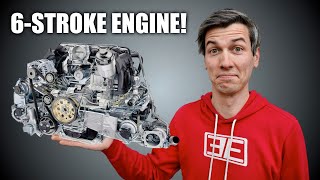

Porsche's 6-Stroke Engine Explained Simply
30sEducational breakdown of a novel engine concept that combines 4-stroke and 2-stroke cycles, sparking curiosity among automotive enthusiasts.
▶ Play Clip"Delivers a thorough explanation of Porsche's innovative six-stroke engine design; title accurately reflects the content."
Porsche has patented a novel six-stroke engine design that combines elements of four-stroke and two-stroke engines to deliver two power strokes per cycle. The design uses a hypocycloidal crank assembly to create two distinct top and bottom dead centers, allowing for a compact, high-output naturally aspirated engine. While the concept promises significant power gains and potential efficiency improvements, it also introduces challenges in cost, emissions, and engine balancing.
The six-stroke engine has two extra strokes compared to a four-stroke, one of which is an additional power stroke, resulting in two power strokes per cycle.
The first three strokes (intake, compression, power) are like a four-stroke, then it switches to a two-stroke pattern (compression, power), followed by a final exhaust stroke.
Fresh air enters through ports at the bottom of the cylinder when the piston reaches a second, lower bottom dead center, enabling scavenging and a second power stroke.
The engine has two distinct top dead centers and two bottom dead centers, allowing the piston to travel different vertical distances depending on the stroke.
A hypocycloidal crank assembly, using an inner gear rotating inside an outer gear, creates a non-circular path for the connecting rod, producing the two different BDCs.
Over 12 strokes, the six-stroke produces four power strokes vs three for a four-stroke, giving about a 33% theoretical power advantage, but realistically around 23% more power.
Applying the six-stroke design to the 4.0L boxer engine in the 911 GT3 could boost power from 500 hp to approximately 600 hp naturally aspirated.
Potential efficiency gains come from downsizing (more power per liter) and operating at lower RPM where brake specific fuel consumption is better.
Challenges include increased complexity and cost, emissions issues typical of two-stroke scavenging, and engine balance due to uneven firing intervals resulting from the asymmetrical piston motion.
Porsche's six-stroke engine is an innovative concept that could offer a meaningful power boost for naturally aspirated engines, though it faces significant engineering hurdles before production. Whether it reaches the road or remains a patent curiosity, it showcases creative thinking in combustion engine development.
How many power strokes does a six-stroke engine have per cycle?
Two power strokes per six-stroke cycle.
00:03
What is the total crankshaft rotation for one full six-stroke cycle?
1080 degrees (three full rotations).
03:03
What mechanical assembly enables two different bottom dead centers?
A hypocycloidal crank assembly with inner and outer gears.
05:50
What is the realistic power advantage of a six-stroke over a four-stroke engine?
Approximately 23% more power.
08:24
What cylinder count does the patent suggest for balancing?
A multiple of three (e.g., 3, 6, 9 cylinders).
11:35
Why is an even firing interval impossible in a six-stroke engine?
Because the power strokes are not evenly spaced at 180° intervals due to the asymmetrical hypocycloidal motion.
12:03
How does the six-stroke engine get air for the second power stroke?
Air enters through ports at the bottom of the cylinder when the piston reaches a deeper bottom dead center.
02:08
Two Power Strokes per Cycle
Core innovation that distinguishes the six-stroke from conventional engines.
00:03Hypocycloidal Crank Assembly
Key mechanical enabler for variable piston travel; a clever engineering solution.
05:50Power Advantage Calculation
Provides a quantifiable benefit over four-stroke engines, backed by a study comparison.
07:09Emissions and Balance Challenges
Highlights practical hurdles that may prevent production, despite clever design.
10:25[00:03] so for my viewers that are proficient at math you'll realize that's two extra Strokes versus a typical fourstroke engine and what's exciting is that one of those extra Strokes is a power stroke so we now have two power strokes how
[00:17] does it work well Porsche spells it all out in the patent and not to brag but I out in the patent and not to brag but I read the whole thing yes all 12 Pages half of which are pictures okay so the easiest way to think about this engine
[00:31] is that we are combining a fourstroke and a two-stroke engine so here we are this engine so we're just looking at one cylinder and what it does through each of the six Strokes so the first three Strokes intake compression power just
[00:47] like a fourstroke engine then we switch over to our two-stroke engine we've got compression power and then finally we end with a final exhaust stroke completing our initial four strokes Okay so we've got the fourstroke engine plus
[01:01] the two-stroke engine making this six-stroke engine now you're probably wondering if we only have one intake stroke well then where do we get the air for the second power stroke all right so let's look at these six Strokes in more
[01:14] detail now one of the critical differences we need to understand versus a typical fourstroke engine is that with a fourstroke engine you have a high dead center and then you have a low point that the Piston reaches called
[01:27] bottom dead center in this engine we have two of both of those points so we have two different top dead centers and we have two different bottom dead centers so the Piston can travel between these different regions so let's look at
[01:41] now how it works out so with our initial intake stroke we're starting from the lower top dead center and we're pulling in that fresh air and fuel then it's coming down only to that first bottom dead center so it's still blocking off
[01:54] this port that you can see here at the bottom then we compress that air and fuel we have our power Power Stroke which is compressing all the way to this upper top dead center Power Stroke begins that piston goes all the way down
[02:08] to the second bottom dead center now once the Piston reaches that second bottom dead center you now have fresh air that comes in from these ports on the side at the bottom of that piston so that small difference in these two
[02:21] bottom dead centers is what enables that air to then come in so you've got your exhaust valve opening up allowing that exhaust to escape you've got your fresh air potentially fuel coming in as well or you could have fuel injection and
[02:34] then you compress that air and fuel for a second power stroke again this is very similar to a two-stroke engine have that second power stroke again going all the way up to that first top dead center Power Stroke occurs it goes down to that
[02:50] first bottom dead center so not all the way to the bottom not showing these ports and then of course you push all of that exhaust gas out of the exhaust valve there so a lot of the magic with this engine is that you're varying how
[03:03] much that piston travels up and down so here we're just looking at a simple graph of our crank angle going from 0 to 1080° in other words three full rotations of that crankshaft versus how much our piston is traveling here in red
[03:18] and so you can see there's two upper points that the Piston reaches and then one top dead center two that it reaches and then you have these two bottom dead center one points and then this further lower four point here and so it's during
[03:31] that super low point that we reveal these ports and then we have Scavenging occur so we can have that air flow into the cylinder push out those exhaust gases and then use that air and fuel mixture for an additional power stroke
[03:45] realize here is that they're trying to keep the compression ratios the same so you're going from this bottom dead center one all the way to your top and not compressing while those ports are open so you're starting from this point
[04:00] right here compressing all the way to the top there once again so they're trying to make sure that these power strokes are fairly even in how much power they are applying now before we dive any further it's important to
[04:13] realize that patents are intentionally broad right so we don't know exactly how this engine is going to turn out unless one is actually developed for example the patent allows for this engine to be gasoline or diesel there are many
[04:26] are possible different Scavenging meth methods different number of ports different cylinder counts though the patent does suggest that the cylinder count should be a multiple of three but it could be an inline engine or a v or a
[04:40] w or horizontally opposed engines which of course Porsche is famous for their boxer 6 cylinder or perhaps they could use a smaller three-cylinder as a potential option for the Cayman so we don't know exactly what it will look
[04:53] will be different about it versus today's fourstroke production cars so we've added a power stroke one of the important things to realize here is that now our cam shaft is going to rotate at 1/3 of the crankshaft speed rather than
[05:08] 1/ half of the crank speed uh like you would have with a four stroke of course because you have three full rotations of that crankshaft for one rotation one actuation of each point here for these valves now an interesting point there is
[05:23] that for the exhaust cam in the patent drawing they actually show two different loes on it because that exhaust valve is going to open up during this stroke here and then during this stroke here in order to allow for those exhaust gases
[05:35] to escape so a two lobe exhaust cam profile kind of cool to see and then finally the big question here is how do you actually create these two different bottom dead centers and that is done using what is called a hypocycloidal
[05:50] crank assembly okay so within your crank assembly you have an outer gear and rotating inside of that is an inner gear as this inner gear rotates you can see the center of this gear follows a circular motion and this circular motion
[06:05] is what drives the crankshaft just like you would have in any other piston cylinder engine however where this design differs is that the connecting rod attaches to another Circle which is offset from the inner gears Center so
[06:21] while the crank's rotation is circular where the connecting rod attaches is not because of the offset the connecting Rod follows what is called a hypocycloidal path you can see this path has three Peaks and three valleys Each of which
[06:38] highest point for that stroke or top dead center or the Piston's lowest point for that stroke bottom dead center and as you can see the distances of these high and low points differ up top there are two high points and one slightly
[06:53] lower high point at the bottom there are two low points and one even deeper low point so this is how the Piston is able to travel different vertical distances depending on which stroke it's on okay so why go to all this trouble what's the
[07:09] point well let's talk about advantages so the most obvious Advantage versus a fourstroke engine is that we have more power right we have more power strokes turns out that's where power comes from so let's look at 12 engine Strokes for
[07:24] different styles of an engine and see how many power strokes do we have well 12 engine Strokes with a two stroke 12 / two that's six power strokes 12 engine Strokes with a fourstroke engine 12 / 4 that gives us three power strokes about
[07:40] half the power of a two-stroke or 12 engine Strokes with a six-stroke engine 12 ID 6 is 2 but we have two power strokes per cycle 2 * 2 is 4 so four versus three power strokes in 12 total Strokes in other words about 4/3 or a
[07:57] Strokes in other words about 4/3 or a 33% power advantage over a fourstroke engine now that's not exactly accurate so I found a study that was comparing two-stroke and fourstroke engines to see how much power does one make versus the
[08:10] other if you keep things similar like RPM and cylinder size and so in that RPM and cylinder size and so in that study a two-stroke makes about 70% more power versus a four stroke and so if we look at that logic and say okay if we
[08:24] have 1/3 of a two-stroke and 2/3 of a fourstroke engine and we add that all up that means realistically we have about a 23% power Advantage versus a fourstroke
[08:36] so an exciting uh application of that say you have the 911 GT3 with its 4.0 L naturally aspirated boxer 6-cylinder making 500 horsepower the same Engine
[08:48] with all the same size same RPM could potentially make 600 horsepower another 100 horsepower in a naturally aspirated engine and that's really cool because we're really at the limits of naturally saturated right like how do you get more
[09:01] little bit above atmospheric and that's it that's your limiting factor so this is enabling you to boost the power significantly in naturally aspirated applications and of course turbocharged
[09:14] applications now the patent also strongly suggests that a big part of why this six-stroke engine should exist is to improve efficiency now it's interesting because when you look at the engine design itself nothing about it
[09:27] inherently looks more more efficient so I struggled to see how they would have a significant bump in efficiency overall that said there are some methods of using this engine in which you could probably improve fuel economy two of
[09:42] those scenarios being downsizing the engine right if we make more power per liter we can use a smaller engine and often that results in better fuel economy because you tend to have lower pumping losses in addition because this
[09:55] engine is making more power at a lower RPM it means it doesn't need to rev as high and so this is another potential way that you can improve fuel economy because what tends to happen if you look at RPM versus load you want your engine
[10:10] to be at a fairly High load at a really low RPM to maximize fuel economy that's where you get your best brake specific fuel consumption and so as a result if you make more power at a lower RPM as this engine would you can operate at
[10:25] that lower RPM have better efficiency at that lower RPM and thus get better fuel economy now the patent isn't quick to point out disadvantages but as I read through it three things stood out to me as potential challenges first and most
[10:38] obvious of course cost and complexity right we've got more moving parts to me this isn't a huge deal because combustion engines are already insanely complex and the fact that they work at all and are reliable is truly impressive
[10:52] next is emissions so emissions are notoriously challenging for two-stroke style here is that we're not injecting cylinder walls like you do in a two-stroke engine however you do still
[11:06] have a lot of the elements of the two-stroke engine so I think emissions are going to be challenging however the patent says the disadvantages of the two-stroke method can be eliminated through the clean and complete
[11:20] combustion of the fuel mixture so all it took was clean combustion poof not a problem anymore so neat that they Sol to that now the third and final challenge is engine balance now I believe the reason why Porsche States the engine
[11:35] should have a cylinder count as a multiple of three is for balancing purposes however it is still impossible as far as I am aware to have an even firing interval with this engine so let me elaborate if you have a fourstroke
[11:49] me elaborate if you have a fourstroke 4cylinder engine you have 720° of crankshaft rotation you're going to fire four cylinders within those 720° 720 divid 4 gives you 180 you fire every 180° of crankshaft rotation you have
[12:03] this very even beautifully smooth firing interval now one of the things with this engine is that your power stroke your top dead centers here is not actually
[12:15] top dead centers here is not actually directly aligned with 360 and 720° of crank rotation because of this unique shape right so one is slightly to the left of 360 one is slightly to the right so with that alone and you can see this
[12:28] in the patent drawing with that alone you're not going to have an even firing interval okay so for example let's say we have a three-cylinder engine we have 1080° of crank rotation and we need to have six power strokes occur because we
[12:42] have six power strokes occur because we have those three cylinders right so 1080 ided 6 that means we want to fire every 180° of crank rotation we already can't do that because of that slight offset but that's not a huge deal let's try and
[12:55] plan out each of these three cylinders when they're going to fire right so know with our six Strokes here we're going to fire on the third and the fifth Strokes so looking at our first cylinder here we're going to fire at three and
[13:10] we're going to fire at five right we're separated by about 360° of rotation so for our second cylinder we can offset it and then we can choose to fire at a different time so let's say there and there right it has to be offset by
[13:25] 360° so for our third cylinder where do we put this well if we start here that means these two overlap if we start here then these two overlap so there's no way of evenly splitting this out in order to have an even firing interval so you can
[13:41] gaps in there between power strokes what I think is really cool about this is it's going to sound very unique so it probably will sound really cool what I'm interested in is how they end up balancing this to make sure it's a
[13:54] fairly smooth engine regardless all of this is a really clever solution that Porsche has up with and it'll be neat to see if something does eventually end up in production now just a quick comment here at the end of this video because
[14:06] this is my 1,000th video so it's hard to believe where this channel would have gone when I started this in 2011 so here we are I started this in 2011 so here we are nearly 14 years later and it is unreal
[14:21] the incredible opportunities I have gotten as a result of this channel I appreciate so much all of you whether old or new to the channel that have watched I really appreciate it it is incredible what I get to do for a job
[14:34] thank you all so much for watching and if you have any questions or comments of if you have any questions or comments of course feel free to leave them below


⚡ Saved you 0h 14m reading this? Transcribe any YouTube video for free — no signup needed.