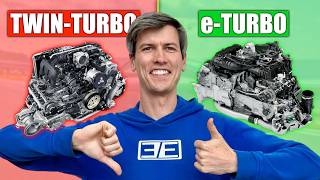

Less Turbo, More Power? Porsche's New 911 Engine
55sThe surprising switch from twin turbos to a single electric turbo with a larger engine sparks curiosity about how it actually increases power and efficiency.
▶ Play Clip"Delivers deep technical insight, but 'Formula 1 Tech' is more hype than substance; the video focuses on production car engineering."
Porsche's new 911 GTS replaces its 3.0L twin-turbo boxer with a larger 3.6L single electric turbocharged engine, paired with a hybrid system. The result is a modest 5-horsepower increase to 478 hp, but the total system output rises to 532 hp with 449 lb-ft of torque. The video dives into the engineering behind this powertrain, focusing on improved response, wider torque curves, and the clever use of electric turbocharging to maintain Lambda=1 operation for emissions.
The new 911 GTS uses a 3.6L single-turbo boxer instead of the previous 3.0L twin-turbo, with a single electric turbocharger.
New engine produces 478 hp (only 5 more than before) and same 420 lb-ft torque, but with a wider torque curve.
An electric motor between engine and transmission adds 64 hp peak (54 continuous) and 110 lb-ft, raising total output to 532 hp and 449 lb-ft.
The hybrid system adds only 103 lbs for the motor, battery, and electric turbo components.
New GTS laps the Nürburgring 9 seconds faster than its predecessor.
Larger engine (3.6L vs 3.0L) uses less boost (1.3 bar vs 1.4 bar) for better response; electric turbo spools instantly.
Old engine takes over 3 seconds to reach full boost from 2000 RPM; new engine does it in under 1 second.
Electric motor provides 110 lb-ft instantly, filling the torque gap while the engine spools.
1) Max power: engine+ motor+ turbo recovery. 2) Top speed: engine plus turbo recovery without battery. 3) Battery recharge via exhaust energy (up to 11 kW). 4) Regen braking.
New engine always runs at Lambda=1 (perfect air-fuel ratio) except during cold start, which is rare for performance engines.
Performance engines run rich to cool cylinders and prevent knock at high load/RPM by injecting excess fuel.
Three-way catalytic converter is most efficient at Lambda=1, reducing NOx, CO, and hydrocarbons simultaneously.
During cold start, the engine runs rich with secondary air injection to heat the catalyst quickly; electric turbo enables high air flow even under load.
A study by Molly Powertrain shows that an electric turbo allows a larger turbo, reducing exhaust restriction and keeping temperatures low without needing rich mixtures, thus maintaining power at Lambda=1.
Porsche engineer reveals that the previous 3.0L engine already ran Lambda=1 in the vast majority of conditions; new engine eliminates the few exceptions.
Contrary to some reports, the new engine runs about 10% less boost (1.3 bar vs 1.4 bar) under same conditions, not more.
Porsche's new 911 GTS powertrain delivers superior response, a wider torque curve, and cleaner emissions without sacrificing power, thanks to a larger engine, electric turbo, and hybrid assist. The clever engineering ensures that Lamba=1 operation is maintained almost always, setting a new benchmark for performance hybrids.
What is the displacement of the new Porsche 911 GTS engine?
3.6 liters.
00:02
How much horsepower does the new engine produce alone, and what is the total system output?
478 hp alone; 532 hp total with the electric motor.
01:13
How many turbochargers does the new 911 GTS use compared to the old?
New uses a single electric turbo; old used twin turbos.
00:02
What is the weight penalty of the hybrid system?
103 lbs.
02:17
How much faster is the new GTS on the Nürburgring?
9 seconds faster than its predecessor.
02:47
What is Lambda=1 in terms of air-fuel ratio?
The perfect stoichiometric ratio, about 14.7:1 for gasoline.
09:31
Why do most performance engines run rich (Lambda<1) at high load?
To cool cylinder temperatures and prevent knock by injecting excess fuel that vaporizes and absorbs heat.
10:40
How does the electric turbo help achieve Lambda=1 without losing power?
It allows a larger turbocharger that is less restrictive at high RPM, reducing exhaust backpressure and temperatures, so no need for fuel enrichment.
15:01
Under what condition does the new engine run rich?
During cold starts to heat up the catalytic converter quickly.
12:45
True or False: The new engine runs higher boost than the old engine.
False. It runs about 10% less boost (1.3 bar vs 1.4 bar) under same conditions.
18:48
Boost Response Improvement
Old engine takes over 3 seconds to reach full boost; new does it in under 1 second, a dramatic improvement.
05:55Always at Lambda=1
A performance engine that never runs rich (except cold start) is extremely rare; shows advanced emissions engineering.
09:02Electric Turbo Enables Larger Turbo
Using an electric motor on the turbo allows a larger, more efficient turbo that doesn't sacrifice low-end response, solving the traditional trade-off.
15:01Previous Engine Already Mostly Lambda=1
Porsche was already running Lambda=1 most of the time; the new engine just eliminates the remaining exceptions.
18:20[00:02] convinced you that a Hybrid engine is cooler than twin turbos I know it sounds awful but Porsche is doing Porsche things they've got a new 911 engine and all right don't come clean it totally sucks no of course it doesn't suck this
[00:17] is Porsche we're talking about it's better in every single way with a few small exceptions we'll get to that now previously the Porsche 911 GTS used a previously the Porsche 911 GTS used a 3.0 L twin turbo boxer 6cylinder now the
[00:32] 3.0 L twin turbo boxer 6cylinder now the new GTS is using a larger 3.6 L single turbo boxer six-cylinder now sometimes people on this channel say I lose them in the math so to be very clear one turbocharger is less than two
[00:46] turbochargers now this new single turbo is an electric turbocharger so surely with an electric turbo and a larger engine we're making more power right engine we're making more power right well yeah but only five extra horsepower
[01:00] well yeah but only five extra horsepower 478 versus 473 in the previous engine we're revving to the same red line and we're making Peak power at the same RPM and they make the same amount of torque 420 lb feet though with the new engine
[01:13] it is a slightly wider torque curve where you are at that Peak torque so advantages to doing this I mean it seems pretty minor between these two well yes there are all kinds of advantages because we also have an electric motor
[01:27] sandwiched between the engine and the transmission providing even more power so this electric motor has a peak of 64 horsepower or continuously it can run with 54 horsepower and it's good for 110 lb feet of torque this raises our total
[01:41] system output to 532 horsepower and our total system torque to 449 lb feet of torque from a much wider 1950 to 6,000 RPM so if we look at the previous engine
[01:53] you can see not only do we have more torque the torque curve is now higher we also have a wider torque curve so there's a lot more torque available especially on that low end where you can use that electric motor for that huge
[02:05] bump and torque and they also means you have a much quicker response with those electric motors and that electric turbo into getting to that torque so massive improvements across the board for this power train all right so that's a bunch
[02:17] of advantages but what's the downside of course there's the added cost and complexity but this is a Porsche 911 GTS costly is a given the only major disadvantage in my view is the weight penalty but it's surprisingly small
[02:31] powerful electric motor added to the transmission a nearly 2 KW hour lithium ion battery pack an electric motor for the turbocharger and all the inverters and wiring to go along with this entire system the nextg GTS only weighs 103 lb
[02:47] system the nextg GTS only weighs 103 lb more than the previous GTS only 103 lb for an added 110 lb feet of torque that's a really good deal okay but to the performance benefits outweigh the weight penalty because fast fast in a
[03:00] with the performance car world but what a surprise the new GTS handles well too as it completes the nurur green norch life nearly 9 seconds faster than its predecessor love it or hate it electric motors Done Right mean better
[03:14] performance now on the subject of electric motors I want to briefly shout out a product that's fully electric and has a stainless steel exterior no it's not the cybertruck but some people might say it's actually cooler big thanks to
[03:29] life and for sponsoring today's video This Is The Wave electric toothbrush if This Is The Wave electric toothbrush if 7500 RPM isn't enough for you how about up to 66,000 vpm or vibrations per minute
[03:41] combined with a 60° pivoting head which results in very effective cleaning and if you thought hey you know what my toothbrush really needs an app well you're in luck but real talk this allows for a ton of customization so you can
[03:55] tune the settings like the vibration intensity or how much it pivots and Save three custom modes that you can easily switch between on the toothbrush and finally you can get replacement heads for less than the price of a quality
[04:07] manual toothbrush a three-pack is just 10 bucks and a six-pack is 17 with three because I never shy away from offering bold advice here's my official take you should brush your teeth Brave I know all right we've strayed too far back to car
[04:22] motors so the big advantages of this new Porsche engine are response response and resp response so first of all we have a larger engine from 3 l to 3.6 l so say
[04:35] you want to design an engine that makes 500 horsepower well there's a lot of ways of making 500 horsepower you could use a really small engine with a ton of boost but unfortunately that means it's going to have a lot of lag a lot of
[04:47] delay in getting that power or you could use a large naturally aspirated engine that would have really fast response so the closer you get to a larger naturally going to get to having that response and so this is a larger engine and it's
[05:02] actually using less boost despite making more power because it has that extra displacement so it's boost pressure is down to about 1.3 bar from about 1.4 bar in standard conditions and this means you're going to have a more responsive
[05:15] engine you also have an electric turbocharger the response benefit of this is huge so you no longer have to wait on the exhaust pressure to build up that boost so on the previous engine you open your throttle all the way you put
[05:28] that creates more exhaust that starts start to pull in more air and then you can put in more fuel and you can finally start making more power with that boost on this engine you don't have to wait
[05:41] spin up that turbocharger immediately with a 20 Kow motor to pull in air so much quicker Porsche says if you take both of these engines and put them at 2,000 RPM with the throttle closed then open it the old engine is going to take
[05:55] over 3 seconds to get to full boost versus the new engine is going to get to full Boost in less than a second and on top of this we've got that electric motor feeding power directly into the 8-speed pdk transmission so now we have
[06:10] up to 110 lb feet of additional torque right when you put your foot down and that helps enable you to fill in that torque Gap when you're waiting for that engine to produce its full torque so you have so much better response with this
[06:24] powertrain overall now to better understand how this system works I want to talk through four different scenarios so here we have a simple torque versus RPM and you can see in blue I have the engine only torque curve and then in
[06:36] purple I have the total system curve including the electric motor so number one here is maximum power how do we make maximum power well we've got three maximum power well we've got three sources of power production here so
[06:48] first we've got of course our engine which is creating 478 horsepower at 6500 RPM that's where that Peak power occurs next we have our battery sending power to the electric motor helping to provide extra power to that transmission and
[07:01] then finally we're actually recovering some of that exhaust Gas Energy with power from the electric turbo directly to that motor so getting a little bit to the electric motor and finally getting that at the wheels all right so
[07:16] let's move on to top speed now of course if you're going to remain at your top speed you can't be riant on the battery right the battery could deplete and then your top speed is now lower so to achieve that top speed you need to be
[07:29] this scenario what you're doing is you've got the engine at its peak power and you're able to use that electric turbocharger and recover energy from the exhaust and send it directly to the electric motor so you can get a little
[07:42] bit additional power so actually if you look at the engine's torque curve it kind of comes down here but you can push it slightly up there on the end by using that electric turbocharger and sending that power to the motor sandwiched
[07:55] between the engine and the transmission and giving yourself a little bit of a hitting your top speed now you might wonder how do you recharge that 1.9 KW battery pack and so that's where we get two scenarios 3 and four scenario 3 we
[08:09] are using the exhaust to recharge the battery so it can do this up to 11 Kow of power where you can take your engine and if you're operating in a point where you don't need Peak torque meaning at a certain RPM a certain torque level but
[08:23] you have a buffer above that well you can make a little bit extra power and use it to spool up this turbocharge charger in order to spin that electric motor use that electric motor like a brake within the exhaust and send that
[08:35] method of course and the more obvious one is just using that electric motor for regen so scenario 4 here if you're braking trying to slow down the vehicle you use the electric motor turn that kinetic energy into energy that you can
[08:49] going directly from the motor to the battery pack recover some of that energy to recharge it all right moving on there's something I found super surprising about the this engine directly from one of Porsche's lead
[09:02] powertrain Engineers quote the new GTS engine always operates at Lambda equals engine always operates at Lambda equals 1 in all load and use cases even at low temperatures I have never heard of a Performance Engine That Never operates
[09:17] richer than Lambda equals 1 now here's the problem with that statement there's a lot of things I've never heard of so bummer all right so what the heck does Lambda equals 1 even mean all it means is that you're using the perfect amount
[09:31] that you burn up all the oxygen and burn up all the fuel for a gasoline engine it means you're running an air fuel ratio of about 14.7 to1 by mass so if Lambda is less than one it means you have excess fuel or you're running rich if
[09:46] Lambda is greater than one it means you have excess oxygen thus you're running lean so why do most performance engines run rich or with Lambda less than one actually need to so if you look at a plot of torque versus RPM and here you
[10:00] have your torque curve for the majority of this space in other words at most RPM and at most load levels you don't have to worry about running rich but when you start to hit that really high torque and really high RPM that's when you start to
[10:14] really high temperatures and this means really hot thus you're more likely to have knock and have destructive things occur within your engine So to avoid this you inject extra fuel this helps
[10:27] cool down your cylinder temp temperatures it cools your exhaust and it means you're able to avoid knock and thus you can make more power and do so safely so what that means is if you're just going to run at Lambda equals 1
[10:40] torque curve a bit on the top end so does that mean Porsche's new engine is going to make less power well not exactly we will get to that now very there's a lot of different ways of
[10:52] region you don't have to do it just by using a rich air fuel mixture that's problem it just so happens to be a very easy and very cheap way of solving that problem but there's plenty of other Solutions but why in the first place are
[11:07] they trying to run at Lambda equals 1 all right so something very interesting happens at Lambda equals 1 for three-way catalysts or catalytic converters so catalysts or catalytic converters so here on our left hand side this y AIS is
[11:20] our three-way catalyst efficiency how efficient is it at getting rid of certain emissions whether that's nox carbon monoxide or hydrocarbons and then here on the bottom our x-axis is whether our Lambda is running rich say less than
[11:35] one or running lean say greater than one so if we're running rich we're able to make more power that's great but we're injecting excess fuel into the engine which means we're going to have more hydrocarbons and more carbon monoxide
[11:49] emissions as you can see the catalytic converter is not as efficient at eliminating those emissions if we start to run rich versus if we start to run C well potentially we could run more efficiently but we're going to now have
[12:03] excess oxygen within our exhaust which means we could have more nox emissions and as you can see the nox emissions are not eliminated as efficiently with this catalytic converter as we start to run lean so the perfect meeting point of all
[12:16] of these emissions occurs at that perfect air fuel ratio Lambda equals 1 engine to run there so that it has really clean emissions now look I upset set when you start talking about emissions and the challenge is the more
[12:33] nitrogen oxides and carbon monoxide hydrocarbons that a particular Enthusiast breathes in well the less likely it is for them to understand that it's bad for them so no worries folks I'm not here to try and convince anyone
[12:45] that clean air is a good thing moving on previously I did give you a small lie there is a single scenario where the new GTS engine does operate rich and that's on cold starts because in this scenario you need the catalytic converter to heat
[12:59] up as quickly as possible all right so let's walk through the one scenario where the engine is going to be running rich on a cold start so the car's been up in the morning start it up and for maybe a minute or less it's going to run
[13:12] rich in order to heat up that catalytic converter so how does this work well here we have a simplified diagram to help understand the idea don't take it too literally again simplified to explain how this works so we've got our
[13:25] 4-cylinder engine here it's going to be pulling in 100% of that outside side air and you have a secondary air injection system which is going to be diverting some of that air directly to the exhaust now secondary air injection is nothing
[13:39] new there are some advantages however with using modern higher voltage systems which we'll get into so you have 100% of that air coming in from the start 20% of it is going to be diverted to the exhaust 80% is going to the engine and
[13:53] then we're going to inject enough fuel as if we were getting 100% within that engine so we're going be running rich which means we have excess fuel that comes out into the exhaust but then meets up with that oxygen which has been
[14:06] injected later on so now you oxidize that fuel with that oxygen you have that Heats it up you create a lot of heat in the exhaust and thus you heat up that catalytic converter very quickly now the advantage of having an electric turbo or
[14:21] a high voltage secondary air pump in this scenario is that you can handle more loads so let's say you start up your car and you immediately floor it well that's a dumb thing to do if it's cold but let's just say you did it in
[14:33] with this electric turbocharger you can divert plenty of air to that exhaust pump you could divert plenty to the exhaust versus plenty of cars are just running 12volt systems for their secondary air meaning if you were to AFF
[14:48] might not be able to pump enough air into that exhaust to make all of this work out and you still have Lambda equals 1 again because you have excess fuel but then it meets up with the perfect amount of oxygen so you still
[15:01] have Lambda equals 1 ahead of that three-way catalytic converter and as a emissions you're able to get that really warm and keep it at the ideal air fuel ratio all right the critical question here does Lambda equals 1 ruin the
[15:15] Porsche engine in other words do emissions ruin this engine's potential and actually the answer is no and you'll probably be surprised to learn about this through the magic of electric turbochargers so I found a study by
[15:29] Molly powertrain and they were looking at ways of increasing that envelope of where you can run it Lambda equals 1 and so they took an engine with Baseline and they said okay enable any air fuel ratio you want allow it to run rich on that
[15:43] top end so it makes plenty of power then they said okay now force it to only be able to run at Lambda equals 1 and as you can see it pulled in that torque versus RPM here it pulled that in quite a bit and so we have this huge gap where
[15:56] if we were able to run rich we could fill it in but then they found that by using an electric turbo they were able to push that out almost entirely to that Baseline of where they were running rich and that was just using one strategy
[16:09] just using that electric turbocharger so how are they able to do this how does an how are they able to do this how does an electric turbo enabled that I don't know I don't know no I actually know the problem is that today's engines are
[16:23] commonly using small turbochargers now why would you want to use a small turb turbocharger well because turbo lag sucks you want Power when you ask for it not 3 seconds later and because small turbochargers mean you can improve the
[16:37] bottom end of the engine so instead of waiting until get all of that power at the top end you want it immediately you want it at low RPM so you use that small turbocharger it spools up quickly gets you to that Peak torque and then you
[16:49] just hold it out as that engine revs well unfortunately with that strategy a problem occurs as you get to higher RPM all right so let's say we have two identical engines except one is using a tiny turbocharger and one is using a
[17:02] large turbocharger so as you start to get to higher and higher RPM you start building the pressure up before this tiny turbocharger it's restrictive right it's blocking your exhaust flow path so you're building up the pressure you're
[17:15] exhaust is getting hotter your engine cylinder temperatures are getting hotter that's not good how do you compensate for this well you run rich by dumping in more fuel you get that vaporization of that fuel that isn't burned and so you
[17:29] cool down those temperatures and you're able to cool that exhaust and you don't cylinder temperatures and running into knock well what if you just had a larger turbocharger well it's less restrictive so you don't have as much pressure
[17:42] building up so your temperatures remain lower so your cylinder temperatures are lower so you don't have to worry about running rich the challenge is now you lose all that bottom end and you don't have the response because you've got
[17:54] this giant turbocharger well what if you put an electric motor on it suddenly you can spool it up even at low RPM immediately and at high RPM it's way more efficient because it's sized for that RPM it's sized for the higher end
[18:07] of the engine not the bottom end of the engine so you get emissions benefits without losing the power so yes an electric turbo helps Porsche achieve Lambda 1 but you might be surprised to learn how close they already were with a
[18:20] 3.0 L engine their engineer States they were already running Lambda equals 1 in the vast majority of use cases as long as temperatures allowed for it a small amount of enrichment was used when exhaust temperatures reached a certain
[18:34] point but in the real world it was very rare that these temperatures were seen so it's rare for it to use a slightly Rich mixture the new engine strategy simply eliminates these small exceptions more power more torque wider torque
[18:48] curve massive response improvements better emissions Papa John's Porsche nailed it once again okay one frustrating little comment here at the about this engine you're like hey this is cool and you're reading all the
[19:01] material out there well some Outlets are incorrectly reporting about this engine and in fact they're saying that this is running with way more boost and yet it's not making any extra power and it should be making so much more power but it can
[19:13] because Lambda equals one and it's simply not true so if this engine and this engine are running in the same scenario same environment this is running less boost not more like plenty of outlets are saying so it is running
[19:27] about 10% less boost in ideal conditions now if you were to take this engine and mountain that has really thin air lower pressure well yeah it can increase the amount of boost it has in order to compensate and make that Target 478
[19:41] horsepower but in the same conditions the new engine versus the old engine it's actually running less boost about 10% less boost and that's because it's a with as much boost if you have any questions or comments feel free to leave
[19:54] questions or comments feel free to leave them below thanks for watching


⚡ Saved you 0h 19m reading this? Transcribe any YouTube video for free — no signup needed.