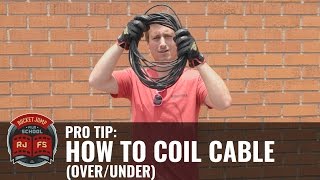

Why Over-Under Wrapping is Controversial
38sChallenges a common film school practice and creates a debate among viewers.
▶ Play Clip"The title accurately describes the tutorial content, delivering exactly what it promises with no exaggeration."
Dominic teaches the over-under cable wrapping technique, contrasting it with the over-over method for power cables. He provides a step-by-step visual guide, emphasizing the hand motions and consistency checks.
Over-over is for power cables (stingers), while over-under is for most other cables like BNC and XLR.
Start with the non-dominant hand, place the end inside, and grab the main cable to set the loop size.
For the under part, flip the hand palm-out, grab from below (thumbs down), then flip to thumbs up.
The end should return to the start, indicating consistent loop size.
Over-Under is for Most Cables
Clarifies that over-under is the standard for 90% of cables, not just a niche technique.
00:26Thumbs Down, Thumbs Up Motion
Provides a simple, memorable visual cue for the under-wrap motion.
01:07Consistency Check
Explains how to verify even loops by bringing the end back to the start.
01:41[00:00] My name is Dominic and I'm going to teach you how to wrap cable.
[00:12] So, in the last video, I had said something kind of like this and never, never, never, never, never wrap over under. Some film schools have taught that, I've heard it, some of my film schools have taught it. Over under everything except maybe power cables.
[00:26] They are the only exception I've ever run into. And that's correct, that's extremely correct. But in the last video we were doing, we were wrapping power cables, and so that's why I was doing over-over for them.
[00:38] In the grip electric world, that's what you do for stingers. But we did say we were doing a follow-up video, and that's what we're going to do today. So I'm going to show you how to wrap over-under like many other cables like BNC and XLR do. So when you over-under cable, start with your non-dominant hand, put the end inside, and
[00:54] grab it. get your main base cable. So that's about the size I want to make it. For the under part, you grab it, flip your hand over so your palms facing out, grab the cable from down.
[01:07] You see how I got kind of like a thumbs down, like ooh I unhappy this cable not wrapped You grab it and you flip it so your thumbs are together and you making a thumbs up So thumbs down palm out thumbs up Thumbs down thumbs up
[01:21] You'll be able to feel it, you'll be able to feel it, it'll be about the exact same size right there. You go back to over. Over, pinch and twist, under, thumbs down, thumbs up. Over. Thumbs down. Thumbs up. And that's how you do it. You just keep going now. Thumbs
[01:41] down. Thumbs up. And in the end, it should be just like that. Bring it pretty much back to the end. That's how you know you're wrapping consistent loops. You'll be able to plug in
[01:54] and you shouldn't have too much space. So, thanks for tuning in. I hope this follow-up was helpful and you realize that over over is for power cables such as stingers like the last video and over under is for like 90% of the other ones
[02:09] are gonna wrap so thanks guys have a good day see ya Dominic out Kirk out



⚡ Saved you 0h 02m reading this? Transcribe any YouTube video for free — no signup needed.