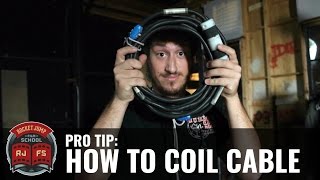

The Ultimate Cable Wrapping Hack
45sPromises a simple, effective solution to a common frustration (tangled cables) with a satisfying visual demonstration.
▶ Play Clip"The title accurately describes the content—a straightforward tutorial on cable wrapping—with no exaggeration or misleading elements."
Dominic demonstrates the pinch and twist method for wrapping cables, emphasizing proper technique to avoid knots and damage. He covers key rules, such as never coiling while plugged in, and clarifies exceptions like BNC cables.
Hold the plug, go an arm's length away, then pinch and twist while wrapping to work out pigtails.
Never coil a cable while it's plugged in; if coiling a head feeder, start at the plugged-in end to avoid tension and knots.
A correctly wrapped cable should lie flat with no knots and can be thrown out without tangling.
Over-under wrapping is only for BNC camera cables; other cables should use the pinch and twist method.
Pinch and Twist Method
This is the core technique demonstrated, essential for proper cable wrapping.
00:30Never Coil While Plugged In
A critical safety and maintenance rule to prevent damage.
01:11Over-Under Only for BNC
Clarifies a common misconception about over-under wrapping.
02:21[00:01] My name is Dominic and I'm going to teach you how to wrap cable. Right here we have just a stinger which is just an extension cord essentially in the
[00:15] common people speak. So the easiest way is if you're a righty like I am, I hold the Edison plug or the Hubble as it's known in your one hand. You go maybe about an arm's length away or something and you go and you wrap it and I
[00:30] do is called like the pinch and twist method. So you go and you hold it and grab it, pinch and you twist your hand a little bit. You'll kind of, every cable has its own kind of memory to it. They all have been wrapped a certain way so you'll be able to feel it, how it kind of wraps together. Pull it out, pinch, twist.
[00:45] What you're doing when you're pinching and twisting is you're essentially taking all of like the, what you call pigtails, like if it gets coiled up like this or whatever and you're working them out. And you'll see it even right here, it's kind
[00:57] of coiled so when you pinch and twist it'll wrap and it works itself out like that. Wrap, wrap and when you do it perfectly it should wrap perfectly and the plug should come right to the other end. Plug it in and you take your ties
[01:11] and you tie it up so it doesn't get all tangled in the truck. This is really tight so I'm just gonna do a little loose square knot so it's not too tight. Then it wrapped up perfect circle Boom One important thing to notice when you coiling your cable is never coil it if it plugged into something If you do coil it when it has to be plugged into something like a light or something if you coiling like a head feeder
[01:34] always start at the plugged-in end. Because what you'll do if you start from the loose end to the plugged-in end, you'll start wrapping it and you'll pinch and you'll twist and you'll pinch and you'll twist, and it's working all that tension up to the light. And so the very end of your light or whatever you're rolling it into is all going to be knotted and twisted up,
[01:50] and it's going to mess up your cable. It's just gonna tell you get shorts and that's how you get things due to bad wrapping when it's wrapped correctly You should be able to just throw it out And notice how there's no knots hasn't coiled up at all hasn't got caught on itself
[02:05] It's just nice and flat and straight. That's how you know you wrap the cable correctly That's how you do it. You know after you do it a while. It just becomes natural quick
[02:21] That's how you wrap cable. Pretty easy. And never, never, never, never, never wrap over under. Some film schools have taught that. I've heard it. Some of my film schools taught it. The only cable you wrap over under is BNC cable for camera.
[02:33] I have no idea why they do that. You'd have to talk to a camera person. Does anybody know? That's it. Thanks for watching how to wrap cable.
[02:51] you




⚡ Saved you 0h 02m reading this? Transcribe any YouTube video for free — no signup needed.