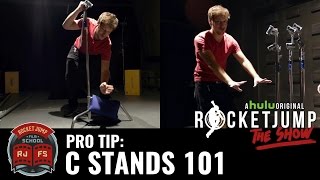

C-Stand Basics: The 100 Uses!
45sThe opening hook about C-stands having over 100 uses and the threat of being fired or someone dying creates immediate intrigue and stakes.
▶ Play Clip"Title promises basics and safety, and delivers exactly that—concise, practical, and on-topic."
This video provides a practical, safety-focused introduction to using C-stands (century stands) on a film set. The presenter explains the correct positioning of the base legs for weight support, the critical 'righty-tighty, lefty-loosey' rule for knuckle orientation, and the importance of sandbagging for stability. It also covers proper storage techniques and safety communication when moving equipment.
The video begins with a basic overview of C-stands, also known as century stands, and emphasizes the importance of using them properly to prevent injuries and equipment damage.
C-stands have three legs at different heights (low, middle, tall). The 'big leg' should be positioned to support the direction of the weight to prevent tipping.
The knuckle should be on the right side when standing behind the stand. This ensures that if the equipment starts to fall forward, it will self-tighten rather than loosen and drop.
Sandbags must be placed on the big leg, not the small legs, to effectively lower the center of gravity and prevent the stand from sliding or tipping.
C-stands should be 'soldiered' (stacked with big leg over medium leg) for neat storage. When moving equipment, shout 'points' to warn others and avoid accidents.
Mastering C-stand basics—proper leg placement, knuckle orientation, and sandbagging—is essential for safety and efficiency on set. These simple practices prevent accidents and ensure equipment stability.
C-stands are versatile
Explains the origin of the name 'century stand' due to over a hundred uses.
00:29Self-tightening safety mechanism
The knuckle orientation ensures equipment self-tightens if it starts to fall, preventing accidents.
01:26Center of gravity principle
Sandbagging on the big leg is a practical application of physics to ensure stability.
02:16[00:00] Have you seen where the C-Stands are at on set? No, where are they? They're right over that way. In case you ever, in case you need them.
[00:16] Today we're going to talk about C-Stands, give you a few little basics into C-Stands and how to use them properly. And then we're probably going to go over some safety always, making sure nobody gets injured or hurt on set.
[00:29] Nothing can fall. Yeah, you don't want that to happen, otherwise you will be fired and someone could die. C-stands, also known as century stands because there's over a hundred things you can do with C-stands.
[00:41] Right here, this is the base, you know, turtle legs and stuff. So you see they're at three different heights. You have a low one all the way to the ground, you have a middle one, you have a tall one. When you set something down, wherever the weight's going to be, you want this big leg
[00:58] to be going out That way all the weight will be pressing out So if you have something heavy up here and you press the leg going to go with it It not going to go If you have it sideways and there nothing here where the leg should be
[01:13] and you push it, it goes down a lot easier. So it's not very safe. So you always want to have your big leg kind of supporting where the weight's going to be. The other main thing to know for C-Stance is that these knuckles,
[01:26] you have to remember righty-tighty, lefty-loosey. When you're standing behind it, the knuckle should always be on the right side. The reason being is when you tighten it, if you have any weight going forward, you know,
[01:38] as though if this is too loose, even if this is loose, someone doesn't tighten it all the way, so a little bit like this, and it starts going forward, it's going to self-tighten itself. That way, it's safe. If something starts to go down, it'll at least stop itself.
[01:50] If you have it the other way, say flip this whole thing around, now it's on my left side. I start pushing it. I start pulling it. how easy it is and it loosens it up and the light or whatever is on there will fall off.
[02:03] So that the main thing you always want to know for C is righty tighty lefty loosey If it on the left left side you have any kind of weight up here it just loosen up and fly off if it out that way
[02:16] The right side, if you have it up and it's going, it tightens up. Righty-tighty lefty-loosey, big legs supporting where the weight's going to be, and always, always, always put sandbags
[02:30] on your C-stands. On the high leg. On the big leg. You have it on the little leg, the sandbag is touching the floor and it's not giving any weight to it. You just slide around. Same
[02:46] thing with this one. This is touching, the bags are still touching the floor, so you're not getting all the weight on the C-stand, you're getting most of the weight on the floor. That's why you want to have it on the big leg. All about center of gravity. Exactly.
[02:59] Center of gravity is physics. So when you're storing a C-stand, you want to soldier them. You put the big leg over the medium leg. You can put 20 of them in a row It be nice and neat and flat instead of having them like this or like that See That ugly Ugly Pretty They line up nice and pretty and everything
[03:27] is all uniform and soldier. So when you're walking with either stands or equipment such as rails and stuff you want to be shouting points, points so people will know and you don't hit them in the face just like that. When you come around corners and stuff, it's
[03:41] most important because people have no idea you're coming. You can also shout free dental because once you hit them in the face, that's what they're going to need. So those are a few little basics about C-Stands. You can use them for anything and everything. It's
[03:55] a grips best friend. It's one of the main things we always use.
[04:07] Thank you.



⚡ Saved you 0h 04m reading this? Transcribe any YouTube video for free — no signup needed.