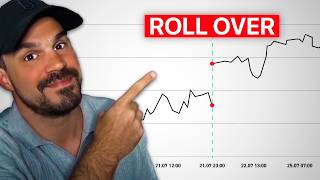

What is a Rollover in Options?
45sClear, concise definition with practical example that hooks beginners.
▶ Play Clip"Delivers a clear, practical explanation of rollovers with examples, though some promotional content for courses adds minor fluff."
This video explains the concept of a rollover in financial options, a strategy used to extend a contract over time by closing an existing position and opening a new one with a later expiration date. The instructor provides practical examples, including scenarios where an option is close to expiring and out of the money, and demonstrates how to execute a rollover by buying or selling the opposite contract. The video also covers when a rollover is beneficial, such as when the market moves against your position but you remain bullish or bearish, and mentions other reasons like maintaining a position or tax purposes.
A rollover is a strategy in financial options to extend a contract over time by closing an option that is about to expire and opening a new position, usually with a later expiration date. This allows investors to maintain their position without waiting for the old contract to close.
Example: On Monday, Nov 18, you sell a call option on 100 Amazon shares at strike $225 expiring Dec 13, receiving a premium of $300. Days before expiry, the stock is above $225. If it stays above, shares will be sold. To avoid this, you can do a rollover.
To close the sold call, you must buy a call contract with the same date and strike price. In the example, you pay a premium of $120 to close, netting a profit of $180 (300 - 120).
After closing, you can open a new call option with a later expiration date and possibly a different strike price. The new premium should ideally exceed the cost to close (e.g., $10) to amortize the cost. Example: same strike $225 for 3 weeks later, receiving $1660, covering the $10 cost.
The real premium received is the difference between the premium from the new position and the cost to close the old one. Whenever possible, the new position should pay more than the cost to close.
If you sold a put option and need more time, you close by buying a put option (opposite), then open a new put sale. The process is symmetric.
The instructor bought a call on a silver ETF at $27.85, strike $20, expiring Jan 16, 2026, paying $975. If price rises to $29 but below break-even ($30.1), he is in the red but still bullish. He extends by closing (selling the same call) for $500, then opens a new contract with a later date.
Rollovers can be used to maintain a position, set a new strike or expiration date, or for tax purposes. These are covered in the advanced course.
A rollover is a flexible strategy to extend an options position by closing the current contract and opening a new one, allowing investors to manage risk and adjust to market movements. The key is to ensure the new premium covers the cost of closing, and to consider strike price adjustments to reduce assignment risk.
What is a rollover in financial options?
A strategy to extend a contract over time by closing an option that is about to expire and opening a new position, usually with a later expiration date.
00:02
How do you close a sold call option?
You buy a call contract with the same date and strike price.
02:27
In the Amazon example, what was the net profit after closing the contract?
The premium received was $300, and the cost to close was $120, so the net profit was $180.
03:27
What is the key principle when opening a new position in a rollover?
The new position should pay a premium higher than the cost to close the old contract, so the difference is the real premium.
05:10
How do you close a sold put option?
You buy a put option with the same date and strike price.
05:25
In the silver ETF example, what was the break-even point?
The break-even point was $30.1.
06:46
What are some reasons to do a rollover besides extending time?
To maintain a position, set a new strike or expiration date, or for tax purposes.
08:38
Definition of Rollover
Provides a clear, concise definition that forms the foundation of the entire lesson.
00:02Closing a Contract by Buying the Opposite
Demonstrates the core mechanism of closing an options position, which is essential for executing a rollover.
02:27Real Premium Calculation
Emphasizes the importance of ensuring the new position's premium covers the cost of closing, which is a key principle for profitable rollovers.
05:10Practical Example with Silver ETF
Illustrates a real-world application of a rollover when the market moves against the investor but they remain bullish, showing how to extend time.
06:18[00:02] how and when you should do it. What is a rollover? Rollover is a strategy within financial options to extend our contract over time. It
[00:14] consists of closing an option that is about to expire and opening a new position, usually with a later expiration date. And this operation allows us as investors to maintain our position without having to
[00:30] wait for it to close and open a new one. Don't worry, we'll see it right now with practical examples. When and how to make a rober? In financial options, there are quite a few situations where doing a
[00:45] rollover is very beneficial. And of course, I'm going to tell you what these scenarios are and take the opportunity to explain how to do it in each one . The option is close to expiring and is out of the money. Let's imagine that on
[01:01] Monday, November 18th, we had 100 shares of Amazon and decided to sell a call option at a strike price of 225 for Friday, December 13th. For this
[01:13] call sale, as you already know, we will have received a premium. In this case, it will be around 300. And if you don't know, well, you have a free course available, but as you can see in the image, a few
[01:28] days before the contract expired, the stock price was already above $225, which was our strike price or selling price. And so, if it ends up above that on Friday, they will sell us the
[01:43] shares, so now we have a decision to make. We can take a chance to see if the stock price drops on Friday and therefore our shares aren't sold. And if it goes down, everyone's happy, I keep my shares and on
[01:58] top of that I keep my bonus of about $300. But if it doesn't go down, as you know, they're going to sell our shares. And mind you, that's not bad at all. I keep my $300
[02:11] premium plus the revaluation from about $ 200 to $225. But if we don't want to take the risk and we want to continue owning the shares, what we must do is a rolloare. And how is this done? Let's take
[02:27] a look. We have a call sale for December 13th for which we have received $300. To close this contract, all we have to do is the opposite. Let me explain. We must buy a
[02:43] explain. We must buy a call contract for the same date and strike price. As you have seen, it is the opposite. We sold a call contract for a certain date and strike price, and now we are
[02:56] buying a call contract for that same price and date. Since we are buying in this case, we will have to pay a premium, for example, of $120. And this is how we close our contract and, of course,
[03:12] the shares will no longer be sold to us, even if the price is higher than $225 because there is no longer a contract. And now, of course, we can do two things. The first option would be to stay as we are, which of course would continue to make us
[03:27] profits, since we were paid $300. And now I'm only paying $10. And that's it, the contract is closed, they don't sell us the shares and they make a profit. It's not the $300 we wanted, but rather 300 - 120 = 180. Or
[03:44] what we can do is a rollover, which is what we are studying in this lesson. In other words, we need to open a new call option for a later expiration date. And of course, for this new call sale we can
[03:59] set any date and strike price we want, but the logical thing is to choose both an expiration date and a strike price that pay us a premium higher than the $10 we paid to close our contract, and in
[04:16] that way we can, as I mentioned, amortize the payment of the $10 we made to close the contract. For example, we could choose the same strike price of $225 for 3 weeks from now and receive $
[04:30] 1660, which as you can see more than covers which as you can see more than covers the $10 paid to close the contract. But of course, in this case we run the risk that the shares will continue to
[04:43] rise in price and therefore we will have to do the same thing again or they may even assign us prematurely. So what we can do to avoid this is to raise the strike price even further. Of course, we will receive less
[04:57] premium, but we will reduce allocation risk. And basically, this is doing a rollover. We closed our position and opened a new one. And of
[05:10] course, whenever possible, the new position we have opened should be paying us more money than we paid to close the position, and the difference between the two will be the real premium we are receiving. Do you think
[05:25] the market will move in your favor? But you need more time now, it's the complete opposite . By the way, I'm not saying this is the best option, but I'm simply
[05:37] explaining it to you with the opposite case. In other words, instead of selling a call option, we would sell a put option, and to close the contract we would have to do the opposite, that is, buy a call option or buy a put option. In this case, we're going to
[05:51] start by buying a call option. And to wrap it up, what are we going to have to do? Well, obviously sell a call option, the opposite, that is. And if it were with a [ __ ] it would be exactly the same. But before I go on, I want to tell you that if, after watching the entire
[06:04] free course, you decide you want to start making money with our advanced course with many more lessons and hours of content to help you become an expert. As I showed you in the
[06:18] slip video, I am bullish on the price of silver and therefore bought a short- term position in a silver ETF. I bought Col at a price of $27.85
[06:32] Col at a price of $27.85 and a strike price of $20 for January 16, 2026, for which I had to pay $975. Now what we're going to do is fast- forward and look at the
[06:46] possible scenarios. Let's imagine that the price has gone up, but only to $29. Since I haven't reached my break-even point of $30.1, I would of course be in the red,
[07:02] but I'm still bullish on the silver market. I simply think I went too soon and missed the mark with my timing. Therefore, what I want timing. Therefore, what I want now is to extend my contract for a couple
[07:15] more years to give the price time to rise. The first thing I would have to do is close my contract and to do that I have to do the opposite, that is, have to do the opposite, that is, in this case sell a call and
[07:28] of course with the same date and same strike. That's why he would be receiving money. Since we are selling a call option, we are receiving a premium, for example, $500. And with the contract already closed, we can
[07:43] And with the contract already closed, we can open another new contract with the same or a different strike price and the date we want. In this case, of course, it is not taken into account that our new contract pays us more money than it
[07:56] cost us to close the old one. Basically because we're buying an Acor here, and that's what we're paying for. And we're also assuming that my contract is losing money and I want to give it more time to become
[08:09] profitable. So, of course, I'll be losing money. The $500 we received for closing the contract only helps us to have fewer losses. We made a mistake in the timing, so now we simply
[08:24] have to accept the losses and open a new contract to see if we can obtain the desired profits in this new time frame . Of course, there are some other reasons why doing a rollover is quite beneficial,
[08:38] such as maintaining a position, setting a new strike or expiration date, or simply for tax purposes. But anyway, we'll leave that for the full course. If you want to take a look at the
[08:53] advanced course, you can click here. And if you want to see the entire free course, you want to see the entire free course, you can click here.
⚡ Saved you 0h 08m reading this? Transcribe any YouTube video for free — no signup needed.