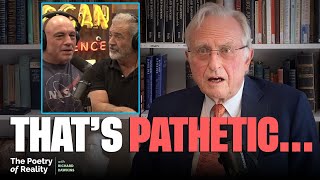
Brain as God's Design? Dawkins Responds
45sHigh controversy as a neuroscientist claims the brain proves creation, followed by Dawkins' sharp 'argument from personal incredulity' rebuttal.
▶ Play Clip The Poetry of Reality with Richard Dawkins
"Title accurately reflects content: Dawkins indeed refutes creationist arguments with scientific reasoning."
Richard Dawkins debates creationist arguments, defending evolution against claims of intelligent design. He refutes the argument from personal incredulity, explains how natural selection and mutation generate information, and addresses topics like the fine-tuning of the universe, the existence of Jesus, and the male-female binary in biology.
A creationist claims the brain's complexity proves divine creation, but Dawkins calls this the argument from personal incredulity.
Dawkins explains that nervous systems show a continuous gradation from simple neural nets in cnidarians to complex brains in vertebrates, supporting evolution.
A creationist says everything is created and adapts through intelligent thought; Dawkins counters that natural selection and mutation provide the necessary increase in information.
A creationist confuses Zinjanthropus with Piltdown Man hoax; Dawkins clarifies that Zinjanthropus is a valid fossil discovered by the Leakeys.
Dawkins emphasizes that feelings don't count in science; the fossil evidence for hominid evolution is overwhelming.
Dawkins refutes the claim that grass was created for cows, explaining that natural selection adapts organisms to existing environments.
Dawkins explains that mutation provides new genetic information, which is then shaped by non-random natural selection.
Dawkins discusses the multiverse as an explanation for fine-tuning, citing Martin Rees's book 'Just Six Numbers' and the anthropic principle.
Dawkins notes that intelligent design is creationism rebranded after legal losses, still relying on the argument from personal incredulity.
Dawkins concedes Jesus likely existed but questions his divinity, focusing on whether he performed miracles.
Dawkins clarifies his 6.9 on a 7-point scale of belief, stating he is agnostic about God as about the tooth fairy, due to lack of evidence.
Dawkins asserts that the male-female divide is a clear binary across the animal kingdom, based on gamete size.
Dawkins systematically dismantles creationist arguments, emphasizing that scientific evidence overwhelmingly supports evolution, while intelligent design and creationism rely on logical fallacies and lack empirical support.
What is the 'argument from personal incredulity'?
Claiming that because one cannot understand a natural phenomenon, it must be caused by a divine creator.
01:06
What does Dawkins say provides the increase in genetic information required for evolution?
Mutation (random genetic change) combined with non-random natural selection.
06:51
Which fossil did a creationist mistakenly call a hoax, and what was the actual hoax?
The creationist confused Zinjanthropus (a valid fossil) with Piltdown Man (a hoax from 1912).
03:05
According to Dawkins, what is the male-female binary based on in biology?
Gamete size: females produce large eggs, males produce small sperm.
19:50
What is the anthropic principle as applied to fine-tuning?
We observe a universe conducive to life because we exist; in a multiverse, most universes are not life-friendly, but we must be in one that is.
10:03
On Dawkins' 7-point scale of belief, where does he place himself?
6.9, meaning he is agnostic but lives as if there is no God, similar to his stance on the tooth fairy.
18:27
What does Dawkins say about the historicity of Jesus?
Jesus likely existed as a historical figure, but the important question is whether he was divine and performed miracles.
15:10
Fossil confusion exposed
A creationist confuses Zinjanthropus with Piltdown Man, and Dawkins corrects him with precise paleontological knowledge.
03:05Ronald Reagan's cook analogy
Dawkins dismisses Reagan's argument that a gourmet dinner implies a cook, calling it 'elementary' and 'pathetic'.
07:36Child reciting Genesis
A child recites the Bible, and Dawkins calls it 'child abuse' to drill such beliefs, sparking a strong reaction.
14:18[00:00] People ask me how I can reconcile being a Christian first and a scientist second.
[00:14] Well, if one doesn't have a reverence for a divine creator after studying the brain for almost half a century, he has more important things to learn than neuroscience, in my opinion. Firstly, we'll never fully grasp the complexities of the brain.
[00:26] It's the black box of the body. Unlike the pump, the heart, or the filters, the layer of the kidney, the flame, or the oxygen exchangers, the lungs, and their biochemistries, our understanding of the brain's anatomy and neurochemistry is truly primitive.
[00:40] With that observation, I can confidently say, without reservation, after studying neuroscience for the better part of 48 years, that the brain is irrefutable evidence that we're a creation and not a gradually progressive accident.
[00:54] The brain has to be God's crowning achievement in creating the human body, albeit not quite so evident in politicians and lawyers. That's what I call the argument from personal incredulity.
[01:06] The man says, I don't understand it, therefore God did it. That's pathetic. If you look at brains, nervous systems throughout the whole animal kingdom, you'll hear a really continuous gradation.
[01:20] Of course, it's not really evolution. They're all living creatures today, But you can see you start with niderians, with sea anemones, and you have just a diffuse neural network. And then you go on to worms that have a sort of ganglion and a nerve cord.
[01:32] And then you go on to fish, which have a relatively small brain. Amphioxus has an infinitely small one. And as you look at the vertebrates, you can see a continuous gradation of brains getting bigger and bigger and bigger,
[01:49] starting off, as I say, just a ganglion at the head of the spinal cord and then getting bigger. So we've got it before our very eyes. We can see how it would have evolved.
[02:01] Brains don't fossil on the whole fossilized, but you can see the brain taste in fossils as well. So as I say, it's the argument from personal incredulity, and it's deeply unimpressive.
[02:13] Do you think there's some sort of a natural selection process, or do you think that it is all intelligent design? Well, I think everything is created. And maybe things do move on and adapt and change through time.
[02:27] But I think that that's a function of an intelligent thought. I can't intellectually tell you why. I don't believe in evolution, but I know. It's just a feeling. I don't think I was some ape or I don't think my ancestors were.
[02:39] I think they had to be pretty smart to survive. So what do you think all these pre-human hominids are? This will keep discovering. Like, tell me what a pre-human hominy is. Like Australia Pythagoras. All right. Or some of the other human-like creatures that never made it,
[02:53] like Denisovans, Neanderthals. Well, they've got something called Vinganthropus. You remember him? No. They looked at it, and they did some core samples on it, and it was put out there by people advocating evolution,
[03:05] and they discovered that it was a human skull attached to the jaw of an ape. Oh, I do remember that. So there's a hoax. Vinganthropus. A hoax. That's rubbish. That's absolute rubbish. He's muddling it up with Piltdown Man.
[03:19] Zinjantifus is not a hoax. Zinjantifus is a perfectly respectable fossil, it's changed its name now to Paranthropus, but it's a perfectly respectable fossil discovered by Mary Leakey and Louis Leakey published about it.
[03:34] He's muddling it up with Piltdown Man, which was a hoax perpetrated in 1912 and was later exposed as a hoax. Tiltdown Man was never evident for evolution anyway.
[03:50] Really, muddling up Tiltdown Man and Vingentropus is just amazing. Then before that he said, it's just a feeling. Feelings don't count in science.
[04:03] He says, I don't believe my ancestor was a name. Who cares what he believes? The question is, what's the evidence? And the evidence is absolutely overwhelming. We now have an enormous number of fossils from Africa
[04:16] showing a beautiful series of evolution of hominids. Zinjantropus was not our ancestors. Zinjantropus was one of the, or Tatarantropus, I should say, was one of the so-called robust hominids.
[04:33] And we are in a different line than Gracile was. But it is indeed a fascinating skull, and nothing to do with Piltdown, which indeed was a hoax. The truth of the matter is, there is more reason for you to believe there is a God than there is for you to not.
[04:51] The fact that it was already set up on this planet for there to be medicines for us to find and utilize it. So, to make a cow, it means you have to also have made grass. And it means you would have had to have invented a whole new eating system for this animal which was cud And that means you would then have to give them three stomachs to be able to and you would have to have known that he was going to be in a nid of gas that was going to be necessary on the planet
[05:19] I don't know who that was, but that's a very strange sort of argument. It sounds as though he's saying that the world was set up for humans, and therefore that implies design. Of course, natural selection sees to it that whatever world there was,
[05:34] he would have adapted to it. So because there was grass, cows evolved. It wasn't that grass had to be there before cows. It wasn't that grass was put there in order for cows to evolve. That's putting the argument backwards.
[05:46] That's putting the cart before the horse. Everywhere you look in the living world, it has apparent design written all over it. And it was only what that looked at. Darwin had an alternative explanation, a much better explanation for apparent design.
[05:59] It isn't design at all. It's produced by the non-random process called Darwinian natural selection. Once I understood that, there was no longer any need for God. He clearly looked at creation and said, yes, there is a parent design.
[06:12] But then he said Charles Darwin, right? And he's talking about natural selection again. You're going to find this often with Richard Dawkins and many evolutions, is they equate natural selection and evolution as the same thing.
[06:24] Natural selection is a loss of information. You could definitely say that from the original kind of dog to like a poodle, there's been a loss of information. Evolution requires a gain of information.
[06:37] It requires an organism to literally gather new information and then become a different organism. This has never been absorbed in nature, ever. Well, yes, it does require an increase in information, and that is provided by mutation,
[06:51] random genetic change plus non-random selection. That is precisely where the information comes from. It's a very simple process to understand. It's very complicated in its details. But that is where the information comes from.
[07:06] I have long been unable to understand the atheists in this world of so much beauty. And I've had an unholy desire to invite some atheists to a dinner
[07:21] and then serve the most fabulous gourmet dinner that has ever been concocted. and after dinner asked them if they believed there was a cook.
[07:36] Oh, really? Come on. I hope Ronald Reagan was a better president than he is a thinker. I mean, really. This is such an elementary argument.
[07:50] If it was really that simple, then all biologists would disbelieve in evolution. It's not that simple. That's a pathetic argument. That's the sort of naive argument of somebody who is absolutely ignorant of everything about biology.
[08:05] You have to know something before you can put an argument, and evidently he got a good laugh for that, but the audience must have been as ignorant as he was. The universe is so fascinating. If you look at the properties of the universe, as documented by theistic and atheistic cosmologists,
[08:22] They refer to a fine-tune of the universe. I talked about Martin Rees, who wrote a book, just six numbers. He details six numbers. All of these numbers, he says, describe the reality of the universe. He said, had one of these numbers been different, the universe would not be able to facilitate human rights,
[08:38] and there would not be a fine-tuning of either. Or the universe could not exist in the complex right now. If we look around and see the intelligent design, it must be followed that we say that there must be an intelligent design. You see what I mean? Henry's did indeed write a book called Just Six Numbers, and he did indeed say that if
[08:55] any one of those numbers, the fundamental concept of physics had been a little bit different, he wouldn't have got the universe as we know it, and he wouldn't have got life. And that's a very respectable argument which physicists often put. There are various answers to it.
[09:12] One is that if the universe had been different because of this, then maybe a different kind of life would have evolved. A much more powerful argument is the one that Martin Rees himself
[09:24] actually prefers, in which that speaker, whoever it was, ignored, which means to say that there is a multiverse. There are other good reasons to expect a multiverse. There are other good
[09:36] reasons which physicists have followed from other physical theories, that there will be not just one universe, there's one set of physical constants, but millions of universes with different values of the physical constants.
[09:49] And most of those universes will not be conducive to life, will not be conducive to producing galaxies, to producing planets, to producing chemistry, to producing life. But a minority, maybe only a very small minority, will be.
[10:03] And of course we have to be living in one of that minority because here we are. That's the so-called anthropic principle. And that's the argument that Martin Lees himself puts forward
[10:15] in that very book which that man selectively quoted. There always been a fundamental difference between creationism or creation science and intelligent design approach to biology The one creation science begins with an understanding of the Genesis account
[10:35] and tries to reconcile that to scientific data, to scientific observation. The other begins really with an unpolluted, unembellished version of science,
[10:49] which is simply that science is the use of observation and reason to come to true understanding of the world. So intelligent design does nothing other than take a science view in its simplest form
[11:03] and apply it to the world and the living world in particular. When you do that, you end up being forced by reason and observation to this conclusion that living things are designed.
[11:15] Creationists lost various levels in the American courts and therefore they change their tactics, they change their name to intelligent design. It's the same thing. It doesn't rely on Genesis this time.
[11:27] But if you actually listen to what they say to their own disciples rather than out in public, it's quite clearly the God of the Old Testament that they have in mind. It is not a good argument, if we turn out of the actual argument that they put.
[11:43] It's the argument from personal incredulity, as I said for the first of these clips. I don't understand it, therefore God did it. That is not an intelligent scientific argument.
[12:00] You have two hypotheses. One is intelligent design, and the other is science. And science has a massive lot of evidence in its favor. Intelligent design has absolutely none.
[12:12] But what they say is, because I found a difficulty that I can understand something in the scientific explanation, therefore the other one must be right. Hypothesis A and hypothesis B are laid before us.
[12:26] You find what you think is a flaw in hypothesis A. You can't actually understand how it works. Therefore, hypothesis B must be right. That is not a good scientific argument.
[12:38] India of intelligent design. Why are they wrong? So they mock because they don't have an answer. Because the more we know about these things, the clearer it becomes. And what we're talking about is the motors and the constructions inside living things.
[12:51] They're just so sophisticated. Things like ATP synthase is present in all living things. There's no way it can come about by any evolutionary process. So they use mocking rather than engagement with the arguments because that's all they have.
[13:04] They're up to creek without a paddle and they know it. And so, if they were engaged with the evidence, I don't believe they'd be evolutionists. There's no way it can be explained. Once again, the argument from personal incredulity.
[13:18] I don't understand it, therefore God did it. We've had this three times now. It doesn't wash. The scientific evidence is overwhelming. Read a book, for goodness sake. In the Bible, it starts with, Jesus, what it was.
[13:33] Hold up. What did you dare say, Amos? And it says, in the beginning, God created the heavens and the earth.
[13:45] But she said, the earth is fullness and peace. And God sent me to be light. And there was light. And let me tell you something.
[13:58] Right there, that life is so good. I might call that child abuse.
[14:18] I mean, that child has been drilled to feed that rubbish. And it's very tragic. And I suppose it was a little bit of a comic relief. But really, Richard Gartens admitted to lying about Jesus.
[14:32] of the God delusion. You say that it's under scholarly dispute among historians that Jesus actually existed. Now I check with the ancient historians. That is not
[14:44] so. And it disturbed me. History is not natural science. But what I don't understand is this why you would write something like that. I don't think
[14:56] it's a very important question whether Jesus existed. There are Some historians, most historians think he did. They certainly do. I couldn't find an ancient historian that didn't. Well, I don't want to. When you look at history, let me decide.
[15:10] Maybe I alluded to the possibility that some historians think he would never exist. I take that back. Jesus exists. Okay, now, for those of you who are itching to type, yes, but that doesn't prove that he's God, I agree.
[15:22] This video is about intellectual integrity and establishing a stepping stone towards that end. It doesn't matter whether a man called Jesus or Yahoshua, whatever the Hebrew name was existed The point was was he a miracle worker Was he the son of God Was he born of a virgin Did he rise from the dead And he did not But of course there were plenty of wandering
[15:43] creatures around them, and no doubt several of them were called Jesus. That's not an important question. It's a trivial question whether there was... one of those wandering creatures happened to be called Jesus or Joshua or Yahushua. They probably did. I don't care about that.
[15:59] What I do care about is whether Jesus was the son of God, whether he was born of a virgin, whether he raised Lazarus, and whether he walked on water, etc. That's the point. So that man, the man that you think of as Jesus, did not exist.
[16:15] Of course, there are plenty of people called Jesus, called Joshua, who did exist. What happened before... So you go for the Big Bang. Physicists are debating this. I'm not a physicist, but they're debating it. my point is that they don't know and I don't know and you don't know and it doesn't help to
[16:32] postulate a god that did it how do you know that he doesn't know if you don't know I mean this doesn't make sense to me and he does this all the time if you're an ignorant person then how do you know that someone else's ignorance is identical to your ignorance if you're ignorant having your
[16:44] epistemological cake and eating it as well at the same time how can you have both if you're ignorant then don't be an arrogant ignorant person because if you're an agnostic which of course you call yourself an atheist, I mean, Richard
[16:56] Dawkins calls himself an atheist, but in reality he's an agnostic. And you say, I don't know, but you don't know as well. But then if you don't know, how do you know that he doesn't know, if you don't know? It's arrogant ignorance. That's what's called you what you are, Richard Dawkins.
[17:08] You're an arrogant man, because you're postulating what other people do or do not know, but also you're an ignorant man because agnosticism is basically ignorance. That's all it is. They said it's sort of a standard rhetorical device. I don't know, and you don't know, and physicists don't
[17:22] know. Well, it's true that I don't know, and physicists don't know. And if physicists don't know, then Piers Morgan most certainly doesn't know. And therefore, although it's correct that I don't actually know whether Piers Morgan knows anything, I'm pretty confident in saying
[17:39] that if the physicists don't know the answer to that question, he doesn't either. What happened before the Big Bang is a standard layman question, and physicists tend to avoid the question, they tend to say there was nothing before the Big Bang, or some physicists do,
[17:53] not all of them do. It's a debatable point, a debated point, and some physicists think that you cannot even ask the question. It's like saying what's north of the North Pole to some physicists. But this is way, way above the head of Piers Morgan, so absolutely,
[18:09] I'm totally confident in saying he doesn't know, of course he doesn't know. An agnostic doesn't know, and nobody can prove that there is no God, that one can live one's life on the assumption that there is no God. In the God delusion, I devised a seven-point scale
[18:27] from one, one was totally confident there is a God, and seven totally confident there isn't, and I call myself a 6.9. So I'm agnostic in the same sense as I'm agnostic about the
[18:41] tooth fairy and mother goose and the Easter bunny. But there's no evidence for any of those and there's no evidence for God either. $5 from Bixie. Why the rise in transphobia? Is it a literal fear of messing with sexuality,
[18:55] a mess of dating men? Do you think the lady's throat is too much? To some extent, there's this kind of, the term of like gender distress, and people with more conservative views of
[19:08] gender have, are more likely to suffer from gender distress where they feel like they're not meeting some ridiculous ideal of how a man or a woman should be in their mind and
[19:20] that causes them distress and seeing other people not meet that rule or break that rule and stuff also distresses them. And then they kind of project that out onto other people and it causes men in particular to be more sexist and probably women too, but I'm sure
[19:38] it's related to transphobia? Not quite sure what that person was saying. The fact is that looking at the whole of the animal and plant kingdoms, the male-female divide is quite clear.
[19:50] Females produce large gametes, eggs. Males produce small gametes, sperm. There are no intermediates, literally no intermediates. Every creature, every vertebrate, let's say, every mammal, every vertebrate, and actually
[20:04] Every animal is either a producer of big gametes or small. There are some hermaphrodites that have both kinds of gametes and produce those, but I think that person was being misled by just talking about humans.
[20:18] She's only one species out of millions. And I think it's very clear that the male-female divide is as clear a divide as we have, as
[20:30] clear a binary as we actually have in biology. Almost everything else in biology is a continuum. But the male-female divide is totally clear, totally unambiguous. It is a binary.
⚡ Saved you 0h 20m reading this? Transcribe any YouTube video for free — no signup needed.