
Can Creationists Be Scientists?
41sThis hook challenges a controversial belief by pitting observational science against creationist claims, sparking debate.
▶ Play Clip"Title accurately reflects the condensed version of the famous debate."
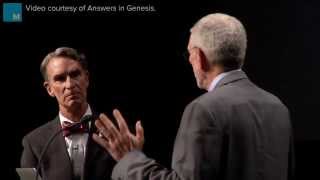
In this debate, Bill Nye and Ken Ham discuss the conflict between creationism and evolution, focusing on the interpretation of geological and fossil evidence. They disagree on the nature of scientific proof and the validity of a global flood as described in the Bible.
Nye claims people are indoctrinated to believe creationists cannot be scientists.
Both sides agree on observational science but differ on historical interpretation.
Ham's view of a worldwide flood influencing all nature is questioned by Nye.
Fossils do not cross layers, contradicting flood expectations of animals swimming up.
Both agree on rock types but disagree on time scales and gaps.
Ham emphasizes difference between direct observation and interpretation of the past.
Nye argues assumptions are based on previous experience, not arbitrary.
Ham asserts natural law hasn't changed and is consistent with a biblical worldview.
Ham says flood models can change, but the fact of the flood is fixed.
Nye asks Ham for a creation model that can make testable predictions.
The debate highlights fundamental differences in worldview: Nye demands testable predictions from science, while Ham relies on biblical interpretation as a basis for understanding nature.
What is the main disagreement between Bill Nye and Ken Ham regarding the Grand Canyon?
They agree on the rock types but disagree on how long it took for the layers to form.
01:10
According to Ken Ham, what is not subject to change in his model?
The fact of Noah's flood is not subject to change.
02:48
What challenge does Bill Nye pose to Ken Ham?
Nye asks Ham to come up with a creation model that can predict something that will happen in nature.
03:26
Fossil Layers Contradict Flood
Nye points out that fossils don't cross layers, which contradicts the expectation from a global flood.
00:55Nye's Challenge for Prediction
Nye's demand for a testable prediction from creationism is a key moment highlighting the scientific method.
03:26Ham's Admission on Models
Ham admits his flood model can change, but the fact of the flood is fixed, showing flexibility within his worldview.
02:48[00:00] We're seeing people in being indoctrinated to believe that creationists can't be scientists. There's experimental or observational science, as we call it. That's using the scientific method, observation, measurement, experiment, testing.
[00:13] All scientists, whether creationists or evolutionists, actually have the same observational or experimental science. Mr. Hamm and his followers have this remarkable view of a worldwide flood
[00:27] that somehow influenced everything that we observe in nature. A 500-foot wooden boat, eight zookeepers for 14,000 individual animals, every land plant in the world underwater for a full year.
[00:41] I ask us all, is that really reasonable? You'll hear a lot about the Grand Canyon, I imagine, also, which is a remarkable place, and it has fossils. And the fossils in the Grand Canyon are found in layers.
[00:55] There is not a single place in the Grand Canyon where the fossils of one type of animal cross over into the fossils of another. In other words, when there was a big flood on the earth, you would expect drowning animals to swim up to a higher level.
[01:10] Not any one of them did. If Bill Nye and I went to the Grand Canyon, we could agree that that's a Coconino sandstone in the Hermit Shale, and there's the boundary, they're sitting one on top of the other. We could agree on that,
[01:22] but we would disagree on how long it took to get there. But see, none of us saw the sandstone or the shale being laid down. There's a supposed 10 million year gap there, but I don't see a gap, but that might be different to what Bill Nye would see.
[01:35] But see, there's a difference between what you actually observe directly and then your interpretation in regard to the past. We're talking about the past when we weren't there. We didn't see those tree rings actually forming. We didn see those layers being laid down It like the dating methods You assuming things in regard to the past that aren necessarily true The fundamental thing we disagree on Mr Ham is this nature of what you can prove to yourself When people make assumptions they making assumptions based
[02:04] on previous experience. They're not coming out of whole cloth. I encourage you to explain to us why we should accept your word for it, that natural law changed just 4,000 years ago completely,
[02:22] and there's no record of it. Natural law hasn't changed. As I talked about, I said we have the laws of logic, the uniformity of nature, and that only makes sense within a biblical worldview anyway of a creator God who set up those laws,
[02:34] and that's why we can do good experimental science because we assume those laws are true and they'll be true tomorrow. We build models based upon the Bible, and those models are always subject to change. The fact of Noah's flood is not subject to change.
[02:48] The model of how the flood occurred is subject to change because we observe in the current world and we're able to come up with maybe different ways this could have happened or that could have happened,
[03:00] and that's part of that scientific discovery. You cannot ever prove using the scientific method in the present, you can't prove the age of the earth. so you can never prove it's old.
[03:12] So there is no hypothetical. What we want in science, science as practiced on the outside, is an ability to predict. We want to have a natural law
[03:26] that is so obvious and clear, so well understood, that we can make predictions about what will happen. And the big thing I want from you, Mr. Hamm, is can you come up with something that you can predict?
[03:38] Do you have a creation model that predicts something that will happen in nature.
⚡ Saved you 0h 03m reading this? Transcribe any YouTube video for free — no signup needed.