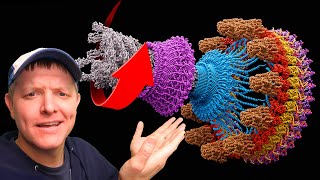

Mind-Blowing Molecular Motor
44sThe discovery of a rotating motor made of molecules sparks curiosity and wonder, making it highly shareable.
▶ Play Clip"Title accurately describes a rotating molecular motor powered by proton gradient, though 'electric' is metaphorical."
In this 300th episode of Smarter Every Day, Destin explores the bacterial flagellar motor, a complex molecular machine that spins like an electric motor. He visits Vanderbilt University to meet researchers who study this motor using cryo-electron microscopy, revealing its structure and function. The video discusses how the motor enables bacteria to move via chemotaxis and raises questions about the origin of such complexity.
Destin discovers an animation of a molecular motor and decides to investigate the flagellar motor, which spins and can reverse direction.
Destin meets Prashant, a Senior Research Associate at Vanderbilt, who published a paper in Nature Microbiology about the flagellar motor.
The bacteria's two membranes are compared to a submarine's outer hull and pressure hull, with the flagellum acting as a propeller.
The motor uses a proton gradient across the membrane, similar to water behind a dam, to generate kinetic energy for rotation.
Sensors detect chemical signals, triggering protein CheY to switch the motor to clockwise rotation for tumbling, while counterclockwise rotation allows straight swimming.
Bacteria use a run-and-tumble strategy, moving straight then tumbling to reorient, similar to pulse-width modulation control in missiles.
The basic structure of the motor has been known for 15-20 years, but recent cryo-EM has revealed atomic-level details.
The motor uses up to 11 MotAB stators that engage sequentially to increase torque, interacting with the FliG ring to change direction.
Dr. Tina Iverson explains that the lab studies how metabolism affects cell movement, including bacterial chemotaxis and antibiotic resistance.
New cryo-EM technologies allow visualization of large molecular assemblies intact, bridging the gap between individual molecules and cellular systems.
Samples are flash-frozen in vitreous ice, then imaged with transmission electron microscopes to capture 2D projections for 3D reconstruction.
Scientists transfer the motor's genetic instructions into E. coli, which then produces the motor proteins for purification and imaging.
2D classification groups similar particle images, which are then used to build a 3D model through iterative alignment and refinement.
Known protein structures (e.g., alpha helices) are fitted into the 3D density map to identify amino acids and interactions.
Disrupting motor interactions could lead to new antibiotics that avoid resistance by targeting the motor rather than traditional pathways.
The motor's irreducible complexity raises questions about evolutionary intermediates, with scientists studying related structures like the type III secretion system.
Destin encourages viewers to think critically about the motor's origin, recommending the book 'Where the Conflict Really Lies' and expressing awe as a Christian.
The flagellar motor is a marvel of molecular engineering, demonstrating how bacteria navigate their environment. Its complexity sparks debate about evolution and design, but Destin emphasizes wonder and curiosity over dogma.
What is the flagellar motor?
A molecular motor on bacteria that spins a flagellum to enable movement.
00:44
What powers the flagellar motor?
A proton gradient across the bacterial membrane.
04:15
What protein triggers clockwise rotation of the flagellar motor?
CheY (C-H-E-Y).
05:00
What is chemotaxis?
The process by which bacteria move toward or away from chemical signals.
07:28
How many MotAB stators can engage on the flagellar motor?
Up to 11, possibly 12 or 13.
10:21
What technique was used to determine the atomic structure of the flagellar motor?
Cryo-electron microscopy (cryo-EM).
15:09
What is the purpose of flash-freezing samples in cryo-EM?
To trap the sample in vitreous ice, preserving its native structure.
15:41
What is the first step in processing cryo-EM images?
Picking particles (selecting protein images from the micrographs).
19:40
What is the resolution of the initial 3D model mentioned?
8 angstroms.
21:17
What is the name of the book Destin recommends about science and religion?
Where the Conflict Really Lies.
26:50
Proton Gradient Power
Explains the energy source for the motor using an intuitive dam analogy.
04:15Run-and-Tumble Analogy
Connects bacterial movement to missile control systems, showing convergent engineering solutions.
07:55Sequential Torque Increase
Reveals a sophisticated mechanism where stators engage as needed, similar to a car's transmission.
10:09Irreducible Complexity Debate
Highlights the scientific and philosophical questions about the motor's evolutionary origin.
25:29Personal Reflection on Awe
Destin shares his personal perspective, encouraging open-mindedness and wonder.
26:50[00:00] This is the 300th episode, which is cool. I was just scrolling on my phone. But I came across this amazing animation that blew my mind.
[00:15] It's a motor that appears to be made out of molecules. When I saw this thing, I was like, that's a motor. That's a spinny thing that has a power source.
[00:29] It has an axel of some sort, and it is moving. can reverse directions, which is amazing. So I thought I've got to get to the bottom of this because the implications
[00:44] for a biomechanical motor are insane. Now, specifically, the thing this is called is called a flagellar motor. You may have heard of the flagellum on the back of sperm or on bacteria.
[00:56] A flagellum is that whipy thing in the the single cellular organism But I've never thought about that thing has to spin, which means it has
[01:08] It's just the implications are wild. So the more I got to reading about this flagellar motor is what it's called, the more I realized this is a really big topic, not only in biomechanics
[01:23] The complexity of a flagellar motor implies many things And I'm not going to answer that in this video, but it raises questions
[01:38] that people are debating, and they're talking about, how can this be? Well, You don't understand the time involved with how this came. So I just wanted to see it.
[01:51] I decided to go to the researchers that made the image, which is So I'm a Smarter Every Day. Just got in the car, drove to Vanderbilt, and we're going to learn
[02:05] Let's go get Smarter Every Day. So I bobbed and weaved my way across the Vanderbilt University campus till I Yeah, doing well. Nice to meet you.
[02:20] Prashant is a Senior Research Associate at the Iverson Laboratory at Vanderbilt. Just to give us whole context here, you have written a paper [D] Nature Microbiology.
[02:34] It's about a motor that's made of molecules that's on bacteria. Okay, can you show me where on a bacteria the motor is? If You see on the screen here, this is how a bacteria looks like.
[02:48] These two membranes protects the bacteria from getting disrupted. [P] If you see here, there will be The two membranes, the orange and the blue.
[03:02] [D] Okay, so it's almost like a submarine. I'm going to say a bunch of engineering terms because I'm an engineer. [D] It feels like a submarine with the outer hull and then the inner pressure hull.
[03:16] [P] Yeah, he was an Indian Navy submariner for 15 years. And is this the propeller of the submarine?
[03:29] Now, this submarine does not have a rudder. It doesn't have a rudder, but it uses a propeller to turn as well as swim. So what we see here, the two membranes that are here,
[03:44] [P] Yeah, it's filled with protons, hydrogen ions in here. [P] The hydrogen ions in here filled, and on the inside here,
[03:57] There's a It's a gradient. [D] Forgive me. When you say proton, you're meaning an atom that is lacking an electron? This is high concentration of protons in this region and low concentration
[04:15] Now, protons, every time there's a gradient, for example, there's a dam, water is up there, and there's a lower, or it could be used, that potential energy could be used to kinetic energy.
[04:30] [D] There's a potential difference of electrochemical force of some sort? That's the gradient that this motor uses to turn itself. What happens is, if you see here, this flagella, which is a propeller,
[04:45] [D] How does it know when to turn the motor on? [P] There are sensors on the outside of the bacteria. Once it knows that there's a threat or there's more energy near me,
[05:00] it senses that it gets a chemical signal, and there's a cascade One of the protein well known for this is called CHeY, C-H-E and Y, capital Y, QY.
[05:14] The moment it senses that I need to run away from this location or I want to go and it encourages the motor to turn in clockwise direction.
[05:28] said because you just created a coordinate system inside the bacteria. Well, it already exists.
[05:40] Somehow the bacteria knows how to trigger what motor on what side of the bacteria.
[05:52] [P] Yes, and how to turn it. [D] And which direction to turn it? So that particular protein it will make it go in clockwise. When it is not attached to it, it will go in counterclockwise.
[06:08] When the motor turns counterclockwise- [P] From the outside, yeah. [D] The outside, okay. And when the motor is running in counterclockwise,
[06:22] So it's just the board goes straight. If I were to design this, I would say that would have to do [P] Yes.
[06:35] So when it starts rotating, it thrusts, the force goes backwards Now, you would think that it would also do the same thing when it's going
[06:47] [P] Now, what happens is when it's going in the counterclockwise, there are All of them start forming a bundle, and multiple propellers form into one big
[07:02] propeller and pushes this straight and it goes boom, straight. I need to reanalyze my situation gradient, I need to test, I need my sensors
[07:14] When it does that, the bundle opens up. When they open up, it just pauses the whole bacteria and It no longer has a certain…
[07:28] [P] Yeah, chemotaxis. Chemotaxis, yeah. We call this whole process of bacteria's mobility like chemotaxis. It's a chemical signal that allows the bacteria to taxis or move
[07:41] Everything happens in milliseconds. and it's just like crashing. Researchers have done this experiment.
[07:55] and put bacteria on the edges of it. You would think the bacteria would go straight to the food, but no, it just goes direction, realizes, Oh, I'm in the wrong direction, goes back.
[08:09] [D] I'm getting emotional now because there's a missile that I've worked on in the past, and it has what we call pulse-width modulation control. and we dither them. We go like that.
[08:26] And then all we do is we bias the dithering up or down. So it's constantly moving, but we just bias it just a little And so what took us a long time to figure out, you're just describing it.
[08:45] It has sensors. It has effectors. And I'm getting emotional.
[08:59] [P] It is. Over the years, this design has evolved to be so perfect. It just takes some time, but it does go where it's supposed to go.
[09:11] It figures out by sensing and moving in directions. Emergent behavior? [D] The structure of this motor, is it well known in the community?
[09:24] In all of research, people know about this? Basically, if I blur this up, they have known that for 15, 20 years. There's a ring at the bottom, there's a ring on the top.
[09:40] each and every amino acid. [D] I noticed on your video, it's almost like a big gear and a small gear. That is what the proton comes through, and that's what turns this thing.
[09:56] [D] Prash explained that the MOT-AB, the little part that spins like an ion pump, is able to interact with this band of red called Fly-G, and that has the ability to pivot 180 degrees, which enables
[10:09] So in your animation, you have one small gear going in. [P] It can employ more if it needs more torque.
[10:21] Up to 11 is what we see can fit on there, but maybe 12 or 13 as well. But it is a sequential increase depending on the load of the flagella.
[10:36] If you have a torque, you have to have a thing to react against. What did you call it? Mot AB.
[10:49] [D] Mot AB. [P] Yeah. [P] Yes. [P] It's also in this inner membrane.
[11:03] So there's multiple colors that you see, orange, cream, and green. And it takes protons or hydrogen ions from the top and goes
[11:15] And as it's doing it, it makes interaction with this red protein here. [D] Okay, but it's pinned in that wall.
[11:27] and it can shift a little bit in and out. It cannot go in two directions. So how does this motor go in two directions?
[11:41] And that does because the MOT-AB, first it's outside, but when it has to go in the other direction, the red protein turns 180 degree, pulls the MOT-AB with it, and then MOT-AB keeps doing what it's doing.
[11:54] [D] It's like shifting into reverse in a manual transmission car. [P] Yeah, it's almost like back to you has a reverse gear. It reminds me of my motor that my grandfather worked on where
[12:09] there's copper coils that he's making, putting in these old, rebuilding these It reminds me of that structure. He used to build and rebuild motors for factory at factories.
[12:25] [P] Yes, it is. It feels very rewarding to be working on something Obviously not the same scale, not the same thing.
[12:40] But just to know that I'm working on motors is fun. We're going to go back and talk to Prash later to understand how he to Dr. Tina Iverson, who runs this lab.
[12:57] This is Dr. Iverson, and this is your lab, right? That's a big deal. And simply put, what have you found here?
[13:09] [T] So we are looking at really this nuts and bolts of how bacteria can move, how they can move toward something that attracts them, like a food source, and how they can move away from something that would kill them, like an antibiotic.
[13:24] Bacteria are moving toward a food source as driven by their metabolism. It's how you bring in energy into your body. But we're asking that question at a larger level, not just for bacteria,
[13:40] How does metabolism affect what our cells do in a way that dictates And so we were trying to understand just at a general level, why does
[13:54] [D] I feel like every time we as humans have the the ability to see smaller or farther. [D] Do you feel that? [T] Oh, yeah.
[14:06] I think that one of the ways the entire field is going now is there's been this ability to image very small things with fine detail,
[14:18] but medium and larger things in the cell with more blob-like characteristics. Some of the new technologies are now getting to these larger assemblies
[14:30] [D] So we're seeing the overall system. [T] Yes. So before we were putting the system together from component parts, and now we're seeing the system more and more intact.
[14:42] And these bridges between the molecules at an individual level, which can But molecules together working in concert tells us much, much more. [D] So we've got this motor that for the first time we can see an image
[14:57] How is Prash able to see this motor and understand its component parts To answer this question, Prash took me over to the imaging lab
[15:09] where they use a series of cryo-electron microscopes to look at the structures He introduced me to Miriam and Scott, who were kind enough to show me around. Am I saying that correctly? [S] Sure.
[15:24] So all of our sample goes onto a grid that's right here. It's a mesh work on there. [D] What's it made out of? There's some other materials that we use for other various niche purposes.
[15:41] [M] You have whatever sample you have that's in a buffer. You literally just drop it in, drop your sample into liquid So your sample is in vitreous ice.
[15:55] with protein trapped in it. And then after plunging, then we load it into that little... So we'll walk in and look at it. So this is the Glacius.
[16:12] [D] So this is like a quick look. We have a source at the top that transmits an electron beam all [D] So you're shooting through it? [S] We're shooting transmission.
[16:26] [D] The process that the scientists use to get these images is incredible, sophisticated animation style. All right, so there's two types of bacteria at work here.
[16:42] Now, Salmonella, that's where the flagellum motor is located. So that's the flagellum, and that's the little motor. Ecoli, a different bacteria, has a little factory in it that can
[16:57] So So this process is called transformation. So basically, I just took that motor off, and I'm not going to put the motor itself I'm going to put the instructions of how to make the motor into Ecoli.
[17:15] but this is the one that the scientists chose to 3D print this particular motor. This little factory goes to work, right? It makes a bunch of these little motors, and then you have a bacterial cell
[17:32] The act of creating this is called expression. called purification. We're going to pop this and we're going to use this grid and we're going
[17:47] to basically dump all of the stuff that's been purified onto this grid array. And then after that, we're going to use this really fancy 200 to look at the grid.
[18:02] So this is like a course view of what we're doing. there's one right there. That's important. And then you're going to go all the way through this whole grid, look
[18:16] How many motors does it have? It might be a lot. You're then going to move it over to the big microscope, the 300 KVA microscope. So what they do is they zoom in, and then they're going to take 50
[18:32] frames of each individual little motor. type level, like the atomic level. So you have to take 50 images in order to compile that together, you have
[18:47] So at that point, you then have an image of a structure. it could be like this, it could be at any number of different aspects.
[18:59] Before we talk to Prash, if you want to learn more about microscopy and how the scientists do all this, I've got way more information over Go check that out if you want to learn more about this.
[19:14] [P] So when you get the images from the microscope, they look somewhat like this. Is that the bottom of a motor?
[19:26] So I would say that this is how it looks. Then this view right here is a side view, something like this.
[19:40] We click on all of these particles, meaning we pick those proteins We run a program of 2D classification, meaning we run a program where all these
[19:52] particles that has been picked so far are similar-looking particles are What we see here is some are just junks, and some are actually [D] You go through there and you pick the ones that are the good stuff.
[20:07] This is a good complex. We don't select those, but select the good particles and put them
[20:20] We have 2D classes. Once we have 2D classes, we put them together here to get a 3D version. You make these shapes actually match up. [P] Yes.
[20:35] Each of those classes on pictures that we saw, we start matching them up as and program starts doing matching those up, and it does a very That's the secret sauce.
[20:50] You have the transformation, putting that information into Ecoli That's expression and then purification. Transformation, expression, purification, that's how you get it done.
[21:03] [P] Once we get the 3D model, it looks something like this. Now what we see is a low-resolution model. We try to collect all the good signals and remove all the bad signals and try to
[21:17] What you see here is an 8 angstrom. to get there, 2-3 weeks. [P] Get to the high resolution.
[21:29] and mapping the proteins. [P] Yes, exactly. the puzzle pieces in, and try to find what protein, So since we know the sequence of the protein, we have the pieces.
[21:45] [D] So we have these 2D images that we wrapped together using software into a 3D model. which are made up of amino acids.
[21:58] And so the question I had is, how do you know what chemical is where? And it's my understanding that biochemists are just smart, and they know that certain amino acids are shaped in certain ways, like physical shapes.
[22:10] So they're like, oh, here's blobafil, or here's quadraline. I don't know these words, but they can physically put the puzzle looks like, which is incredible.
[22:25] [D] The coil. [P] The coil, and that's alpha helix. This coil, now we know alpha helix, only certain amino acids make in a certain So this prior information helps us trace this puzzle.
[22:43] So if you see now, We can fill these gaps with these proteins. [D] This is a shape a biochemist person would not be intimidated by this shape. It's commonly found in almost every protein.
[22:57] looks like a bunch of squiggles. [D] This is easily interpretable data. [P] Yes, it is. Is that what just happened?
[23:12] Our previous researchers have mapped this in the past. We use the information as like, Oh, they have done part of this. If it does, it's good. If not, we go in and do it by hand.
[23:28] It can take weeks to months sometimes, depending on how big your protein is. This is what we have been doing all the work for.
[23:42] So now we come back and sit down, drink our coffee, and we're like, Oh. So for example, I can go here and be like, Let me see if there's So there's a definite interaction between this and this.
[23:59] They're forming some bond between two amino acid. So this is what gets us excited that we have found the interaction that are And if we disrupt this, this can disrupt this can disrupt the motor.
[24:16] This can disrupt the connection it's having or interaction it is [D] Once you disrupt this motor, if you could destroy the motor or if you could then you could start to do things that would affect the chemotaxis?
[24:34] [D] You could disrupt the ability for the thing to move where it wants to go. For infection, stopping the bacteria is almost like having an antibiotic, but not with an antibiotic, because bacteria can get resistant to antibiotic.
[24:49] [D] Maybe you get to invent a new word. [both laughing] [D] Thank you very much. [P] Thank you so much.
[25:02] [D] So the flagellar motor exists, and it's amazing. It's complex, and it reminds me of an electric motor, and I love it. I love this thing, and I think it's incredible.
[25:14] There are implications for the fact that something so complex exists and is I mean, this is fascinating stuff. So it also opens up a huge debate.
[25:29] People say, well, how can something this complex come to be out of nothing? If this motor system is composed of complex individual parts, and all these parts work together to perform the overall function
[25:42] Did it all have to happen at the same time? intermediate stage of development? Is 15% of this motor advantageous to the cell?
[25:57] What were the steps these components took to assemble into such a complex Scientists are trying to figure this out, and I encourage you to read their papers.
[26:10] which works like a hypodermic needle that a cell can use to inject other things. This device looks similar, but it's quite different in its protein structure.
[26:22] The complexity and origin of the bacterial flagellar motor is a really As I was a younger man, and I would read things on the I would People say, Hey, you got to believe all this over here.
[26:36] You're either in one camp or the other. And the more I have matured and started to not really care about defending where
[26:50] matter where they are. I'm still working on this. I can't speak for everything in the book. I'm not done with it. It's called Where the Conflict Really Lies.
[27:04] It talks about this interplay between science, religion, naturalism. It goes more into the areas of philosophy, and I love it because it challenges me,
[27:16] If you have your flag in a camp somewhere, I would encourage you I would encourage you to look at a flagellar motor
[27:29] and just think about it and think about how it is and what it be. It's a fantastic thing to think about. How did this get here? You have intelligence and you get to make up your mind.
[27:42] And I love that about consciousness. I love that about life. I feel joy. and you see all these stars and you feel small and you feel wonder,
[27:58] I feel awe and reverence toward this thing. And as a Christian, this makes me want to thank God that it exists. So that's just where I'm at.
[28:14] You have a brain. Don't defend a flag. And I hope you are very happy and experience the same joy I feel about
[28:27] So anyway, enough about that. I want to say thank you to everybody that supports Smarter Every Day on Patreon. I just wanted to make this for you, and I just want to say thank you
[28:43] to everybody that supports at Patreon.com/smartereveryday. I'm just going around asking questions, and that's all these videos are. So thank you for supporting Smarter Every Day to allow me to do this so long.
[28:59] to consider supporting at Patreon.com/smartereveryday. And if that's not your thing, totally cool with it because I'm having fun and I'm grateful to all of you. Thank you for watching.
[29:14] If you'd like to learn more about the deep detail of all this stuff, how all this works, but I love it. I'm Destin. You're getting Smarter Every Day.
[29:31] Have a good one. Bye.

⚡ Saved you 0h 29m reading this? Transcribe any YouTube video for free — no signup needed.