
Why Share Buybacks Are a Scam?
60sChallenges the common belief that buybacks are equivalent to dividends, sparking debate.
▶ Play Clip"The title is accurate and the content delivers exactly what it promises, with a clear and detailed explanation."
This talk by Magnus Peterson explains the basics of share buyback valuation. It challenges the common belief that buybacks can substitute for dividends and demonstrates, with a simple example, how the value to eternal shareholders changes depending on the market cap relative to the present value of future earnings.
Instead of paying a dividend, a company can buy back shares, which decreases the number of shares and increases the potential for future dividends per share.
In 2012, S&P 500 companies had aggregate earnings of $780 billion, paid out $280 billion in dividends, and had $400 billion in share buybacks.
The common belief that buybacks can substitute for dividends and signal undervaluation is false.
A company with $10 cash and $90 present value of future earnings has a total value of $100. If the market cap is $50, management believes shares are undervalued and does a $10 buyback.
After the buyback, the company's cash is $0, the present value of future earnings is still $90, and the total value to long-term shareholders is $90. The market cap becomes $40.
If the company loses its source of revenue, the value to eternal shareholders is only the cash holdings of $10. The buyback would lose all the value to eternal shareholders.
The relative value of a share buyback is calculated using a formula that compares the value to eternal shareholders to the market cap.
The relative value is a non-linear function of the value to eternal shareholders and the buyback amount.
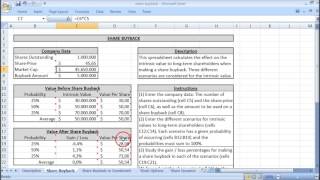
With V=$100, buyback=$10, and market cap=$50, the value to eternal shareholders increases by 12.5%.
With V=$40, buyback=$10, and market cap=$50, the value to eternal shareholders decreases by 2.8%.
The gains are smaller than the losses because of the non-linearity of the function. A buyback magnifies any mispricing.
The value of a share buyback depends on the market cap in relation to the present value of future earnings. A buyback of overpriced shares is more destructive than a buyback of underpriced shares.
Because the future is unknown, a margin of safety is needed when buying back shares.
S&P 500 Buybacks vs Dividends
Provides a concrete example of the scale of share buybacks, showing they are a major way companies return capital.
00:18Buybacks Don't Signal Undervaluation
Challenges a common belief, setting up the core argument of the talk.
00:58Quantifying Buyback Value
Introduces a practical formula for calculating the impact of a buyback on shareholder value.
10:38Non-Linearity of Buyback Value
Explains why the losses from an overpriced buyback are larger than the gains from an underpriced one.
13:47[00:00] Hello, my name is Magnus Peterson. This talk is about the basics of share buyback valuation. Instead of paying a dividend, a company can buy back shares. This decreases the number of shares and hence increases the potential for future dividends per share.
[00:18] The question is, which is more valuable for shareholders? To demonstrate how important this is, in 2012, the companies in the S&P 500 had aggregate earnings of $780 billion.
[00:34] They paid out dividends of $280 billion, but they had share buybacks of $400 billion. So it's very important that we understand the effect of share buybacks
[00:46] on the value for shareholders. The common belief is that share buybacks can substitute for dividends as a way of returning capital for shareholders, possibly with a tax advantage.
[00:58] Another common belief is that share buybacks signal undervaluation. These beliefs are false. And this is proved by a very short example.
[01:10] Let's assume that Ackner Corporation has $10 in cash. The expected present value of future earnings is $90. So the total value to long-term shareholders is $100.
[01:23] The market capitalization is $50. So the management of Atomic Corporation believes that the shares are undervalued and they decide to make a share buyback for $10.
[01:36] Then the company's cash is $0 and the expected present value of future earnings is unchanged, so it's still $90. The total value for long-term shareholders is $100 minus 10 that we use for share buybacks,
[01:52] so it's $90. And the market cap, assuming the share price is unchanged, becomes $50 minus $10 equals $40.
[02:04] What happens if the company loses its source of revenue and earnings? Well, we used $10 for share buyback, so the company's cash is still zero.
[02:18] But now the expected present value of future earnings is also zero, because the revenue and earnings are gone. So, the total value to long-term shareholders is also zero, and presumably the market cap goes to zero as well.
[02:33] So, which choice was best for the remaining shareholders? A dividend payout of $10 that would have been worth $10 to shareholders, or the share buyback of $10 which turned out to be worth $0 to shareholders.
[02:49] So, this example clearly demonstrates that dividends and share buybacks are not equivalent. Before we can value share buybacks, we need to define the value to whom.
[03:02] The argument here is that share buybacks should be made for the sake of the remaining shareholders rather than the selling shareholders. This ultimately means that share buybacks should be made for the sake of eternal shareholders who never sell their shares and rely on dividends as a sole source of value.
[03:20] The value without a share buyback is the potential for dividend payouts. That is, the excess cash plus the present value of future earnings that are available for dividend payouts.
[03:33] Mathematically, we can write it like v, small v, excess cash plus summation of time equals 1 to infinity of earnings time divided by the discounting and we can divide it by the number of shares and multiply it by the
[03:57] remainder of the taxes dividend taxation then we get the capital v which is the value per share after dividend tax. There are two valuation effects of a share buyback.
[04:09] The first is a reduction in the cash available for dividends. The second is a reduction in the number of shares. We write the value per share after dividend tax
[04:21] with a share buyback as a capital W. And it is the value to eternal shareholders minus the amount used for the share buyback
[04:34] and multiplied by the dividend tax divided by the number of shares and the reduction in the number of shares.
[04:46] This transformation of value is very important to understand. So I'm going to go through a few steps so you can see the reduction in the number of shares, how that is derived.
[04:58] The total market price or market capitalization of all shares equals the number of shares multiplied by the share price. This is equivalent to having the share price equal to the market cap divided by the number of shares.
[05:17] So the number of shares bought back is the buyback amount divided by the share price. If we use the above definition of share price, this one here, plug it into this formula down here, we get this result.
[05:35] We should check that this is correct. This is the number of shares before the buyback. Then we subtract the number of shares actually bought back. And then the number of shares after the buyback equals this.
[05:49] The relative value of a share buyback is the value of a share buyback relative to a dividend payout. This is W divided by V, that is the value with a share buyback divided by the value without a share buyback.
[06:09] And we simply use the definitions from the previous slides, plug it in and reduce, and we get this result. you should note that this is a non-linear function in the buyback and market cap.
[06:25] The equilibrium is where the value to the turn shareholders is unaffected by a share buyback and mathematically we write that as the value with a share buyback, W,
[06:38] equals the value without a share buyback, V, and again we just use the definitions from the previous slides and we reduce, and the result is that equilibrium is when the market cap equals the value to
[06:53] eternal shareholders without a share buyback. Usually, we write this as an inequality so that we can see the condition for increasing the value to eternal shareholders.
[07:07] This is an example of a small mispricing. So we have the market cap, the market value of all the shares, and then we have the actual value or intrinsic value to the internal shareholders,
[07:20] which in this case is assumed to be 95 of the market cap So the intrinsic value is slightly less than the market cap Then we want to make a share buyback for 20 of the market cap So the dark gray area is the amount of shares we want to
[07:39] buy back. The value to its own shareholders or the intrinsic value is decreased by the same amount, but because the intrinsic value is slightly less than the market cap,
[07:52] remember 95% of the market cap, the buyback amount is actually almost 21% of the intrinsic value. So after the share buyback, we remove these dark gray areas
[08:04] and what we have left is the market cap and the value to return shareholders, which is now only 93.75% of the market cap. So the mispricing has become slightly magnified.
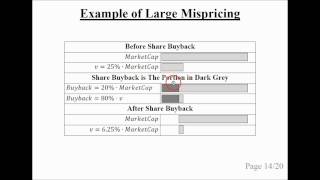
[08:20] This is an example of a large mispricing. We have a market cap here, but now the value to eternal shareholders is only 25% of the market cap.
[08:33] If we want to make a share buyback for 20% of the market cap, it is this dark gray area, and it is now 80% of the value to eternal shareholders. So it is a very large portion of the value to eternal shareholders.
[08:51] After the share buyback, we have removed the dark gray areas. This is the part of the market cap that gets removed, and this is the part of the value to eternal shareholders that gets removed from the share buyback.
[09:04] So now the market cap is this big, and the value to eternal shareholders is this tiny portion here. and again the mispricing has been greatly magnified
[09:17] because it was large to begin with but it's even larger now so before the share buyback the value to return shareholders was 25% of the market cap but now it's only 6.25% of the market cap
[09:31] so the share buyback magnifies any mispricing we can draw the relative value of a share buyback by normalizing the market cap to equal 1 we let the value to eternal shareholders D go from 0 to 2 and we let the buyback amount go from 0 to 1.
[09:53] We basically just use the equation from the previous slide for the relative value of the share buyback and we change these values and plot the results. And what we see is a nonlinear function.
[10:09] and we can take out a small section of this like so. Here we have set the buyback amount to equal 0.4 and again we have the value to eternal shareholders
[10:24] going from 0 to 2 and we get this non-linear function of the relative value of the share buyback. Now we have the tools to actually quantify how much a share buyback changes the value
[10:38] to eternal shareholders. We will again take the example for Acme Corporation and let's first assume that the value to return shareholder V is actually $100.
[10:53] So we use a formula for the relative value and we plug in the buyback amount of $10 and the value V of $100 and the buyback amount again and the market cap of $50.
[11:07] calculated and it comes out to 112 So that means if the value to the eternal shareholders is really before the share
[11:20] buyback, then the share buyback for $10 at a market cap of $50 would increase the value to eternal shareholders by 12.5%.
[11:32] Now let's look at what happens if the value to the current shareholders is actually only $10. And this corresponds to the previous example where we find out that the source of revenue
[11:45] and earnings disappears so we only have the cash holdings of $10. So again we plug in the numbers and the formula for the relative value and we get 0%. That means we have lost the share buyback would lose all the value of the company to
[12:02] eternal shareholders. So these were a bit extreme examples perhaps but let's take a few other examples and let's say we have a market cap of $50 still and in the first example the actual value to eternal
[12:20] shareholders is $60 which is 20% more than the market cap. say the buyback amount is $5 again we plug in all the numbers in the formula for the relative value and we get out the number 101.9% which means that
[12:35] the value to eternal shareholders is increased by 1.9% so let's see if the value is actually 20% less than the
[12:48] market cap so the value of V the value to eternal shareholders is $40 but the market cap is $50. Again, we plug in the numbers in the formula and we get out the result 97.2%.
[13:01] And this means that the value to eternal shareholders is decreased by about 2.8% from this share buyback. And you will note that the difference, the loss here is greater
[13:18] than the gain. And that has to do with this curve. So in this case, it would be $50 here. And if V is actually slightly above here,
[13:33] the gain in shareholder value is about this big. But if the actual value to the current shareholders is slightly less, then the relative value is a greater loss.
[13:47] So it is because of the non-linearity of this function and the shape of the function that the gains are much smaller than the losses.
[14:00] So to summarize, the value of a share buyback depends on the market cap in relation to the present value of future earnings. A share buyback magnifies any mispricing. Buyback of overpriced shares is much more destructive to shareholder value than buyback of underpriced shares.
[14:21] Because the future is unknown, we need a margin of safety when we buy back shares. This talk is based on two papers. The first one is a fairly short introduction which has the main aspects of the theory, the main formulas, a case study, and so on.
[14:41] The treatise is quite long and it has many different valuation formulas and case studies and so on. They are both available on the internet on this website and you can also find the links in the description of this video.
⚡ Saved you 0h 14m reading this? Transcribe any YouTube video for free — no signup needed.