
FDA Approved OTC Hearing Aids: Game Changer?
46sHigh controversy and educational value about the FDA's 2022 approval, offering a quick landscape overview that challenges traditional hearing aid costs.
▶ Play Clip"Delivers a thorough review and tutorial as promised, though the 'best invisible' claim is subjective and the video includes some filler."
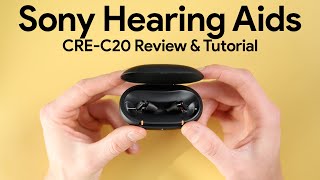
This video reviews the Sony CRE-C20 over-the-counter hearing aids, covering their features, setup process, sound quality, and overall value. The creator highlights the FDA's 2022 approval of OTC hearing aids and compares these premium devices to cheaper alternatives and AirPods.
Before 2022, options were limited to doing nothing or seeing an audiologist. The FDA approved over-the-counter hearing aids in 2022, opening up new options including cheap Amazon devices, AirPods, and premium OTC aids like the Sony CRE-C20.
The Sony CRE-C20 is a premium OTC hearing aid. It comes with a charging case that holds three recharges, providing 28 hours of total use. The case has USB-C and Qi wireless charging, and the aids are IP68 water resistant.
The hearing aids use an ear-to-ear wireless link for good sound sync and have an automatic adjusting microphone for clear hearing even in noisy environments.
The box includes the hearing aids, a manual, multiple silicone tips (XS, S, M, L), a USB-C cable, a brush, and a microfiber cloth. Sony offers closed and vented sleeve options for different sound and feel preferences.
The Sony Hearing Control app guides users through a hearing profile test, playing beeps at different frequencies and volumes to create a custom prescription-grade sound profile.
The CRE-C20 are not Bluetooth earbuds; they only function as hearing aids. For music or calls, consider the CRE-C10 model. The app provides volume, balance, and fine-tuning controls.
The hearing aids are very small and discreet, though not skin-matched. They are comfortable for hours and don't interfere with glasses or hats. They sit deep in the ear and are unlikely to fall out.
The aids communicate with the phone via a high-pitched audio signal rather than Bluetooth, which may be audible to the user when adjusting settings.
Sony offers free unlimited support via the Sony Hear team. The CRE-C20 costs around $900-$1,000, significantly cheaper than audiologist-fitted aids, and is HSA/FSA eligible.
Cheaper Amazon options may be low quality; ensure they are FDA cleared. AirPods Pro 3 can act as hearing aids for $250 but are larger and look different.
The Sony CRE-C20 offers a solid, discreet OTC hearing aid solution with good sound quality and customization, though it comes at a premium price. It's a viable option for those with mild to moderate hearing loss seeking an alternative to audiologist visits.
What year did the FDA approve over-the-counter hearing aids?
2022
00:14
What is the battery life of the Sony CRE-C20 with the charging case?
28 hours of listening or use
01:48
What is the IP rating of the Sony CRE-C20?
IP68 water resistant
02:32
What app is used to set up the Sony CRE-C20?
Sony Hearing Control
04:03
Do the Sony CRE-C20 hearing aids support Bluetooth audio from a phone?
No, they only function as hearing aids, not Bluetooth earbuds.
05:47
What is the approximate price range of the Sony CRE-C20?
$900 to $1,000
10:32
What is the communication method between the phone and the hearing aids?
A high-pitched audio signal, not Bluetooth.
09:09
FDA Approval of OTC Hearing Aids
This regulatory change opened the market to new options, making hearing aids more accessible.
00:14Custom Hearing Profile
The app creates a prescription-grade sound profile based on individual hearing, a key feature for personalization.
04:42Discreet Design
The small size makes them nearly invisible, addressing a common concern for users.
07:49Cost Comparison
At $900-$1,000, they are significantly cheaper than audiologist-fitted aids, making them a viable middle-ground option.
10:32[00:01] actually illegal. These are over-the-counter hearing aids. You see, until a few years ago, the landscape was a lot simpler. You either did nothing a lot simpler. You either did nothing for $0, or went to an aiologist, spent a
[00:14] appointments until you had hearing aids that actually function. But in 2022, the FDA approved over-the-counter hearing aids in the United States, which open up the landscape to three new options. You've got the cheap Amazon junk, which
[00:28] kind of gives over-the-c counter hearing aids a really bad reputation. Many people buy them for $100 or less, and they're very disappointed by the AirPods. I'll talk more about that later, but they're not really designed
[00:41] premium over-the-counter hearing aids like these. So, in this video, I want to do a bit of an overview or a review of these hearing aids and tell you more know about them, and decide if they're
[00:54] video is a little bit different than most of my content. So, if you don't anyone who needs hearing aids, my only request is that you please click the get buried and other people can watch it. My hope is that this content can
[01:07] life by learning more about over-the-counter hearing aids. So, for have hearing loss or you know someone with hearing loss, this could be a really great option for you. So, these are the Sony CRE C20. Sony makes several
[01:22] models of hearing aids. I believe two or three different models. And this one, over-the-counter hearing aids. They're here, they fit in this little case. And the actual hearing aid is quite tiny, so
[01:36] about visibility when you're wearing them a little bit later. But on the back of the case, you'll see a USB type-C port. So, this holds three recharges in here. So, if you're traveling uh for, you know, the weekend or something, you
[01:48] way to not only hold the hearing aids, but also recharge them. and you get 28 hours of listening or use uh with this case and with the hearing aids. So, just set this on your bedside, keep it plugged in all the time, and then every
[02:02] night, just put them in the case, and they'll recharge for morning. And you'll front, so it'll tell you the battery level. You've got a little LED indicator can put into pairing mode. And on the back, like I said, USB type-C, but this
[02:16] also hasQi wireless charging, so you can set this on a wireless charging pad and way you could maybe use this next to your bed without having to find maybe that little port right there. So, setting this down is a very easy way to
[02:32] charge it. It's also worth noting that these are IP68 water resistant. So, if them out when you're showering or maybe if you wear them and it starts raining outside, these should be absolutely fine with water contact. These use an
[02:45] eartoear wireless link, so they should sound really good, very well synced and uh they have an automatic adjusting microphone. I'll talk about that later in the video. And they really do give you some pretty clear hearing even in
[02:58] off by talking about how these work and how these fit. So, each hearing aid, you probably hard to see on camera there. It's honestly a very tiny unit itself. And you've got this little silicone
[03:10] several different ones that come in the box. So, let me open up the box. I'll course, you've got the manual. It tells you about the app. And I'll show you the setup in just a second. Then you have this little pack of the different sizes.
[03:23] So, extra small, medium, large. It comes with small already on there. So, four different sizes. You have, of course, a USB type-C charging cable here. It's also worth noting that Sony has both closed sleeve and vented sleeve options
[03:36] depending on how you want it to sound and feel in your ear. You get a small brush, a microfiber cloth for cleaning these. I believe that's my other tip actual hearing aids, you can see they have a small white outline there. I'll
[03:49] shows you where you're supposed to line up that rubber tip. So, you find the one test on the app when you first set it up right fit. But the app you'll be using is called Sony Hearing Control. And when
[04:03] you first set it up, it'll have you do a hearing profile test. So, you put in right one. And I'll demonstrate right now. So, I'll put the right one in my ear, which by the way, you want it to kind of It says right and left. and you
[04:15] want the stem pointing down. It kind of goes in your ear almost the opposite way I initially expected it to. So now I can say, do you hear the confirmation beep? beeps in different frequencies in different volumes. So this probably
[04:29] set these up, but you'll see it plays beeps. It'll ask you how many beeps you you heard zero, you heard one, you heard whatever. Um, and obviously you don't you heard more than you did. If you
[04:42] to say that so it can make a custom hearing profile for you. And this is going to actually make a prescription grade sound quality hearing profile based on your own hearing. So if you were interested in buying these, you can
[04:54] buy them from Sony's website. I'll have a link down below. Those links help to support the channel at no cost to you or you can find them on, you know, several other websites out there. But one thing to note is if you buy it on Sony's
[05:06] website, it is HSA and FSA eligible. So, if you have a health savings account, uh these. So, once you're done with that hearing test, it will then apply the hearing profile to the left and to the right. You see it's applying it to the
[05:20] right right now. We'll say yes. We'll say continue. And now you can adjust the dullness. You can say, "All right, it sounds good, but I want a little more volume in the right ear." We can then say continue. And they make this app
[05:34] very large text everywhere. Just simple buttons. Not a whole lot going on here. So, let's say done. And now we could just have general volume control right here. So, if we can make them louder or we can make them quieter if we wanted
[05:47] to. But one thing to note is that these are not Bluetooth earbuds. These will not play the audio from your phone. These are only functioning as hearing aids in your ears. There is a different model, the CRC C10, I believe, that does
[06:01] also work as an earbud. So, if you want to listen to music or podcasts or watch videos on your phone, you can do that. But with these, like I said, you're not going to be getting Bluetooth audio from your phone. They're just functioning as
[06:14] you'll see not only do we have volume, but we also have the sound balance. So, if you want it to sound a little more sharp or a little bit less sharp, you can adjust how that sounds right there. And on the top left, you can tap on that
[06:27] little hamburger icon there, the menu. And of course, we've got remote control, which is where we just were. You've got fine-tuning. So, if you want to adjust the hearing aid, you can do that by tapping okay or continue. We could do
[06:39] some fine-tuning. And you could say, all right, I like the way this sounds, but I really want to focus more on maybe speech. Maybe speech is not quite good. And you could say speech is right now a little bit too soft. So, you could then
[06:51] settings. So, we could say, all right, here try this solution. Try this And you can listen to people talking and say, "Oh, that fixed the problem. We're good." Or you could try different solutions. So, it adjusted it and it
[07:05] that right now. That's a wild difference. I'll say yes. And we can ways you can fine-tune things. You don't always have to, you know, go, you never Um, but it's kind of a nice feature they have there. Going back to where we were,
[07:21] I'll say leave. We can tap on the little menu icon on the top left. Hearing a into settings, you've got a couple basic things right there, but not really much on the top right, you have a battery with a question mark. So, that's going
[07:35] say tap to check the battery. It'll give you a number of beeps. So, three beeps what mine just gave me. It beeped three times in my ear. Same thing with the right earbud or right hearing aid. So, it looks like we're good on battery. So,
[07:49] let's talk about the aesthetics of these earbuds. These are not skin matched in visible than some other options out there. But that said, they are incredibly small. So, it really is quite hard to see unless you're looking
[08:02] directly from the side. Anyone in front of you or behind you is very unlikely to small enough that I don't think anybody would ever really find them intrusive or uncomfortable. I've worn these uh for several hours and I had no problem with
[08:16] even in your ears. And with the many different fits, I think a lot of people will find them very comfortable. As far as the sound quality goes, as somebody who does not have hearing loss, I'm definitely very sensitive to the audio
[08:28] quite good. Your voice may sound a little strange. Anytime you're wearing hearing aids, hearing your own voice is going to be a little bit odd. It might sound slightly muffled or a little bit uh kind of tunnly, but other voices
[08:41] just sounds like what you would normally hear, but significantly louder, own hearing profile. Another positive with the Comfort is that these don't go that you're not going to have any interference with glasses or hats or
[08:57] hard to, you know, accidentally pull these out. These are pretty deep in your ear and you really have to go in and actually grab them intentionally to take big positive there. If we're getting into some of the negatives, one is that
[09:09] they don't seem to use Bluetooth. They use kind of an audio communication And I'll show you an example right now. If I change the volume or really any setting on my phone, my phone speaker will make a really high-pitch like kind
[09:22] and that's how it communicates to the hearing aid. So listen to this. As far as the little tip on here, it does seem to stay on really quite well.
[09:37] I was originally worried like what if that got stuck really deep in your ear, time I've put these in and taken them out, that tip never even comes loose. It loose. And so I'm not particularly worried about that. As far as any
[09:51] questions or assistance with these, Sony does have a full-time dedicated team, the Sony here team as they call it, which is free with unlimited support. As to that. You don't need a subscription or anything. and they're very helpful
[10:04] might have and make sure these are working for you. Other things to note, there are no controls on the earbuds at all. So, any controls will be done on your phone, but you do not need to have the app nearby. If your phone dies or is
[10:18] somewhere else, these will still function using the most recent settings want to brush over too quickly is the price of these. These are certainly not cheap hearing aids. These are around $900 to $1,000, which as I mentioned is
[10:32] definitely significantly cheaper than a lot of the options from, you know, aiologists. Although sometimes insurance may pay for the aiologist hearing aids. If you are buying this for yourself, though, and you have an HSA, that could
[10:44] something, you know, without having to go to an audiologist. And I know a lot of people, probably four and five people who need hearing aids do not get them, probably because of the inconvenience or the price of going to an aiologist. So,
[10:58] cheaper options on Amazon, as I said, quality. If you do look at any of them, the only thing I recommend is that you ensure that they are in fact FDA cleared. Otherwise, they may just be
[11:11] lowquality earbuds. And of course, the AirPods Pro 3 also kind of work as significantly larger and they look a little bit strange, but for $250, they do a surprisingly decent job of acting
[11:24] as hearing aids. But that's my quick review of the Sony CRE C20s. I hope you are getting these, let me know in the comments down below how they perform for somebody else, maybe a parent or a relative. Again, I wish you the best of
[11:39] luck and I would love to hear comments down below about how these actually performed for you. Thanks for watching and I'll see you in the next
⚡ Saved you 0h 11m reading this? Transcribe any YouTube video for free — no signup needed.