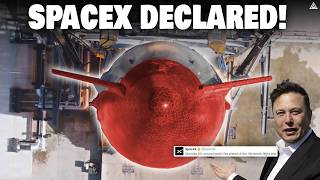

6 Raptor Engines Ignite for 60 Seconds
45sA 60-second static fire of all six engines is a spectacular visual and a major milestone, sparking excitement about the upcoming launch.
▶ Play Clip"Title promises imminent launch and '100x faster' but delivers a detailed status update with speculation; solid content but oversells the timeline."
SpaceX is rapidly progressing toward Starship Flight 13, following a successful 60-second static fire of Ship 40's six Raptor engines. The test, along with extensive pad modifications and parallel testing of Ship 41, signals a program accelerating its pace. The primary goal of Flight 13 is to demonstrate reliability, especially for the Raptor 3 engines and the vacuum engine relight in space.
All six Raptor engines (three sea-level, two vacuum) fired together for a full 60 seconds at Massey's test site, a major milestone before rolling to the launch pad.
On June 24-25, fueling stopped early (oxygen at 2/3, minimal methane), and only one engine (Engine 142) fired for 15 seconds, indicating a narrow, fixable issue.
Six days later, Ship 40 returned and all six engines burned cleanly for 60 seconds, with vacuum engines lighting first, a deliberate sequence to monitor startup transients and simulate in-space relight.
The 60-second duration is a stress test of the complete propulsion system, validating engine performance, vibration, thermal behavior, and structural integrity under maximum thrust.
Ship 40 rolled back to Mega Bay 2 for inspection; likely no major fixes needed. Next steps: final integrations, payload, and stacking with Booster 20 at Pad B.
Booster 20 is getting its 33 Raptor engines installed in Mega Bay 1. It will likely undergo a tanking test and a 33-engine static fire, which will set the timeline for Flight 13 (late July or August).
Ship 41 began its cryo test campaign on June 28, running in parallel with Ship 40, showing SpaceX's increased operational tempo.
Pad 2 saw water deluge activations with two distinct profiles (launch and landing), chopstick movements, BQD cycling, and clamp arm tests, indicating preparations for booster catch attempts.
Chopstick actuators were upgraded from hydraulic to electric for faster, more precise movements, essential for catching a 70-meter booster.
Three successful catches (Boosters 12, 14, 15) out of three attempts. Booster 20, the first V3 Super Heavy, will attempt a catch on Flight 14, not Flight 13.
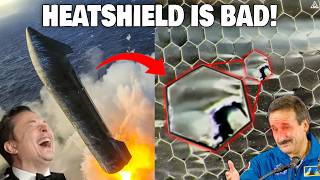
White heat shield tiles reappeared on a nose cone, half-sized and thicker, with no insulation layer, likely an intentional test of new tile material under extreme re-entry conditions at the nose tip.
Flight 13 is imminent, with Ship 40's successful static fire and Booster 20's progress setting the stage. The mission aims to prove Starship's reliability, especially for Raptor 3 engines and vacuum engine relight, while pad upgrades and tile experiments show SpaceX's iterative approach to rapid reusability.
How long did Ship 40's successful static fire last?
60 seconds
02:09
What was the initial anomaly during Ship 40's first test?
Fueling stopped early (oxygen at 2/3, minimal methane) and only one engine fired for 15 seconds.
00:45
Why did SpaceX light the vacuum engines first during the static fire?
To monitor their startup transients and chamber pressures, as they experience more stress on the ground due to back pressure and flow separation.
02:25
What is the purpose of the 60-second static fire?
It's a stress test of the complete propulsion system, validating engine performance, vibration loads, thermal behavior, propellant flow rates, and structural integrity.
03:33
What is the next major milestone for Booster 20?
A 33-engine static fire.
05:13
What are the two distinct water deluge profiles at Pad 2?
One matching the launch sequence and a second with stronger pressure, pulsing intervals, and a heavy purge phase, matching a landing.
07:20
What upgrade was made to the chopstick actuators?
They were upgraded from hydraulic to electric for faster, more precise movements.
08:57
How many successful booster catches has SpaceX achieved?
Three (Boosters 12, 14, 15) out of three attempts.
09:23
What is the likely purpose of the white heat shield tiles?
To test new tile material or coating under the harshest re-entry conditions by removing insulation layers, exposing the tile to extreme heat at the nose tip.
11:42
Successful 60-second static fire
Demonstrates Ship 40's propulsion system is ready for flight, a key milestone before launch.
02:09Stress test of complete propulsion system
Explains the significance of the 60-second duration as a full-duration test, not just a health check.
03:33Dual deluge profiles for launch and landing
Indicates pad readiness for booster catch attempts, a critical step for reusability.
07:20Chopstick actuator upgrade to electric
Shows SpaceX's iterative improvements to enable precise booster catches.
08:57White tile experiment at nose tip
Reveals SpaceX's method of testing new heat shield materials under extreme conditions.
11:42[00:02] with ship 40. All six Raptor engines roared to life together. A full 60 seconds of sustained fire at Massey's test site. And that means they've just milestones before rolling the ship to the launch pad, too. And that's not all.
[00:17] Some very deliberate activity has been happening around the area lately. Everything is pointing toward one thing. Starship flight 13 is getting dangerously close. But the real question is, when? To answer that, we need to
[00:31] look at what ship 40 actually went through at Massey's. The ship first rolled out to Massey's on June 23rd, and by June 24th, propellant loading had already begun. Matching the exact levels used during ship 39's test campaign
[00:45] before flight 12. Everything pointed toward a routine six-engine static fire. Then something changed. Fueling stopped early. The oxygen tank only filled to about 2/3, and barely any methane was loaded. That's not how you prepare a
[00:59] full stack ignition. On June 25th, only one engine fired. Engine 142, a central Raptor 3 sea-level engine, burned for about 15 seconds while the other five stayed completely silent. Ship 40 rolled back to Megabay 2 the following day.
[01:15] Now, here's the thing. If the problem had been structural, a tank fault, an airframe issue, SpaceX wouldn't have fired anything at all. Engine 142 running clean was its own kind of data. It told engineers the core vehicle was
[01:29] healthy. Whatever the issue was, it was narrow, contained, fixable. And even in that constrained test, the partial tank fill and header tank ignition sequence closely mirrored an in-space burn. The exact reignition profile Starship needs
[01:43] to execute during re-entry. SpaceX found a way to collect meaningful data even from an incomplete attempt. And then, just only 6 days later, ship 40 rolled back out to Massey's. This time, there was no partial attempt. The ignition
[01:57] sequence was notably different from previous tests. The two Raptor vacuum engines appeared to light first, followed moments later by the three sea level Raptors. All six engines then burned together cleanly for a full 60
[02:09] seconds, delivering a powerful stable flame that lit up the South Texas sky. No anomalies were reported publicly. Exactly what SpaceX needed. Why did they sequence the vacuum engines first? My theory is that SpaceX is being extra
[02:25] deliberate with the RVacs. These engines have much larger nozzles optimized for vacuum. So, on the ground they experience more stress from back pressure and potential flow separation. Lighting them first allows the team to
[02:37] closely monitor their startup transients, chamber pressures, and how stand and the sea level engines. It's also excellent practice for in-space engine relight scenarios, where the vacuum engines will play a critical role
[02:50] during orbital burns or landing burns. And SpaceX didn't waste a second before posting it on X. Starship 60-second static fire ahead of the 13th flight test. Are you already feeling the heat? Because flight 13 is getting very, very
[03:05] close. If you are, drop a go 13 in the comments. And if you haven't subscribed yet, now's a great time. That 60-second number isn't arbitrary. SpaceX commissioned its first Starship flame trench at Massey Outpost in 2024,
[03:20] specifically to allow these long static fires. The kind of sustained full duration test that simply wasn't possible before. One engine firing for 15 seconds is a health check. Six engines burning for a full minute is
[03:33] something else entirely. It's a stress test of the complete propulsion system, validating engine performance, vibration loads, thermal behavior, propellant flow rates, and the ship's structural ability to hold together under maximum thrust.
[03:48] real flight without actually leaving the ground. And critically, this test validates the Raptor 3 engines, the newest generation of SpaceX's most important hardware. Flight 13 will be another suborbital flight, mirroring
[04:02] much of Flight 12's profile, with particular focus on the ship's vacuum engine relight in space, something Flight 12 attempted, but Flight 13 needs to nail cleanly. Every data point from that 60-second fire feeds directly into
[04:16] reducing that risk. So, where does Ship 40 stand now? It rolled back to Mega Bay 2 on July 2nd and was lifted onto a work stand for post-fire inspection. Engineers will go through the engines, the TPS tiles, the structure, check for
[04:30] leaks, and review telemetry data from the test. Given how clean the fire was, major fixes are unlikely. After that, the checklist is short. Final integrations, payload installation, and then transport to Pad
[04:45] B to stack with Booster 20. And that's the other half of this story. While Ship 40 was wrapping up its engine campaign, Booster 20 was back in Mega Bay 1 getting its full complement of 33 Raptor engines installed. Unlike Booster 19,
[04:59] which had a longer static fire campaign, Booster 20 should move through quickly. Likely a tanking test to verify pad changes, then a straight 33 engine static fire before rolling back for flight preparations. That 33 engine
[05:13] static fire is the next major milestone, and it's the one that will set the clock for Flight 13. Based on current vehicle timelines, late July is possible, but this window could easily slip into August. Ship 40 is expected within the
[05:27] next month or so. The ship side is essentially done. The bottleneck now sits entirely with Booster 20. But zoom out, and the bigger picture is just as striking. Meanwhile, Ship 41 was already rolling out to Massey's on June 28th to
[05:43] begin its own cryo test campaign running in parallel. Two Block 3 ships in active test campaigns at the same time. That's not an accident. That's a program that has learned to move. Flight 13 has one job above all others. Show that Starship
[05:58] is reliable, that the Raptor three engines can be trusted, that the lessons from flight 12 have been absorbed, acted on, and proven on the ground before being proven in the sky. The 60 seconds at Massey suggests they're on track. But
[06:11] while ship 40 was wrapping up its engine campaign at Massey's, something equally significant was happening a few miles down the road at pad two. Water deluge down the road at pad two. Water deluge activations, chopstick movements, BQD
[06:24] activations, chopstick movements, BQD and SQD cycling, clamp arm checks, one by one in rapid succession. Taken individually, each of these looks like routine pad maintenance. Taken together, they paint a very clear picture. Start
[06:38] with the water deluge system. Pad two's deluge is not a simple fire hose. It floods the launch mount and flame trench with roughly 350,000 gallons of water in a precisely timed sequence, absorbing the thermal energy
[06:52] and dampening the acoustic shock waves that would otherwise tear the pad apart when 33 Raptors light simultaneously. SpaceX learned that lesson the hard way at pad one. Pad two was designed from day one with a water-cooled steel deck
[07:06] on the orbital launch mount to handle repeat high cadence launches. But what observers noticed recently wasn't just a standard deluge check. There were two distinct firing profiles. One matching the familiar launch sequence and a
[07:20] second that was noticeably different. Stronger water pressure, pulsing intervals, and a heavy purge phase at the end. That second profile doesn't match a launch. It matches a landing. When a Super Heavy booster returns for a
[07:33] catch attempt, 13 of its Raptor engines are firing at close range directly above the pad structure. The heat and acoustic load are different, more concentrated, more directional. SpaceX appears to be tuning the deluge system to handle both
[07:47] scenarios within a single flight cycle. Then there's the mechanical side. The chopsticks, pad two's catch arms, were raised to full height and cycled through stabilizer movements. The BQDs, the quick disconnect arms that supplies
[08:01] propellant and power to the booster, were extended and retracted repeatedly with engineers clearly evaluating both speed and precision. SpaceX has been relocating the BQD alignment sensors into protective hoods to ensure they
[08:15] survive repeated operations. A design choice that only makes sense if you're planning to use those disconnects over and over again, flight after flight. And critically, the 20 hold down clamps on the launch mount were tested
[08:29] individually, retracted at normal speed, then deployed one by one at slow speed so engineers could observe each clamp independently. That level of granular testing suggests SpaceX wants to be certain every single clamp can hold a
[08:43] fully loaded booster in an abort scenario or release it cleanly on command. Both matter enormously when you're planning to catch that same chopstick actuators have also been upgraded from hydraulic to electric. A
[08:57] responsiveness and reliability during booster and ship catches. Faster, more precise arm movement is not a requirement for a launch. It is absolutely a requirement for snagging a
[09:09] 70-m booster out of the sky at low speed. And that brings us to something that deserves its own moment of reflection. When does a V3 Super Heavy Booster finally get caught? Three catches, all Block One or Block Two.
[09:23] Booster 12 on Flight Five, the first ever, snagged by Mechazilla's arms on the very first attempt. Booster 14 on Flight Seven. Booster 15 on Flight Eight. Three for three when SpaceX actually committed to the attempt, and
[09:39] then it stopped. Flight six's catch was aborted mid-flight. Not all criteria were met, so the flight director never gave the command. Flights nine, 10, and 11 didn't attempt to catch at all with the boosters directed to splashdowns or
[09:53] used for experimental data. And on flight 12, booster 19 never even made it to the catch window. The boost back burn failed and it crashed into the Gulf of failed and it crashed into the Gulf of Mexico at over 1,400 km/h. Now enter
[10:06] booster 20, the first V3 Super Heavy to ever attempt a catch. Block three is a fundamentally different vehicle, taller, heavier, running 33 Raptor 3 engines
[10:18] cycle before. Everything validated on the previous boosters needs to be proven again from scratch. Flight 13 won't attempt the catch. That's flight 14's job, but it needs to prove the boost back is reliable and the descent is
[10:32] controlled enough to set up that attempt. That's exactly what all the activity at pad two is building toward. The dual deluge profiles tuned for a booster return. The BQD sensors relocated into protective hoods to
[10:45] survive repeated operations. The chopstick actuators upgraded from hydraulic to electric for faster, more precise response. Do you think SpaceX might actually go for the catch on flight 13? Let me know in the comments.
[11:00] Outside of ship 40 and pad two, there's something else worth noting and it's happening inside Star Factory. Do you remember back in March when we covered that Starship nose cone spotted with white heat shield tiles? Well, they're
[11:12] back. Those mysterious white heat shield tiles have made a comeback. This time They're half-sized to better fit the tight curvature of the nose. Noticeably thicker than the standard black tiles with no insulation layer or protective
[11:27] felt underneath. Just the tile itself, a visible gap between it and the hole, and the same attachment pins as everything else. The obvious question is, why white? And why exactly at the nose tip? Here's what I think. That gap isn't a
[11:42] mistake or a temporary placeholder. SpaceX may have intentionally stripped away the underlayers to expose these tiles to the absolute harshest conditions during re-entry with almost no thermal buffering. Think about it.
[11:55] The normal tile stack, pins, felt, mesh, ablative material, then the tile on top, is designed to spread and absorb heat gradually. By removing those protective layers, the white tile essentially faces re-entry almost naked. Whatever happens
[12:10] to it will give engineers extremely clear, real-world data on how the new tile material or coating performs entirely on its own. And the nose tip is the most brutal place to run this test. It's the single most thermally stressed
[12:23] point on the entire vehicle during re-entry. Highest heat flux, highest pressure, and the most aggressive plasma interaction. If you want to know exactly what a new tile formulation can handle at its absolute limit, you don't test it
[12:37] somewhere safe. You put it right where the heat hits hardest.


⚡ Saved you 0h 12m reading this? Transcribe any YouTube video for free — no signup needed.