

Why No One Went Back to the Moon
45sIt challenges a common assumption and reveals the real reason—money—sparking curiosity and debate.
▶ Play Clip"Delivers a detailed look at Starship HLS life support, but the 'TOILET' hook is clickbait; the toilet is barely mentioned."
This video explores the design and life-support systems of SpaceX's Starship HLS lunar lander, contrasting it with Blue Origin's Blue Moon Mark II. It details the physical challenges of living on the Moon, the engineering solutions, and the philosophical debate between automation and human control.
Starship HLS is the first spacecraft built for astronauts to live, eat, sleep, and work on the lunar surface for days, with conditions closer to Earth than any previous mission.
The Apollo program cost ~$280 billion (today's money) and was driven by Cold War prestige, not a sustainable business model. After the Soviet Union collapsed, the motivation disappeared.
NASA awarded SpaceX the Human Landing System contract in 2021, and Blue Origin in 2023, leading to two spacecraft being built in parallel for lunar missions.
Blue Origin's lander is 16 m tall, uses liquid hydrogen/oxygen (BE-7 engines), carries up to 4 astronauts, stays up to 30 days, and delivers 20 metric tons of cargo. Crew cabin delivered to Johnson Space Center in early 2026.
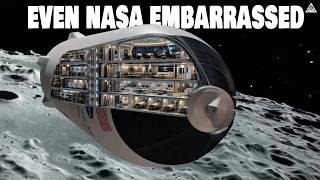
Starship HLS is ~50 m tall, with a pressurized cabin volume of ~600 cubic meters, over 37 times that of Blue Moon. It serves as housing, warehouse, and launch pad.
Space is vacuum with no temperature, but one side of a spacecraft can reach over 100°C while the other drops below -120°C. On the Moon, temperature differences can be 300°C between sunlit and shadowed rocks.
Without convection, exhaled CO2 can surround an astronaut, causing them to pass out even in an oxygen-rich cabin. Ventilation fans must run continuously to circulate air.
Toothpaste is edible, bathing uses wet wipes, and water is recycled up to 98% via membrane filters and catalytic reactors, producing water cleaner than most city tap water.
Microgravity reduces taste and smell, so astronauts crave spicier food. Food is packaged to avoid crumbs; tortillas replace bread, and drinks are sipped from sealed pouches.
Apollo 14's abort button triggered itself due to a loose fragment; MIT rewrote code in 4 hours. Apollo 11's Buzz Aldrin fixed a broken circuit breaker with a felt-tip pen.
SpaceX's avionics process hundreds of variables per second, but NASA insists on manual override. A 2026 Inspector General report highlighted disagreement on this issue.
Raptor engines throttle down, avionics scan terrain, and RCS thrusters control attitude. Lunar dust shoots out ballistically and drops instantly due to no atmosphere.
Astronauts suit up in an airlock (13 cubic meters), depressurize, and use a fault-tolerant elevator to descend to the surface. After operations, they repressurize and run health checks.
Starship HLS lifts off vertically to rendezvous with Orion, leaving footprints on the Moon as evidence of humanity's return after 50+ years.
The video concludes that the choice between Starship HLS and Blue Moon Mark II is not about engineering superiority but about what humanity wants to do on the Moon: arrive, work, and leave, or stay and build a sustained presence.
What is the approximate cost of the Apollo program in today's money?
Roughly $280 billion.
01:12
What is the pressurized cabin volume of Starship HLS?
Approximately 600 cubic meters.
03:34
How much water can Starship HLS's ECLSS recycle?
Up to 98% of all water on board.
06:37
Why do astronauts on spacecraft use edible toothpaste?
Because there is no sink or running water; water forms floating spheres that could drift into electronics.
05:53
What was the issue with Apollo 14's abort button?
A loose metal fragment was occasionally closing the circuit, triggering the abort button mid-descent.
07:59
How did Buzz Aldrin fix the broken circuit breaker on Apollo 11?
He used a felt-tip pen.
08:27
What is the main disagreement between NASA and SpaceX regarding Starship HLS?
NASA wants a manual override for landing, while SpaceX argues that manual flying is beyond human reaction capability.
09:24
The Cost of Apollo
Explains why the Moon was abandoned for 50 years: it was a Cold War prestige project, not a sustainable business.
01:12Space's Temperature Paradox
Clarifies a common misconception: space is vacuum, not cold, but extreme temperature differences exist.
04:02The CO2 Trap
Highlights a little-known danger: without convection, CO2 can accumulate around an astronaut, causing unconsciousness.
05:13Apollo's Hardware Lessons
Shows how small hardware failures nearly caused disasters, informing modern design.
07:59Automation vs. Manual Control
Reveals a fundamental philosophical debate about human vs. machine decision-making in critical situations.
09:24[00:02] HLS cabin on the moon isn't what most people picture. Not because it's enormous, not because it's packed with futuristic technology, but because it's the first spacecraft ever built where astronauts won't just survive, they'll
[00:15] astronauts won't just survive, they'll actually live, eat, sleep, breathe, work, step outside, come back in for days at a time on the surface of another world, and do it in conditions closer to Earth than anything that came before.
[00:29] So, what makes it that different? To answer that, we need to go back. Because before we talk about what SpaceX built, we need to understand why it took over 50 years for anyone to build it at all. In 1972, humans set foot on the moon for
[00:44] the last time, and then no one went back. Over 50 years have passed. We now have smartphones, AI, self-driving cars, brain implants, but the moon, a rock sitting less than 400,000 km away,
[00:59] closer than the distance some people drive in a lifetime, still has no human footprints on it. Why? Not because we lack the technology, not because we lack the knowledge, but for something far more practical. Who's going to pay?
[01:12] What's the point of going back? What does anyone actually gain? The Apollo program cost roughly 280 billion in today's money. It was born out of the Cold War, a national prestige race, not a sustainable business model. When the
[01:26] Soviet Union collapsed, the motivation went with it. The moon became an unfinished dream, and for half a century, no one seriously asked, "When do we go back?" until Elon Musk decided to build Starship, not to win a Cold
[01:40] War, but to move humanity to Mars. And on that road, the moon is just the first stop. NASA saw SpaceX as exactly the push it needed to finally finish what Apollo started. In 2021, they handed SpaceX the human landing system
[01:55] contract. Then in 2023, to keep the competition alive, they gave Blue Origin one, too. For the first time in history, two spacecraft are being built in parallel, both pointed at the same destination, the lunar surface. But, how
[02:10] different are they? And inside that Starship HLS, what does life actually look like for the astronauts? Blue Origin, Jeff Bezos' company, is building the Blue Moon Mark II, a more conventional lander in design thinking.
[02:24] Standing about 16 m tall, it was built specifically for lunar landing missions. The crew cabin sits near the base of the vehicle, making it easy for astronauts to get in and out. The Mark II burns liquid hydrogen and liquid oxygen
[02:38] through its BE-7 engines, clean combustion, but notoriously difficult to store in space because liquid hydrogen boils off quickly. It can carry up to four astronauts to the surface, stay up to 30 days, and deliver up to 20 metric
[02:52] tons of cargo in a reusable configuration. A full-scale prototype of the Blue Moon Mark II crew cabin was delivered to Johnson Space Center in early 2026 for astronaut training. The cabin stands over 5 m tall, enough to
[03:06] stand upright, with windows looking out onto the lunar surface, designed clearly onto the lunar surface, designed clearly around one idea, compact but functional. Then, their Starship HLS, standing about 50 m tall, the height of a 15-story
[03:20] building, balanced perfectly upright on the lunar surface. And it isn't just a lander, it's a complete spacecraft that doubles as housing, warehouse, and launch pad, all in one. The pressurized cabin volume is approximately 600 cubic
[03:34] meters, more than 37 times the estimated cabin volume of Blue Moon Mark II. This isn't competition between equals. These are two completely different philosophies about what humans should do when they go to the moon. Blue Moon,
[03:48] when they go to the moon. Blue Moon, arrive, work, leave. Starship HLF-E, stay. But before any astronaut gets to enjoy that enormous cabin, they have to survive getting there. And space doesn't
[04:02] forgive careless assumptions. Space is not cold. This is one of the most common misconceptions people have. Space is vacuum. It has no temperature in itself because heat only exists where there's matter to carry it. But that same vacuum
[04:16] creates a lethal paradox. One side of the spacecraft facing the sun can reach over 100°C while the other side sitting in shadow drops below -120. And this doesn't happen gradually. It
[04:29] happens simultaneously, side by side at the same moment. On the lunar surface, it gets more extreme. No atmosphere to buffer anything. No wind to equalize temperatures. A rock sitting in sunlight
[04:42] and a rock sitting in shadow a few steps apart can differ by 300°. Inside that environment, Starship HLS's ECLSS, environmental control and life support system, has to maintain stable cabin temperature, control humidity,
[04:58] filter the air, and regenerate oxygen all at once without stopping for even a second. But there's another physical challenge that almost nobody talks about. In space, there's no up or down. Everything floats, including air. If an
[05:13] astronaut stays in one spot too long without air flow circulating around them, they get surrounded by their own exhaled CO2. There's no thermal convection to push CO2 down and pull O2 up the way Earth's atmosphere does. An
[05:27] astronaut can pass out inside a cabin full of oxygen simply because the CO2 has nowhere to go. That's why the ventilation fans on every spacecraft never stop running. That noise isn't background sound. It's the sound of
[05:39] staying alive. Now, let's go inside Starship HLS and forget everything you think you know about life in space. Every morning on Starship HLS, when an astronaut brushes their teeth, they don't spit into a sink. There is no
[05:53] sink, no running water. In microgravity, water doesn't flow. It forms floating spheres that drift into electronics. So, toothpaste used on spacecraft is designed to be edible. Astronauts brush, then swallow the foam. Every mission
[06:08] from the ISS to Orion works this way. Not by preference, because there's no other option. Bathing. On the moon, water is worth more than gold. Not metaphorically, literally. Every gram has to be recycled. Astronauts clean
[06:23] themselves with wet wipes, no showers. But, what happens to that water afterward is what's actually impressive. Starship HLS's ECLSS can recycle up to Starship HLS's ECLSS can recycle up to 98% of all water on board. Breath,
[06:37] sweat, urine, all of it gets collected, run through membrane filters and catalytic reactors, and comes out as drinking water. NASA has proven this on the ISS. The recycled water comes out cleaner than tap water in most cities on
[06:51] Earth. Yesterday, it was urine. Today, it's drinking water. Tomorrow, it's coffee. Astronauts on Starship HLS essentially live inside a closed loop. Not a single water molecule goes to waste. Eating in space has a paradox
[07:06] that catches most people off guard. Microgravity reduces a person's sense of taste and smell. Fluid shifts toward the head, the same feeling as having a mild cold, which causes slight nasal congestion. Everything tastes blander
[07:20] than normal. Astronauts consistently crave spicier and more flavorful food than they would on the ground. On Starship HLS, food is specially packaged. No loose crumbs, no free-floating particles, because even a
[07:33] small fragment drifting in the air can be inhaled or land inside electronics. That's why tortillas replaced bread on every space mission. No crumbs. Drinks have to be sipped through straws from sealed pouches. Opening a regular water
[07:47] bottle in space produces a floating sphere that immediately drifts toward equipment. But, there's something about buttons and switches on the moon that history has already taught us the hard way. Apollo missions ran on hardware
[07:59] with hundreds of switches packed close together. On Apollo 14, the abort button triggered itself mid-descent. A loose metal fragment floating inside the switch was occasionally closing the circuit. MIT had 4 hours to rewrite the
[08:13] guidance computer's code from the ground, tricking it into thinking an abort was already in progress, so it couldn't start another one. 61 keystrokes transmitted up to the crew, entered manually. It worked. On Apollo
[08:27] 11, Buzz Aldrin accidentally knocked off the tip of the engine arm circuit breaker while putting on his backpack, the one switch controlling power to the ascent engine, the only way home. He fixed it with a felt-tip pen. A pen, a
[08:41] few cents, the difference between making it back and not. SpaceX knows this history. The entire HLS interface has been redesigned. Larger screens, controls spaced further apart, software requiring multiple confirmation steps
[08:56] before any critical command executes. But, that redesign opened a larger argument. SpaceX believes in automation. Their avionics will process hundreds of variables per second during lunar descent, altitude, velocity, terrain,
[09:10] fuel load, and adjust engine thrust millisecond by millisecond. No human reflex comes close. NASA doesn't disagree in principle, but they want a disagree in principle, but they want a manual override, always. A 2026 NASA
[09:24] Inspector General report stated it directly. There is disagreement between NASA and SpaceX on whether SpaceX's current proposed approach meets the agency's manual control requirement. And the risk trend is getting worse, not
[09:38] better. SpaceX argues that manually flying a 50-m rocket landing vertically is simply beyond human reaction capability. NASA argues that no software anticipates everything. Apollo 15's lander came down on the edge of a small
[09:53] crater no instrument detected. The crew saw it. The crew handled it. The debate underneath it is older than space flight. When everything is on the line, who gets to decide? When Starship HLS begins its descent, the Raptor vacuum
[10:09] engines throttle down through a thrust profile tested specifically for lunar landing. No atmosphere, no aerodynamic braking, no margin for error. Everything depends on the engines. The landing avionics scan terrain in real-time using
[10:24] radar and optical sensors, mapping rocks, craters, and slopes, picking the flattest available surface. In the final seconds, high-thrust RCS engines position mid-body, not at the base like standard Starship, fired to control
[10:39] attitude precisely and keep exhaust from blasting regolith into the main engines. When the vehicle touches down, lunar dust shoots outward in every direction, then drops instantly. No air means no floating dust clouds, just ballistic
[10:53] arcs and silence. And inside the cabin, for the first time in over half a century, humans look through wide windows at the lunar surface from a spacecraft standing on it. After landing, [music] astronauts can't just
[11:05] open a door and walk out. One of the two airlocks, each with 13 cubic meters of volume, is the mandatory transition space between cabin and vacuum. Astronauts suit up inside the airlock, a process that takes hours. Air is slowly
[11:20] pumped out until pressure reaches zero. Then the outer hatch opens, and the elevator, fault-tolerant, built specifically for lunar conditions, carries them down from tens of meters above the surface. When surface
[11:32] operations are done and they return to the cabin, they repressurize, strip off the suits, and run health checks through the onboard medical system connected to ground telemedicine. Then the engines fire again. This time, not gently.
[11:47] Starship HLS lifts off vertically, accelerating into orbit to rendezvous with Orion. Below, pressed into the gray surface of the moon, are footprints, evidence that humans were here again, after more than 50 years. Put Starship
[12:01] HLS next to Blue Moon Mark II and the question isn't which one is better engineering. The question is what humanity wants to do on the moon.

⚡ Saved you 0h 12m reading this? Transcribe any YouTube video for free — no signup needed.