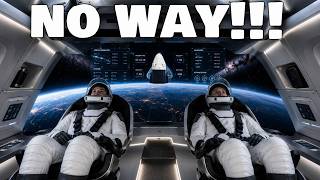

Why Astronauts Love Dragon's Cabin
45sAstronaut praise and the contrast with Boeing's Starliner create an engaging hook about spacecraft comfort.
▶ Play Clip"Delivers a detailed comparison but the title oversells 'too advanced'—it's more about reliability than interior tech."
This video compares the crew cabins of SpaceX's Crew Dragon, Boeing's Starliner, and Russia's Soyuz spacecraft, explaining why Dragon's interior is considered more advanced and comfortable. It highlights design philosophies, safety features, and operational histories, ultimately arguing that Dragon's success stems from repeated, reliable missions rather than a single breakthrough.
Soyuz's descent capsule has only 4 cubic meters of interior space, roughly the size of a large SUV interior shared by three people in pressure suits. Crew members are cramped with limited movement during launch and re-entry.
Soyuz has an orbital module (about 2.2m long, 2.5m wide) adding 6 cubic meters, but it is jettisoned before re-entry, forcing crew back into the tiny descent capsule.
Starliner's capsule is about 4.6 meters in diameter with 11 cubic meters total, but it's a single undivided capsule with no extra room once in orbit.
Crew Dragon is 4 meters in diameter, seats four, with about 9.3 cubic meters of pressurized space. It features white walls, large windows, and three touch screens, feeling like a smartphone-era design. Crew can float vertically once in orbit.
Soyuz uses over 800 physical switches and analog gauges. Dragon consolidates controls into three touch screens with hard buttons for emergencies. Starliner uses touchscreens but retains more physical controls.
Dragon's real advantage is the integration of interface, capsule, Falcon 9, control team, and procedures, stress-tested over many missions. Starliner has flown only twice, with one crewed flight that couldn't bring astronauts home.
Soyuz uses a launch escape tower and solid fuel motors. Starliner uses four launch abort engines (160,000 lb thrust) but never tested in-flight. Dragon uses eight SuperDraco engines mounted on the capsule, proven in a live in-flight abort test in January 2020.
Soyuz reaches ISS in about 3 hours (two orbits). Dragon takes 28-34 hours. Starliner's only crewed flight took about 26 hours.
Dragon splashes down in the ocean under four parachutes. Soyuz lands on land with a single chute and retro rockets. Starliner was designed for land landings with parachutes and airbags, but has only landed twice, once without crew.
Dragon is more flexible, serving ISS, Axiom missions, and independent flights like Inspiration4 and Polaris. Soyuz does one thing but provides a critical backup via seat swaps, ensuring ISS crew return capability.
In 2014, NASA awarded Boeing $4.2 billion and SpaceX $2.6 billion for commercial crew. The goal was two independent systems. Boeing was the established giant, but SpaceX proved more reliable.
By 2024, Dragon had flown 12 successful crewed missions. Starliner had three test flights with serious problems: OFT1 (2019) missed the ISS, OFT2 (2022) had thruster failures, and the crewed test in 2024 had helium leaks and thruster failures.
During the crewed test, helium leaked and five thrusters went offline. Butch Wilmore took manual control. The vehicle stayed in orbit 93 days, returned empty, and the astronauts returned on a Crew Dragon after 286 days.
NASA classified the crew flight test as a Type A mishap. Inspector general found thruster failures across all three test flights (10, 3, 5). By April 2026, SpaceX's contract grew to $4.9 billion for 14 missions, while Boeing shrank to $3.7 billion after two missions were cut.
Dragon's superiority comes from consistent, reliable operations, not just a fancy interior. SpaceX built a dependable transportation pipeline, while Starliner's repeated failures and lack of flight history undermined its potential.
What is the interior volume of Soyuz's descent capsule?
4 cubic meters
01:42
How many physical controls does Soyuz's cockpit have?
Over 800
03:48
What is the diameter of Crew Dragon's capsule?
4 meters
03:07
How long does Soyuz take to reach the ISS?
About 3 hours (two orbits)
05:42
What is the thrust of Starliner's launch abort engines?
Around 160,000 pounds of thrust
05:14
When did SpaceX perform a live in-flight abort test?
January 2020
05:28
How many crewed missions had Dragon flown by 2024?
12 successful crewed missions
09:31
What was the total time Butch Wilmore and Sunita Williams spent on the ISS?
286 days
10:40
What was the final cost of SpaceX's contract by April 2026?
Roughly $4.9 billion for 14 missions
11:39
Dragon's Spacious Cabin
Contrasts with Soyuz's cramped conditions, showing a design philosophy focused on crew comfort.
03:07System Integration Advantage
Explains that Dragon's success is due to holistic engineering, not just hardware.
04:15Proven Escape System
SpaceX's in-flight abort test demonstrated safety in a way Starliner hasn't.
05:28Repetition as a Strategy
Highlights that reliability comes from repeated successful missions, not just design.
09:31Pattern of Failures
Shows that Starliner's issues were systemic, not isolated incidents.
11:09[00:02] into Soyos's cramped cabin and spent months memorizing hundreds of physical switches, a cockpit built on last century technology. Then SpaceX built good. >> And and they've worked uh equally as
[00:17] hard to make the inards and the displays and everything else with the vehicle >> And it's not just astronaut Doug Hurley. Plenty of other astronauts have also praised SpaceX's spacecraft, admitting
[00:30] comfortable, something Boeing's Starlininer, designed in the exact same era, never even got close to. So, how is Dragon's cabin so advanced it destroys its rivals? Let's find out. On July 14th, 2026, Jared Isaacman flew to
[00:46] Bikonor to watch his friend, American astronaut Anneil Menon, launch to the astronaut Anneil Menon, launch to the ISS aboard Soyuse MS29 alongside two Russian cosminauts. It was the first time a NASA administrator had set foot
[00:59] at that launch site in 8 years. Maybe he was there to rebuild the relationship between NASA and Roscosmos. Maybe he was genuinely worried about his friend. Because when all is said and done, Anil Minan was about to spend three hours
[01:13] strapped inside a spacecraft built on 60-year-old technology hurtling toward a 60-year-old technology hurtling toward a space station at 28,000 kmh. that actually feels like from the inside, let's talk about that. Picture
[01:28] three people in pressure suits, shoulders touching, knees pulled up, backs pressed into custom molded seat liners, surrounded by pipes, handrails, and instrument panels. You can move your arms, you can turn your head, but you're
[01:42] basically not changing position. That's what Soyu's crew members deal with during launch, re-entry, and landing. All crammed into a descent capsule with just 4 cubic meters of interior space. For reference, that's roughly the size
[01:56] of a large SUV interior shared between three people in full pressure suits. So, if someone handed you a free ticket to the ISS, but this is your seat for the next 3 hours, would you still take it? Drop your answer in the comments. Now,
[02:11] calling the whole Soyuse a phone booth isn't quite fair. There's an orbital module up front, roughly 2.2 2 m long and 2.5 m wide where the crew can actually move around once they're in space. That adds another 6 cubic meters,
[02:26] bringing the total to 10. But that module gets jettisoned before re-entry. When things get intense, all three crew members have to squeeze back into that members have to squeeze back into that descent capsule, just 2.2 m in diameter,
[02:39] about 4 cub m. Think of it like three passengers crammed into the front seat of a compact car. Then the entire dashboard and engine block close in around them. Starlininer improves on this slightly. The capsule measures
[02:52] around 4.6 meters in diameter, roughly twice the width of Soyos's re-entry module with 11 cubic meters total, but it's still a single undivided capsule. There's no orbital module to retreat to and no extra room that appears once
[03:07] you're in orbit. Crew Dragon is a completely different picture. At four meters in diameter, it seats four inside a cabin with around 9.3 cubic meters of pressurized space. And unlike Soyos, that number doesn't shrink at any point
[03:21] in the mission. White walls, large windows, three touch screens. It feels like something built in the smartphone era. Once in orbit, crew members can float out of their seats and move around freely vertically, not just side to
[03:35] side. If someone gets space sick or needs help with a suit check, that extra room stops being a comfort feature and starts being a safety feature. So runs on physical switches, buttons, and analog gauges. A cockpit that's been
[03:48] layered and refined across generations with an estimated 800 plus physical controls the crew needs to know. Dragon consolidates most of that into three screens with hard buttons kept only for emergencies. Starlininer also uses
[04:02] touchcreens, but Boeing kept significantly more physical controls alongside them. A hybrid approach that sits somewhere between the two philosophies. Dragon is the one that committed fully. Software service is
[04:15] exactly what you need, and humans stay in the loop to supervise. Both vehicles dock with the ISS autonomously and have manual backup modes. A nice screen doesn't automatically make Dragon safer. The real advantage is that SpaceX has
[04:29] welded together the interface, the capsule, the Falcon 9, the control team, and the procedures into a system that's been stress tested across mission after mission. Starlininer, by comparison, has flown exactly twice. Once uncrrewed,
[04:44] once with two astronauts it couldn't bring home. Soi Nguchi, who has flown on the shuttle Soyuse and Dragon, summed up his take in just four words. Dragon is the best. The escape systems also reflect two completely different
[04:59] philosophies. Soyos uses a launch escape tower for the early phase, then switches to a separate set of solid fuel motors. A two-stage system that has worked, but adds mechanical complexity. Starlininer uses four dedicated launch abort engines
[05:14] uses four dedicated launch abort engines capable of producing around 160,000 lb of thrust. powerful, but they fire for only a few seconds, and the system has never been tested in a live in-flight scenario. Dragon Bolts eight Super Draco
[05:28] engines directly onto the capsule, letting it blast itself away from Falcon 9 at any point during ascent. And SpaceX proved the system works with a live in-flight abort test in January 2020, deliberately destroying a Falcon 9 to
[05:42] demonstrate the capsule could escape cleanly. But if there's one thing Soyuse still does better than Dragon, it's time. Two orbits, a little over three hours from launch to docking. Dragon typically takes around 28 to 34 hours.
[05:57] Starlininer, in its only crude flight, clocked in at about 26 hours. Put all three on a countdown clock, and the spacecraft with nearly 60 years of heritage still wins. And it's not even close. They spent hours chasing down the
[06:11] ISS, but it only takes 10 seconds to hit subscribe. So, if you're enjoying this video or any of the others, go ahead and do that. It genuinely helps. Now, getting there is only half the story. The three vehicles also land in
[06:27] completely different ways. Dragon comes down under four main parachutes and splashes into the Atlantic or the Gulf of Mexico, where a recovery ship and medical team are already waiting. Soyos descends onto the Kazak step under a
[06:40] single main chute. Then just seconds before touchdown, solid fuel engines fire from the base of the capsule to cushion the impact. Starlininer was designed to split the difference. Parachutes plus airbags touching down on
[06:53] solid ground in the American Southwest. No ocean, no recovery fleet, no waves to worry about. On paper, it's the most practical landing system of the three. In practice, Starlininer has landed exactly twice. And the last time it did,
[07:08] it came home without its crew. Dragon is more comfortable, carries more crew for NASA, and is far more flexible. It serves the ISS, supports Axiom customers, or flies completely independently like Inspiration, Polaris,
[07:22] Dawn, and Frammed. Soyos does essentially one thing, but it does that experience behind it. And that limitation is exactly what makes Soyos matter. The seat swap agreement. Americans flying Soyos, Russians flying
[07:38] Dragon ensures that both segments of the ISS stay crude if one vehicle has to come home early or gets grounded. Soyos can't replace Dragon's full capability and it's not a real commercial competitor to SpaceX. But in a crisis,
[07:52] an independent flight path is worth more than a beautiful cabin. That's why Isaac man was standing at Bikonor. So why did NASA keep pouring money into Starlininer, a program on the verge of collapse, when they already had Soyos
[08:05] and Dragon? Back in 2014, NASA awarded Boeing up to $4.2 billion and SpaceX Boeing up to $4.2 billion and SpaceX $2.6 billion. The logic was simple. Two capsules, two independent supply chains, two separate launch systems. At the
[08:21] time, Boeing was the established aerospace giant. SpaceX was still proving it could land and reuse a rocket. Few people imagined that 12 years later, NASA would be worried about depending too heavily on Elon Musk's
[08:33] company. And to be fair, Starlininer wasn't a bad idea on paper. Put the two capsules side by side. Dragon is tall, white, and sleek, splashing down under four parachutes. Starlininer is wider, silver, and lands on desert ground using
[08:48] three shoots and six airbags. Both seat four. Both dock autonomously. Both have manual backups, launch escape systems, and reusable crew modules. Starlininer even had some advantages. Land landings avoid corrosive saltwater. The wider
[09:04] cabin feels more spacious, and Boeing designed it for more reuse cycles. So, the failure of Starlininer hits different than Soyos, looking outdated. Boeing didn't lose because they brought a cold war design to a fight with
[09:16] SpaceX. They lost because a vehicle with modern specs never grew into a reliable transport service. And here's what makes it so frustrating. By the time Star Liner's crew flight test launched in 2024, Dragon had already flown 12
[09:31] successful crude missions to the ISS. 12. Not simulations, not paper reviews, actual astronauts, actual docking, actual returns. Meanwhile, Starlininer
[09:43] had three test flights, and all three had serious problems. OFT1 in 2019 got the mission clock wrong and never reached the ISS. Oft2 in 2022 docked successfully but still had thruster failures. NASA knew this pattern. The
[09:59] data was right there and they kept the program on life support anyway. Then came the moment that made everything impossible to ignore. As Starlininer approached the ISS on its crude test flight, helium began leaking from the
[10:11] propulsion system. Then five thrusters went offline. The vehicle temporarily lost the maneuvering capability it needed. Butch Wilmore had to take manual control while the ground team worked to recover four of them. Imagine seeing the
[10:24] station right outside your window and watching your engines disappear from the screen one by one. Starlininer stayed in orbit for 93 days, then came home empty. Wilmore and Williams remained on the ISS for 286 days total and finally came home
[10:40] aboard a Crew Dragon in March 2025. The brought Boeing's own test astronauts back to Earth, the comparison stopped being a debate about screens, seat counts, or landing styles. One vehicle
[10:54] had become a rescue service. The other was still under investigation. In February 2026, NASA classified the crew flight test as a typea mishap, the agency's most serious investigation tier. The report identified both
[11:09] hardware failures and gaps in testing, risk assessment, and management. NASA's inspector general found that thruster failures had appeared across all three failures had appeared across all three test flights. 10 on OFT1, three on OFT2,
[11:23] five on the crude mission. This wasn't a freak accident. It was a repeating pattern that nobody stopped in time. The money tells the same story. By April 2026, SpaceX's contract had grown to roughly $4.9 billion across 14 missions.
[11:39] Boeing shrank to $3.7 billion after two missions were cut. NASA even paid SpaceX originally been earmarked for Starlininer. One side was getting more
[11:51] to deliver. This is how Dragon beat Starliner. Not with a single jaw-dropping speck, but with repetition. Launch, dock, wait, come home, fly again. SpaceX built an entire transportation pipeline.

⚡ Saved you 0h 12m reading this? Transcribe any YouTube video for free — no signup needed.