
Moon Base Is Happening: NASA & SpaceX Reveal Plan
44sHigh-impact announcement with Elon Musk's bold statement and the shift from Apollo to a permanent base grabs attention immediately.
▶ Play Clip"Delivers on the promise of detailing Starship's transformation into a lunar home, though some speculative economics feel padded."
The video outlines NASA and SpaceX's plans to construct a permanent lunar base, transforming Starship rockets into habitable structures. It details the technical process, economic viability, and survival challenges of establishing a sustained human presence on the Moon.
NASA and SpaceX are moving beyond the Apollo-era brief visits to establish a permanent lunar base with dozens of massive vehicles and thousands of tons of equipment.
NASA's May 26, 2026 news conference, led by Jared Isaacman, confirmed the lunar base as a funded, scheduled project. Elon Musk responded with 'Time to build a major base on the moon.'
Starship can deliver over 100 tons of cargo to the lunar surface at ~$100 million per launch, compared to SLS's $4 billion per launch with less payload.
Starship uses a propellant depot in low Earth orbit, with 4-8 tanker launches to refuel before heading to the Moon, enabling full payload delivery.
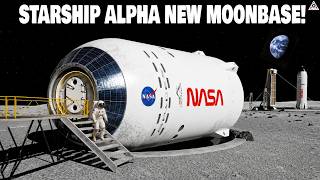
After landing, the 50-meter Starship is deliberately tipped onto its side, becoming a habitat with 2,500 cubic meters of interior volume, 2.5 times the ISS's pressurized volume.
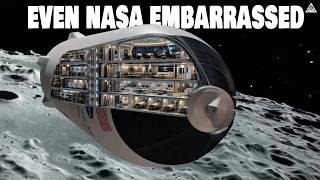
Converting a Starship into a livable habitat takes ~165 days, involving cutting open fuel tanks to create three floors with 850 square meters of usable space.
The structure is buried under 5 meters of lunar regolith to protect against radiation and micrometeorites, turning a hazard into armor.
Leasing space on a converted Starship at ISS-equivalent rates could generate $428 billion annually against $600 million operating costs, making the base a profitable business.
Beyond leasing, a new economy includes high-bandwidth communications, low-gravity pharmaceutical research, and lunar tourism.
Helium-3, abundant on the Moon, could fuel clean nuclear fusion. A single Starship load could power the entire US for a year.
Lunar dust is jagged and toxic, posing health risks. Solutions include electrostatic shields and back-entry suits to keep dust outside.
In-situ resource utilization extracts oxygen and metals from regolith, with up to 37.5% oxygen yield per kilogram, crucial for sustainability.
The base needs ~8,000 kg of consumables monthly. Lunar greenhouses use hydroponics, and ECLSS recycles 95% water and 99% oxygen.
No atmosphere means unfiltered radiation and extreme temperature swings (-70°C to +130°C). Nuclear fission reactors provide power through 14-day nights.
The video concludes that a permanent lunar base is not just feasible but inevitable, with Starship as the key enabler. The only question is whether you'll be watching when it happens.
What is the estimated cost per launch of Starship?
Around $100 million per launch.
01:55
How much cargo can Starship deliver to the lunar surface in one flight?
Over 100 tons.
01:55
What is the interior volume of a converted Starship habitat?
2,500 cubic meters, 2.5 times the ISS's pressurized volume.
03:57
How long does it take to convert a Starship into a livable habitat?
Approximately 165 working days (over 5 months).
04:12
What is the potential annual revenue from leasing space on a converted Starship at ISS-equivalent rates?
$428 billion.
07:00
How much helium-3 can a single Starship carry to power the US for a year?
A fully loaded Starship can carry enough helium-3 to power the entire United States for a full year.
08:26
What is the oxygen extraction efficiency of the ISRU process from regolith?
Up to 37.5% of each kilogram as breathable oxygen, with efficiencies above 90% in lab conditions.
10:30
How much oxygen does each astronaut need per day?
0.82 kg of oxygen every day.
10:43
What are the recycling rates of the ECLSS system?
95% of water and 99% of oxygen.
11:56
Starship's Cost Advantage
Highlights the dramatic cost difference between Starship and SLS, making lunar missions economically feasible.
01:40Orbital Refueling Architecture
Explains the unique refueling system that enables Starship to carry full payloads to the Moon.
02:23Alphabase Concept
Introduces the innovative idea of tipping a rocket on its side to create a habitat, maximizing interior space.
03:04Helium-3 Potential
Presents a compelling economic and energy rationale for lunar colonization.
08:00ISRU for Sustainability
Demonstrates how using local resources is critical for long-term survival on the Moon.
10:00[00:01] most people still picture the same iconic scene from 1969. A small spider-like lunar module barely 7 meters tall. Two astronauts in white suits stepping carefully onto the gray surface. But it belongs to the past
[00:16] because what NASA and SpaceX are preparing for today looks nothing like that. The next time humans set foot on the moon, there won't be a single small lander touching down for a few hours. There will be dozens of massive vehicles
[00:29] up to 50 m tall descending one after another carrying thousands of tons of another carrying thousands of tons of equipment, machinery, robots, and dozens of astronauts with one mission, not to visit, but to stay. This is exactly the
[00:43] vision NASA laid out during its moonbased news conference on May 26th, moonbased news conference on May 26th, 2000 26. a one-hour live stream led by administrator Jared Isaacman alongside the leaders of both the Aremis program
[00:56] and the moon base initiative. The message was clear. This is no longer a dream on a whiteboard. The construction of a permanent lunar base is now a funded scheduled full-scale project. Elon Musk followed the briefing closely
[01:10] and responded the way only Elon Musk responds. One line, no elaboration needed. Time to build a major base on the moon. It wasn't a surprise. Back in February 2026, Musk had already announced that SpaceX was shifting its
[01:25] primary focus toward the moon, specifically building a self-sustaining city on the lunar surface. His timeline, less than 10 years, faster, he said, than getting to Mars. So, what gives him such confidence? The answer is
[01:40] straightforward. Starship. Starship isn't just another rocket. It is the foundation, the backbone, and the true gamecher that NASA desperately needs to make the Aremis program sustainable. In one flight, it can deliver over 100 tons
[01:55] of cargo directly to the lunar surface at an estimated cost of around $100 million per launch. Compare that to the SLS, which costs NASA over $4 billion per launch and carries a fraction of the payload. The space shuttle, retired and
[02:10] outclassed. New Glenn, not even in the same conversation. Raw numbers though only tell half the story. What truly sets Starship apart. What makes it genuinely unprecedented in the history of space flight is its orbital refueling
[02:23] architecture. After launching from Earth, the lunar starship HLS doesn't head straight to the moon. Instead, a dedicated Starship propellant depot is first placed in low Earth orbit. Then four to eight Starship tankers launch
[02:37] one by one, rendevuing with the depot to transfer propellant in a carefully choreographed sequence until the depot is fully stocked. Only after that does the Starship human landing system launch, dock with the depot, top off its
[02:50] tanks, and begin the real journey. 380400 km to the moon's south pole, carrying its full payload without running dry. No other rocket in existence can do this. After crossing that distance, Starship
[03:04] executes a precise vertical landing on the rim of Shackleton Crater. Then comes the move that sounds almost absurd the first time you hear it, but makes through. Instead of standing upright like a monument, the entire 50 m vehicle
[03:19] gets tipped onto its side deliberately, permanently. SpaceX calls it Alphabase. A fleet of AI rovers, modular robotic construction autonomous systems, rolls
[03:31] out and takes over, remotely operated by the crew from a safe distance. Using cables anchored deep into the regalith and heavy scissor lifts positioned along the hull, they slowly lower the massive structure until it rests horizontally
[03:44] between protective bms of piled lunar soil. Barriers built specifically to keep it from rolling. Once on its side, the interior volume opens up to an the interior volume opens up to an astonishing 2,500 cub m, 2 and 1 half
[03:57] times the pressurized volume of the entire International Space Station. A rocket becomes a home. It won't happen overnight. Converting a landed starship into a livable habitat is estimated to take around 165 working days, more than
[04:12] 5 months of methodical, grueling work on the lunar surface. The process starts from the inside out. Astronauts cut open the walls of the now empty methane and oxygen tanks, the same tanks that fueled the journey here, and reclaim that
[04:27] volume as living space. Three full floors go in, connected by staircases, floors go in, connected by staircases, unlocking nearly 850 m of usable area. Think about that for a second. The fuel tank that carried this rocket across
[04:40] 384,400 km of space is now someone's ceiling. Three floors, 850 square meters, carved out of a rocket on the moon. Each floor has a distinct purpose. The ground level handles the heavy work. EVA prep,
[04:56] handles the heavy work. EVA prep, equipment storage, logistics. One floor up, the mood shifts entirely. Laboratories, research stations, and a greenhouse module where crops grow under artificial light. The first agriculture
[05:09] on another world. Then the top floor. private crew quarters, a gym, and a galley where astronauts can sit down, eat a warm meal, and for a few minutes, forget how far from home they really are. Once the interior is complete, the
[05:24] robot swarm turns its attention outside, burying the entire structure under 5 m of lunar regalith. The same dust that makes the moon hostile becomes its best armor, shielding the crew from radiation and micrometeorites around the clock.
[05:39] And this is just one module designed for eight people. Now picture more Starships arriving over time. Each one landing, tipping, connecting to the last. Module by module, the base grows. What started as a single converted rocket becomes a
[05:54] connected outpost capable of housing 100 permanent residents. That's not a colony. That's a city. And it starts with one ship lying on its side in the lunar dust. But here's the question nobody asks out loud. Who's actually
[06:07] going to pay for all of this? Building a lunar base is one thing. Keeping it running year after year, resupply mission after resupply mission is another problem entirely. And the answer, surprisingly, might come down to
[06:20] something very familiar. Real estate. Think about it this way. NASA currently spends roughly 3 to 4 billion every year just to operate the International Space Station. Spread that across the ISS's total pressurized volume and you get a
[06:35] total pressurized volume and you get a staggering $428 million per cubic meter per year. That's the going rate for space in space. And it tells you something important about how valuable that volume actually is. Now look at a
[06:48] converted Starship. Total interior volume 2500 cubic meters. If SpaceX dedicates just 2/3 of that, around 1,000 cubic meters, to leasing space to other
[07:00] nations, research institutions, or private companies at ISS equivalent rates, the math becomes almost uncomfortable to look at. That's $428 billion in potential annual revenue against an estimated operating cost of
[07:15] around $600 million. The profit margin on that deal would make most Silicon Valley CEOs jealous. Suddenly, the moon base isn't just an exploration outpost. It's a business. And leasing is just the beginning. A whole new economy is taking
[07:30] shape in the space between Earth and the moon. What engineers call sis lunar space, high bandwidth communications, pharmaceutical research in low gravity, where drugs behave in ways impossible to replicate on Earth. And further down the
[07:45] road, lunar tourism. The first hotel room with a view of the entire Earth hanging in the black sky. But the prize that makes all of this look small is buried in the regalith itself. Helium 3, a rare isotope that barely exists on
[08:00] Earth, but has been accumulating in the lunar soil for billions of years, deposited there by the solar wind. Scientists have long considered it the ideal fuel for clean nuclear fusion reactors. No radioactive waste, no
[08:14] reactors. No radioactive waste, no meltdown risk, near limitless energy. And the moon is sitting on an enormous reserve of it. Here's the number that stops people cold. A single fully loaded Starship returning from the moon could
[08:26] carry enough helium 3 to power the entire United States for a full year. One rocket, one trip, one year of energy for 330 million people. That's not an
[08:38] energy source. That's a reason to own the moon. But owning the moon means more than just getting there. It means surviving there indefinitely. The first enemy is one nobody talks about enough. And it's hiding in plain sight,
[08:51] literally underfoot. Lunar dust, regalith. It looks harmless in photos. Just gray powder blanketing the surface. Up close though, every single particle is microscopically jagged and razor sharp, shaped by billions of years of
[09:06] meteorite impacts with no atmosphere to soften the blows. It clings to everything, suits, visors, equipment, and once it gets into a human lung, it doesn't come back out. Apollo astronauts noticed it after just a few hours on the
[09:21] surface. On a permanent base, with people going in and out every single day, that becomes a genuine long-term health crisis. The solution goes far beyond a brush and a vacuum cleaner. Space suits will be equipped with
[09:33] electrostatic shield systems, using electrical fields to repel dust particles before they can accumulate. The suits themselves are being redesigned from scratch with a back entry mechanism where the astronaut
[09:45] climbs in from behind, leaving the entire outer shell caked in toxic dust permanently outside in the vacuum. Not a single particle makes it through the airlock. The suit stays outside. The astronaut steps in clean. But that same
[10:00] dust, the one trying to kill you, is also the base's most valuable resource. tens of thousands of dollars per kilogram. So the only practical solution is to extract what's already underfoot. That's the premise behind ISRUN insitu
[10:16] resource utilization. One of the most promising methods involves heating regalith until it melts, then running an electrical current through it to separate the molecules. The result, pure oxygen and usable metal alloys. This
[10:30] process can extract up to 37.5% of each kilogram as breathable oxygen. And a efficiencies above 90% in lab conditions. Each astronaut needs 0.82 kg
[10:43] of oxygen every single day just to stay alive. At some point, the base has to breathe on its own. Oxygen is only part of the equation. The base burns through roughly 8,000 kg of consumables every month. Food, water, air. At some point,
[10:59] the base has to feed itself. That's where the lunar greenhouse system comes in. Picture inflatable dome structures, petal-shaped, pressurized, attached to the outside of the base. Inside, hydroponic systems grow crops without a
[11:13] gram of traditional soil. Roots fed directly by nutrient-rich water mist. Beyond food and oxygen, there are threats you can't see at all. No atmosphere means cosmic radiation and solar particle storms hit the surface
[11:27] completely unfiltered. Temperatures swing from -70° at night to plus 130 during the day. Every day roughly 1.7 kg of air bleeds out through imperfect seals small in isolation, devastating over months.
[11:43] NASA's answer, compact nuclear fision reactors for power through 14 straight reactors for power through 14 straight days of total darkness. And an ECLSS days of total darkness. And an ECLSS system recycling 95% of water and 99% of
[11:56] oxygen continuously. Sweat, breath, waste water. Nothing leaves the system. On the moon, waste is just a resource you haven't processed yet. The most psychologically brutal environment humanity has ever attempted to inhabit.
[12:11] for it. The only question left isn't whether it will happen. It's whether you'll be watching when it does. If this kind of story is what gets you out of bed in the morning, subscribe. There's a lot more coming. [bell]
⚡ Saved you 0h 12m reading this? Transcribe any YouTube video for free — no signup needed.