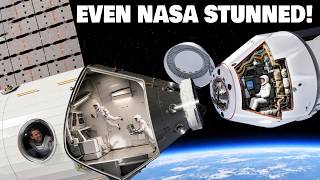

World's First Gravity Space Station
45sThe promise of artificial gravity in space is a revolutionary concept that sparks curiosity and debate.
▶ Play Clip"Delivers on the promise of a new space station launching sooner than expected, with detailed technical insights, though some sections feel padded with speculative content."
Vast Space, a company founded in 2021, is developing Haven-1, a commercial space station designed to be more comfortable and efficient than the ISS, with plans for artificial gravity in future iterations. The station is set to launch on a SpaceX Falcon 9 in early 2027, and the company aims to prove its capability to build a replacement for the ISS, leveraging a strategic partnership with SpaceX and its Starship rocket for larger modules.
Haven-1, the first module of Vast's space station, will launch on a SpaceX Falcon 9, aiming to be the most ambitious space station ever built, with the first artificial gravity capability.
Jed McCaleb, co-founder of a cryptocurrency exchange, bet his fortune on building a space station to replace the ISS, leading to the creation of Vast Space.
In less than 5 years, Vast grew from 200 to over 1,000 employees, building what NASA needs, with a focus on in-house manufacturing to reduce costs and time.
Haven-1 is 80% complete, weighs ~14,000 kg, offers 45 cubic meters of pressurized volume, and is scheduled for launch in Q1 2027, becoming the heaviest Falcon 9 payload.
The first launch will be uncrewed to validate systems in orbit, with a Crew Dragon docking later, serving as a lifeboat for the crew.
Vast is developing a Hall effect thruster based on NASA's H10 design, achieving a specific impulse above 3,000 seconds, to maintain orbit without using Dragon's fuel.
Haven-1 focuses on human comfort, with a redesigned spoon, gourmet food from a former Campbell's chef, and a 1.1m domed window for panoramic views.
Haven-1 is not meant to replace the ISS but to prove Vast's capability, with a 3-year life and support for four crewed missions of ~2 weeks each.
Vast aims to be first to orbit and prove its track record, which could be decisive in NASA's selection for the commercial LEO destinations program in July 2026.
Haven-2 will launch modules on Falcon Heavy and Starship, with a core module (Haven Core) requiring Starship's 8m diameter payload bay, leading to a station larger than the ISS by 2032.
Vast plans to test artificial gravity by spinning Haven-1 docked with Dragon, aiming for 1/6 Earth's gravity (moon-like), to gather data for future long-duration missions.
Vast's ultimate goal is a 100m rotating station with near-Earth gravity, enabling normal living in space, eliminating bone loss and muscle atrophy.
If ISS retires in 2030 without a replacement, China's Tiangong becomes the only permanent outpost, making the race a geopolitical issue.
Haven-2's first four modules launch on Falcon Heavy starting 2028, but the core module (Haven Core) requires Starship, which is critical for the station's full configuration.
Starship's 9m payload bay is the only one that can accommodate the 8m-diameter Haven Core, making Starship essential for Vast's plans.
Current Starship uses a PEZ dispenser for Starlink, but Haven Core requires a full cargo bay opening, like the Space Shuttle, which is not yet available.
Musk confirmed Starship V4 with 42 engines, 142m tall, 200 tons to LEO, targeting 2027, which could enable launching Haven Core if a cargo variant with an open bay is developed.
Starship HLS has a docking port, but docking with Haven-2 faces challenges: momentum, plume impingement, and docking standard compatibility, making it unlikely by 2030.
Starship serves as heavy-lift for modules, while Dragon acts as crew taxi, a logical split based on each vehicle's strengths.
Vast's roadmap aligns with Starship's capabilities, making the partnership a strategic alliance for the future of human spaceflight.
Vast Space is positioning itself as a key player in the commercial space station race, with a pragmatic approach that leverages SpaceX's rockets and focuses on proving its capabilities. The success of Haven-1 and the development of Starship V4 will determine whether Vast can achieve its ambitious vision of a rotating station with artificial gravity, potentially reshaping human presence in orbit.
What is the name of Vast Space's first space station module?
Haven-1
02:13
When is Haven-1 scheduled to launch?
First quarter of 2027
02:28
What is the pressurized volume of Haven-1?
45 cubic meters
02:42
Why does Dragon have to stay docked to Haven-1?
It serves as the station's lifeboat for emergency return.
03:25
What type of thruster is Vast developing for Haven-1?
Hall effect thruster
04:48
What is the specific impulse of Vast's thruster?
Above 3,000 seconds
05:16
What is the diameter of the Haven Core module?
8 meters
14:11
What is the target artificial gravity level for the Haven-1 experiment?
1/6 of Earth's gravity (moon's surface)
11:31
What is the payload capacity of Starship V4 to LEO?
200 tons
18:18
What is the main challenge for Starship docking with Haven-2?
Momentum due to its large mass, plume impingement, and docking standard compatibility.
20:25
In-house manufacturing advantage
Vast builds components in 6 months at under $5 million, versus competitors buying at $55 million, showing a cost-efficient approach.
01:46Main competitor: Time
Vast's CEO identifies time as the only competitor, highlighting the urgency in the space race.
02:00Hall effect thruster efficiency
Achieving a specific impulse above 3,000 seconds is two to three times more efficient than Dragon's thrusters, enabling autonomous orbit maintenance.
05:16Largest panoramic window in space
The 1.1m domed window offers an unprecedented view, enhancing the human experience in orbit.
07:43Vision of a rotating station
Vast's ultimate goal of a 100m rotating station with near-Earth gravity could eliminate health issues of zero gravity, enabling long-term habitation.
12:00Starship's unique capability
Only Starship can launch the 8m Haven Core, making it indispensable for Vast's expansion plans.
14:54Strategic alliance with SpaceX
The partnership is not just a launch contract but a strategic alliance that could shape the future of human spaceflight.
23:36[00:01] station module will leave Earth on a SpaceX Falcon 9. And when it does, it won't just be another payload reaching orbit. It will be the beginning of the most ambitious space station ever built, much bigger than the aging ISS, more
[00:15] first in history designed to give astronauts something no station has ever astronauts something no station has ever offered: gravity. That station is Haven, and Vast Space is closer to the finish line than most people realize. By the
[00:28] way, today is my birthday. So, if you enjoy the channel, hit subscribe and help me get one step closer to my first Tesla. Thanks. This is the story of Jed McCaleb. You
[00:40] might know him as the co-founder of a cryptocurrency exchange. But like Elon Musk, he had an unconventional vision. Instead of waiting for government funding, he decided to bet almost everything he had on a single dream:
[00:52] building the space station that could one day replace the ISS. So far, that gamble seems to be paying off. Vast is led by CEO Max Haot, and neither of the company's two top leaders came from traditional aerospace engineering. Yet
[01:07] in less than 5 years, they've grown the team from around 200 people to more than 1,000, and built exactly what NASA needs right now. But they weren't trying to build another aging government-style space station. Their goal was far more
[01:20] ambitious. They wanted to build a five-star hotel in orbit. Yes, it sounds a little crazy. What makes Vast truly different isn't just the vision, it's how they execute it. They build almost everything in-house. They design their
[01:32] own hatches. They roll and weld their own aluminum structures. They integrate their own thermal control systems. Even the control moment gyroscopes, the devices that keep the station precisely oriented in space, are developed
[01:46] internally. As the company likes to put it, "We build them in 6 months. Competitors are buying at 55 million euro. Our internal cost is less than 5 million." "Who do you view as your main competitor? Time. That's it. Just time.
[02:00] Because for a company that didn't exist 5 years ago, the clock is the only thing standing between them and the rest of the industry. And their first answer to that clock is already taking shape. Haven-1
[02:13] the first module, a sleek white structure weighing around 14,000 kg, currently sitting inside Vast's facility in Long Beach, California, already 80% complete, with launch scheduled for the first quarter of 2027.
[02:28] Once it leaves the ground, it will become the heaviest payload ever launched on a Falcon 9. SpaceX and Vast signed the launch agreement in May 2023, just 2 years after the company was founded. The station offers 45 cubic
[02:42] meters of pressurized living space, roughly the size of a single-decker bus, about the same as one module on the ISS. That's not a huge amount of room, but Vast was never trying to beat the ISS in size. The real goal is harder than that.
[02:57] build and operate a space station safely, on schedule, and at a fraction of what governments have spent doing the same thing. The first launch will be uncrewed. That's how Vast plans to validate every critical system in the
[03:11] real space environment, not just inside test facilities on Earth. Only after weeks or even months of on-orbit verification will a Crew Dragon dock and bring astronauts aboard. But throughout that entire period, Dragon has to stay
[03:25] attached. It can't undock. It can't leave. Why? Because Dragon isn't just a transportation vehicle. It's also the station's lifeboat. No one, not even Vast, knows exactly how the world's first commercially developed space
[03:39] station will behave during its first months in orbit. Keeping Dragon docked gives the crew an immediate way home if anything goes wrong. Fortunately, that's hardly a problem for SpaceX's current fleet. The company now operates nine
[03:52] Dragon spacecraft in total, including five Crew Dragons, three Cargo Dragons, and the experimental vehicle C205. Even if one Crew Dragon remains permanently docked to Haven-1, SpaceX still has more than enough spacecraft to
[04:08] support the ISS alongside its growing list of commercial missions. That's why the Vast SpaceX partnership isn't taking resources away from the ISS. It's an ecosystem where both companies benefit. But, keeping Dragon docked introduces
[04:22] another challenge that rarely gets discussed, fuel. Dragon relies on chemical thrusters for orbital maneuvers. If it were constantly using those thrusters to reboost Haven-1, counteracting orbital decay caused by
[04:36] Earth's thin upper atmosphere, it could eventually burn through the fuel it might need for an emergency return to Earth. That's exactly why Vast is developing its own propulsion system, and the type of thruster they chose
[04:48] matters. Unlike conventional chemical thrusters, which burn propellant in a combustion reaction, a Hall effect thruster works differently. It ionizes a gas, typically xenon, and accelerates those ions using an
[05:02] electric field to generate thrust. Less propellant burned per unit of thrust, the same fuel lasts significantly longer. Vast's version, based on NASA's H10 design, has already been tested in a vacuum chamber and achieved a specific
[05:16] impulse above 3,000 seconds, roughly two to three times more efficient than what Dragon carries. Combined with Impulse Space's SIF chemical thrusters and six in-house control moment gyroscopes for attitude control, Haven-1 can maintain
[05:31] its own orbit without drawing on Dragon's reserves. The ISS handles this by relying on visiting Progress and Cygnus spacecraft to deliver propellant and periodically raise its orbit. Haven-1 is being designed to handle most
[05:45] of that work itself, quietly making it one of the more consequential engineering decisions of the entire program. But Haven 1 isn't just an engineering problem. It's also a place people will actually live. What's it
[05:57] actually like to live aboard Haven 1? If you've ever watched footage of astronauts eating on the ISS, squeezing vacuum-sealed meals out of plastic lighting, Haven 1 is going to feel like a
[06:10] different world. During an interview at Vast's headquarters, former NASA astronaut Drew Feustel, who spent 225 days aboard the ISS, described what mealtime is really like in orbit. "On the ISS, we trade food with each other.
[06:24] My favorite was duck confit. A German astronaut had it because Lufthansa made almost anything just to get those duck confit meals." Think about that for a confit meals." Think about that for a second. A barter economy on a $125
[06:38] billion space station. It's funny, but it's also a symptom of an infrastructure that was never designed with the human experience in mind. Vast hired a former Campbell's food chef to completely rethink how astronauts eat in space.
[06:51] When reporters sampled Haven 1's menu at headquarters, one of them tried a vegetable curry with rice and said, "This tastes like something I'd buy at the grocery store. It's that good." From freeze-dried tiramisu to caramel apple
[07:04] granola. But this isn't just about taste. Astronauts have almost no control over their daily lives in space. Their schedules, experiments, and sleep are planned down to 5-minute increments. Meals are one of the very few things
[07:17] they can actually look forward to. Vast treats that seriously. And then there's the spoon. Vast redesigned it specifically for microgravity. The handle is longer, so astronauts don't have to reach deep inside food pouches.
[07:30] The tip is flatter, making it easier to scrape every last bit from the corners in zero gravity. A spoon redesigned from scratch because every inconvenience, no matter how small, is a design problem worth solving. But, the most
[07:43] breathtaking feature isn't the food. It's the view. Haven 1 includes a 1.1 m domed window, the largest panoramic window ever flown into space. Not a tiny window ever flown into space. Not a tiny porthole. A true glass dome. Astronaut
[07:58] Don Pettit recently had the chance to experience it firsthand. And by all accounts, he loved it. Which makes sense. Who wouldn't want to sit in front of a glass dome and watch Earth turn beneath them? And the interior? It's
[08:10] described with a phrase you'd never expect to hear about a space station. Scandinavian chic. Warm earth tones, adjustable lighting, astronaut, inflatable sleeping bags that can be
[08:24] pressurized to create the sensation of gentle body support while resting, and Starlink in orbit. So, if an astronaut wants to unwind with Netflix after a long day of experiments, they can. At this point, Haven 1 isn't trying to feel
[08:38] like a traditional space station. It's trying to feel like an orbital home. But, that raises the obvious question. Can Haven 1 replace the ISS? No, because it was never meant to. Haven 1 isn't designed to replace the International
[08:52] Space Station. It's designed to prove that Vast is capable of building its replacement. One is a destination, the other is a proof of concept. And right now, the proof of concept is what matters. With 45 cubic meters of
[09:06] habitable volume and a planned operational life of about 3 years, Haven 1 will support no more than four crewed missions, each lasting roughly 2 weeks. No permanent crew, no continuous operations. But, if Haven 1 reaches
[09:22] orbit, validates its systems, welcomes astronauts aboard, and brings them home Vast will have something no competitor can claim. A real, operational, commercial space station. A proven track record.
[09:36] And in the race for NASA's commercial LEO destinations program, expected to select one or two stations to succeed the ISS with a decision in July 2026, that track record might be worth more than any proposal on paper. First to
[09:50] orbit, first to prove it. That's the entire strategy. If it works, the next chapter begins with Haven 2. The first module launches aboard Falcon Heavy in 2028. At 16 m long, it's already 60% larger
[10:04] than Haven 1 and carries two docking ports instead of one. Between 2029 and 2030, three more modules follow and connect. Then the centerpiece, a massive 7-m diameter core module launched by Starship, tying the entire station
[10:19] together with a fifth docking port and a dedicated EVA airlock. By 2032, Haven 2 is expected to offer around 510 cubic meters of habitable volume, more than 11 times larger than Haven 1. A robotic arm, a 3.8-m cupola window. But, there's
[10:36] one thing no space station has ever achieved, artificial gravity. It sounds like science fiction. For Vast, it's already in the test plan. The simplest way to picture it, imagine sitting in a car taking a sharp corner at high speed.
[10:50] You feel your body pressed against the seat. That's centrifugal force, and to your body, it feels similar to gravity. The same principle applies in space. Spin the station, and centrifugal force pushes everything outward. Astronauts
[11:04] standing along the inner wall would feel as if gravity were pulling them toward the floor. No one has ever tested this with a crewed spacecraft. Vast's approach is clever. Instead of spinning Haven 1 alone, difficult and risky for a
[11:17] single module, they'll leave it docked to Dragon and rotate the entire combined structure end over end, like a baton spinning around its center. Because the combined Haven 1 and Dragon form a much longer structure, the astronauts
[11:31] farthest from the rotation axis will experience the strongest centrifugal force. The target, roughly 1/6 of Earth's gravity, the same as the moon's surface. That's nowhere near Earth's gravity. But, it would be something no
[11:45] experienced before. And the data from that experiment could shape the future of long-duration spaceflight. Vast's ultimate vision is a rotating station nearly 100 m long, built from multiple 7-m diameter modules
[12:00] launched by Starship. The entire structure rotating at about 3.5 produce something close to Earth gravity. Astronauts could walk normally, sleep normally, live normally in space for as long as they need. No bone loss,
[12:15] no muscle atrophy, no vision problems from months in zero gravity. For the first time in human history, space wouldn't just be a place we visit. It could become a place we actually live. So, would you want to live aboard Haven,
[12:28] even just once? If yes, drop a go Haven in the comments. Until next time. If ISS retires on schedule in 2030 and there's no replacement station ready to take over, China's Tiangong becomes the only permanent human outpost in orbit. Just
[12:43] let that sink in. This isn't a science problem anymore. This is geopolitics. A gap in human presence on orbit, even just a few months, is a blow to American credibility that no defense budget can fix. Fortunately, there's a contender
[12:58] emerging. And nobody saw this one coming. Vast Space with their station Haven 2. This company was founded in 2021. Not even 5 years old. And yet they've managed to embarrass every big name in the industry. Axiom, Starlab,
[13:14] Blue Origin's Orbital Reef. With a pace that frankly doesn't make sense for a company that young. Haven 2 is at this point almost certainly the station that goes up first. Vast is already targeting the first module launch in 2028 pending
[13:28] their CLD contract win this year. But, here's the thing. Haven 2 isn't going up all at once. Just like ISS, this is a multi-chapter story, and each chapter needs a different rocket. The first four modules, each 16 m long, roughly 29
[13:44] tons, will ride up on Falcon Heavy, about one module every 6 months starting in 2028. For that size and weight, Falcon Heavy can handle it, no problem. But, the bigger modules, the more critical ones, Falcon Heavy doesn't
[13:58] stand a chance. That's where Starship enters the picture. And this isn't speculation. Andrew Feustel, NASA astronaut and VAST's own advisory astronaut, said it plainly, "The core module can only launch on Starship."
[14:11] That's a structure with an 8-m diameter. That one sentence is the key to this entire story. The next phase of Haven 2 centers on launching a larger core module, 8 m in diameter, aboard Starship in 2030. This piece, called Haven Core,
[14:27] is the backbone of the entire structure. Without it, Haven 2 is just a line of modules strung end to end, functional but limited. With it, the station expands into a cross shape, accommodating four additional modules,
[14:41] and by 2032 becomes a nine-module station with a pressurized volume station with a pressurized volume exceeding 1,000 cubic meters, larger than the entire ISS. So, why can no other rocket replace Starship for this
[14:54] other rocket replace Starship for this job? The answer is one number, 8 m. Falcon Heavy's fairing maxes out at around 5.2 m in diameter, already the largest in commercial launch today. Starship's payload bay is 9 m wide, 18 m
[15:08] tall, the largest of any launch vehicle flying or in development. Nothing else can swallow an 8-m module in one piece. If Starship fails, if the program slips badly, Haven Core has is way to orbit. And without Haven Core, Haven 2 stays a
[15:23] stripped-down transitional outpost, never the permanent American infrastructure it's meant to be. That's why Starship isn't just Vast's preferred project's survival. And I really appreciate you sticking with us this
[15:37] far. If you're enjoying the video, taking a few seconds to subscribe would think. But here's where things get complicated because Starship, in its current flying configuration, wasn't actually designed to launch a massive
[15:51] station module the traditional way. Right now, Starship's primary payload system is what the space community calls the PEZ dispenser, a sliding door mechanism at the nose cone that ejects Starlink V3 satellites one by one
[16:05] through a narrow slot, pushed out by a mechanical rail. Brilliant for dozens of small satellites. But for a station module weighing nearly 30 tons with a 8-m diameter, you can't dispense something like that through a narrow
[16:19] slot at the nose of a rocket. What Vast needs isn't Starship acting like a candy machine. They need Starship to swing open a full cargo bay, the way spacecraft did in those iconic photos from the '80s and '90s. Exactly how the
[16:32] space shuttle once handled ISS modules. Worth mentioning the shuttle here because that's the historical blueprint. Over 30 years and 135 flights, 37 missions went directly toward assembling ISS, hauling modules, trusses, solar
[16:47] panels into orbit. The shuttle's cargo bay was 4.6 m wide, 18.3 m long, capable of lifting 27.5 tons to LEO. It would carry a module up, the Canadarm robotic
[17:01] arm would pull it out, dock it to the station, and astronauts would go outside to finish the job. That's how ISS was pieced together over more than a decade. Starship V3, the version currently being prepared, stands 124.4
[17:15] m tall and can deliver over 100 tons to low Earth orbit. A A massive leap, but for Haven Core, raw lift capacity isn't enough. The delivery mechanism matters just as much. Starship needs a wide-open cargo bay configuration, not a PEZ
[17:31] dispenser. And that brings us to a name Elon Musk dropped briefly on X. Briefly enough to send the aerospace internet into weeks of speculation. Starship V4. In a post from August 2025, Musk confirmed Starship V4 will have 42
[17:48] engines, adding three more Raptors to a significantly longer ship. It will fly in 2027. This version stands 142 m tall, a 47-story building standing upright, with 42 Raptor engines across the full
[18:02] system. The target, 10,000 tons of thrust at liftoff, nearly three times Saturn V, the equivalent of over 130 Boeing 747s taking off simultaneously. And more importantly, in Block 4 configuration, payload to LEO is
[18:18] configuration, payload to LEO is expected to reach 200 tons, double V3. That's not just a number for Starlink or moon missions anymore. That's enough to launch space station-scale structures into orbit in a way no vehicle in
[18:30] history has ever been able to do. Now, fair warning, V4 is still a target, not a frozen hardware design. Musk says a lot of things on X, schedules slip, but the direction is clear, and the timeline lines up almost suspiciously well with
[18:44] Haven 2's schedule. Haven Core is targeting a 2030 launch. Starship V4 is targeting 2027. If V4 develops on schedule and SpaceX rolls out a cargo variant with a full open bay mechanism, like the Space
[18:59] Shuttle, but orders of magnitude more powerful, then with a few years of testing and certification on top, the timing fits almost exactly what Vast is waiting for. This isn't a coincidence. This is engineering logic. And when all
[19:12] these pieces start clicking into place, a bigger question surfaces. If Starship can put Haven Core into orbit, can it also bring people up to dock with Haven 2? In theory, yes. And there's actually a crude Starship variant already
[19:26] designed for exactly this kind of mission. Just not for Haven 2. For the moon. Starship HLS, the human landing system, has a docking port built into the top of the nose cone, developed from the same proven system used on Dragon 2.
[19:42] SpaceX and NASA have already run over 200 simulated docking scenarios with full-scale hardware at Johnson Space Center. Now, if a crude Starship with a living cabin, life support, and that nose cone docking port could pull up and
[19:57] dock with Haven 2, the potential is almost hard to wrap your head around. A single Starship launch could carry 100 tons of cargo and dozens of people at once. Dragon carries four crew and about 200 kg of cargo. That's not just a
[20:11] bigger number, that's a completely different category. But this is the part where engineers stop and start slowly shaking their heads. The challenge isn't approach speed. Starship can creep up to a station incredibly slowly, even slower
[20:25] than Dragon if you control it right. The real problem is momentum. Even after burning through most of its propellant, Starship's dry mass is still hundreds of tons. And when two objects make contact, the force on that docking interface
[20:38] depends not just on speed, it depends on mass. Haven 2's docking structure, designed to receive Dragon, Cygnus, and similarly sized vehicles, would need to be reinforced at an entirely different level to survive contact with something
[20:52] level to survive contact with something as massive as Starship without just uh buckling. Then there's plume impingement. The thrusters Starship fires to adjust its attitude during approach blast out powerful jets that
[21:04] could damage Haven 2's delicate exterior. Solar panels, external sensors, all of it. Dragon's plume is small, well-characterized, accounted for. Starship's plume is a completely different animal. And nobody's fully
[21:18] modeled what that does to a nearby structure in orbit. And then there's the docking standard problem. Starship HLS uses the NDS, the NASA docking system, built for Orion and Artemis moon missions. But for Haven 2 to actually
[21:32] receive Starship, it would need a compatible port. And right now, Haven 2's design is oriented around Dragon and smaller commercial vehicles. Not an impossible redesign, but a full redesign, recertification, and retest
[21:46] process that costs an enormous amount of time and money. And after all of that, after Starship docks with Haven 2, completes its mission, and the crew is ready to go home, it still has to come back. Reentry at thousands of degrees,
[22:01] heat shield tiles on the belly, a vertical landing for reuse. Doing all of that with a crew aboard requires a level of safety certification that Dragon earned over dozens of missions across many years. Starship is still in the
[22:13] test flight phase. Not impossible, but not 2030. So, Starship docking with a space station, realistic or not? Let me know in the comments. So, what's the most realistic picture for the next
[22:27] decade? Probably a clean division of roles. Starship as the heavy-lift workhorse, delivering massive modules, enormous cargo holds, the structures that define what Haven 2 actually becomes. And Dragon as the crew taxi,
[22:41] reliably bringing astronauts up on a regular schedule. That's not a compromise. That's the most logical split based on what each vehicle actually does best. But here's the thing that makes this whole picture worth
[22:53] watching in the years ahead. Aerospace history has proven this over and over again. When you have a machine powerful enough and flexible enough, people will find ways to use it that nobody originally imagined. Saturn V was
[23:07] designed to go to the moon, but its final version became the structural core of Skylab. The Space Shuttle was a transport vehicle and ended up being the assembly tool for ISS across two full decades. Starship is following that
[23:21] exact same path. Haven 2 will launch on both Falcon Heavy and Starship, a dual launch ecosystem that perfectly captures Vast's strategy. Use Falcon Heavy to survive, use Starship to grow. And SpaceX's Starship
[23:36] now covers nearly every major piece of Vast's long-term roadmap. That's not Vast's long-term roadmap. That's not accidental. Since 2023, Vast has stated its goal of building a 100-m rotating space station with artificial gravity.
[23:49] And the entire thing launches on Starship. This relationship isn't just a launch contract. This is a strategic alliance, and it might be the most consequential partnership in the future of human spaceflight.

⚡ Saved you 0h 24m reading this? Transcribe any YouTube video for free — no signup needed.