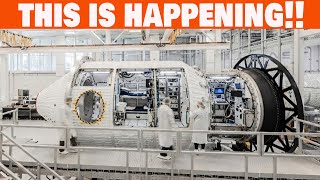

ISS Replacement Revealed!
45sThe imminent retirement of the ISS and the emergence of a new station sparks curiosity and urgency.
▶ Play Clip"Delivers on the promise of Haven 1's launch timeline, but the second half pivots to Starship, diluting the focus."
The video discusses the imminent retirement of the ISS and the race to replace it with commercial space stations, focusing on Vast's Haven 1 as a leading contender. It details Haven 1's design, recent schedule updates, and its strategic partnership with SpaceX, before pivoting to a broader analysis of SpaceX's Starship program and its implications for Mars colonization and the space economy.
NASA plans to retire the ISS around 2030, creating pressure to find replacements. The commercial LEO destinations program includes Axiom Space, Voyager Technologies, and Blue Origin, but Vast's Haven ecosystem appears most realistic.
Vast announced Haven 1 has begun clean room integration and updated the launch schedule to Q1 2027, slipping from mid-2026. CEO Max Haot explained this is due to a realistic assessment of integration and testing timelines, not technical failures.
Haven 1 is in the first phase of clean room integration, installing core systems like pressure management, thermal control, life support, and propulsion. It has a launch mass of 14,600 kg, 4.4 m diameter, 10.1 m length, and 80 cubic meters of pressurized volume.
Vast switched from stainless steel to aluminum alloy 2219 in early 2024 after parallel material tests, favoring manufacturing compatibility with five-axis CNC machining, reducing production time and cost while maintaining structural integrity.
Haven 1 leverages Crew Dragon as a functional support module for life support and docking, using Dragon's CO2 cartridges and expanding livable space by six times compared to Dragon alone. Four crewed missions are planned over 3 years.
Haven 1 features a 1.1 m domed window, four private crew quarters with queen-size sleeping surfaces (patent pending), and eight wet trash tanks for waste management. It uses six control moment gyroscopes and 12 solar arrays providing 13.2 kW peak.
Haven Demo, a 552 kg technology demonstrator, launched in November 2025 on SpaceX's Bandwagon rideshare, validating propulsion, avionics, and power systems for Haven 1.
Haven 1 will be the first commercial space station with a Starlink laser terminal, providing gigabit-class internet with low latency, enabling high-quality video calls and real-time data transmission.
Axiom uses a modular approach with autonomous modules attached to ISS then separated, while Vast starts small and scales. Haven 1 targets 2027, potentially ahead of Axiom, and generates flight data for Haven 2.
Haven 2 is planned for 2028, an upgraded NASA-certified evolution with a stretched length of 16 m, nearly doubling habitable volume to 80-90 cubic meters, compatible with Falcon Heavy.
Elon Musk posted that humans could reach Mars in 5-10 years, with a self-sustaining civilization taking another 20-30 years. Starship is the only system designed for human Mars landing.
Starship is designed to deliver 150-200 tons to LEO with full reusability, aiming for rapid turnaround like commercial aircraft. This rewrites the scale of space launch capability.
Wernher von Braun's early Mars concepts involved fleets of spacecraft, and NASA's Mars Direct (1990) emphasized ISRU. These plans were canceled due to cost and political issues, but Starship finally matches von Braun's scale.
The journey to Mars takes 6-9 months, exposing crew to radiation and isolation. Radiation is the greatest threat, requiring faster transit and shielding.
SpaceX plans early refueling demonstrations in 2026, maturing by 2027. Raptor engines are improving, with Musk mentioning >350 bar pressure, potentially leading to Raptor 4/5, compressing transit to 3-5 months.
Using polyethylene and water as shielding, concentrated around habitation zones, especially sleeping quarters. Starship's size allows thicker barriers, potentially 70-140 cm of water.
Mars entry heating is lower (1200-1400°C) than Earth's, making heat shield design more forgiving. Return requires ISRU to produce propellant from Mars' CO2 atmosphere via Sabatier reaction.
SpaceX plans to send autonomous ISRU systems to Mars as early as 2026, producing methane and oxygen from CO2 and water, targeting 1200-1500 tons of propellant for ascent.
Musk suggested the biggest company in 10 years could be worth $100 trillion, roughly 22 times Nvidia's current market cap. He hinted at space-based industries harnessing 100,000 times more energy than Earth.
Musk said Starship will add three orders of magnitude to SpaceX's mass to orbit, meaning ~1000x increase. Current annual mass is ~1500-1600 tons, but Starship could enable 1.5 million tons per year.
To achieve 1.5 million tons per year at 200 tons per launch, SpaceX would need 7,500 launches annually, or ~20-21 per day, requiring 6-8 launch pads and rapid turnaround.
SpaceX targets ~10 Starship/Super Heavy sets per year in early 2026, ramping to hundreds. Musk envisions gigafactories inspired by Tesla, with costs potentially under $10 million per vehicle.
Challenges include rapid methane/LOX fueling, ultra-fast inspection and reuse, and regulatory constraints (FAA currently limits Starbase to 25 launches/year). These are structural barriers to high cadence.
Overall feasibility of Musk's vision is medium-to-high in the 2040-2045 timeframe, not within the next decade. Musk's aggressive timelines are meant to force faster progress.
Starship reshapes geopolitical power, enabling rapid global mobility and challenging airspace sovereignty. The US military is interested in delivering tens of tons anywhere within an hour.
SpaceX plans to catch boosters with Mechazilla, perform orbital refueling, and land an uncrewed HLS on the moon. Artemis 3 is now scheduled for 2028 per executive order, giving more time.
The video underscores that while Haven 1 represents a pragmatic step toward commercial space stations, Starship is the transformative force that could enable large-scale space industry and Mars colonization, albeit with significant technical and regulatory hurdles.
Max Haot
person
Elon Musk
person
Ben Longmir
person
Wernher von Braun
person
Robert Zubrin
person
David Baker
person
Jared Isaacman
person
SpaceX
service
Vast
service
NASA
service
Axiom Space
service
Blue Origin
service
Starlink
service
Crew Dragon
tool
Starship
tool
Falcon 9
tool
Falcon Heavy
tool
Raptor engine
tool
Haven Demo
tool
MOXIE
tool
When is NASA planning to retire the ISS?
Around 2030.
00:42
What is the updated launch target for Haven 1?
Q1 2027.
01:40
What material did Vast switch to for Haven 1's primary structure?
Aluminum alloy 2219.
05:49
How does Haven 1 handle carbon dioxide removal?
It relies on Crew Dragon's CO2 cartridges.
06:57
What is the habitable volume of Haven 1?
45 cubic meters.
05:37
What is the peak power output of Haven 1's solar arrays?
13.2 kW.
08:55
What is the purpose of Haven Demo?
To validate propulsion, avionics, and power systems.
09:09
What is the estimated total mass humanity has launched into orbit in 60 years?
About 45,000 to 50,000 tons.
27:33
How many Starship launches per year are needed to deliver 1.5 million tons?
7,500 launches per year.
28:42
What is the Sabatier reaction used for on Mars?
To produce methane and oxygen from CO2 and hydrogen.
23:06
Haven 1 Launch Slip
Reveals a realistic schedule adjustment based on actual progress, not failure.
01:40Aluminum Alloy Switch
Demonstrates a data-driven manufacturing decision that reduces cost and time.
05:49Starlink Laser Terminal
First commercial station with high-speed internet, enhancing usability.
10:04Musk's Mars Timeline
Bold claim that sets ambitious goals for Starship development.
13:29Three Orders of Magnitude
Quantifies the transformative scale of Starship's mass-to-orbit capability.
26:04Feasibility Assessment
Provides a realistic timeframe for Musk's vision, balancing optimism with practicality.
33:54[00:01] station designed to replace the ISS, will lift off into orbit. And we're talking about Haven 1, an incredibly advanced space station module developed by Vast. This isn't just another experiment. Haven 1 is poised to shatter
[00:15] growing concerns that China could dominate Earth orbit with its Tangong vision like this wouldn't be possible without a major contribution from without a major contribution from SpaceX. So, how far along is Haven 1
[00:28] right now? and more importantly, how could it redefine the standards of space station design in the years ahead? Let's find out in today's episode of Alpha Tech. The era of the International Space Station is slowly coming to an end. NASA
[00:42] has officially planned to retire the ISS around 2030 after more than three decades of non-stop contributions to scientific research and international cooperation. That leaves us with just over 4 years from now. Let me repeat
[00:56] that, just four years. And such a short timeline has created enormous pressure on NASA to find viable replacements that can keep humans continuously present in low Earth orbit. Against this backdrop, the commercial LEO destinations program
[01:11] has turned into a fierce race involving major players like Axiom Space Voyager Technologies and Blue Origin. But when you look closely at real world progress and long-term sustainability, one project clearly stands out. More than
[01:25] any other contender, Vast Space's Haven ecosystem appears to be the most realistic and capable successor to the ISS legacy. And now, for the first time in quite a while, Vast made a rare move by sharing a key milestone and an
[01:40] updated timeline on X, stating Haven 1 has begun the first phase of clean room integration at Vast HQ. With this milestone, we are updating the schedule for Haven 1 to be ready to launch in Q12027.
[01:54] At first glance, this sounds like good news. But almost immediately, a serious issue stood out. The original plan called for a launch in mid 2026, meaning Haven 1 was supposed to reach orbit in just 5 or 6 months. Now that target has
[02:08] just 5 or 6 months. Now that target has shifted to the first quarter of 2027. So what happened? In an interview with RS Technica, CEO Max Hayatt offered a clear and refreshingly realistic explanation for the delay. Hayot revealed that as of
[02:23] January 10th, 2026, the team had completed the entire primary structure and part of the secondary structure with acceptance testing already finished back in November 2025. Based on this realworld progress, the company realized
[02:38] that the remaining integration and final closeout work would likely run into the fall of 2026. That would then be followed by a full environmental test campaign at NASA's Plum Brook facility toward the end of
[02:51] the year, pushing the launch window into Q12027. He was careful to emphasize that this was not a delay caused by failures or unexpected technical problems. Instead, it was a schedule adjustment driven by a
[03:04] much deeper understanding of what it truly takes to build a flight ready space station module. a highly complex process that demands absolute precision to ensure crew safety and long-term durability. Hayot added that the new
[03:18] timeline actually derisks the entire program. The team now has a clear databacked picture of how long each step really takes rather than relying on earlier, overly optimistic estimates. He also noted that the time between Haven
[03:32] crew could range from a few weeks to readiness of the module itself, crew dragon availability, and other system level factors. But the priority is clear. Get the module safely and stably
[03:46] into orbit first. In other words, better safe than sorry. At this point, Haven 1 has officially entered its first phase of clean room integration at Vast's headquarters. This is the stage where
[03:59] engineers begin installing the modules core service systems onto the completed primary structure, including pressure management, thermal control, life support, propulsion, and the associated fuel tanks. And take a look at the
[04:13] images that were released alongside the update. They show the massive cylindrical module inside a spacious clean room surrounded by engineers in white protective suits working methodically around the structure. In
[04:25] the background, you can see a modern facility marked by the American flag and the vast logo. It's a striking visual one that clearly signals a major transition. Haven 1 is moving beyond the era of standalone components and into
[04:38] full system level assembly, laying the groundwork for comprehensive testing and ultimately a flight ready space station module. Now, let's take a closer look. module. Now, let's take a closer look. What exactly makes Haven 1 stand out? At
[04:52] its core, Haven 1 isn't just another commercial space station. It's a carefully engineered technological statement built around a minimum viable product philosophy, prioritizing speed, safety, and realworld operability over
[05:05] unnecessary complexity. In terms of size and mass, Haven 1 has a launch mass of and mass, Haven 1 has a launch mass of 14,600 kg with a diameter of 4.4 m and a length of 10.1 m. Its primary structure is monolithic, meaning it's welded as a
[05:21] single piece from aluminum panels. This allows it to fit perfectly inside Falcon 9's standard payload fairing, which is about 5.2 m in diameter. That design choice has major implications. Haven 1 becomes the largest pressurized payload
[05:37] ever launched by Falcon 9, offering 80 cub m of pressurized volume and 45 cub m of habitable space. It achieves this without requiring an extended fairing or
[05:49] Falcon Heavy by fully exploiting every centimeter of available fairing volume. A key turning point came in early 2024 when VAS switched from stainless steel to aluminum alloy 2219 after running parallel material tests.
[06:05] This wasn't a theoretical decision. It was driven by manufacturing reality. Aluminum is far more compatible with five-axis CNC machining, significantly reducing production time and cost while enabling highly precise orthog
[06:18] reinforcement structures. The result is a shell that can withstand launch loads and orbital pressure while remaining substantially lighter. But Haven 1's feasibility hinges on one critical factor, its tight integration with
[06:31] SpaceX. Rather than developing an entire life support ecosystem from scratch, VAS smartly leverages Crew Dragon as a functional support module. Dragon transports the crew, handles much of the initial life support load, and docks
[06:45] passively via an adapter designed by Space X with fit checks already Space X with fit checks already completed by late 2025. Even carbon dioxide removal follows this philosophy. Instead of manufacturing dozens of
[06:57] dedicated scrubbers, Vast relies on Dragon's proven CO, two cartridges stocking only what's needed for short missions. Over Haven 1's 3-year lifespan, the plan calls for roughly four crude missions, each lasting about
[07:11] 2 weeks, plus an initial uncrrewed commissioning phase. This approach expands livable space by roughly six times compared to staying inside Dragon alone, transforming Haven 1 into a true orbital home, not just an extended
[07:25] capsule. Inside Haven, one clearly breaks from traditional space station design with a human ccentric layout. The centerpiece is a 1.1 m domed window located in a 24 cubic meter common area. Unlike the ISS Cupula, this is a single
[07:41] panoramic dome offering nearly 180 degrees of Earth views, complete with MOD shielding and impact testing already completed. Sleeping quarters represent one of Haven 1's most novel innovations. Currently patent pending, each of the
[07:56] four private crew quarters features a queen-size sleeping surface with adjustable equalized pressure distribution. This design helps reduce the floating sensation in microgravity and supports both side sleeping and back
[08:09] sleeping. A significant upgrade over the suspended sleeping bags used on the ISS. Waste management is equally well thought out. Haven 1 uses eight wet trash tanks, each capable of handling 5 days of waste for four crew members. These tanks are
[08:25] vacuumsealed and vented externally, preventing odor buildup and bacterial spread in the sealed habitat. On the control side, Haven 1 is equipped with six control moment gyroscopes, all designed and manufactured in-house by
[08:38] VAST. The current V3 generation revealed in 2024 allows precise attitude control without expending propellant critical for maintaining solar alignment. Power comes from 12 deployable solar arrays delivering up to 13.2 kW peak output.
[08:55] Most core components, including flight computers, batteries, pressure valves, and cold plates, have already been flight tested via Haven Demo, a 552 kilogram technology demonstrator launched successfully on SpaceX's
[09:09] bandwagon for ride share mission in November 2025. That mission validated propulsion, avionics, and power systems before committing them to the full flight article. Taken as a whole, Haven 1 is far more than the first commercial
[09:23] space station. It's a strategic technology platform, one that favors speed, safety, and real operational learning over chasing perfection on day one. But here's the real question. Why does Haven's design pose such a serious
[09:37] threat to its competitors in the race to replace the ISS? As we've touched on earlier, the first and perhaps smartest decision, Vastmade was choosing SpaceX as its core partner. Haven's docking ports are designed to be
[09:51] fully compatible with Crew Dragon, the primary vehicle for transporting crews to and from orbit. On top of that, Haven 1 deliberately leverages Dragon's life support systems to support longer duration missions rather than
[10:04] reinventing everything from scratch. What truly sets Haven 1 apart, however, is that it will be the first commercial space station equipped with a Starlink laser terminal. That means gigabit class internet speeds with low latency in
[10:17] orbit enabling highquality video calls, real-time transmission of scientific data, and even Wi-Fi connectivity for personal devices on board. Combined with its clean, modern, minimalist interior design, Haven 1 doesn't feel like a
[10:31] traditional space station at all. It looks more like a luxury hotel room in hundreds of thousands of dollars per night if space tourism pricing ever becomes the norm. This approach proves a crucial point. Partnering closely with a
[10:46] dominant launch and spacecraft provider like SpaceX can dramatically accelerate timelines and improve economic viability, especially when Falcon 9 has already demonstrated exceptional reliability at a relatively low cost.
[11:00] When you compare this to Axiom station, one of Haven's primary competitors, the contrast in strategy becomes very clear. Axiom has pursued a fully modular approach from the start building highly autonomous modules with their own
[11:13] propulsion and control systems. These modules are first attached to the ISS then later separated to form an independent station. A design optimized for long-term expansion and continuous habitation. Haven 1 by contrast is takes
[11:28] a very different path. Start small, prove it works, then scale up. Vast has already completed docking fit check tests and move directly into system integration. This dramatically reduces early complexity, shortens the time to
[11:42] an operational station currently targeted for 2027, potentially several months ahead of Axiom's schedule, and most importantly generates real flight data. That data will feed directly into Haven 2, which is currently planned to
[11:56] launch in 2028. It will be an upgraded NASA certified evolution of Haven 1. The diameter remains 4.4 m, ensuring compatibility with Falcon Heavy. But the module is stretched by roughly 5 additional meters, bringing its total
[12:10] length to about 16 m. That extra length nearly doubles the livable space with a projected habitable volume of around 80 to 90 cub m for a single module. Recently, a man named Ben Longmir, one of the leading engineers in the
[12:23] satellite industry and a former senior figure at SpaceX, stepped away from the company due to family reasons after years of truly remarkable contributions. He was the person who led the development of direct to cell or DTC, a
[12:36] breakthrough technology that allows ordinary smartphones to connect directly to satellites with no additional hardware required. Today, that system thousands of satellites serving users on
[12:48] six continents. And yet, even after leaving SpaceX, Ben Longmir publicly thanked both Elon Musk and Gwyn Shotwell. More importantly, he made it clear that SpaceX's journey is far from over, stating, "Obviously, this is only
[13:01] the beginning for SpaceX as Elon and the team continue to expand humanity's presence to the moon, Mars, and further along the Cardev scale." In other words, someone with his level of talent and experience openly aligned himself with a
[13:14] vision many still dismiss as science fiction. For a moment, it almost seemed like Elon Musk had set that dream aside, focusing instead on nearer term goals like building an AI data center in orbit or establishing satellite manufacturing
[13:29] recently, Musk dropped a post that sent shock waves through the space community. Don't want to get complacent, but if civilization keeps advancing, humans will reach Mars in 5 to 10 years. What really matters is building a
[13:42] self-sustaining civilization on Mars, which will take another 20 to 30 years. And yes, when Musk talks about civilization, he may very well be referring to SpaceX itself because right now it's the only company on Earth
[13:54] actively designing a true Mars landing system, Starship. Everyone else is still talking about rovers and orbital probes. Starship is about people. Starship is the largest, most powerful, and most ambitious launch vehicle humanity has
[14:07] ever built. This is not just another rocket. It's a fully reusable transportation system designed to deliver more than 150 to 200 tons of payload to low Earth orbit with launch costs driven down by rapid repeated
[14:21] reuse. Compared to traditional rockets like Saturn 5 or even the upcoming SLS, Starship completely rewrites the scale of what's possible in size, in payload, and in capability. It's built to land vertically, be turned around quickly,
[14:35] and fly again closer in spirit to a commercial aircraft than a one-off space features. They are the absolute prerequisites for sending humans to Mars. As for that 5 to 10year timeline Musk mentioned, it's not just wishful
[14:49] Starship's development roadmap. A road map SpaceX has been quietly executing for years. So how exactly does the Starship program need to evolve over the next 5 to 10 years to reach true human to Mars capability? To answer that, we
[15:05] first need to understand just how difficult a journey to Mars really is. As far back as the 1950s and 1960s, Wernern von Brown, the father of the American rocket program, was already laying out detailed plans for a human
[15:18] mission to Mars. In his earliest concept, DS Mars project developed concept, DS Mars project developed between 1948 and 1952. He envisioned a massive fleet of 10 spacecraft carrying a total of 70 astronauts with tens of
[15:31] thousands of tons of cargo and equipment assembled in Earth orbit. By the late 1960s, those ideas were scaled down, but they were still enormous by any standard. His later plans called for a dozen astronauts and large cargo
[15:44] vehicles, delivering hundreds to thousands of tons to the Martian surface with a target landing in the early 1980s, specifically around 1982, as presented in 1969. NASA itself has revisited the idea of human Mars
[15:58] missions many times. One of the most influential proposals was Mars direct introduced in 1990 by Robert Zubran and David Baker. It emphasized incidu resource utilization producing return fuel directly from the Martian
[16:12] atmosphere dramatically reducing launch mass cost and mission complexity that was followed by NASA's Mars design reference missions built around Orion large surface habitats and long duration stays on Mars. Even the constellation
[16:25] stays on Mars. Even the constellation program acted between 2005 and 2010 incorporated many of these elements with Mars as the long-term goal after a these plans met the same fate cancellation or indefinite delay. The
[16:39] reasons were always the same. Astronomical costs, immature technology, and the lack of sustained political commitment and budgetary stability. Now compare all of that to Starship. In terms of scale alone, Starship finally
[16:53] matches the kind of architecture von Brown was talking about more than half a century ago. And this time, it's being developed by SpaceX, a company led by the world's wealthiest individual, where funding is no longer the primary
[17:06] be just as critical. The United States competition with China on the moon. A system capable of reaching not only the moon but Mars as well would send an unmistakable signal, a technological
[17:20] leap so large that it would fundamentally redefine the gap between the two nations. Right now, the single biggest constraint holding back Starship's path to Mars is distance. The gap between Earth and Mars can stretch
[17:32] to nearly 34 million miles, turning the journey into a 6 to9month voyage through deep space. That kind of mission pushes a crew into prolonged isolation with at a time. But above all else, the greatest threat is radiation, galactic
[17:49] cosmic rays, and solar particle events that bombard spacecraft far beyond Earth's protective magnetic field. Low gravity, by comparison, is a manageable problem. We've already learned how to mitigate its effects through exercise
[18:02] designed nutrition. Radiation and forgiving, which is why Starship ultimately needs to reach Mars faster. To do that, the vehicle must launch with fully topped off tanks made possible
[18:16] through orbital refueling. And that's not a distant 5 years away concept. SpaceX is already planning early refueling demonstrations as soon as this year with the goal of maturing the technology by 2027. The second key
[18:28] factor is propulsion. The Raptor engine must continue to improve either by increasing specific impulse thrust or both to make faster, more efficient transfer orbits possible. Recently, Elon Musk revealed on X, "We've gone beyond
[18:42] 350 bar, but not safely yet. With some additional work, we should be able to achieve greater than 350 bar as standard operating pressure." That statement is widely believed to refer to Raptor 3. And looking 5 to 10 years ahead, it's
[18:55] not unrealistic to imagine Raptor 4 or even Raptor 5 pushing performance even further. If those upgrades come together, the implications are enormous. A Mars transit that once took 6 to9 months could be compressed to just 3 to
[19:08] 5 months, dramatically reducing radiation exposure, mission risk, and the psychological toll on the crew. Of course, speed alone isn't enough. Starship also needs serious radiation protection. NASA has already shown how
[19:21] this can work with Orion, which uses polyethylene and water as key radiation shielding materials, two of the most effective options against galactic cosmic rays and solar particle events. The reason is simple hydrogen-rich
[19:33] materials interact efficiently with protons and neutrons, slowing down secondary neutrons generated by high energy radiation. Polyethylene, in particular, has a higher hydrogen density per unit mass than water, making
[19:46] layers. In real NASA designs and studies, polyethylene is often used as interior linings or secondary structural elements while water, whether stored, water, wastewater, or coolant, is repurposed as a flexible water wall
[20:00] around crew areas. Applied to Starship, this approach becomes even more powerful. SpaceX doesn't need to reinforce the entire vehicle. Instead, shielding can be concentrated around the main habitation zones, especially the
[20:12] sleeping quarters where astronauts spend most of their time, and therefore receive the highest cumulative radiation dose. This is where Starship's sheer size becomes a decisive advantage. With the ability to carry hundreds of tons of
[20:24] payload, it can support much thicker radiation barriers, potentially on the radiation barriers, potentially on the order of 70 to 140 cm of water. Based on recent studies using onboard water tanks, water later produced via ISRU or
[20:38] even thick polyethylene or hydrogen-rich composite structures. Unlike Orion, which carries just four crew members and must optimize every gram of mass Starship can afford to think in entirely different terms. It can bring tons of
[20:52] polyethylene or advanced hydrogen-rich materials without being constrained by weight, fundamentally changing how radiation protection for deep space missions is designed. And of course, technology on this scale doesn't come
[21:05] together in just 1 or 2 years. But if Musk is seriously talking about landing humans on Mars within the next 5 to 10 years, then it's very likely that much of this work is already underway behind the scenes and that early testing may
[21:18] not be far off. Beyond the transit itself, approaching Mars introduces two additional and very different challenges. The first is landing on the Martian surface. Mars has a much thinner atmosphere than Earth, which results in
[21:30] atmosphere than Earth, which results in lower peak entry heating, roughly 1,200 to 1,400° C compared to 1,600 to 2,000° during Earth re-entry. That actually makes the job of Starship's ceramic heat shield
[21:44] somewhat more forgiving. As long as the entry angle is carefully tuned to avoid either skipping back into space or burning up. This is not entirely new territory. SpaceX can draw on decades of experience from uncrrewed Mars landers
[21:58] as well as lessons learned from lunar and planetary descent profiles. From a purely thermal standpoint, Mars entry is challenging but manageable. The second problem, however, is far more difficult. Getting back home. Returning to Earth
[22:11] depends entirely on a self-sufficient fuel supply chain on Mars. SpaceX has no intention of hauling return propellant from Earth. The mass penalty would make that approach completely impractical. Instead, the entire strategy hinges on
[22:25] Instead, the entire strategy hinges on insitu resource utilization or ISRU. The plan is to send fully autonomous propellant production systems to Mars on the very first uncrrewed Starship missions currently targeted as early as
[22:38] missions currently targeted as early as 2026. These vehicles would carry ISRU hardware electrolyers to split water into hydrogen and oxygen along with either stored water or the ability to extract subsurface ice to kickstart the
[22:50] process. Mars' atmosphere is composed of roughly 95% carbon dioxide providing an abundant raw material. Through the sabotary reaction, combining atmospheric CO2 with hydrogen, methane, and oxygen can be produced as propellant. This
[23:06] process is extremely energyintensive. It would require large-scale power generation either from expansive solar arrays or compact nuclear reactors, and it must operate continuously for 1 to two years between launch windows, which
[23:19] open roughly every 26 months. The goal is to accumulate on the order of 1,200 is to accumulate on the order of 1,200 to 1,500 tons of propellant enough for a single Starship ascent from the Martian surface. SpaceX is developing compact,
[23:32] surface. SpaceX is developing compact, highly automated ISRU modules, drawing inspiration from NASA technologies such as Moxy aboard the Perseverance rover, which has already demonstrated successful oxygen production from
[23:44] Martian CO2. Once sufficient propellant is produced, Starship would lift off vertically from Mars. With gravity at just 38% of Earth's ascent, becomes far easier and significantly more fuel efficient. From there, the vehicle would
[23:57] enter Mars orbit, perform arrow capture or retro burn maneuvers, and begin the long journey back to Earth. In a recent discussion post asking, "How valuable will the biggest company be in 10 years?" Elon Musk made a jaw-dropping
[24:12] claim, he casually replied, "Maybe as high as $100 trillion." That number stunned a lot of people. To put it into perspective, it's roughly 22 times the current market capitalization of Nvidia, the most valuable public company in the
[24:26] world today. Musk didn't specify which company he was referring to, and that ambiguity matters. After all, he's the CEO of multiple major ventures, SpaceX, Tesla, Starlink, XAI, and more. But when you look a little deeper, the
[24:41] implication becomes hard to ignore. Not long ago, Musk left a telling comment that sheds light on what he really meant. He wrote, "Space-based industries will vastly exceed the value of all of Earth, given that you could harness
[24:54] roughly 100,000 times more energy than Earth and still be using less than a millionth of the Sun's energy." What Musk is pointing to here is scale, a level of economic scale that simply doesn't exist on Earth. Once humanity
[25:08] industrial infrastructure in space and orbit on the moon or eventually on other planets, we are no longer constrained by Earth's atmosphere geography or even the dayight cycle. Direct access to uninterrupted solar energy alone changes
[25:23] the equation entirely. At that point, the size of the economy isn't just larger. It becomes almost unimaginable by today's standards. And crucially, only one company is actively building the system required to make that future
[25:36] possible. That company is SpaceX. Starship isn't just a rocket meant to replace Falcon 9 for satellite launches. It's a multi-roll space transportation platform, a launch vehicle and orbital tanker, enabling large-scale refueling
[25:51] in space, and the human landing system variant designed for lunar missions and beyond. In other words, Starship is the missing piece, the infrastructure layer that unlocks the large-scale space industry. This lines up almost perfectly
[26:04] with another bold statement Elon Musk has made about SpaceX's future. At one point, he said, "Starship will add three orders of magnitude to SpaceX mass to orbit and beyond. What Musk is communicating here becomes very clear
[26:18] once you look at the technical context and his long-term ambition. Three orders of magnitude simply means a roughly 1,000 times increase because 10 cubed equals 1,000. Today, SpaceX relies on Falcon 9 and Falcon Heavy to deliver
[26:33] payloads to orbit. Each launch typically carries on the order of a few tens of tons to low Earth orbit. Over the course of 2025, SpaceX is estimated to have delivered roughly 1,500 to 1,600 metric tons of payload mass to
[26:49] orbit in total, already an industry-leading number. But Starship changes the scale entirely. Once fully operational, Starship paired with the Super Heavy booster is designed to deliver 100 to 150 tons to LEO in fully
[27:04] reusable mode and potentially 200 tons or more in expendable or optimized configurations. At that point, if SpaceX flies Starship at high cadence, the total annual mass delivered to orbit could reach 1.5 million tons per year.
[27:20] That number is hard to even wrap your head around. To put it in perspective, the entire human race across nearly 60 years of space flight has launched only years of space flight has launched only about 45,000 to 50,000 tons of material
[27:33] into orbit in total. In other words, one year of Starship operations could deliver more than 30 times everything humanity has ever put into orbit combined. And that's the scale Musk is talking about. So, the real question
[27:46] isn't whether Starship is big. The question is just how enormous does Starship's operational ecosystem have to be for numbers like this to even make sense. Now, let's put some real numbers on this. Imagine SpaceX operating
[27:59] Starship version 3. Whether it's launching massive batches of Starlink satellites or even hauling entire data center class infrastructure to the moon. If you assume a fully reusable Starship configuration capable of delivering 200
[28:13] tons of payload to low Earth orbit per flight, a figure Elon Musk has flight, a figure Elon Musk has repeatedly floated for future. V2 and V3 designs once upgraded, Raptor's lighter structures and full optimization are in
[28:26] place. You can start to calculate what this scale actually looks like in practice. Let's begin with the target. roughly 1.5 million tons to orbit per year at 200 tons per launch. That works out to 7,500 Starship launches annually.
[28:42] Break that down further and you're looking at about 20 to 21 launches per day averaged across the entire year with a small buffer to account for maintenance weather or operational downtime. That sounds insane at first
[28:55] glance, but it's surprisingly consistent with Musk's long-term rhetoric. He has openly talked about thousands of Starship flights per year and at times has even thrown out extreme figures like producing up to 10,000 Starships per
[29:08] year in the far future. That number isn't a literal near-term plan. It's meant to signal automotive scale mass production, more Tesla than traditional aerospace. Crucially, SpaceX wouldn't need anywhere near 10,000 vehicles
[29:21] flying at once. If each Starship Superheavy stack can fly 50 to 100 times over its operational lifetime, assuming rapid turnaround and aggressive reuse, something Falcon 9 boosters have already demonstrated with dozens of flights,
[29:36] then a fleet of just 75 to 150 active vehicles, could theoretically sustain 7,500 launches per year through continuous rotation. The real bottleneck isn't vehicles, it's infrastructure. To
[29:49] support 20 launches per day, the number of launch pads would have to scale dramatically. Right now, SpaceX is on track to operate three Starship capable pads in the near term. Two at Starbase and one at LC39A
[30:03] with additional pads planned at SLC37. But to sustain this kind of cadence, SpaceX would likely need at least 6 to eight active launch pads spread across multiple sites. Each pad would need to support one to two launches per day,
[30:17] which implies lightning fast propellant loading, rapid inspections, streamlined integration, and near industrialized launch operations. At that point, Starship stops behaving like a rocket program. It starts behaving like a
[30:30] global logistics system, one designed not just to reach orbit, but to move mass at a scale humanity has never even attempted before. But launch cadence is only half the story. The other side of the equation and arguably the most
[30:44] interesting and most difficult is starship production. Elon Musk has been very open about this challenge. He has repeatedly talked about building massive gigabay factories designed to manufacture Starships at true industrial
[30:57] scale explicitly inspired by Tesla's automotive production lines rather than traditional aerospace assembly. The idea is simple, but radical rockets built is simple, but radical rockets built like cars. As of early 2026, SpaceX is
[31:11] targeting the production of around 10 Starship Superheavy sets per year with plans to ramp that up gradually to dozens and eventually hundreds per year. Realistically, reaching that level within the next decade will be extremely
[31:24] challenging. That said, to sustain 7,500 launches per year with very high reusability. SpaceX wouldn't need to build thousands of new vehicles annually. They would only need a few hundred Starships per year to replace
[31:37] worn out vehicles and expand the fleet over time, not anything close to 10,000. However, if SpaceX truly wants to realize Musk's vision of three orders of magnitude growth, and eventually scale toward Mars, where thousands of ships
[31:51] may be required per planetary launch window, then much higher production rates will become necessary. This is where SpaceX's manufacturing philosophy becomes critical. Unlike legacy aerospace, they are already applying
[32:04] automotive style techniques, extensive robotic welding, large-scale 3D printing for structural and engine components, and aggressive supply chain optimization. The clearest example is Raptor. SpaceX is already producing
[32:18] something that would have been unthinkable for a full flow stage combustion engine a decade ago. If SpaceX can push the cost of a single Starship down to a few million dollars per vehicle, a target Musk has
[32:32] repeatedly stated aiming for under $10 million, potentially even cheaper than a Tesla Semi, then producing hundreds of Starships per year stops being science fiction. At that point, it becomes a question of capital investment and time,
[32:45] not physics. Launch cadence, however, remains the biggest near-term bottleneck, especially for missions beyond Starlink. Reaching 20 launches per day requires solving several enormous challenges simultaneously.
[32:58] First is rapid methane and liquid oxygen fueling. Each Starship flight consumes thousands of tons of propellant, which demands massive on-site production, storage, and transfer systems operating continuously. Second is ultraast
[33:12] inspection and reuse. Falcon 9 boosters currently take weeks between flights. Starship's long-term goal is turnaround times measured in days or even hours. Then there are regulatory and operational constraints. Today, the FAA
[33:27] permits only 25 launches per year at Starbase. That number would need to scale to hundreds or thousands annually, which requires an unprecedented safety record. On top of that come airspace management, maritime exclusion zones,
[33:41] and orbital traffic coordination, especially critical as launch rates climb. These are not minor hurdles. They are structural barriers that SpaceX must systematically dismantle if Musk's vision is to materialize. Taken
[33:54] together, the overall feasibility of this plan is best described as medium to this plan is best described as medium to high in the 2040 to 2045 time frame, not within the next decade. Elon Musk has a wellocumented habit of setting goals
[34:08] that sound impossible, not because he expects to hit them on schedule, but because they force organizations to move faster than they otherwise would. History backs this up. SpaceX made partial reusability with Falcon 9
[34:21] routine when the industry said it was impossible. Dragon broke Russia's monopoly on crude access to orbit. And now Starship fully reusable super heavy lift is moving steadily from concept to reality despite years of skepticism. So
[34:36] while the timeline may slip, the direction is clear. What once sounded impossible has a habit of becoming inevitable at SpaceX. At the end of the day, launching satellites at truly massive scale creates an entirely new
[34:49] kind of strategic leverage. Countries that control synthetic fuel supply chains and launch capacity gain a powerful advantage, forcing traditional oil exporting nations to rethink their role in a rapidly shifting global energy
[35:02] order. More importantly, Starship fundamentally reshapes geopolitical power itself. It challenges traditional concepts of airspace sovereignty because suborbital trajectories cut through the blurred boundary between atmosphere and
[35:16] space, a gray zone that existing missile defense systems are poorly equipped to monitor or intercept. The US military has openly expressed interest in rapid global mobility, the ability to deliver tens of tons of equipment or troops to
[35:30] anywhere on Earth within an hour, dramatically reducing reliance on overseas bases and aircraft carrier groups. The author argues that this represents a shift in power from horizontal expansion rooted in geography
[35:42] and physical presence to time dominance. In other words, whoever controls launch windows and orbital access controls strategic initiative. The United States is building a closed loop advantage through SpaceX's civil commercial model,
[35:55] integrating reusable launch vehicles, Starlink, and orbital logistics into a single ecosystem, one that could become a formidable technological barrier for competitors in the near term. In just a few days, we'll wrap up a roller coaster
[36:09] year of 2025 marked by five Starship flights from SpaceX. Flights that gave us all the thrills, the nerves, and the excitement we live for. But those feelings are set to hit even harder in 2026 as this private company gears up
[36:25] for even bolder plans. Catching both Starship and Superheavy with Mechazilla, carrying out orbital refilling missions with Starship, and most exciting of all, landing an uncrrewed HLS mission on the moon to test and earn NASA's crew
[36:40] certification. All of these daring goals serve one ultimate purpose, supporting the Aremis 3 mission. A mission that promises to capture the world's imagination and make a global impact. It's not just about sending astronauts
[36:54] to the lunar surface, planting a flag, and scooping up a few buckets of regalith to bring back to Earth. This mission will lay the groundwork for an even bigger vision, one that NASA administrator Jared Isaac man publicly
[37:07] shared on television. Let's build the moon base and then from there we're nuclear power in space, nuclear propulsion so we can make that next giant leap. To achieve these near impossible goals, SpaceX now has less
[37:21] than 2 years to get everything ready before Artemis 3, originally scheduled before Artemis 3, originally scheduled for 2027. So, is that timeline completely insane, especially when SpaceX hasn't even rolled out a full HLS
[37:34] vehicle yet? Well, maybe not, but it would certainly be extremely President Donald Trump signed an executive order called Ensuring American Space Superiority on the very day Jared Isaac man officially took office as NASA
[37:49] administrator. Interestingly, both men are known to have a close relationship with SpaceX CEO Elon Musk. The order specifically emphasizes returning American astronauts to the lunar surface through the Aremis program in 2028
[38:04] instead of 2027 to ensure feasibility and safety. Essentially, it publicly shifts Artemis 3 back by about a year, giving SpaceX extra time to prepare. And that's not a bad thing. After all, this mission involves astronauts lives and
[38:19] the reputation of a nation. More time for SpaceX means a higher chance of success. Of course, this delay isn't just for SpaceX. It also applies to the other vehicles. The SLS and Orion for Artemis 2 are both in their final
[38:33] stages, already docked and set to launch in 2026. But the SLS and Orion for Artemis 3 are still in production and need extra time for thorough testing and completion. In fact, the NASA inspector general

⚡ Saved you 0h 38m reading this? Transcribe any YouTube video for free — no signup needed.