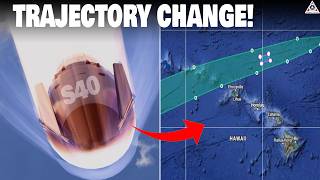

Starship's Secret Hawaii Splashdown Plan
44sReveals a hidden regulatory filing that hints at an orbital attempt, sparking curiosity and debate.
▶ Play Clip"Delivers on the core claim with solid evidence, though some speculation and filler reduce the score."
The video analyzes SpaceX's regulatory filings and technical preparations suggesting that Starship Flight 13 may attempt its first orbital mission, with a splashdown near Hawaii. It contrasts this with Boeing's Starliner struggles and the aging ISS, highlighting the broader implications for spaceflight.
SpaceX filed a NOAA document requesting permission for Starship to splash down near Hawaii, which requires a full orbit, contradicting earlier statements about suborbital flights.
The filing (OHC 2020-I-601306) proposes up to 25 reentries per year in the North Pacific near Hawaii, indicating a committed plan, not speculation.
The FCC amended flight 13's special temporary authority, reclassifying Ship 40 from suborbital to orbital, a legal change that signals orbital intent.
A likely two-layer profile: suborbital arc, apogee hold, then a prograde burn to orbit, with a free-return to the Indian Ocean as contingency.
SpaceX conducted a single-engine static fire with partially filled tanks to simulate in-space conditions, rehearsing the orbital insertion burn.
Flight 12's success (ship 39) proved the vehicle's readiness, and external pressures like IPO and Starlink v3 deployment demand orbital flights.
Starliner remains grounded after a type A mishap, with no launch date, costing over $2 billion and risking obsolescence as ISS nears retirement.
Starliner's per-seat cost is $90M vs Dragon's $55M, and without competition, SpaceX's price rose to $72M, highlighting the cost of monopoly.
The ISS is aging with leaks and equipment failures, requiring multiple spacewalks; safety panel warns of funding cuts and structural issues.
SpaceX appears poised to make Starship's first orbital flight on Flight 13, a historic milestone, while Boeing's Starliner and the ISS face significant challenges, underscoring the shifting dynamics in space exploration.
What regulatory filing suggests Starship Flight 13 will be orbital?
A NOAA filing requesting splashdown near Hawaii, which requires a full orbit.
00:16
How many reentries per year does the NOAA filing propose?
Up to 25 reentries per year.
01:01
What change did the FCC make for Flight 13?
Reclassified Ship 40 from suborbital to orbital.
02:25
What is the likely flight profile for Flight 13?
Suborbital arc, apogee hold, prograde burn to orbit, deorbit burn near Hawaii.
03:38
What was the purpose of the single-engine static fire?
To simulate in-space conditions for the orbital insertion burn.
05:04
What is the cost per seat for Starliner vs Dragon?
Starliner: $90M, Dragon: $55M.
09:02
What is the ISS's current condition?
Aging with leaks and equipment failures, requiring multiple spacewalks.
10:29
NOAA Filing Signals Orbital Intent
A regulatory filing that contradicts public statements, revealing a concrete plan for orbital flight.
00:16FCC Reclassification
Legal classification change that is a strong indicator of orbital plans.
02:25Ground Rehearsal for Space Conditions
Demonstrates SpaceX's meticulous preparation for orbital insertion.
05:04Cost of Monopoly
Highlights how lack of competition led to higher costs for NASA.
09:02ISS Deterioration
Emphasizes the urgency of maintaining the ISS and the risks of aging infrastructure.
10:29[00:02] Raptor lighting, so we feel pretty comfortable, but we want another suborbital shot on the next flight, and then I hope we at least attempt an orbital injection on flight 14. >> Well, Gwynne Shotwell declared this last
[00:16] month. However, SpaceX just quietly filed a regulatory document requesting permission to splash Starship down near Hawaii on the very next flight. And you know, Hawaii doesn't work for a suborbital trajectory. The only way
[00:30] Starship lands near Hawaii is if it completes a full orbit around the Earth. So, what does this mean? Let's find out. The document is filing number OHC The document is filing number OHC 2020-I-601306
[00:46] and Atmospheric Administration. The title is almost comically boring, SpaceX Starship Reentry Ops. But buried inside are two details that should make anyone paying attention sit up straight. First, the proposed splashdown zone is the
[01:01] North Pacific Ocean, federal waters near Hawaii. Second, up to 25 reentries per year. Now, here's the thing about NOAA filings. Before SpaceX can use any stretch of ocean as a splashdown zone, they're legally required to go through
[01:17] an environmental consultation under the Endangered Species Act because whales, sea turtles, and other protected species live out there. It's slow, it's bureaucratic, and nobody does it speculatively. When SpaceX files this
[01:30] kind of paperwork, they're not exploring options. They're committing to a plan, which immediately raises the question, why Hawaii? And this is where orbital mechanics walks into the story. In all 12 previous Starship flights, the ship
[01:44] ended up in the Indian Ocean off the western coast of Australia after roughly half an orbit from Texas. That's the suborbital arc. The vehicle climbs fast and high, but doesn't carry enough energy to keep circling the Earth, so it
[01:58] falls back down to a fixed point down range. Getting to Hawaii is an entirely different calculation. The ship would need to complete nearly a full orbit, about 90 minutes of flight, roughly 25,000 miles, before reaching the
[02:12] Pacific near Hawaii. That's not a suborbital trajectory. That's the real thing. There is no version of physics where Starship launches from Texas and splashes down near Hawaii without going almost all the way around the planet.
[02:25] convincing enough, there's a second piece of evidence, one that actually appeared before the NOAA filing and before Shotwell's statement. On April 6th, 2026, more than a month before flight 12 even left the ground, the FCC
[02:41] quietly amended the special temporary authority for flight 13. The key change, the upper stage, Ship 40, was reclassified from suborbital to orbital. Flight 12 kept its suborbital designation for both stages. Only flight
[02:57] 13 got the upgrade. The FCC doesn't grant an orbital STA for a mission SpaceX isn't planning to fly orbitally. This is a legally specific classification, not a bureaucratic formality. What that means is that as
[03:11] far back as April, before flight 12 flew, SpaceX had already told a federal agency that Ship 40 would be an orbital vehicle. Put those two independent data vehicle. Put those two independent data points together, FCC in April, NOAA in
[03:24] June, and the picture becomes hard to ignore. SpaceX had been preparing for a scenario Shotwell hadn't announced publicly. She wasn't wrong to sound cautious after flight 12, but underneath that caution, the paperwork was pointing
[03:38] somewhere else entirely. So, what might flight 13 actually look like in practice? The most technically coherent scenario is a two-layer profile. The vehicle climbs on a standard suborbital arc, reaches apogee, and holds there for
[03:53] a few minutes while the team evaluates the ship's systems, engines, temperatures, propellant pressures. If everything checks out, a prograde burn pushes it into low Earth orbit, and a deorbit burn brings it down near Hawaii.
[04:06] If anything looks off during that window, no burn free return trajectory, Indian Ocean. Same as before. Hawaii is the reward when everything works. The Indian Ocean is the contingency that's already permitted and planned. Both
[04:20] outcomes have legal filings. Both have been accounted for. And physically, the gap between those two outcomes isn't a canyon. It's a few seconds of engine burn. Enough delta V to clear orbital velocity at around 7.8 km/s. The
[04:35] hardware doesn't change. The propellant is already loaded. The difference comes down to what the flight computer decides to do in the seconds between apogee and the insertion burn window. This isn't orbital or nothing. It's let the flight
[04:48] decide based on what's actually happening. That context makes another event from June 25th land differently. Days before the Hawaii filing became public, SpaceX ran a test on ship 40 that observers flagged as unusual. Not
[05:04] the standard six-engine static fire, but a single-engine burn. More telling was were partially filled and left without being topped off, allowing the cryogenic LOX and methane to slowly boil off before the test. That's a deliberate
[05:20] simulation of in-space conditions. After Starship coasts through apogee, propellants warm unevenly, pressures shift, and then the vehicle needs to relight a Raptor in that environment to execute the orbital insertion burn.
[05:34] SpaceX was rehearsing on the ground exactly what ship 40 will need to do in space. As for why the plan appears to have shifted after Shotwell's cautious public statement, the answer probably lives in flight 12's own
[05:47] Booster 19 failed? Yes. But ship 39 delivered, it hit the intended trajectory, deployed 22 Starlink mass simulators, successfully relit a Raptor engine in space, and splashed down precisely in the Indian Ocean. When the
[06:02] engineering team worked through ship 39's telemetry in the weeks after, they weren't looking at a vehicle that needed another suborbital lap to gather more that had already outgrown the profile it was flying. When the ship is ready,
[06:15] there's no good technical argument for making it wait. External pressure matters, too. SpaceX is moving toward an IPO, and the entire growth narrative rests on one central claim. Starship will deploy Starlink v 3 at a pace no
[06:30] one else can match. Every repeated suborbital flight is a flight that put zero satellites into orbit. Starlink v 3 needs orbit. Artemis needs orbit. Orbital refueling needs orbit. Everything downstream is waiting on the
[06:45] And the ship appears to have already cleared it. If flight 13 is genuinely the first orbital Starship mission, it's categorically different from every milestone that came before it. Not technically, but in terms of what it
[06:58] unlocks. The largest rocket ever built by human hands would, for the first time, complete a full loop around the Earth. After that, everything that follows, the moon, Mars, point-to-point transport, stops being a question of
[07:12] whether and becomes a question of when and how much. SpaceX won't announce a plan change until NOTAMs go out a few days before launch. That's just how they operate. No press conferences, just paperwork. And the paperwork, if you
[07:25] know how to read it, has already said everything that needs to be said. Hawaii is waiting. Ship 40 is being prepared. Flight 13 may be the first time the world watches the largest rocket ever built circle the Earth. And when it
[07:38] happens, history won't have been written by an announcement. It will have been written by a no AA filing, a line in an FCC database, and a few extra seconds of engine burn at apogee that nobody saw coming. And while SpaceX is quietly
[07:52] rewriting what's possible, on the other side of the industry, Boeing is still trying to figure out how to get back to square one. Two years after the crew flight test fiasco, Boeing's Starliner still hasn't found its way back. The
[08:05] mission that was supposed to be Starliner's triumphant debut ended with Butch Wilmore and Suni Williams stranded aboard the ISS for 9 months. Then the capsule came home without them, carrying nothing but two empty spacesuits. NASA
[08:19] formally classified the episode as a type A mishap, the kind of designation reserved for incidents involving over $2 million in damage or worse. More than 4 months after that report dropped, the follow-up mission, Starliner 1, which
[08:34] won't even carry a crew, still has no confirmed launch date and could be as far as a year out. The clock, meanwhile, is not waiting. With ISS retirement roughly 4 years away, Boeing risks watching its spacecraft become obsolete,
[08:48] having spent over $2 billion and never once completing a round-trip crewed mission the way it was designed to. The alternate timeline, where Starliner hits its original 2020 target and flies alongside Dragon, is worth
[09:02] examining seriously because the gap it left isn't just symbolic. Even at baseline, Starliner was the more expensive option. NASA's inspector general pegged the cost per seat at $90 million for Boeing versus $55 million
[09:17] for SpaceX. And as Dragon racked up successful missions, that number only got harder to justify. But a functioning Starliner in 2020 would have done something Dragon alone couldn't, given NASA actual leverage. When you have one
[09:32] contractor and zero alternatives, you don't negotiate, you accept. A competitive market with two certified vehicles would have pressured both sides to keep costs down, improve turnaround times, and maintain genuine redundancy.
[09:46] If Dragon had ever needed to stand down for technical review, NASA would have had somewhere else to turn. Instead, every grounding became a crisis, and every contract extension handed SpaceX more pricing power with less pushback.
[10:00] By the time NASA extended Dragon's contract through Crew 14, the per seat cost had already $72 million and Boeing wasn't there to compete it back down. What Boeing handed SpaceX wasn't just market share. It was an
[10:14] uncontested monopoly over the most strategically critical route in low Earth orbit during the final operational years of the only permanently crewed station humanity has ever built. And final operational years isn't just a
[10:29] polite way of saying the ISS is getting old. It's a clinical description of a structure that is actively breaking down. On June 30th, NASA astronauts Jessica Meir and Chris Williams performed a 6 and 1/2 hour spacewalk,
[10:42] performed a 6 and 1/2 hour spacewalk, the 280th in ISS program history. With a single task, replace a malfunctioning wrist joint on Canadarm 2, which had failed during routine operations the previous month. That repair alone would
[10:55] be unremarkable in isolation. What makes it significant is that it's the first in a series of spacewalks planned over the coming months. Three more already scheduled covering a new solar array, electrical jumper fixes, and a
[11:08] communications antenna replacement. The station isn't just aging, it's on a functional at all. The people responsible for ISS safety aren't sugarcoating it. Susan Helms, chair of NASA's Aerospace Safety Advisory Panel,
[11:23] told the committee that managing critical spares had become a persistent challenge and flagged concern that NASA might ramp down operational funding ahead of the 2030 retirement. Meanwhile, cracks in the Russian segment's transfer
[11:37] tunnel have been causing persistent air leaks, patched, declared stable, then leaking again, with the underlying structural issues never fully resolved. During a June 5th incident, NASA directed five crew members to shelter
[11:50] inside the docked Crew Dragon as a precaution, including an astronaut who had arrived on a separate Soyuz, because Dragon happened to have a fifth seat In a station with unresolved leaks and active emergency protocols, having the
[12:04] right vehicle docked at the right moment isn't procedural. It's the difference isn't procedural. It's the difference between options and no options.


⚡ Saved you 0h 12m reading this? Transcribe any YouTube video for free — no signup needed.